
Makeup and Acne-Prone Skin: An Ayurvedic Guide to Wearing Both Wisely
Makeup rarely causes breakouts on its own; the habits around it do. Lighter bases for humid commutes, brushes washed weekly, and an evening cleanse treated as ritual.
If you wear makeup to work every day, you have probably wondered whether your foundation is feeding your breakouts. The honest answer is that makeup itself is rarely the villain; the habits around it usually are. This guide walks you through wearing makeup wisely on acne-prone skin, from the humid commute to the evening cleanse, the way a family vaidya (a traditional Ayurvedic physician) would explain it: without alarm, and without asking you to give up your kajal.
Key takeaways
- Makeup rarely causes breakouts on its own; the proven troublemakers are sleeping in it, sharing brushes and sponges, and wearing heavy long-wear bases through sweaty, humid commutes.
- Dermatologists have a name for cosmetic-triggered congestion, acne cosmetica: small, uniform bumps and whiteheads across the forehead, chin and cheeks that build slowly over weeks of daily use.
- Non-comedogenic is not a strictly regulated term in India, so no label can promise a formula will suit your pores; a week of patch-testing new base products along the jawline is the more reliable check.
- On melanin-rich Indian skin, picking at a concealer-covered pimple is the most expensive habit of all: the post-inflammatory hyperpigmentation (PIH) mark it leaves can outlast the pimple by months.
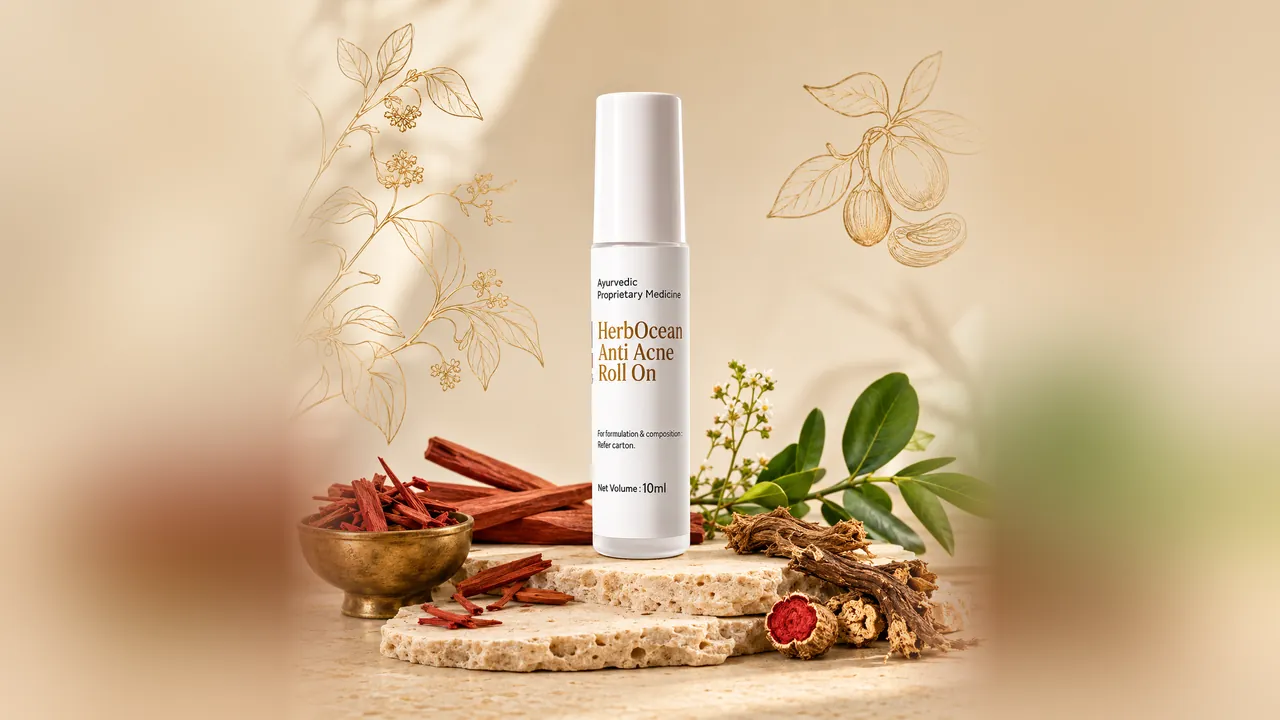
- The HerbOcean Anti-Acne Roll-On, an AYUSH-licensed Ayurvedic medicine classically indicated for acne and pimples, is night-time spot care: it goes on clean skin after the day's makeup is fully removed.
Why Makeup Gets Blamed for Breakouts (and What Actually Happens)
Start with what the makeup is actually doing on your face through an Indian working day. A base product forms a film, and through a humid commute that film sits over sweat that cannot evaporate. Sweat, sebum and pigment pressed together against the skin for ten hours is occlusion, and occlusion is what congests pores; the foundation gets the blame for a situation the weather co-authored. This is why the same product that behaves perfectly in an air-conditioned office in December can seem to break you out in July.
Dermatologists long ago gave cosmetic-triggered congestion its own name, acne cosmetica: crops of small, same-sized bumps and whiteheads across the forehead, chin and cheeks, building quietly over weeks of daily use rather than erupting overnight. It was first described by the American dermatologists Kligman and Mills in a 1972 report in the Archives of Dermatology, and its defining feature is that it fades once the offending product and habits change. That is genuinely good news: this kind of breakout is one of the most fixable there is.
Then there are the accessories. A foundation brush that has not been washed in a month is a soft, damp reservoir of old product and bacteria, reapplied to your face every morning. Wash brushes and sponges weekly with a gentle cleanser, dry them fully, and never share concealer sticks or sponges, even within the family. This is practical hygiene, not fear; the brush does more daily damage than most formulas do.
The mid-day touch-up deserves its own honest look, because July changes its meaning. When your face turns shiny at 2 pm, the instinct is to press more powder over it, but powder over sweat only thickens the film your pores are fighting. Blot first: press a clean tissue or blotting sheet flat against the skin, lift it away, and only then decide whether you still need powder. Press, never drag. And look hard at the sponge living loose in your handbag; warm, damp and reused daily, it is one of the quietest breakout triggers a working woman carries. Keep it in a small pouch, wash it with the weekly brush load, and retire it the month it starts to crumble.
What 'Non-Comedogenic' Really Means on an Indian Shelf
Here is the part almost nobody prints. Non-comedogenic means a product is formulated to be less likely to block pores, but the term is not strictly regulated in India, and the testing behind it is imperfect everywhere. There is no standard test a product must pass before the words go on the box, so the label is a signal of intent, not a guarantee. Two non-comedogenic foundations can behave completely differently on the same face.
The more reliable check costs nothing: patch-test new base products along one side of the jawline for about a week before wearing them across the face. The jawline breaks out readily and is easy to watch, so it will tell you the truth about a formula faster than any label. While you are reading labels, be most careful with heavy silicone long-wear bases and full-coverage concealers, which are built to stay put for twelve hours; they are the likeliest daily culprits for acne-prone skin. Keep them for occasions, and let a lighter tinted base do the weekday work.
Since the label cannot decide for you, let the finish claims on the box do some honest talking. Words like twelve-hour wear, transfer-proof and matte-locked describe films engineered to resist sweat and touch, which is exactly the occlusion acne-prone skin struggles under on a humid day. Words like skin tint, serum foundation and lightweight breathable describe thinner films that let sweat escape. Neither category is good or bad in itself; they are tools for different days, and the skill is picking the film your day can actually carry.
None of this requires abandoning makeup. It requires matching the coverage to the day: light base for the daily commute, full coverage for the shaadi season, and a genuine cleanse waiting at home either way.
The Makeup Bag Itself: Old Kajal, Expiry Dates and Shared Tools
Old kajal is the worst offender in most makeup bags. It sits on the waterline, closer to a mucous membrane than to skin, and most of us keep it long past the date on the tube because it seems to last forever. A dried, crumbling kajal is not the product you bought. The same goes for a foundation that has separated in the bottle, or a compact that smells faintly off: when a product has changed texture or smell, its time is over. Eye products deserve the shortest leash of all; replace them every few months rather than every few years.
Then there is the warm, familiar habit of passing a kajal or a lipstick around the room before photographs. Generous, yes. It also moves bacteria between people: kajal sits on the waterline, and lipstick sits on lips that often carry tiny cracks. This is a hygiene point, not a judgement on a lovely habit. Carry your own to functions.
A wedding or a long festive evening asks more of your skin than a working day does. Makeup goes on in the afternoon and comes off close to midnight, and a touch-up pressed over sweat seals a few hours of oil under a fresh layer. Primer, foundation, compact, setting spray: none of those steps is reckless on its own, and stacked across eight or nine humid hours they add up to a real load. The blotting rule above earns its keep here, and so does a light hand on the touch-ups. On the longest days, what your skin remembers is not the brand of the base but the hours it carried it and the wash that ended them.
The Evening Cleanse as Ritual, Not Chore
Ayurveda would not have used the word makeup, but it understood the principle at stake: the skin is a living, breathing organ, and the classical daily routine (dinacharya) regards cleansing as care, not as admin. Readers who grew up with ubtan already understand ritual cleansing; the evening makeup removal is the same instinct in a modern bathroom. Acne itself has its classical name, Yuvanpidika (literally the youthful eruption), and the classical approach to it begins with not letting the day's accumulation sleep on your face.
The method matters more in India because of what comes out of the tap. In a hard-water home, the tap water itself carries dissolved minerals that blunt cleansers and leave residue, so a single hurried wash often removes the top layer of makeup and leaves a film of pigment, sunscreen and mineral scum behind. A gentle two-step cleanse solves this: first a remover or cleansing balm to dissolve the makeup, then a mild water-based cleanser to wash the remnants away. Lukewarm water, soft hands, no scrubbing. If your face feels tight and squeaky at the end, the routine was too harsh rather than thorough: a barrier under that kind of nightly pressure turns reactive and uncomfortable, and it often looks worse rather than calmer by morning.
Make the tired-night version realistic instead of ideal. One in the morning, shoes just off at the door, is precisely when the never-sleep-in-makeup rule gets broken, and precisely when it counts most. Keep micellar water and cotton pads on the bedside table rather than in the bathroom cabinet; two minutes on the edge of the bed beat a perfect ten-minute routine that never happens at that hour. The morning after, skin that wore a full base for nine hours wants a plain wash, a moisturiser and to be left alone. Another function that evening? Start from clean, dry skin rather than layering a second day over the first.
Give your skin one open-air day a week, too. A Sunday without base makeup is not a beauty sacrifice; it is the same rhythm of work and rest that runs through every classical routine, a day when sweat evaporates freely, cleansing is light, and the skin is handled by nothing but your own clean hands. Many women notice that the weekday makeup behaves better when the weekend gives the skin this pause. If a no-makeup day feels exposing during a breakout, remember that the breakout settles fastest on exactly that day.
And one rule above all: do not pick at a pimple you have been concealing all day. On melanin-rich Indian skin, every squeezed spot risks PIH, the flat brown mark that stays for months after the pimple is forgotten. A pimple under concealer is invisible to everyone but you; let it stay invisible and let it settle. For marks that have already formed and settled, HerbOcean Soundarya Cream is traditionally used in the care of post-acne marks, and patience does the rest.
Where Targeted Spot Care Fits Around Makeup
Spot care and makeup can share a face; they just should not share a moment. The HerbOcean Anti-Acne Roll-On is an AYUSH-licensed Ayurvedic medicine (Licence No. DL-474 A&U), classically indicated for acne and pimples (Yuvanpidika) and traditionally used in the care of the marks they leave. Its home in a makeup-wearer's routine is night-time: after the two-step cleanse, on clean, dry skin, rolled onto the active pimple and the skin just around it, then left to absorb while you sleep. Nothing layers over it, nothing dilutes it, and your fingers never touch the spot.
The formula is six classical herbs in equal measure, the same dose for every one: Manjistha, Ayurveda's foremost blood-purifying (rakta shodhana) herb, Lodhra, an astringent bark classically paired with it for skin eruptions, Jaiphal (nutmeg) with its scraping (lekhana) character, cooling Raktchandan (red sandalwood), Daruhaldi, a bitter bark whose berberine content draws modern antimicrobial research interest, and Kuth, in a light glycerine base with gluconolactone and a trace of lavender oil. It contains no neem and no tea tree. It was formulated by Vaidya Shri Ram Prakash Ji, the master vaidya whose 40-year formulation legacy the HerbOcean line is built on, and made in-house at Roshni Botanicals' GMP-certified unit in Bawana, Delhi. Manjistha and Raktchandan appear often in Indian beauty writing, so one boundary belongs here in plain words: HerbOcean makes no claim about your skin's colour or shade, and the aim throughout is calm, settled and comfortable skin.
If you must use it in the morning, apply it on cleansed skin and let it dry completely before any base product goes near your face; a spot preparation smeared into wet foundation helps neither. It is for external use only; patch-test on the inner arm before first use. For the fuller method, our practical guide to Ayurvedic acne spot care walks through placement and timing, and the complete guide to the Ayurvedic treatment of acne sets out the whole classical framework.
When to See a Dermatologist
Habit changes fix acne cosmetica, but some patterns need a clinician, not a cleaner brush. See a dermatologist for painful, deep, cystic breakouts; for acne that appears suddenly in adulthood after years of clear skin; for jawline breakouts that track with irregular cycles, which deserve a hormonal work-up; or for acne that keeps flaring despite three months of consistent, gentle care. And if a breakout is a spread of small, itchy, uniform bumps that worsens after sweating, it may be fungal rather than true acne, and it needs a diagnosis before anything else. A good routine works best on a correctly named problem.
Makeup and Clear Skin Can Share a Dressing Table
The discipline, not the product, decides how this story goes: lighter bases for humid days, brushes washed weekly and shared with no one, a patch-tested jawline before any new foundation, and an evening cleanse treated as the day's most important two minutes of skincare. Keep the HerbOcean Anti-Acne Roll-On in the drawer for the night the odd pimple rises anyway, and give the marks you did not pick the quiet credit they deserve. Your kajal was never the problem; the shortcuts were.
References
- Sushruta Samhita, Nidana Sthana 13 (Kshudra Roga chapter), on Yuvanpidika, the classical description of facial eruptions of the young.
- Kligman AM, Mills OH. Acne cosmetica. Archives of Dermatology, 1972; the report that first named cosmetic-triggered acne.
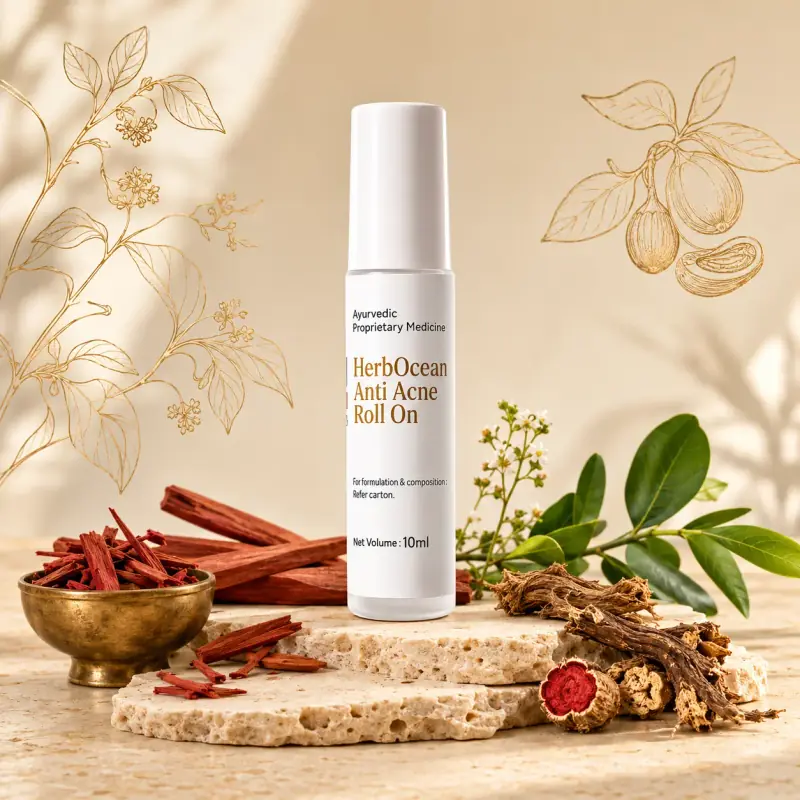
Anti-Acne Roll-On
Ayurvedic spot care for active pimples and post-acne marks (PIH) — a herbal roll-on classically indicated for acne (Yuvanpidika). Made in-house in Delhi.
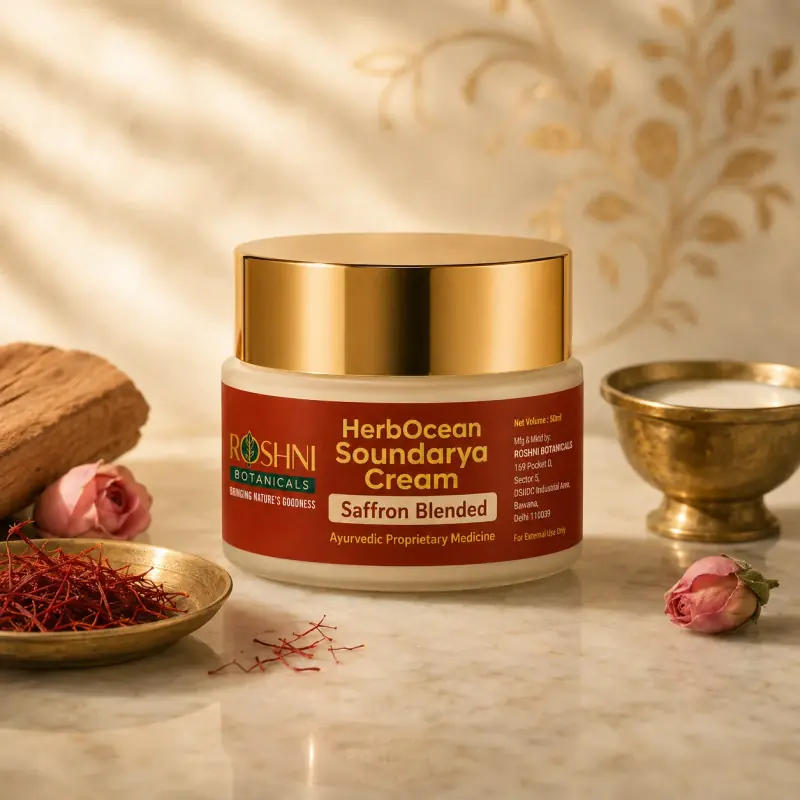
Soundarya Cream
A rich saffron brightening and repair cream with bargad (Vatt) bark on a goat-milk and coconut base, with shea and kokum butters, traditionally used in the care of skin where post-acne marks (PIH) linger.
Part of our guide: Ayurvedic treatment for acne: the complete guide.