Pillowcases, Towels and Phone Screens: The Acne Hygiene System Nobody Teaches
Five surfaces press against your face every day. What each one actually adds, and a cadence that survives humid North Indian weather.
Keep your face clean. Everyone with breakouts hears it, and it is the least useful advice in the category, because it lands like an accusation. Something narrower is going on. Acne and pimples (Yuvanpidika, the classical Ayurvedic term) begin inside the follicle, deeper than any scrubbing reaches. What you can steer is the handful of surfaces pressing against your face for hours a day: pillow cover, face towel, phone, helmet liner, makeup brushes. All five sit here, on a cadence built for humid North Indian weather rather than an ideal laundry week.
Key takeaways
- Acne starts inside the follicle, with hormones, oil output, follicular keratin and inflammation. No pillow cover, towel or phone creates it from nothing, and being unclean is not what produces it.
- Five surfaces are worth managing: pillow cover, face towel, phone screen, helmet liner and makeup brushes. Some carry oil back onto skin; others press, warm and rub.
- A cadence that survives Indian humidity: pillow cover every two to three nights in an active phase, a small face napkin dried right through daily, helmet liner aired after every ride, brushes washed weekly.
- Dermatology calls the friction and pressure pattern acne mechanica, which is part of why the jaw on your call side or the forehead under a helmet strap often carries more than the rest of the face.
First, the Part That Usually Goes Unsaid: Acne Is Not a Cleanliness Problem
Acne is driven by hormones, sebum output, keratin gathering inside the follicle, and the inflammation around it, including a bacterium that already lives inside the follicle. All four sit below the surface, and none of them is the dirt on your pillow. Wash twice a day with a mild cleanser and a papule can still turn up on the jaw. Wash four times and you are not spared. Being unclean is not what produces acne.
Washing more often is the reflex, and it does not buy you what you hope. The trap opens here: the washing climbs to three or four times a day, and before long the skin feels tight, stings when anything is applied, and looks angrier than before. That discomfort is real barrier wear, not imagination. Frequency itself is barely studied: the one small trial on face-washing frequency in young men found twice daily a sensible middle, four times daily no better, and once daily the only arm where acne actually worsened (Choi and colleagues, 2006, United States). So washing less is not automatically safer either. Twice a day suits most people: morning, evening, mild cleanser, lukewarm water. If your tap runs hard, as it does across much of Delhi and the north, that tight feeling arrives faster and pushes people towards another product instead of fewer.
So where does hygiene fit? One layer above the cause. Surfaces that touch your face all day do two separate jobs. Some carry material back onto skin: oil, sweat, hair oil, sunscreen residue, foundation. Others press, warm and rub. Dermatology has a name for that second pattern, acne mechanica, meaning acne aggravated by repeated friction, pressure, occlusion and trapped heat.
One more reason to bother, and it weighs more on Indian skin. Melanin-rich skin can respond to inflammation by laying down pigment, so a spot that stays angry a while may leave a flat brown mark behind once it settles. Post-inflammatory hyperpigmentation (PIH) often outlasts the spot itself. Each aggravated breakout you avoid is one less chance of a mark being left behind. For how classical care approaches the condition itself, our complete guide to Ayurvedic treatment for acne covers the ground underneath this post.
The Five Surfaces, and a Cadence That Actually Survives Indian Humidity
Start with the pillow. Seven hours of your face on cotton, the whole weight of your head behind it, and it collects skin oil, whatever you applied at night, and hair oil. Oil your hair, sleep on it, and some of that oil ends up on the cover and back against your cheek, so change the cover, or lay a napkin over it, on the nights after you oil. During an active phase, change the cover every two to three nights. Weekly holds up when things are quiet. That cadence is practical housekeeping, not a studied dose; no trial has tested how often a pillow cover should be changed. On the nights in between, lay a clean cotton napkin or a soft dupatta flat across the pillow and swap it each morning.
Standard towel advice assumes a dry bathroom and a tumble dryer. In a Delhi bathroom through the humid weeks, a thick bath towel on a hook does not dry between morning and evening, and by day three you are pressing a cloth that has not dried into skin that is already sore. Small fix: one dedicated face napkin per person, washed daily and dried right through, in sunlight where you have it and near an open window or a fan where you do not, rather than left on the bathroom rod. Shared towels need no lecture. In most Indian households one towel really does serve several people, and a stack of small napkins, one each, goes down more easily than a rule about the big towel. One exception matters. Acne is not an infection and does not pass from one person to another, but skin infections such as ringworm and impetigo do travel on a shared towel; anyone at home with an itchy ring-shaped patch or crusted, spreading sores needs a towel of their own and an appointment. Pat dry rather than rubbing, especially over sore spots.
The phone earns its place through pressure and heat rather than germs. The question turns up in search as phone se pimple hote hain kya, and the honest answer is the same. A screen warms up during a long call, and you hold that warmth against the same cheek and jaw. That is the combination of pressure, warmth and repeated contact that dermatology calls acne mechanica, described in patients who broke out on the side of the face they held the phone against. Take longer calls on earphones or the speaker, swap sides through the day so one cheek is not taking every conversation, and wipe the screen with a dry, soft cloth when it needs it, without expecting the wiping to be the part that matters.
A helmet strap presses the same line along the jaw for a whole ride, and the liner goes back on damp the next morning. Air the helmet after every ride, take the liner out and wash it whenever it has been sweated into, and keep a clean spare so a damp one never goes back in. What that does to the scalp itself is covered in scalp acne under helmets and damp buns. Makeup brushes hold product, oil and old pigment, so wash them weekly with a gentle cleanser. The detail on foundation, brushes and base choices sits in makeup and acne-prone skin, including brush care.
Bedsheets belong to the body rather than the face, and that argument is made in back acne, straps and the sheets you sleep on. Train or commute in the heat, and sweat that cannot evaporate under damp kit changes the surface your follicles sit in; gym acne and sweat pimples covers that lane. Through the humid weeks the air stays heavy and laundry takes its time, and what that does to skin generally goes into humid-weather acne care.
What Changes, What Does Not, and How to Judge It
Managing these five surfaces can lower the number of avoidable aggravations your skin meets. Slow and cumulative rather than an overnight change.
None of this touches the driver underneath. If your pattern sits along the chin and jawline and keeps time with your cycle, that rhythm carries on however often the pillow cover changes, because the input is hormonal and the linen has no say in it. That lane has a post of its own on hormonal acne on the chin and jawline.
The second limit is the hardest to accept. No change of linen acts on a spot that already exists, and nothing here acts on a flat brown mark once a spot has settled. Marks are their own lane: a mark is a colour change and a scar a texture change, which is why we separate them in acne scars versus marks. For that lane, once active spots have settled and only on settled skin, Soundarya Cream is traditionally used in the care of post-acne marks: a rich saffron repair cream with bargad (Vatt) bark on a goat-milk and coconut base, with shea and kokum butters, best paired with daily sun protection. It is rich, so very oily or acne-prone skin may not want it during an active phase. It is a different job from spot care, and marks keep their own schedule.
Give it a couple of months before you judge any of this, and expect a steadier surface environment rather than a finish line. No numbers are on offer here. Any figure you meet elsewhere should arrive with the study behind it.
None of that waiting applies to the patterns below. Deep nodules that hurt under the skin, acne that arrives suddenly in your thirties or forties, spots that leave pitted scarring, a spread of small, itchy bumps that are all much the same size rather than mixed, or a pattern that has not settled across a few months belong with a dermatologist, and scarring in particular is worth an early appointment rather than the end of a judging window. Many people follow a doctor’s plan and use classical care alongside it; tell your dermatologist what you are applying.
Where Classical Spot Care Fits, and Where It Does Not
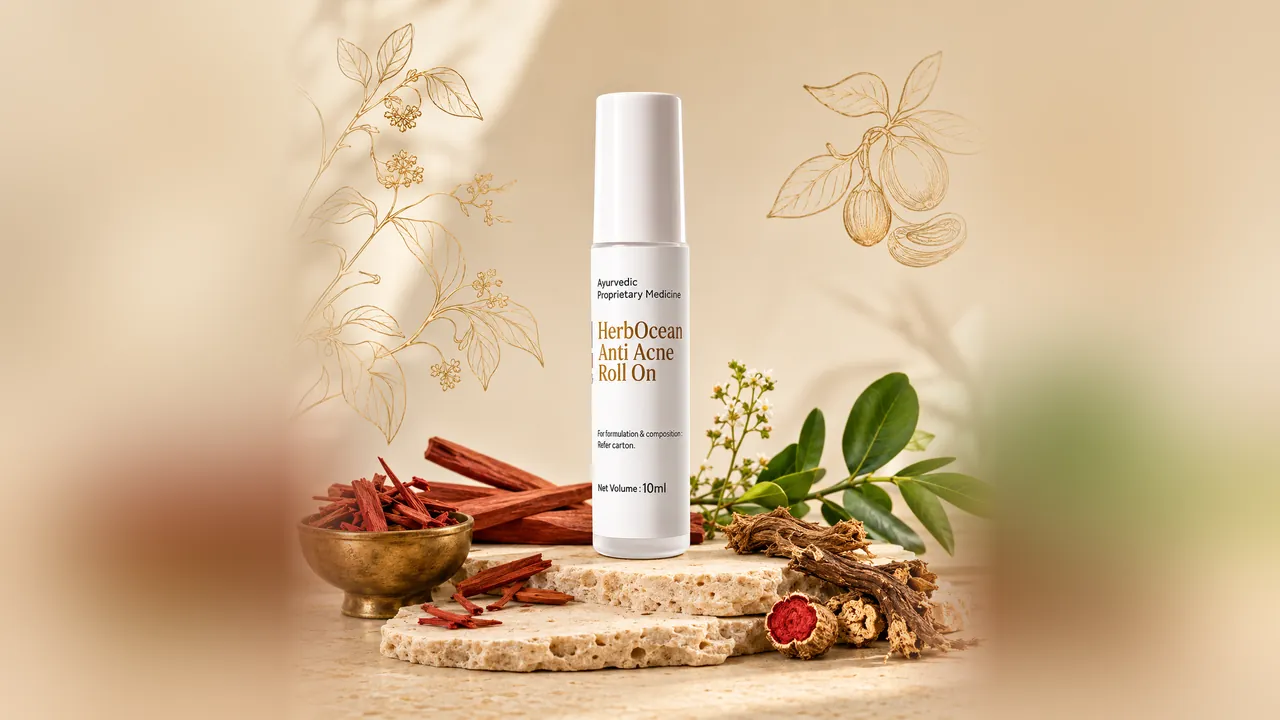
What follows is about a licensed medicine, and it is a separate question from the cadence above. Nothing in the hygiene routine on this page is part of what the Roll-On is licensed for, and the Roll-On is no substitute for any of it. HerbOcean Anti-Acne Roll-On is an AYUSH-licensed Ayurvedic medicine, Licence No. DL-474 A&U, for external use, classically indicated for acne and pimples and traditionally used in the care of post-acne marks and pigmentation (PIH). Targeted spot care, then: cleanse, pat dry, then roll a thin layer directly over the pimple, morning and night, then follow with your moisturiser. Spot use only, not across the whole face, and not under makeup.
The formula is deliberately narrow. Six classical botanicals in equal measure, the same dose for every one: Manjistha, Lodhra, nutmeg (Jaiphal), red sandalwood (Raktchandan), Indian berberry (Daruhaldi) and costus root (Kuth), in a glycerine and purified-water base, with lavender oil for aroma. No single herb leads the formula. Manjistha and Raktchandan are long-standing rakta shodhana (blood purification) herbs, and the other four sit with them in the same classical skin group. To be plain: this roll-on is not a skin-shade product, and we make no claim that it changes your natural colour. The goal is calm, settled, comfortable skin.
It is built on the 40-year Ayurvedic formulation legacy of Vaidya Shri Ram Prakash Ji, and it is made in-house at our GMP-certified unit in Bawana, Delhi. The limits, plainly: it is spot care, not a wash, not a moisturiser, and no substitute for changing the pillow cover. HerbOcean does not manufacture a sunscreen, and nothing in the range replaces one, so your sun protection stays a separate step. For external use. Patch-test on the inner forearm before a first full application, and if you are pregnant or nursing, ask your Ayurvedic physician before use.
Pick Two Surfaces This Week
Start with two: the pillow cover, changed every second or third night, and a small face napkin that is yours alone and dries right through. The phone, the helmet and the brushes can follow. For spots already there, the HerbOcean Anti-Acne Roll-On is the targeted lane, patch-tested on the inner forearm first. And deep painful nodules, sudden adult onset or pitted scarring mean the dermatologist rather than another napkin.
References: Choi JM et al. Pediatric Dermatology. 2006;23(5):421-427 (face-washing frequency trial, young men, United States; once daily worsened acne, four times daily no better than twice). Mills OH, Kligman AM. Acne mechanica. Archives of Dermatology. 1975;111(4):481-483 (experimental induction by occlusion). Singh M and colleagues. Clinical and Experimental Dermatology. 2020;45(7):903-905 (case series of 13 patients in India, new or flaring acne mainly on the side of the face held against the phone; uncontrolled, descriptive only).
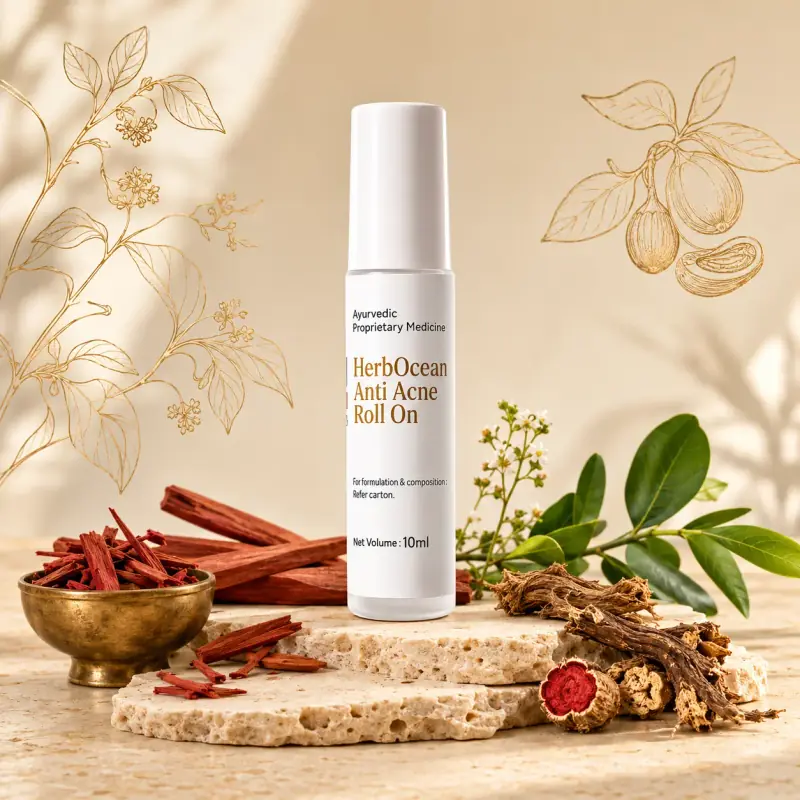
Anti-Acne Roll-On
Ayurvedic spot care for active pimples and post-acne marks (PIH) — a herbal roll-on classically indicated for acne (Yuvanpidika). Made in-house in Delhi.
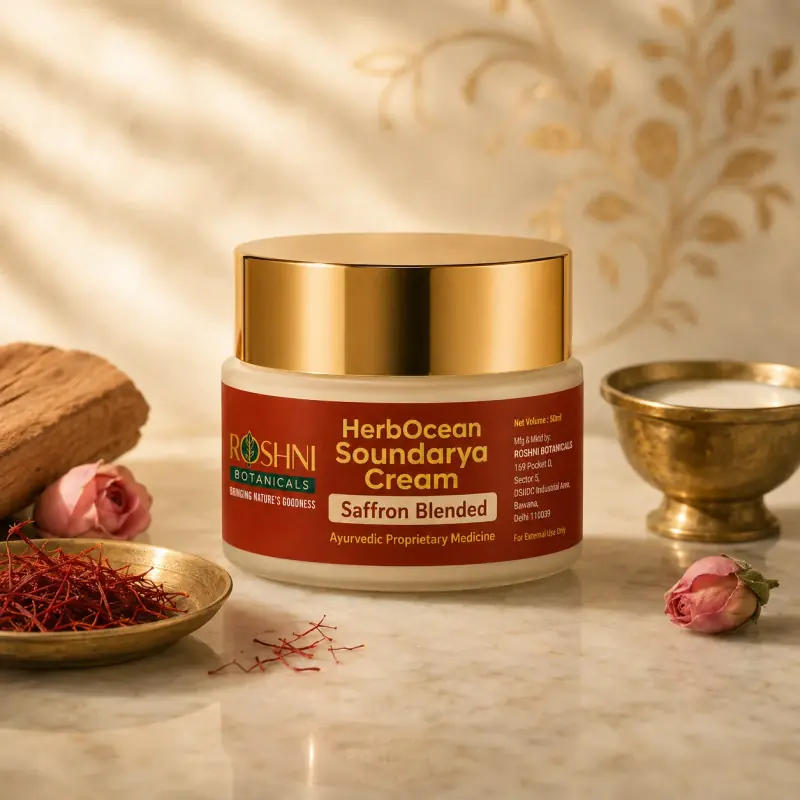
Soundarya Cream
A rich saffron brightening and repair cream with bargad (Vatt) bark on a goat-milk and coconut base, with shea and kokum butters, traditionally used in the care of skin where post-acne marks (PIH) linger.
Part of our guide: Ayurvedic treatment for acne: the complete guide.