Beard Pimples and Shaving Bumps: Three Different Problems on Indian Skin
Bumps along the jaw and neck are usually one of three separate problems. How to sort them, how to shave so fewer turn up, and why to keep your hands off.
You look in the mirror, see bumps along the jaw and neck, and call the whole lot pimples. One word, three different problems underneath. That is why the routine that sorted out a friend does nothing for you.
At eight in the morning they do look much the same. Give them two weeks and they behave nothing alike. Sort them first; the shaving technique and the barbershop questions Indian men actually deal with follow from that.
Key takeaways
- True acne (Yuvanpidika, the classical Ayurvedic term for acne, literally youthful eruption) begins inside a blocked follicle and appears whether or not you shave, while razor bumps appear only along the shaved line.
- Razor bumps, known in dermatology as pseudofolliculitis barbae, usually turn up a day or two after a close shave, and often show a dark hair looped just under the surface.
- A crop of similar itchy, pus-topped bumps soon after a shave, with no blackhead or whitehead among them, points instead at folliculitis barbae, which comes from Staphylococcus aureus settling into the follicle.
- Two shaving changes do most of the work: map the grain before you shave and go with it, especially on the neck, and keep your free hand off the skin instead of pulling it taut.
- On melanin-rich Indian skin, the mark left behind by picking at a bump can outlast the bump by months, which is the strongest argument for leaving it alone.
Three Different Bumps in One Beard: How to Tell Them Apart
Bumps in the beard area are usually one of three separate problems, and each one asks for different care. True acne forms inside a blocked follicle and can appear whether or not you shave. Razor bumps happen when a coarse, curved beard hair is cut short, curls over and re-enters the skin, so they sit along the shaved line. Folliculitis barbae shows up instead as many similar itchy, pus-topped bumps soon after a shave, from ordinary skin bacteria settling into the follicle, with shared or reused shaving equipment one route they travel.
Start with location. Acne in the beard area rarely keeps to the beard: cheeks, jaw and often the forehead flare together, small closed bumps mixed with inflamed ones, and none of it cares whether you shaved on Sunday or Wednesday. Bumps that sit in the same places month after month, shaved or unshaved, are acne, and our complete guide to Ayurvedic treatment for acne covers that ground properly. None of it means you are unclean: acne is a follicle problem, not a hygiene report card. Sushruta places these eruptions of youth among the minor skin conditions of Nidana Sthana 13.
Razor bumps work the other way round. They obey the blade. Look for them where hair grows in swirls, on the neck and the underside of the jaw, which is the commonest site of all, and expect them a day or two after a close shave rather than the same evening. Under good light you can often spot a dark hair looped just beneath the surface, attached to the skin at both ends; under the dermatoscope that loop is the commonest sign of the condition. It can itch or it can ache, and often does both.
The third pattern looks the most uniform. Folliculitis barbae arrives as a crop of similar bumps, many at once, each topped with a small point of pus, and it tends to itch as much as it hurts. It comes from Staphylococcus aureus settling into the follicle, and shaving equipment can carry it from one use to the next. The discriminator most people skip is the simplest one: ordinary acne is mixed company, with blackheads or whiteheads somewhere among the spots, and folliculitis has none. If every bump looks identical and none of them is a blackhead or whitehead, that belongs with a dermatologist rather than with acne care.
Five questions sort most of it out: where the bumps sit, how long after a shave they showed up, whether they all look alike, whether there is a blackhead or a whitehead anywhere among them, and whether a trapped hair is visible. Two can run at once, and mixed pictures are common in a beard shaved often.
Why Shaved Hair Curls Back In, and What Technique Changes
Razor bumps follow coarse, tightly curling beard hair, which grows out of a curved follicle. Cut that hair level with the skin, or a shade below, and the tip growing back is sharp and angled. It points at the skin rather than away, and on the neck, where growth swirls, it can re-enter within a day or two. That is the mechanism, and it explains why the closest shave so often buys you the worst week.
Nearly all the published work on pseudofolliculitis barbae studies men of African descent, with small series from elsewhere, and nothing published looks at Indian men. Map your own grain first. Run a dry palm up and down the neck; where it feels rough, you are going against the grain. Neck hair often grows upward while cheek hair runs down, so one downward stroke everywhere works against half your face. Shave with the grain, even though it leaves you less smooth. And keep your free hand off the skin: stretching it taut is what lets the blade cut below the surface and leave the tip buried. In the one dermoscopy series that asked, every patient using a razor said he stretched the skin while shaving.
Then the small mechanical things. Soften the beard under warm water for a couple of minutes and work up a proper lather; dry shaving is asking for trouble, because an unsoftened hair takes a sharp bevelled tip off the blade while a hydrated, swollen one takes a blunter edge. Use a fresh, sharp blade, since a dull one drags and tears. Which razor suits you is less settled than the grooming pages suggest, and technique matters more than the head you use.
While bumps are actively inflamed, put the blade down and let the skin settle. Once it has, a longer gap between shaves is not the fix on its own: hair left to grow only a short way is exactly the length that re-enters the skin. Hard water across much of North India makes lather thin and blade drag worse, so rinse well and pat dry rather than rubbing. As the monsoon pulls back the air dries while sweat still sits under beard hair through the afternoon, which is the same ground our guide to gym acne and sweat pimples covers for training and the ride home.
At the Barber: Blades, Alum and Towels, Without the Panic
You get shaved at a shop, and you are not going to stop. A beard-area infection has a route, and knowing the route lets you close it without making a scene.
Shared equipment is the route. A blade reused between customers, a brush and bowl that never dry out, a towel going from one face to the next: all of it can carry skin bacteria such as Staphylococcus aureus, and the same logic runs through the surfaces that touch your face every day, from the face towel to the pillow cover. Ringworm of the beard travelling by the barber razor is largely a thing of the past and is uncommon now, though it has not disappeared entirely. So a sudden crop of uniform itchy bumps soon after a shop shave points at folliculitis rather than acne. The alum block (phitkari) counts here too: a block rubbed across several faces in a row is a shared surface, like the towel.
Four asks, none of them confrontational. Ask for a new blade opened in front of you; most shops will do it without a second thought. Ask for a fresh towel. Carry your own trimmer guard, the clip-on comb that snaps over the blades, since that is the part running along your skin on a trim. Carry your own phitkari rather than using the block on the counter.
None of these needs an argument. And the same logic follows you home: a razor shared with a brother or a father is still a shared blade, with a familiar face attached.
Caring for the Beard Area While It Settles, and the Marks Left Behind
While the area is actively inflamed, put the blade down. A guarded trimmer leaves stubble sitting just above the skin, so the hair tip stays out of the follicle and nothing gets dragged across sore bumps. A millimetre is enough; the point is only that the tip never gets back below the surface. Wash with lukewarm water and a mild cleanser twice a day, pat dry, and stop there. No scrubbing, no exfoliating grains over inflamed skin, no hot towel pressed onto it. Washing more often is the reflex, and it does not buy you what you hope; past a point it leaves the barrier tight and uncomfortable.
Now the part that costs the most, and that almost nobody follows. Do not pick. No digging at a trapped hair with a pin or tweezers over the washbasin: freeing one is a clinic job done with a sterile needle, and plucking at it often snaps the hair and leaves a fragment behind to inflame. On melanin-rich Indian skin, the inflammation you set off going after a two-day bump can leave post-inflammatory hyperpigmentation (PIH) sitting there for many months, long after the bump itself is forgotten. In the largest survey of the condition, that mark was the commonest thing it left behind. If you are unsure whether what you are looking at is a mark or something deeper, our guide to acne scars versus marks has the fingertip and side-light check.
What follows is about a licensed medicine, and it is a separate question from the shaving habits above.
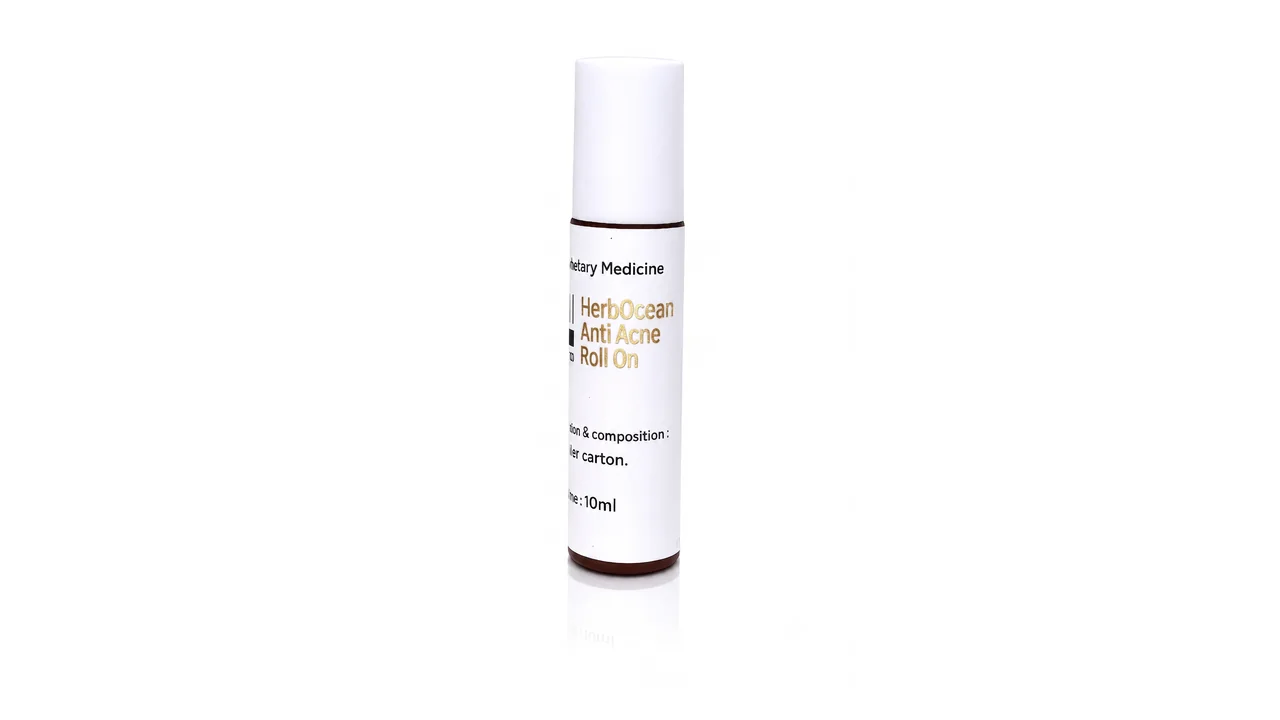
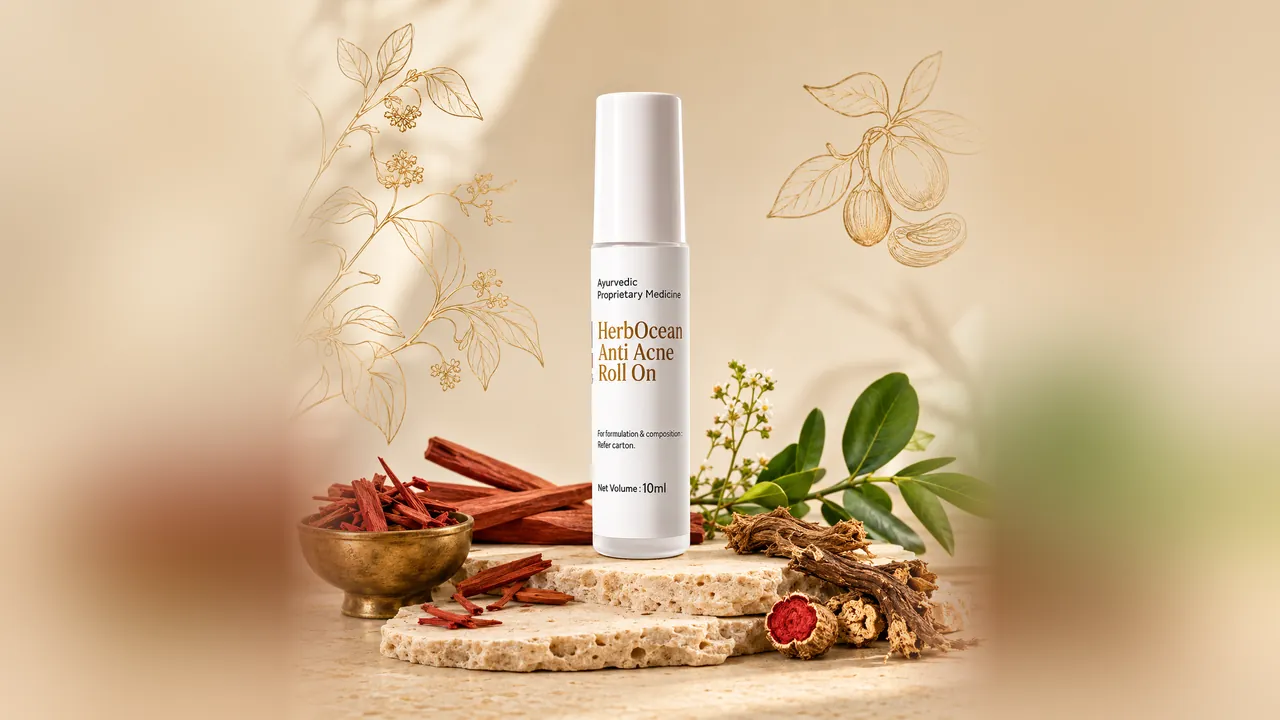
For individual spots, HerbOcean Anti-Acne Roll-On is an AYUSH-licensed Ayurvedic medicine, Licence No. DL-474 A&U, for external use, classically indicated for acne and pimples and traditionally used in the care of post-acne marks and pigmentation (PIH). Targeted spot care, then: cleanse, pat dry, then roll a thin layer directly over the pimple, morning and night, then follow with your moisturiser. Spot use only, not across the whole face, and not under makeup.
Six classical botanicals in equal measure, the same dose for every one: Manjistha, Lodhra, nutmeg (Jaiphal), red sandalwood (Raktchandan), Indian berberry (Daruhaldi) and costus root (Kuth), carried in a glycerine and purified-water base, with lavender for aroma. No single herb leads the formula. There is no neem in it and no tea tree.
It is built on the 40-year Ayurvedic formulation legacy of Vaidya Shri Ram Prakash Ji, and it is made in-house at our GMP-certified unit in Bawana, Delhi.
Placement matters more than usual on a shaved face. Use it on clean, dry, unbroken skin. Never roll it over a razor nick, a shaving graze or any broken skin, and keep it away from the lips and eyes. For external use. Patch-test on the inner forearm before a first full application, and if you are pregnant or nursing, ask your Ayurvedic physician before use. HerbOcean does not manufacture a sunscreen, and nothing in the range replaces one, so your sun protection stays a separate step.
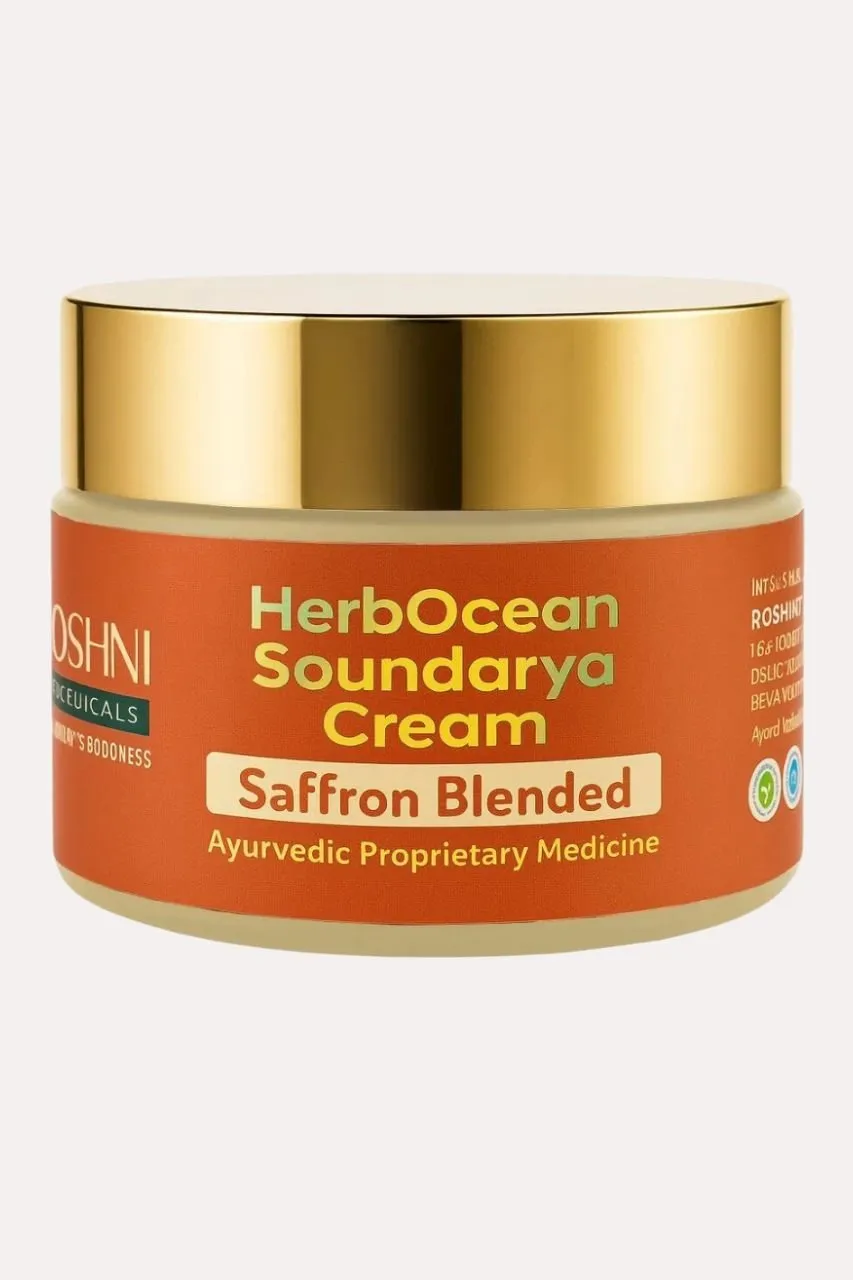
For lingering marks along the jaw, once active spots have settled and only on settled skin, Soundarya Cream is traditionally used in the care of post-acne marks: a rich saffron repair cream with bargad (Vatt) bark on a goat-milk and coconut base, with shea and kokum butters, best paired with daily sun protection. It is rich, so very oily or acne-prone skin may not want it during an active phase.
Go to a dermatologist if the bumps spread quickly, if they itch uniformly across the beard, if they turn into boils or weeping crusts, if the skin is left pitted or raised where a bump used to be, if the same patch keeps flaring for months despite gentler shaving, if deep, painful nodules sit under the skin, or if you run a fever alongside them.
Change One Thing About How You Shave
Work out which of the three you have before you buy anything. Then change one thing about how you shave, and grain direction is usually the one to change first. Give it two weeks. Leave the bumps alone meanwhile, because the mark lasts longest. Spot care on clean, dry, unbroken skin has a place alongside that, and so does a dermatologist, if what you are seeing is spreading, itching uniformly or leaving the skin pitted.
References: Sushruta Samhita, Nidana Sthana 13 (Kshudra Roga Nidana), on Yuvanpidika, the eruptions of youth. Perry PK et al. Journal of the American Academy of Dermatology. 2002;46(2 Suppl):S113-S119 (literature review; men and women of African American and Hispanic origin with tightly curled hair; United States). Ogunbiyi A. Clinical, Cosmetic and Investigational Dermatology. 2019;12:241-247 (review, Nigeria; anterior neck the commonest site; itch or pain a day or two after shaving; stretching the skin, shaving against the grain and blunt blades each raise the risk). Kaliyadan F et al. International Journal of Trichology. 2016;8(1):40-42 (24 consecutive male patients, Saudi Arabia; every razor user reported stretching the skin while shaving). Seck B et al. Medecine Tropicale et Sante Internationale. 2024;4(2) (cross-sectional, 655 police students, Senegal; shaving against the grain associated with the condition, electric clippers with less of it; itch the commonest symptom). Frazier WT et al. American Family Physician. 2023;107(1):26-34 (review, United States; shaving cessation the best initial step). DermNet, Pseudofolliculitis barbae (shave with the follicle and do not stretch the skin; non-Indian clinical reference). DermNet, Folliculitis barbae (Staphylococcus aureus colonisation of the superficial follicle; reinfection may point to previously used razors; non-Indian). Tinea Barbae. StatPearls, NCBI Bookshelf NBK563204 (the barber-razor route is the historical attribution and is now uncommon; fever and swollen glands accompany the deep form; non-Indian). Davis EC, Callender VD. Journal of Clinical and Aesthetic Dermatology. 2010;3(7):20-31 (review; epidermal post-inflammatory hyperpigmentation may take months to years to settle without treatment; skin-of-colour populations, non-Indian).
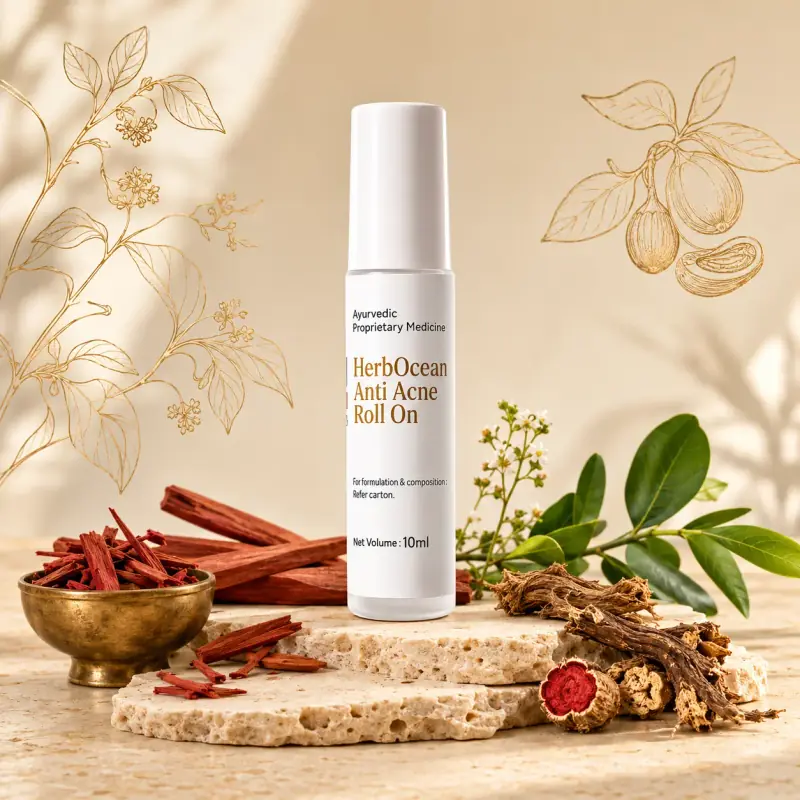
Anti-Acne Roll-On
Ayurvedic spot care for active pimples and post-acne marks (PIH) — a herbal roll-on classically indicated for acne (Yuvanpidika). Made in-house in Delhi.
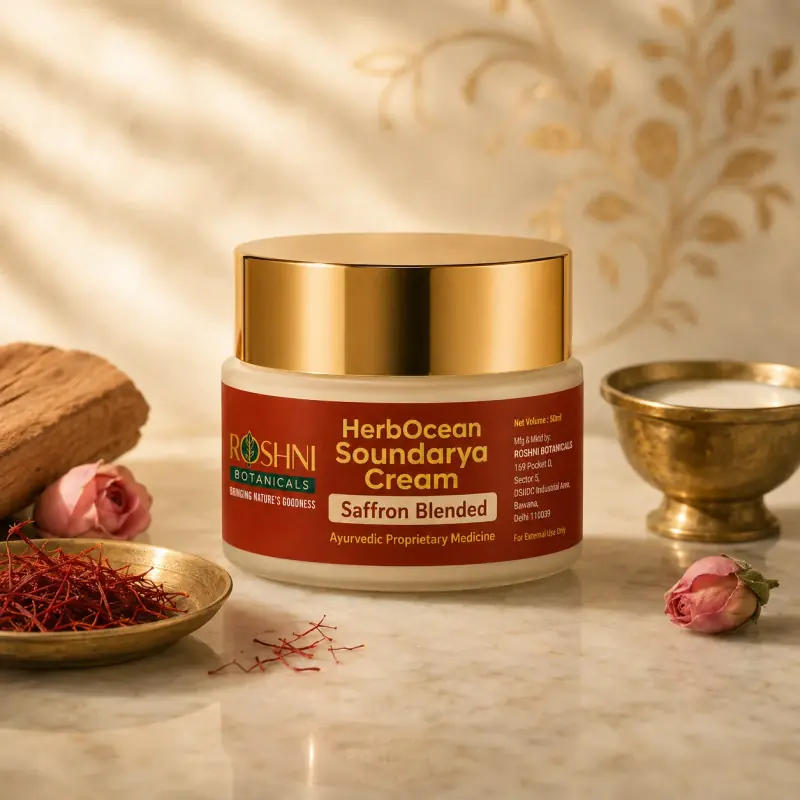
Soundarya Cream
A rich saffron brightening and repair cream with bargad (Vatt) bark on a goat-milk and coconut base, with shea and kokum butters — often reached for where post-acne marks (PIH) linger.
Part of our guide: Ayurvedic treatment for acne: the complete guide.