Gym Acne and Sweat Pimples: An Ayurvedic Care Guide for Indian Skin
Workout pimples start after the session, not during it. What kit, helmets and the ride home do to skin, and the care that actually helps.
Most people who train regularly meet the same problem sooner or later. The session goes well, and by evening the jawline is dotted with small sweat pimples, especially once a two-wheeler helmet commute and humid air pile on top of the workout. Advice on this swings between two useless poles: scare you off the treadmill, or hand you a four-step wash routine that leaves skin crosser than it started. Here is the better news. Most of what drives gym acne is fixable, and almost none of the fixes involve washing more.
Key takeaways
- Sweat itself does not plug a pore: the plug forms inside the follicle, from sebum and shed cells. What sweat changes is the surface it sits on, and warm, damp skin under tight kit and straps is where friction does its work.
- The one small trial that tested shower timing found no difference between showering within an hour of training and waiting four. So the rinse is comfort and habit; the real levers are the pressure and occlusion dermatologists call acne mechanica, friction acne.
- On melanin-rich Indian skin, an inflamed spot often leaves post-inflammatory hyperpigmentation (PIH) that outlasts the spot itself, so a breakout avoided is a mark avoided.
- Washing more is not the answer, and washing less is not automatically safer either. One gentle wash after training and one at night, each followed by a light moisturiser, serves most people well, and hard municipal water plus repeated stripping can leave the barrier uncomfortable.
- Small, uniform, itchy bumps clustered on the chest or upper back after a run of sweaty sessions are often folliculitis rather than ordinary acne. Check whether any of them is a blackhead or whitehead, and take that pattern to a dermatologist.
Where Gym Acne Actually Starts: Sweat, Kit and the Commute
Sweat is mostly water and salts, and it is not the villain here, though it is not entirely innocent either. Sweat itself does not plug a pore: the plug forms inside the follicle, from sebum and shed skin cells. What sweat changes is the surface those follicles live in. As skin warms with effort, sebum flows more freely, and skin that stays damp under pressure swells slightly at the follicle openings, so outflow meets more resistance. Add steady pressure and rubbing, a strap, a tight collar, a helmet edge, and you have the picture dermatologists call acne mechanica, friction acne: occlusion and friction pushing existing blocked pores (comedones) towards inflamed spots. It is an old, well-described entity; Mills and Kligman induced it experimentally with simple occlusion back in 1975. In classical practice, skin behaving this way is read through aggravated Pitta (one of the three doshas, the biological energies in Ayurveda) meeting trapped heat and moisture at the surface.
So start by listing what presses on your face. Synthetic activewear is engineered to move moisture, yet a tight collar, a bra strap or a compression tee still traps heat wherever it hugs. Helmets are harder to work around: a chin strap sets up the same pattern described in athletes and soldiers, pressure and occlusion on damp skin through the whole ride, and while nobody has studied the daily two-wheeler commute itself, the mechanism rides pillion. The scalp side of the same helmet, the liner and what to do about it, is covered in our scalp acne guide. Then there are hands. Between sets they travel from a barbell to a machine handle to a phone screen, and then to the jaw. A shared gym towel wiped across the forehead does much the same job. And makeup left on through a session is worth watching: it sits on the skin exactly when heat and friction peak, and readers who train made-up often report exactly that pattern of breakouts.
Humidity adds a twist of its own. When the air is heavy, sweat evaporates slowly, and the twenty minutes between your last set and a tap stretch into something your skin registers. Delhi, Mumbai and Kochi can be living quite different weather in the same week, so read this as a tendency and adjust for your own city; our guide to what humid weeks do to breakout-prone skin covers that ground in detail. Here is the honest surprise, though. The one small trial that tested shower timing directly, physically active young men showering within an hour of training or waiting at least four hours, found no difference in breakouts either way (Short and colleagues, 2008, 23 participants, United States). So rinse soon because it feels better, not out of fear, and put your effort into the friction and occlusion you can actually design around.
Underneath all of it sits the point that matters most here. Melanin-rich skin answers inflammation by depositing pigment, so one angry spot can leave a brown mark that lingers long after the spot has gone. That is post-inflammatory hyperpigmentation (PIH), and it is why gym acne is worth attention early: a breakout avoided is a mark avoided.
The Post-Workout Wash, Without the Over-Washing Trap
Rinse reasonably soon, and rinse gently. Mild cleanser, lukewarm water, fingertips, no scrub, then pat dry with your own clean towel. Follow that with a light moisturiser even if your skin runs oily. That last instruction is the one everybody skips. How you wash is the well-studied part: high-pH soaps and harsh surfactants measurably irritate skin that milder, skin-pH cleansers leave comfortable (Baranda and colleagues, 2002, 30 participants).
The trap opens right here. A breakout appears, so the washing climbs to three or four times a day, usually with something foaming and astringent, and before long the skin feels tight, stings when anything is applied, and looks angrier than before. That discomfort is real barrier wear, not imagination. The honest footnote is that frequency itself is barely studied: the one small trial on face-washing frequency in young men found twice daily a sensible middle, four times daily no better, and once daily the only arm where acne actually worsened (Choi and colleagues, 2006, United States). So washing less is not automatically safer either. One gentle wash after training and one at night, each followed by a light moisturiser, is the routine most people land on, with a plain water rinse in between if you are feeling sticky.
Hard water is a common complaint across much of urban India, and a gym shower is no different from the tap at home. Mineral-heavy water makes cleansers lather poorly and can leave a tight, filmy feeling that people then answer by washing harder. Keep the rinse short and lukewarm, carry your own towel instead of using the one draped over the bench, and answer that filmy feeling with a milder cleanser and a light moisturiser rather than with a harder wash.
Shared kit deserves the same attention. Wipe the bench down, clean the phone screen that meets your cheek, and keep your hands off your jaw between sets. Breakouts across the back and shoulders follow much the same logic, and our Ayurvedic care for back acne guide covers kit, showering and shoulder friction in detail.
The Whey Protein Question, Answered Honestly
Ask around any gym floor and this one comes up, so it deserves a straight answer rather than a shrug or a scare. The mechanism is real and reasonably well described. Whey is the most insulinotropic fraction of milk, meaning it pushes post-meal insulin up sharply, and insulin and insulin-like growth factor 1 (IGF-1) both influence sebaceous activity and the behaviour of cells lining the follicle (the pathway is set out in Melnik’s 2011 review). A mechanism only takes you so far, though, and the step readers usually hear, that whey raises circulating IGF-1, is precisely the step the milk-fractionation data complicate: in the trial that separated the milk fractions, whey raised insulin while casein, not whey, raised IGF-1.
The human evidence points both ways, and honesty means listing both sides. Pointing towards a link: a case series of five teenage athletes whose acne tracked whey use (Silverberg, 2012, United States), a case-control study of 201 young men in which supplement users showed more acne (Muhaidat and colleagues, 2024, Jordan), and a small case series of gym-goers whose breakouts sat only on the trunk (Cengiz and colleagues, 2017, six patients, Turkey). Pointing away: the one randomised trial in the field, a double-blind noninferiority trial in 49 men, found six months of whey no worse than a non-whey supplement for acne lesions and severity (Sompochpruetikul and colleagues, 2024, Thailand). None of these studies is Indian, so read all of it as signals from other populations rather than your personal odds, and expect individual variation to be wide.
So if your breakouts began after you started supplementing, run a controlled experiment rather than a sudden purge. Talk to your doctor or a dietician about pausing whey, and about how to keep your protein up while you do; let them set the duration. Hold your training and the rest of your routine steady so the change means something, and write down what you see. Nobody should be prescribing your diet from a blog post, us included. For the wider picture, taking in dairy and the glycaemic load of everyday Indian eating, read this alongside our guide to hormonal acne on the chin and jawline.
Spot Care, Morning and Night, and the Marks That Matter
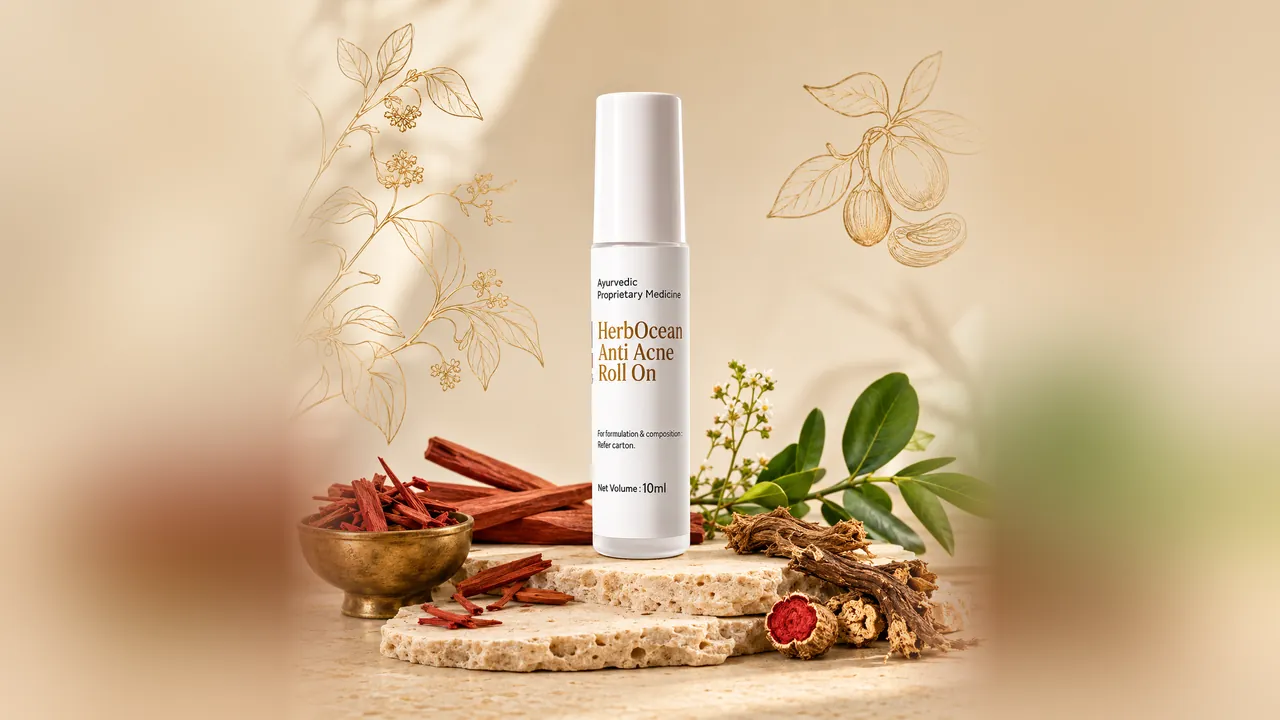
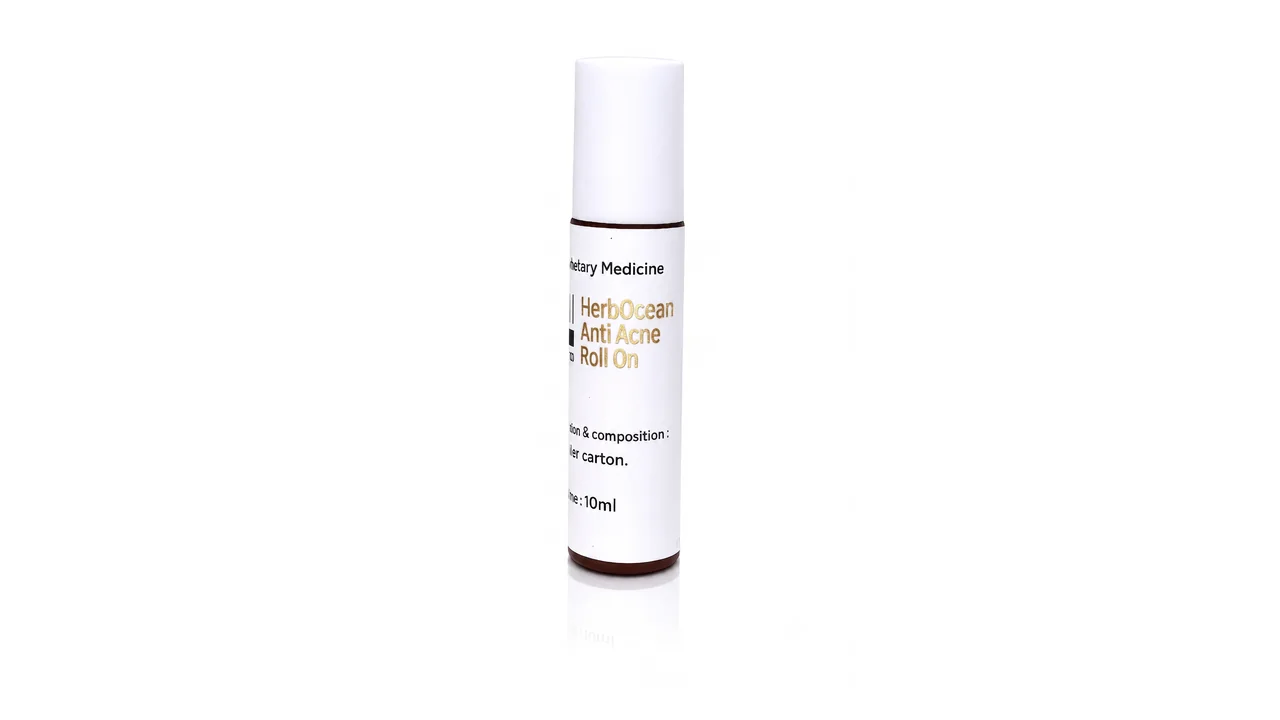
Targeted care earns its place on clean, dry skin. HerbOcean Anti-Acne Roll-On goes on after you cleanse and pat dry, a thin layer rolled directly over the pimple, morning and night, and only on the few spots that are actually active, not across the whole face. After training, that means once the post-workout rinse has dried; at night, after your last cleanse. It is an AYUSH-licensed Ayurvedic medicine (Licence No. DL-474 A&U) for external use, classically indicated for acne (Yuvanpidika, the classical term) and traditionally used in the care of the marks that breakouts leave behind.
Six classical botanicals sit in the formula in equal measure, the same dose for every one: Manjistha, the classical rakta shodhana (blood purification) herb; Lodhra, a classical astringent skin herb; nutmeg (Jaiphal); red sandalwood (Raktchandan); Indian berberry (Daruhaldi); and costus root (Kuth), in a glycerine and purified-water base, with lavender oil for aroma. No single herb leads the formula, and there is no neem in it and no tea tree. To be plain: this roll-on is not a skin-shade product, and we make no claim that it changes your natural colour. The goal is calm, settled, comfortable skin.
The Roll-On is made in-house at our GMP-certified unit in Bawana, Delhi, and it belongs to a line built on the forty-year formulation legacy of Vaidya Shri Ram Prakash Ji. Patch-test anything new on the inner forearm first, and if you are pregnant or nursing, ask your Ayurvedic physician before use.
Marks need their own patience. Once active spots have settled, and only on settled skin, HerbOcean Soundarya Cream is traditionally used in the care of post-acne marks: a rich saffron repair cream with bargad (Vatt) bark on a goat-milk and coconut base, with shea and kokum butters, best paired with daily sun protection, because on melanin-rich skin sunlight is what sets a mark. Hold off on it while the itchy, uniform pattern below is still a possibility.
When a Doctor Matters More Than a Routine
Some patterns are not for home care at all. Small, uniform, itchy bumps clustered across the chest and upper back after a run of sweaty sessions look like acne and often are not. Check for the discriminator most people skip: blackheads and whiteheads. Ordinary acne is mixed company, blackheads, whiteheads and a few larger tender spots together. If every bump looks the same and none of them is a blackhead or whitehead, that points to Malassezia folliculitis, often called fungal acne, a yeast pattern that thrives in occluded, damp skin, and layering acne products on it usually makes the itch worse. Our back acne guide walks through telling the two apart. At the hairline the same uniform, itchy look has more than one possible cause, bacterial folliculitis among them, so it earns the same appointment without a name attached.
See a dermatologist too for painful deep nodules or cysts sitting under the skin, a sudden adult-onset flare in someone whose skin was settled for years, breakouts that track alongside irregular cycles and deserve a proper hormonal work-up, and breakouts that persist despite a consistent, sensible routine. Any spot that leaves a scar is worth an appointment sooner rather than later, because scarring is the one thing here you cannot undo. And a breakout that arrives suddenly and severely alongside fever, aching joints or simply feeling unwell is not a skincare question at all: see a doctor promptly.
After the Last Rep
Rinse gently soon after training because it feels better, not because the clock decides your skin. Change out of damp kit. Keep hands, shared towels and the phone screen away from your face. If whey is your question, run the experiment properly with your doctor rather than guessing at it. Then let spot care do its quiet, targeted work, morning and night, on clean, dry skin. And for the wider picture beyond the gym floor, taking in dosha, diet, daily routine and how classical formulations are built, our complete guide to Ayurvedic treatment for acne pulls it together in one place.
References: Short RW et al. Pediatric Dermatology. 2008;25(1):126-128 (randomised pilot; 23 physically active males, United States; shower within one hour vs after four or more hours, no difference in truncal acne). Mills OH, Kligman AM. Acne mechanica. Archives of Dermatology. 1975;111(4):481-483 (experimental induction by occlusion). Choi JM et al. Pediatric Dermatology. 2006;23(5):421-427 (face-washing frequency trial, young men, United States; once daily worsened acne, four times daily no better than twice). Baranda L et al. International Journal of Dermatology. 2002;41(8):494-499 (30 participants; cleanser pH and skin irritation). Melnik BC. Evidence for acne-promoting effects of milk and other insulinotropic dairy products. 2011 (mechanism review). Silverberg NB. Cutis. 2012;90(2):70-72 (case series, five male athletes aged 14 to 18, United States). Muhaidat J et al. Dermatology Research and Practice. 2024;2024:2158229 (case-control, 201 young men, Jordan). Cengiz FP et al. 2017 (case series, six gym-goers with trunk-only acne, Turkey). Sompochpruetikul K et al. Journal of Dermatology. 2024;51(7):1022-1025 (double-blind randomised noninferiority trial, 49 men, six months, Thailand; whey no worse than the non-whey supplement).
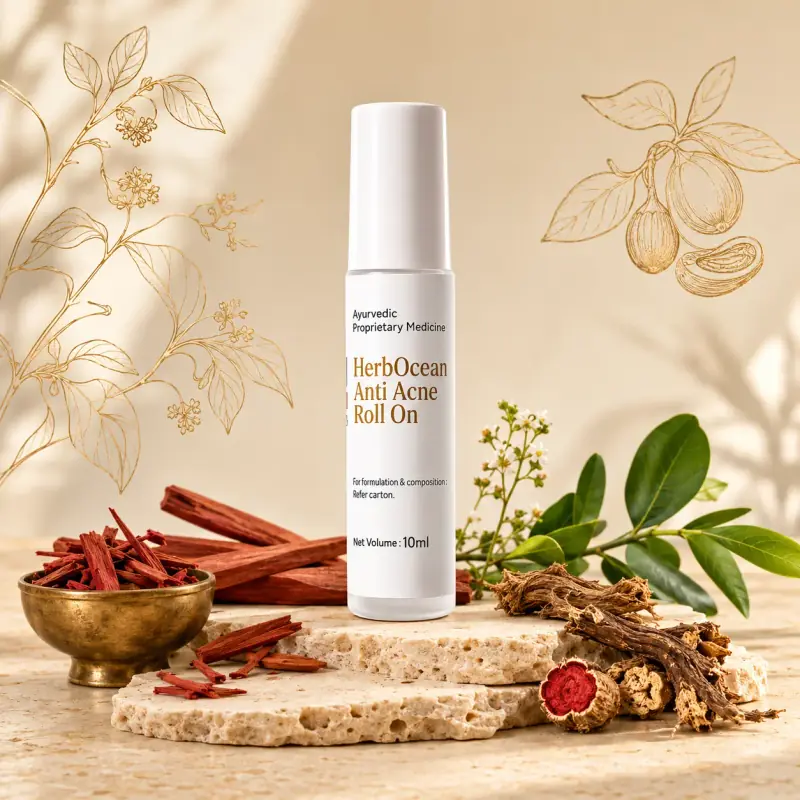
Anti-Acne Roll-On
Ayurvedic spot care for active pimples and post-acne marks (PIH) — a herbal roll-on classically indicated for acne (Yuvanpidika). Made in-house in Delhi.
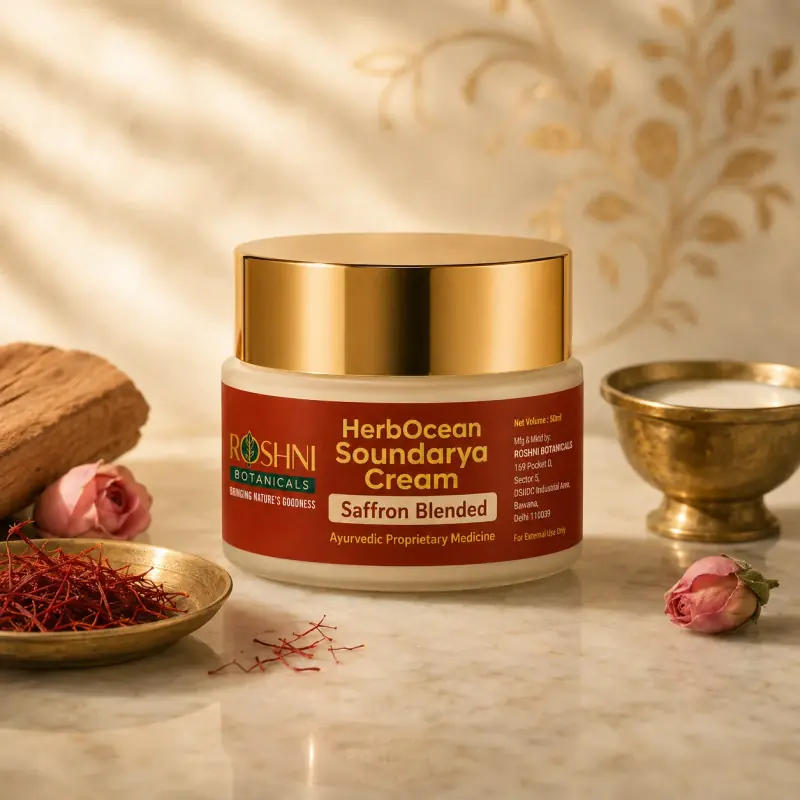
Soundarya Cream
A rich saffron brightening and repair cream with bargad (Vatt) bark on a goat-milk and coconut base, with shea and kokum butters, traditionally used in the care of skin where post-acne marks (PIH) linger.
Part of our guide: Ayurvedic treatment for acne: the complete guide.