Forehead Pimples: Why They Keep Coming Back, and an Ayurvedic Care Plan
Most recurring forehead pimples do not begin on the forehead. They begin at the scalp: dandruff, hair oil past the hairline, helmets and trapped sweat. The honest order that actually fixes it.
Your cheeks stay mostly clear, yet a fresh crop of pimples returns to your forehead every few weeks, usually right along the hairline. Before you blame your face wash or reach for a face-mapping chart, look a few centimetres higher. Most recurring forehead pimples do not begin on the forehead at all; they begin at the scalp, and an honest care plan has to start there too. This is the whole cascade, in the order that actually fixes it, and yes, it includes some honesty about hair oil that an oil brand would rather not print.
Key takeaways
- Recurring forehead pimples usually start at the scalp, not the skin: dandruff and oily-scalp drip, hair oil applied past the hairline, sweat trapped under fringes and helmets, and sticky styling products are the common culprits.
- The forehead is part of the oilier T-zone, so acne (Yuvanpidika, the classical Ayurvedic term for acne, literally "youthful eruption") settles here easily, and classical Ayurveda reads it as congestion at a high-oil zone.
- Fix the causes in order: settle the scalp first, keep the hairline clean, and only then use targeted spot care on the pimples that remain.
- Dense, uniform, itchy little bumps across the forehead may be fungal folliculitis rather than true pimples; that behaves differently and needs a dermatologist, not more acne care.
- On melanin-rich Indian skin, picking a hairline pimple can leave post-inflammatory hyperpigmentation (PIH) that outlasts it by months, so hands off, and let a metered roll-on do the work instead.
It Starts at Your Scalp, Not Your Skin
Think of the forehead as the collision zone of two routines: your hair care and your skin care meet there, and whatever is happening on your scalp runs downhill onto it. A flaky, dandruff-prone or oily scalp sheds oil and flakes that settle along the hairline, exactly where cleanser rarely reaches and where forehead pimples cluster. Sticky styling products, gels and sprays do the same. So a forehead that keeps breaking out while the rest of the face behaves is often not a face problem at all; it is a scalp problem wearing a forehead's clothes, and no amount of face washing fixes an upstream cause.
One honest line on the face-mapping charts, since someone will ask: the friction and scalp factors this post describes are real and physical, but the old idea that a forehead zone maps to your digestion or a specific organ is not evidence-based, so let it go and follow the mechanics instead. The mechanics are enough to explain almost every stubborn forehead break-out, and unlike the charts, they give you something to actually change tonight.
Classical Ayurveda read the same forehead through its own lens, and it is worth a sentence because it points the same way the mechanics do. The Sushruta Samhita sets out Yuvanpidika in its chapter on minor diseases (Nidana Sthana 13, the Kshudra Roga chapter), where the eruption is attributed not to one humour but to Kapha, Vata and Rakta (two of the three doshas, the biological energies of Ayurveda, together with the blood tissue) acting at once. The oily, sticky quality the tradition assigns to Kapha is at its most obvious along the forehead's high-oil band, and monsoon damp only deepens that heaviness. The classical response was never a harsher scrub but clearing the congestion and cooling the heat beneath it, with blood-supporting herbs and a lighter, cleaner routine, which is exactly the shape of the plan below. Old framework, same conclusion: unclog the source, do not attack the surface.
The Hair-Oiling Blind Spot Nobody Names
Here is the part an Ayurvedic hair-oil maker has to say plainly, because leaving it out would be dishonest. Regular hair oiling is a wonderful practice, and this brand believes in it; but oil belongs on the scalp and the lengths, not smeared down onto the forehead. When a champi is applied too generously right to the hairline, or when oil is left in and then seeps onto the forehead through a monsoon-warm night, it sits in the forehead's pores and feeds exactly the congestion you are trying to clear.
Dermatology has a name for this and has had one for over fifty years. Plewig, Fulton and Kligman described "pomade acne" in Archives of Dermatology in 1970, examining 735 long-term users of scalp oils and creams and finding that around 70 per cent carried a recognisable acneiform eruption of the forehead and temples, mostly uniform closed comedones. That study looked at African-American men in the United States rather than an Indian population, and the pomades of the day were heavier than most Indian hair oils, so read it as the mechanism rather than as your odds. The mechanism is the point: oil worn on the forehead for hours, day after day, blocks the pores it sits in. The fix is not to stop oiling; it is to oil with a boundary. Keep the oil above the hairline, wipe the hairline clean with a soft cloth after a champi, and on wash day rinse the forehead and hairline as thoroughly as you rinse your scalp.
Two more forehead-specific frictions matter in Indian life. Fringes and bangs, worn over a sweaty forehead through a humid day, hold moisture, oil and product against the skin like a warm compress; pin them back when you can, and wash them when you wash the rest. And headgear: the two-wheeler helmet padding, the tight cap, the dupatta pulled low over the brow through a sticky commute, all press sweat into the hairline for hours, which is friction-driven acne in the making. Keep a clean cotton lining in the helmet, dry the forehead after removing it, and never let sweat-soaked headgear sit on skin longer than it must. Monsoon simply multiplies all of this, because the sweat never quite evaporates.
Small Uniform Bumps or True Pimples? Know the Difference
Before you assume a forehead breakout is acne, look closely at what is actually there, because one common monsoon pattern is not acne at all. True pimples vary in size, and some come to a head. A dense field of small, itchy, remarkably uniform bumps, especially one that flares after sweating, is more likely fungal folliculitis, an overgrowth of the skin's own Malassezia yeast around the follicles. A 2014 review in the Journal of Clinical and Aesthetic Dermatology describes it as uniform papules and pustules of one to two millimetres, itchy in about four cases in five, commonest in hot, humid climates and in people who sweat heavily, and it notes that the condition is often misdiagnosed as ordinary acne and can persist for years on that mistake. The face is among the most affected sites, along with the back and chest, though within the face the chin and sides tend to be involved more often than the centre. It does not respond to ordinary acne care, it often worsens under heavy creams and oils, and it needs a dermatologist's diagnosis rather than a stronger spot product. If your forehead bumps are uniform, itchy and stubborn, get them looked at before you spend months chasing the wrong thing.
The Care Plan, In Order: Scalp First, Hairline Clean, Spot Last
Because the cause runs downhill, the fix has to as well, and the order is the whole point. First, settle the scalp. Wash it gently two to three times a week, dry it fully before tying your hair, and if flaking is part of the picture, settle the dandruff directly; our guide to dandruff in the monsoon covers the scalp side, and calming the scalp alone clears many foreheads without another product touching the skin. Second, keep the hairline clean: the oil boundary, the pinned-back fringe, the cotton helmet liner, the thorough wash-day rinse. Only third, once the upstream causes are handled, does targeted spot care make sense on the pimples that remain.
That second step, the hairline, rewards a little extra attention because it is the strip of skin your face wash most often skips. On wash day, run your cleanser deliberately along the hairline and just into the first few millimetres of scalp, where product and oil collect. On a gym or heavy-sweat day, a quick swipe of a gentle micellar water along the hairline after you finish, before the sweat dries into the pores, does more than most people expect. And check your leave-in habits: a hair serum or gel applied every morning sits on the forehead all day if it is not kept back from the skin, so keep the hairline as a border your styling products do not cross. None of this is elaborate; it is simply cleaning the one place the trouble actually gathers.
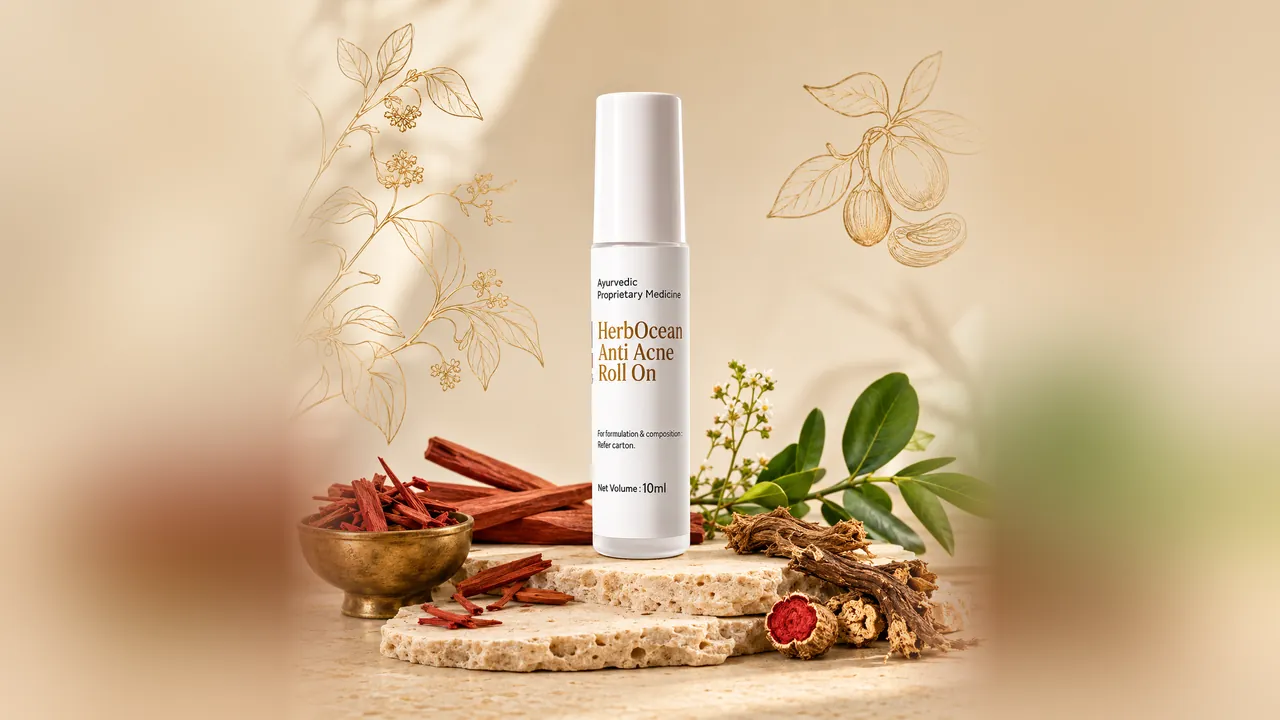
That third step is where the HerbOcean Anti-Acne Roll-On fits. It is an AYUSH-licensed Ayurvedic medicine (Licence No. DL-474 A&U), classically indicated for acne and pimples (Yuvanpidika), applied through a rollerball straight onto the active spot so your fingers never touch it. Manjistha leads the formula, Ayurveda's foremost blood-purifying (rakta shodhana) herb, with astringent Lodhra, warming Jaiphal, cooling Raktchandan (red sandalwood), and bitter Daruhaldi and Kuth. Those six herbs sit in a light base of glycerine and water, with gluconolactone and sodium benzoate to keep the preparation stable and a trace of lavender oil. There is no neem and no tea tree in it. It was formulated by Vaidya Shri Ram Prakash Ji, the master vaidya (a traditionally trained Ayurvedic physician) whose 40-year formulation legacy the HerbOcean line is built on, and made in-house at Roshni Botanicals' GMP-certified unit in Bawana, Delhi. Use it on clean, dry skin, on the spot only, and let it absorb; for external use, patch-test on the inner arm first.
And the one rule that matters most on melanin-rich skin: do not pick a hairline pimple. A 2010 review of post-inflammatory hyperpigmentation in skin of colour, by Davis and Callender in the Journal of Clinical and Aesthetic Dermatology, describes inflammation of almost any kind as the usual trigger and notes that the resulting marks are both more common and more persistent in darker skin. Squeezing a spot adds inflammation on purpose, which is why the mark so often outstays the pimple by months. For marks already settled, HerbOcean Soundarya Cream is traditionally used in the care of post-acne pigmentation.
When to See a Dermatologist
Most forehead pimples answer to the scalp-first plan, but a few patterns should skip it and see a doctor. Go to a dermatologist for painful, deep or cystic bumps rather than surface pimples; for a forehead that stays broken out despite a settled scalp and clean hairline over a couple of months; for the uniform, itchy fungal pattern described above; and for any breakout that is clearly scarring rather than marking. A dermatologist can also tell you quickly whether a stubborn forehead is acne, fungal folliculitis or a reaction to a product, which is exactly the fork in the road where guessing costs the most time. For the fuller classical framework, our complete guide to the Ayurvedic treatment of acne is the deeper read, and our monsoon acne care guide covers the humid-season version of all of this.
Fix the Scalp, and the Forehead Follows
A forehead that keeps breaking out is usually asking you to look higher. Settle the scalp, hold the oil above the hairline, keep fringes and helmets from pressing sweat into the skin, and let a measured roll-on handle the pimples that survive good hygiene rather than your fingers handling them. Keep the HerbOcean Anti-Acne Roll-On for that last step, give the marks you did not pick their quiet weeks to settle on their own, and remember the order every time the hairline flares again: scalp first, hairline clean, spot last. The forehead almost always follows the scalp; lead it well.
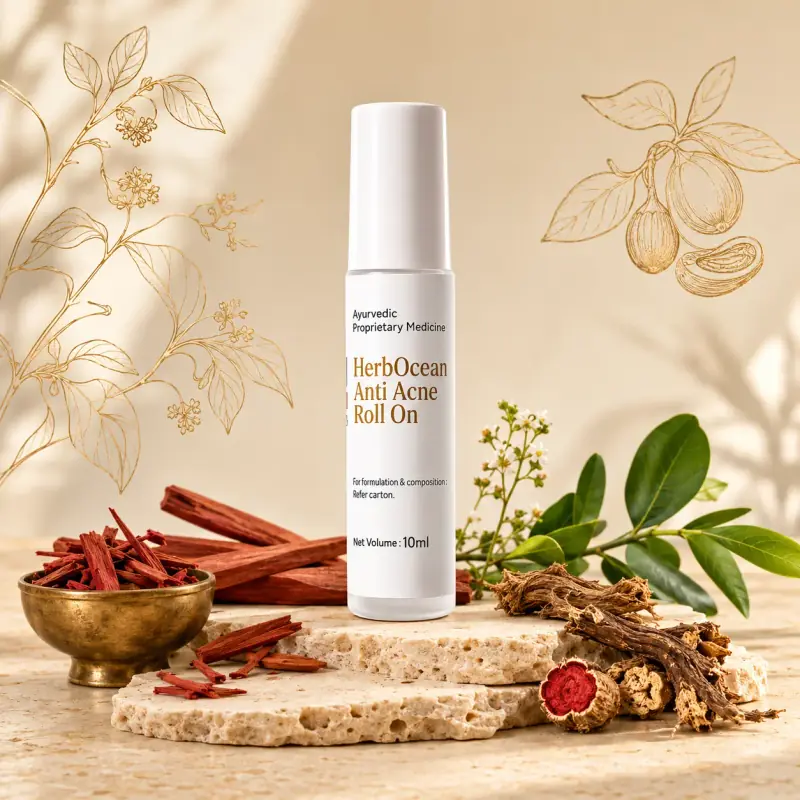
Anti-Acne Roll-On
Ayurvedic spot care for active pimples and post-acne marks (PIH) — a herbal roll-on classically indicated for acne (Yuvanpidika). Made in-house in Delhi.
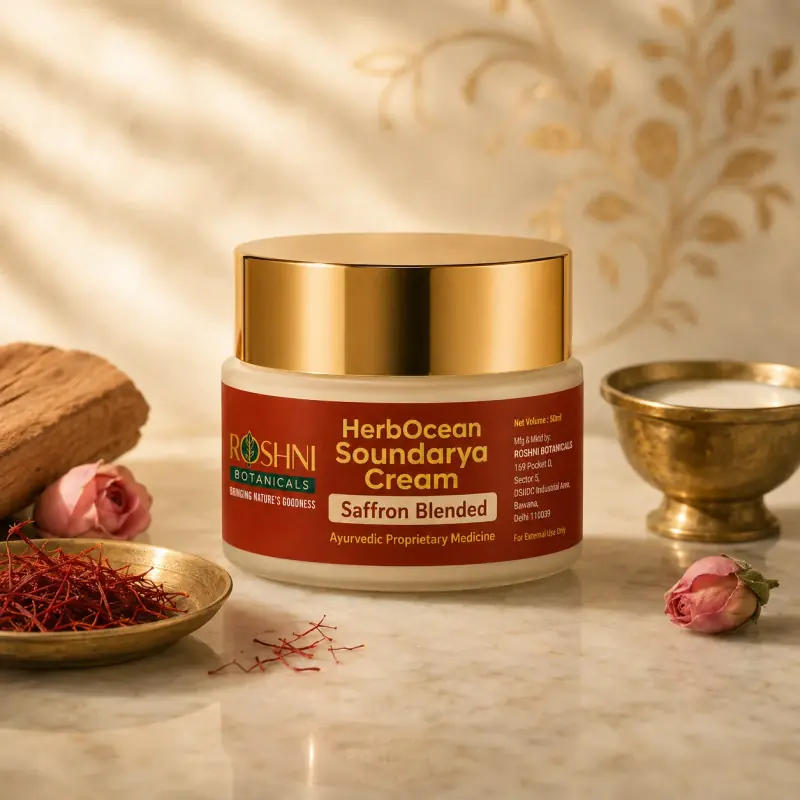
Soundarya Cream
A rich saffron brightening and repair cream with bargad (Vatt) bark on a goat-milk and coconut base, with shea and kokum butters, traditionally used in the care of skin where post-acne marks (PIH) linger.
Part of our guide: Ayurvedic treatment for acne: the complete guide.