Goat Milk Cream for Dry Skin: Why Ayurveda Reaches for It
Skin in North India often turns tight before the cold arrives. What dry air and hard water do to it, and where a goat-milk cream fits in a routine.
In North India, skin often turns tight before the weather turns cold. As the monsoon pulls back, the afternoons still feel warm, yet cheeks can feel tight an hour after a shower and the light lotion that suited the rains stops being enough. The air dries out ahead of the cold, and skin tends to notice first.
The short answer: dry, easily disturbed skin is usually more comfortable under a cream than under a thin lotion, applied to slightly damp skin, with the habits that strip the skin taken out of the routine. Here is why the classical tradition reaches for goat milk, what hard water adds to the problem, and how to put a routine together that holds through the dry months.
Key takeaways
- Goat milk (Ajadugdh) is a classical liquid base in Ayurvedic skin preparations, and in a rich cream it sits alongside coconut, shea and kokum.
- As the monsoon pulls back in North India, the air dries out while the afternoons stay warm, which is why skin can feel tight before the cold arrives.
- Where tap water is hard, as much of the groundwater in Delhi is, more of your cleanser stays on the skin after rinsing; wash in warm rather than hot water.
- Layering order matters: a few drops of facial oil on slightly damp skin first, the cream over it, and sunscreen last by day.
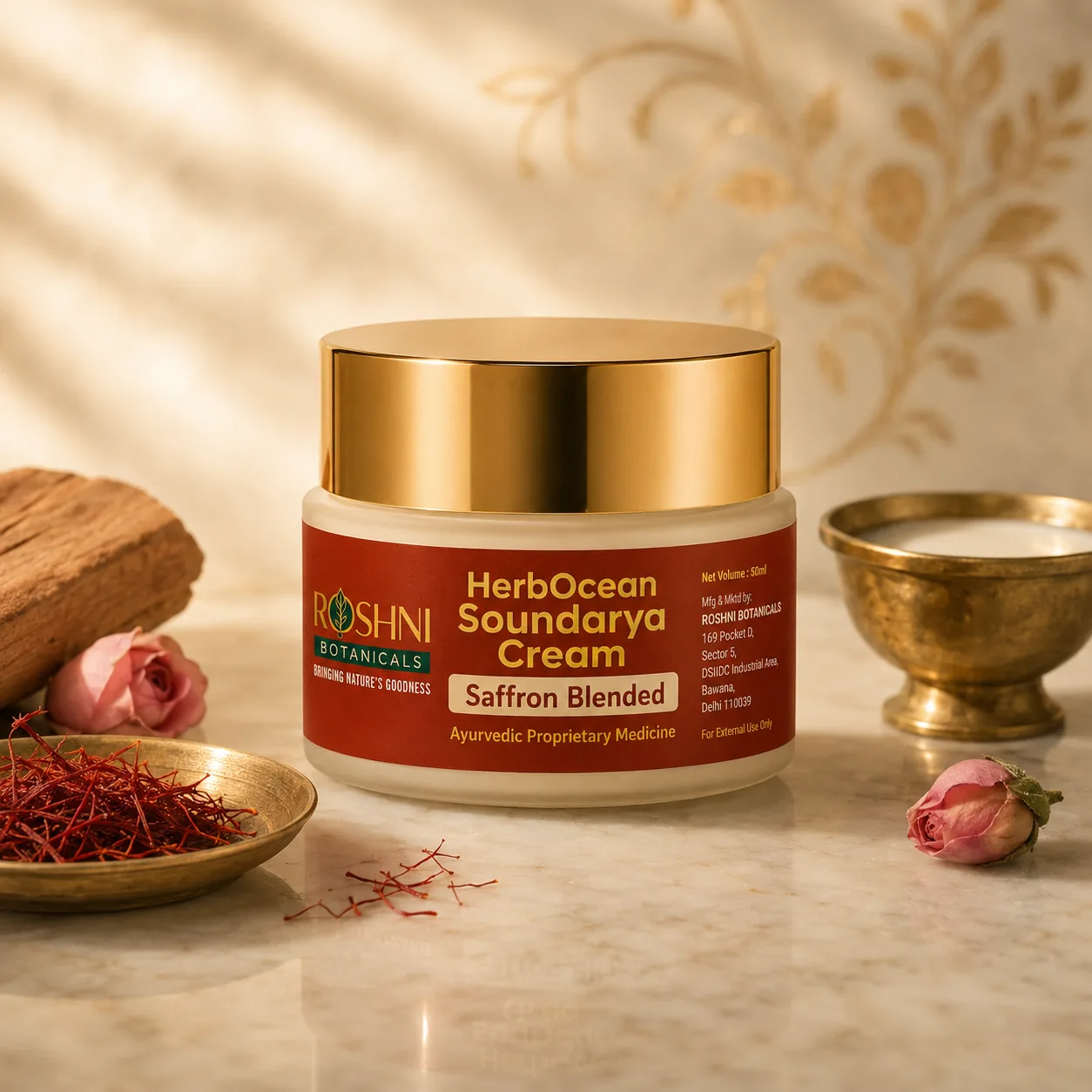
- HerbOcean Soundarya Cream is the rich saffron repair cream on a goat-milk and coconut base, with shea and kokum butters.
Why Skin Turns Dry Before the Cold Arrives
The long-term weather normals for Delhi show it plainly. In the weeks after the rains, afternoon humidity and the moisture in the air fall steeply, the nights begin to cool, and the daytime high barely changes. The real cold comes weeks later. Afternoons in the hot weeks before the rains run drier still, and through the cold months the air holds less and less moisture even when the humidity reading looks ordinary, so dry air, not only cold air, is the thing to watch through the year.
Three signals usually arrive first. Skin feels tight within an hour of washing. Makeup and sunscreen cling in patches. Fine flakes appear where the skin is driest, usually the cheeks and the sides of the chin. None of it is dramatic. All of it is the outer layer of the skin reporting a change in the air, and what it asks for is a change of texture, along with a gentler wash. An office with the air conditioning running all day counts as dry air too, whatever the weather outside is doing.
Two Readings of the Same Dryness: The Skin Barrier and Ayurveda
Plain English first. The outer layer of skin sets its cells in a mortar of fats. Dry air, harsh cleansers and very hot water all leave that barrier letting water out faster, and the surface turns tight, rough and dull. Dermatology calls this an impaired skin barrier, and it is a physical description rather than a diagnosis. It is also why a thin, water-heavy lotion so often disappoints on dry skin: much of it evaporates, and what is left is not rich enough to matter, which is why dermatology guidance favours a cream or an ointment instead.
Ayurveda reads the same picture through Vata (one of the three doshas, the biological energies in Ayurveda), whose qualities in the Charaka Samhita include dry, cold, light, mobile and rough, and it answers a quality with its opposite: the oily, unctuous quality (snigdha), with warmth and steadiness. The classical seasonal regimen (Ritucharya) sets oil massage (abhyanga) among the practices of the cold, dry months, which is the same instinct behind the winter oil-and-bath habit that many Indian households still keep. A shorter companion piece on winter skincare for Vata dryness takes the winter view of the same dryness.
Two frames, one instruction: wash more gently, and wear something richer.
Why Ayurveda Reaches for Goat Milk
Goat milk has a place in the classical texts first as a food and an internal medicine: the Charaka Samhita lists it among the milks and sets out its qualities for use by mouth. On the skin, its classical home is as a liquid medium. In the goat-milk Kshira-paka method (the classical milk-and-oil method, in which herbs are simmered with milk in the oil until the water evaporates and only the medicated oil remains), goat milk is the liquid the herbs are cooked in, and the classical oil-making chapter names milk among the liquids a medicated oil may be processed with. Our guide to how a classical goat-milk face oil is actually made sets out the full sequence.
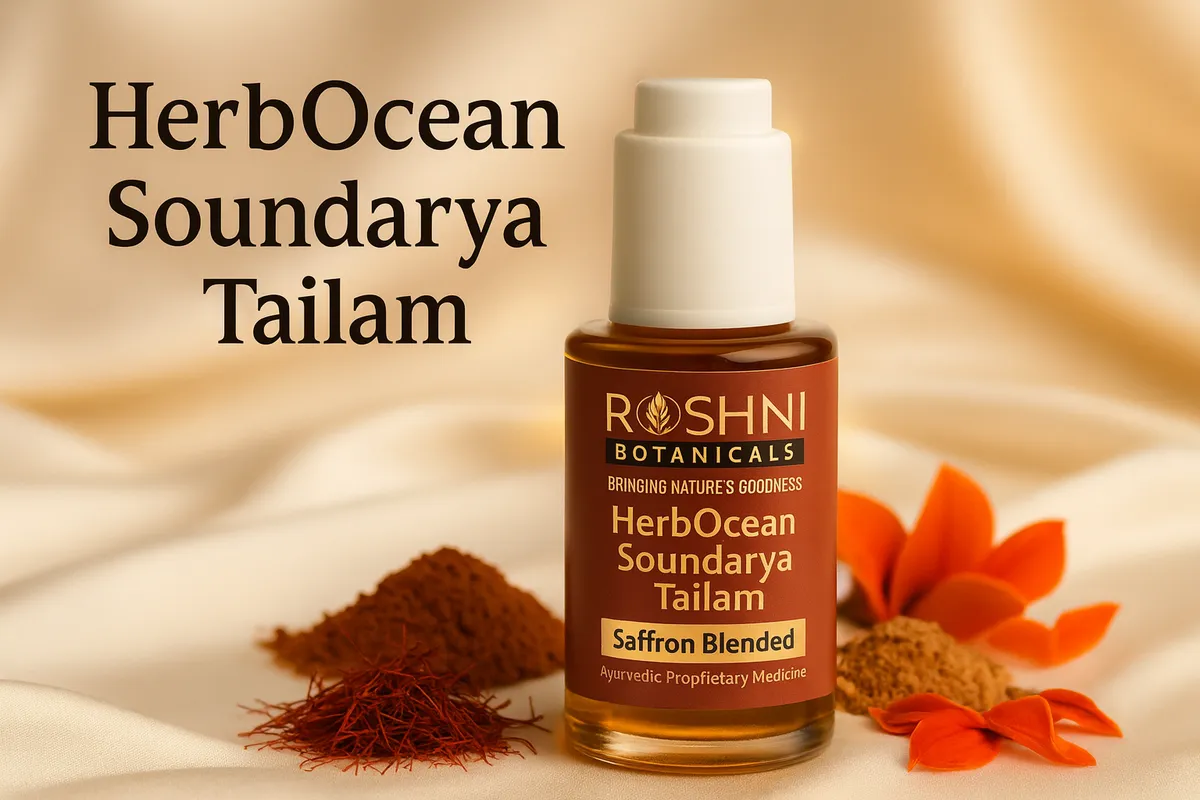
HerbOcean Soundarya Tailam, a saffron Taila (medicated oil), is prepared that way, with goat milk as its largest single ingredient. HerbOcean Soundarya Cream is its own preparation, and it follows the other classical logic: a rich, fatty base for skin that is dry and depleted. Goat milk carries its own fats and proteins, and in the cream it sits alongside coconut, shea butter and kokum butter, which is where the richness comes from. The two are different preparations, and neither is a stronger version of the other.
Hard Water, Hot Water and Dry Skin
If your tap water is hard, as much of the groundwater in Delhi is, it matters mainly through what it does to your cleanser: hard water makes a cleanser harder to rinse away, so more of it stays on the skin after washing. In a British washing study of eighty people, skin washed in hard water held on to more cleanser, lost more water and was more easily irritated than skin washed in softened water, most clearly where the barrier was already fragile. Chalky scale on taps and kettles is the everyday sign that your supply runs hard.
Very hot water adds to it. In a small Spanish study in which volunteers held their hands in hot or cold water, hot water raised the water lost through the skin more than cold water did, which is why warm rather than hot is the better habit, in the shower as much as at the basin.
The corrections are ordinary. Move to a milder cleanser and use less of it, since the cleanser is the step that runs every day and the one to change first. Keep baths and showers short, in warm rather than hot water. Pat dry with a soft towel and apply the cream while the skin is still slightly damp. For hair, and for a two-minute home test that tells you whether your tap water is hard, see what hard water does to your scalp.
Choosing a Cream for Dry Skin, and Where Oil Fits
The rule of thumb is short. Dermatology guidance favours a cream or an ointment over a thin lotion for dry skin, applied while the skin is still slightly damp. Moderately dry skin is usually comfortable with cream alone by day. Very dry skin can take a few drops of a facial Taila at night, under the cream. Our Tailams are light, herb-infused oils, so they go into slightly damp skin first and the cream seals them. Give each layer a minute to settle. At night the order is the same without the sunscreen. A small amount goes further than it looks, and a second thin layer on the driest patches does more than one thick one.
By day, sunscreen goes on last, in every season. HerbOcean does not manufacture a sunscreen, and nothing in the range replaces one.
Combination skin usually needs the richer routine only on the cheeks and around the mouth, with the T-zone left as it was. Our guide to face oil or face cream, and how to layer them sets out the order in full, including what to do with a heavier plain oil, which sits differently from a light herb-infused one.
Where HerbOcean Soundarya Cream Fits
HerbOcean Soundarya Cream is an AYUSH-licensed Ayurvedic medicine for external use, traditionally used to support soft, nourished skin, and it helps maintain comfort in dry, depleted skin. It is a rich saffron repair cream with bargad (Vatt) bark on a goat-milk and coconut base, with shea and kokum butters, and vitamin E to round it off. Very oily or acne-prone skin may find it rich. Warm a small amount and press into clean skin, morning or night.
It is made in-house at our GMP-certified unit in Bawana, Delhi, under AYUSH Licence No. DL-474 A&U, and built on the 40-year Ayurvedic formulation legacy of Vaidya Shri Ram Prakash Ji. The classical background to saffron (Kesar) on skin is set out in our guide to saffron for skin.
Patch Testing, a Fair Trial and When to See a Dermatologist
Change one thing at a time, so that any response has an obvious cause. Start with the wash: a milder cleanser and warm rather than hot water. Then bring in the richer cream on slightly damp skin. Add a facial Taila at night only if the skin still feels tight with the cream alone. Give any new routine several weeks of steady use before you judge it, and judge it on comfort: how the skin feels an hour after washing is a better marker than how it looks in the mirror at night. Keep a note of what changed and when, because a routine judged on a single bad morning is judged too early.
For external use. Patch-test on the inner forearm 24 hours before first use and discontinue if irritation occurs; avoid the eye area. Avoid if allergic to coconut, goat milk or a listed botanical. If pregnant or breastfeeding, check with your doctor. If your skin reacts easily, the guide to Ayurveda for sensitive skin sets out a longer forearm test.
See a dermatologist if the skin cracks or bleeds, if patches weep or crust, or if the itch is intense and follows an eczema pattern in the creases of the elbows and knees, on the hands or around the eyes. Scaly flaking in the folds beside the nose and in the eyebrows, especially alongside dandruff, is a different pattern, a common rash of oily areas (seborrhoeic dermatitis), and it belongs with a dermatologist. If dryness continues after these steps, that deserves an opinion too, and sudden, widespread dryness that arrives with tiredness or changes in your hair is worth raising with your doctor, who can check for a medical cause.
Start Early, While the Skin Still Feels Comfortable
Timing matters. Change the routine as the air starts to dry after the rains, while the skin still feels comfortable. Wait for the first cold morning and you begin when it is already flaking. If the cold has already arrived, the same steps apply, starting with the wash.
HerbOcean Soundarya Cream suits dry skin and anyone who wants a richer leave-on cream by day or night. Still deciding between jars? Our comparison of Soundarya Cream or Radiance Cream, chosen by concern is the next read.
References: Charaka Samhita, Sutrasthana 1 (Deerghanjiviteeya), on the qualities of Vata, dryness among them, and their pacification by substances of the opposite quality. Charaka Samhita, Sutrasthana 6 (Tasyashiteeya), on oil massage (abhyanga) among the practices of the cold, dry months. Charaka Samhita, Sutrasthana 27 (Annapanavidhi), on the kinds of milk, goat milk among them, described there for use by mouth. Sharngadhara Samhita, Madhyama Khanda 9 (Sneha Kalpana), on the classical preparation of medicated oils, including those processed with milk as the liquid medium. Elias PM. Epidermal lipids, barrier function, and desquamation. Journal of Investigative Dermatology. 1983;80 Suppl:44s-49s (review setting out the two-compartment model of the outer skin layer, cells set in intercellular lipids; non-Indian). Engebretsen KA, Johansen JD, Kezic S and colleagues. The effect of environmental humidity and temperature on skin barrier function and dermatitis. Journal of the European Academy of Dermatology and Venereology. 2016;30(2):223-249 (review; low humidity and low temperature lower skin barrier function; non-Indian). Danby SG, Brown K, Wigley AM and colleagues. The effect of water hardness on surfactant deposition after washing and subsequent skin irritation in atopic dermatitis patients and healthy control subjects. Journal of Investigative Dermatology. 2018;138(1):68-77 (controlled forearm washing study, 80 participants, healthy volunteers and atopic dermatitis patients, United Kingdom; skin washed in hard water retained more cleanser, lost more water and was more easily irritated; funded by a water-softener manufacturer; non-Indian). Herrero-Fernandez M, Montero-Vilchez T, Diaz-Calvillo P and colleagues. Impact of water exposure and temperature changes on skin barrier function. Journal of Clinical Medicine. 2022;11(2):298 (prospective observational study in which 50 healthy volunteers held their hands in hot or cold water, Spain; hot water raised water loss through the skin more than cold water; non-Indian). American Academy of Dermatology, patient guidance on relieving dry skin (a cream or ointment over a lotion, applied to damp skin; short baths and showers in warm water) and on seborrhoeic dermatitis (the sides of the nose and the eyebrows among its usual sites). India Meteorological Department, Climatological tables of observatories in India 1991 to 2020, New Delhi (Safdarjung): monthly normals in which afternoon humidity falls steeply after the monsoon while the daytime maximum barely changes, and afternoon humidity is lowest in the hot weeks before the rains. Educational, not medical advice.
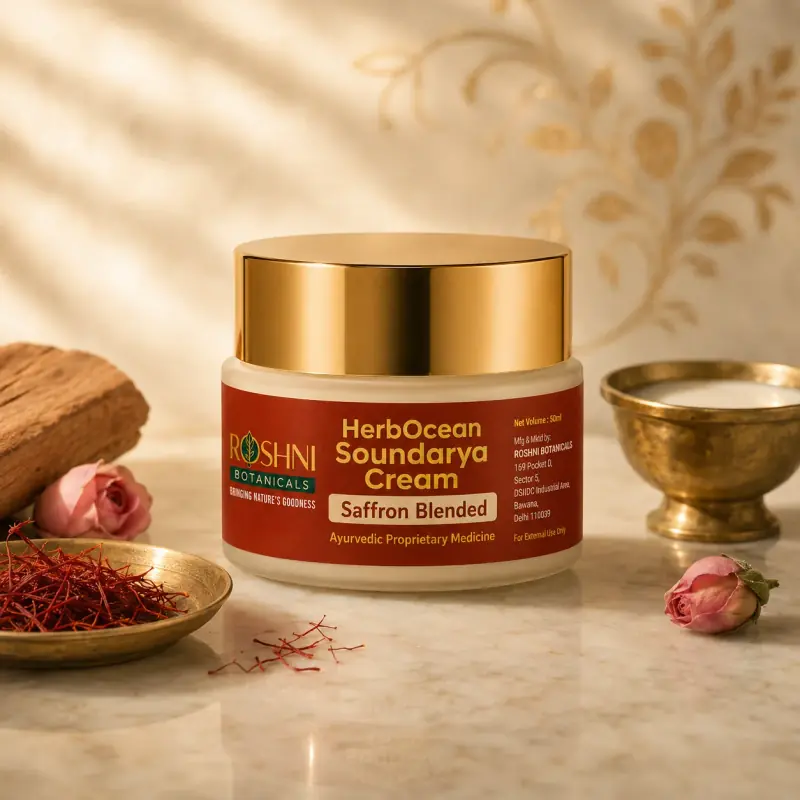
Soundarya Cream
A rich saffron brightening and repair cream with bargad (Vatt) bark on a goat-milk and coconut base, with shea and kokum butters, traditionally used in the care of skin where post-acne marks (PIH) linger.
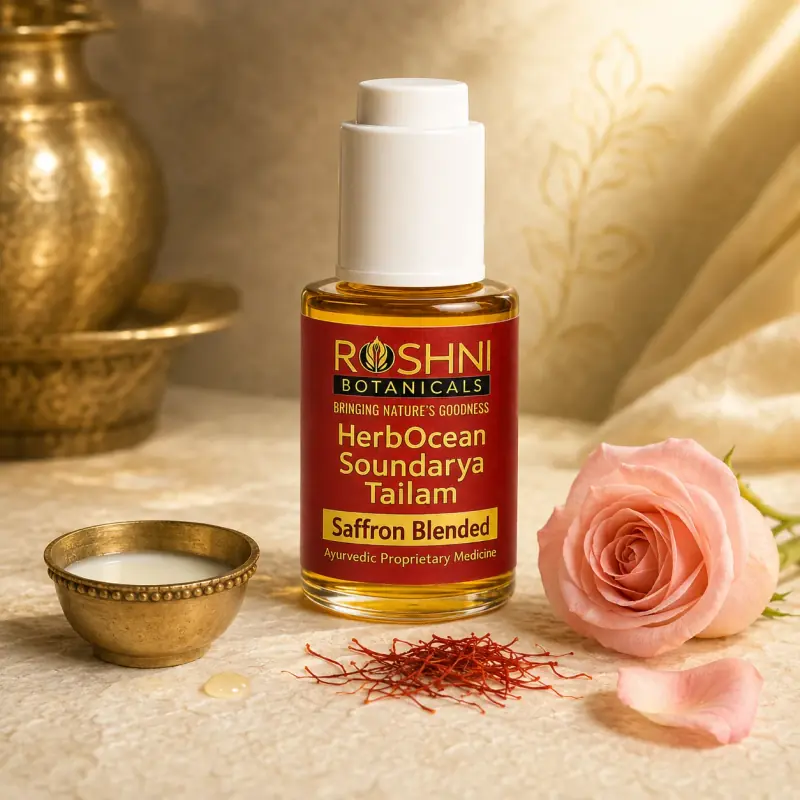
Soundarya Tailam
A saffron-infused facial Taila prepared in the goat-milk Kshira-paka tradition, with Manjistha, Mulethi and Kesar. For soft, bright, even skin.