Herbal Anti Ageing Cream India: What Ayurveda Really Recommends for Ageing Skin
Choosing a herbal anti-ageing cream in India is really one question: what is in the jar? What classical Ayurveda actually recommends for ageing skin.
At a glance
- Ayurveda attributes skin ageing to Vata dominance and Dhatu Kshaya (the gradual depletion of deeper skin tissues), not just surface dryness.
- Indian skin carries a compounded ageing load: intense year-round UV, urban PM2.5 pollution, hard water and seasonal extremes all accelerate the visible signs.
- A genuinely herbal anti-ageing cream in India should carry an AYUSH licence, a verifiable INCI list and no harmful synthetics.
- The Varnya (complexion-supporting) and Rasayana (rejuvenative) herb traditions are the authentic framework behind any honest natural anti-ageing formula.
- Deep-acting Ayurvedic care builds gradually: four to six weeks of consistent use is the minimum meaningful trial.
You notice it first after a long Delhi summer. A sharpness around the eyes that wasn’t there the year before. A dryness at the corners of your lips that no amount of water quite fixes. You reach for the nearest “anti-ageing” cream at the pharmacy, flip it over, and find a wall of preservatives you cannot pronounce.
If that sounds familiar, you have already started asking the right question: what is the cream actually made of?
Ayurveda calls this stage of skin Jara — not a failure, but a natural shift in the body’s constitution. As we age, Vata dosha (the body’s air-and-space energy) tends to rise: skin gets drier, thinner, less elastic. The knowledge of what to do about it is thousands of years old. What is not old is the habit of printing “herbal” on a jar and hoping no one turns it over.
Why skin ages faster in the Indian environment
India is not a gentle climate for unprotected skin. The UV Index sits above 10 across much of the country for at least six months of the year, and that year-round sun quietly disrupts Bhrajaka Pitta, the Pitta sub-dosha that governs the skin’s ability to absorb nourishment, regulate temperature and hold its natural lustre. When Bhrajaka Pitta is chronically overworked, skin stops looking well-rested long before the years would otherwise demand it.
Then there is the air. Delhi’s PM2.5 levels routinely exceed what the WHO considers safe, and fine-particle pollution accelerates oxidative stress in skin cells, weathering the skin from the outside in. On top of that, the mineral-heavy hard water in most Indian households strips the skin’s acid mantle with every wash. Three simultaneous pressures a cream formulated in Paris or Seoul was simply not built for.
The traditional Indian diet used to compensate. Ghee, sesame, turmeric and fermented foods supported the body’s anti-inflammatory baseline in ways modern eating increasingly does not. Lose that internal buffer over years, layer it over daily UV, pollution and hard water, and what Ayurveda calls Dhatu Kshaya sets in: a gradual depletion of the body’s deeper tissues. In the skin it shows as Vali (fine lines) and Palita Twak, skin that has simply been under-nourished for too long. Surface moisturisers reach the surface; they were never designed to reach here.
What makes an anti-ageing cream truly herbal?
“Herbal” has become one of India’s most abused words on a label. Walk down any pharmacy aisle and you will find products claiming to be natural and Ayurvedic whose actual plant content is one extract buried beneath synthetic emulsifiers, a petroleum derivative or two, and a long list of parabens. The word is doing marketing work, not formulation work.
A genuinely herbal cream has an AYUSH licence number on the label — verifiable, not decorative — and a full INCI (International Nomenclature of Cosmetic Ingredients) list that names every ingredient without placeholders like “herbal extract.” It is free of parabens, mineral oil, SLS and synthetic fragrance.
Beyond the label, look at the tradition the formula draws from. Ayurveda identifies two classical categories of skin-supportive herbs. Varnya herbs are associated with healthy complexion and lustre: Kumkuma (saffron, Crocus sativus), Yashtimadhu (liquorice), Chandana (sandalwood) and Manjistha (Rubia cordifolia) are among the most cited, valued for their effect on Kanti (lustre) and the skin’s own natural complexion. Rasayana herbs work deeper, nourishing the tissues from within.
A herbal anti-ageing cream worth the name draws from these traditions deliberately, not by adding a drop of extract to a synthetic base and printing “Ayurvedic” on the front.
The Ayurvedic anti-ageing philosophy: Rasayana, explained
The vaidya’s approach to ageing skin was never really about what you apply to it. That is where most modern readings of Ayurveda go wrong.
Rasayana, the branch of Ayurveda devoted to rejuvenation, is concerned with the quality of dhatu (the body’s foundational tissues) over time. Not reversing age. Not erasing lines. Maintaining the vitality of what is already there, so the skin does not age ahead of its natural pace. The word breaks down to rasa (essence, nourishment) and ayana (path): the path of nourishment. That is a different, older and more honest aspiration than “anti-ageing.”
A classical vaidya thinks about three things at once. Ahara, what you eat, and whether it genuinely nourishes Vata-prone skin from within. Vihara, how you live, including sleep, sun exposure and the stress the nervous system carries. And Lepa, what you apply, a topical that works with the skin’s tissues rather than coating them. The cream is one-third of the picture; it works differently when the other two-thirds are also attended to.
What makes a Rasayana-aligned formula different from a moisturiser is depth: it is built to reach the dhatu, not just the surface. Forty years of that formulation knowledge sit behind the HerbOcean line, developed by Vaidya Shri Ram Prakash Ji and manufactured in-house.
HerbOcean Soundarya Cream: an honest look
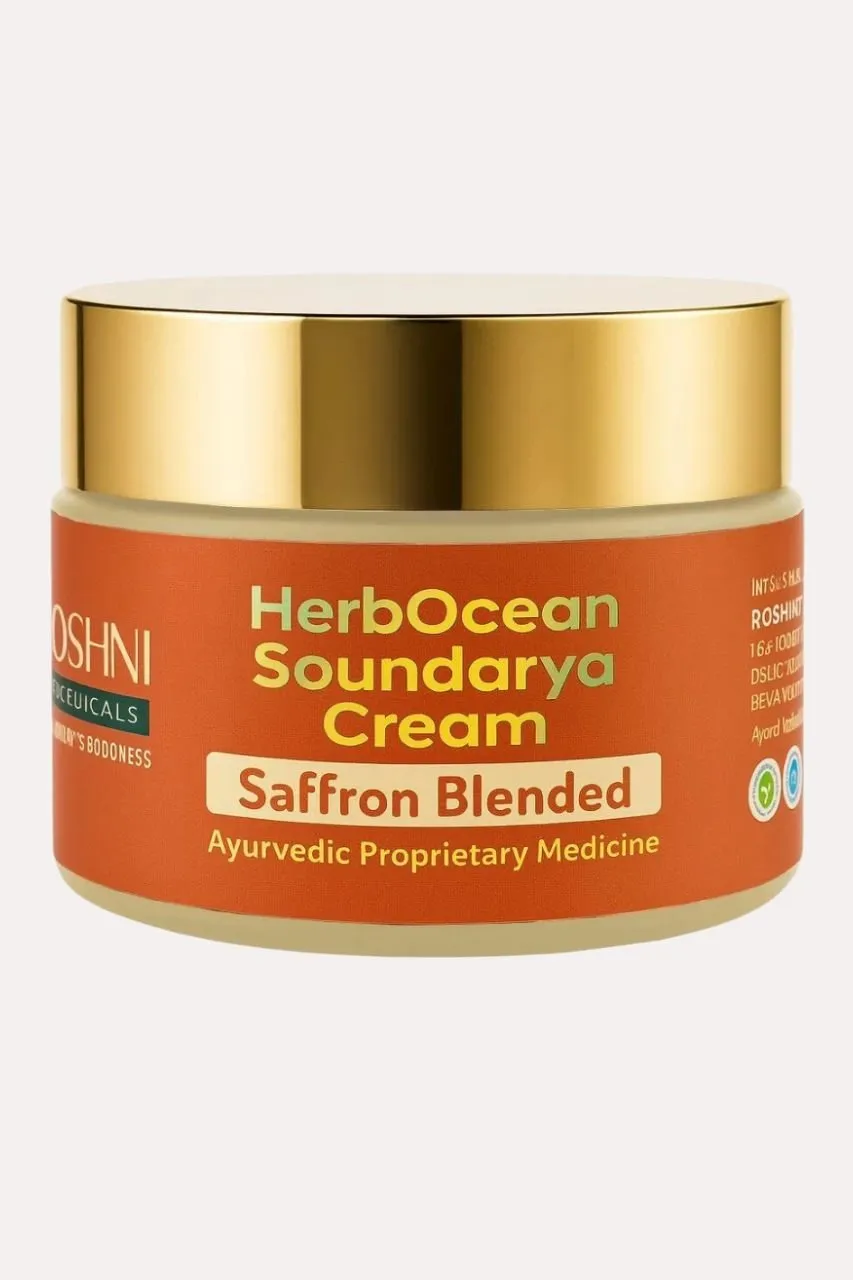
For anyone wanting a daily herbal anti-ageing cream in India that is genuinely usable, not a luxury ritual kept for special occasions, Soundarya Cream is the natural starting point from the Roshni Botanicals range. Seven ingredients, each chosen with classical reasoning.
Kesar (saffron, Crocus sativus) leads, which surprises no one who grew up watching a grandmother stir kesar into warm milk before a wedding. Saffron is documented in the Bhavaprakasha Nighantu among the pre-eminent Varnya herbs, associated with Kanti (lustre) and Prabha (radiance); its antioxidant compounds help skin cope with the UV and pollution most aggressively ageing Indian city skin. Our saffron and anti-ageing guide goes deeper.
Ajadugdh (goat milk) is the medium that carries the herbal actives into the skin. Classical Ayurveda uses goat milk as the basis for Kshira-paka preparations because its fatty acids sit close to the skin’s own lipid profile, traditionally regarded as well-suited to the dry, thinning skin that Vata dominance brings.
Manjistha (Rubia cordifolia) sits in the same classical lists as saffron for supporting a clear, even complexion and healthy Bhrajaka Pitta. It does not lighten or bleach; it supports the skin’s own natural tone and lustre, which is the more accurate and honest claim.
Raktchandan (red sandalwood, Pterocarpus santalinus) is not the fragrant white chandan. Traditionally cooling and complexion-supporting, its presence reflects a classical principle: pair warming Varnya herbs with a cooling one to regulate Bhrajaka Pitta rather than simply push it. Shea and kokum butters form the base, kokum light enough for Indian seasons and shea for the deeper nourishment maturing skin rarely gets, and Vitamin E supports the barrier alongside saffron’s antioxidants.
The whole formula is made at the Bawana, Delhi facility under AYUSH Licence DL-474 A&U, an AYUSH-classified Ayurvedic medicine rather than a cosmetic with Ayurvedic branding, free of parabens, synthetic fragrance and mineral oil. No exaggerated promises: Soundarya Cream is traditionally associated with supporting Kanti and radiance over consistent use. It does not claim to erase wrinkles, because no honest Ayurvedic product does. What it offers is a genuinely classical foundation, honestly priced for daily use.
How to use your herbal anti-ageing cream correctly
The most common mistake with Ayurvedic skincare is impatience. These formulations are not quick-acting; they work at the dhatu level, and that takes time.
In the morning: cleanse, pat dry, and smooth a small amount of Soundarya Cream in slow upward strokes from the neck to the forehead. Then, before stepping out, apply SPF. This is not optional in the Indian climate: no cream substitutes for sun protection, and unprotected UV will undo much of what the cream is doing.
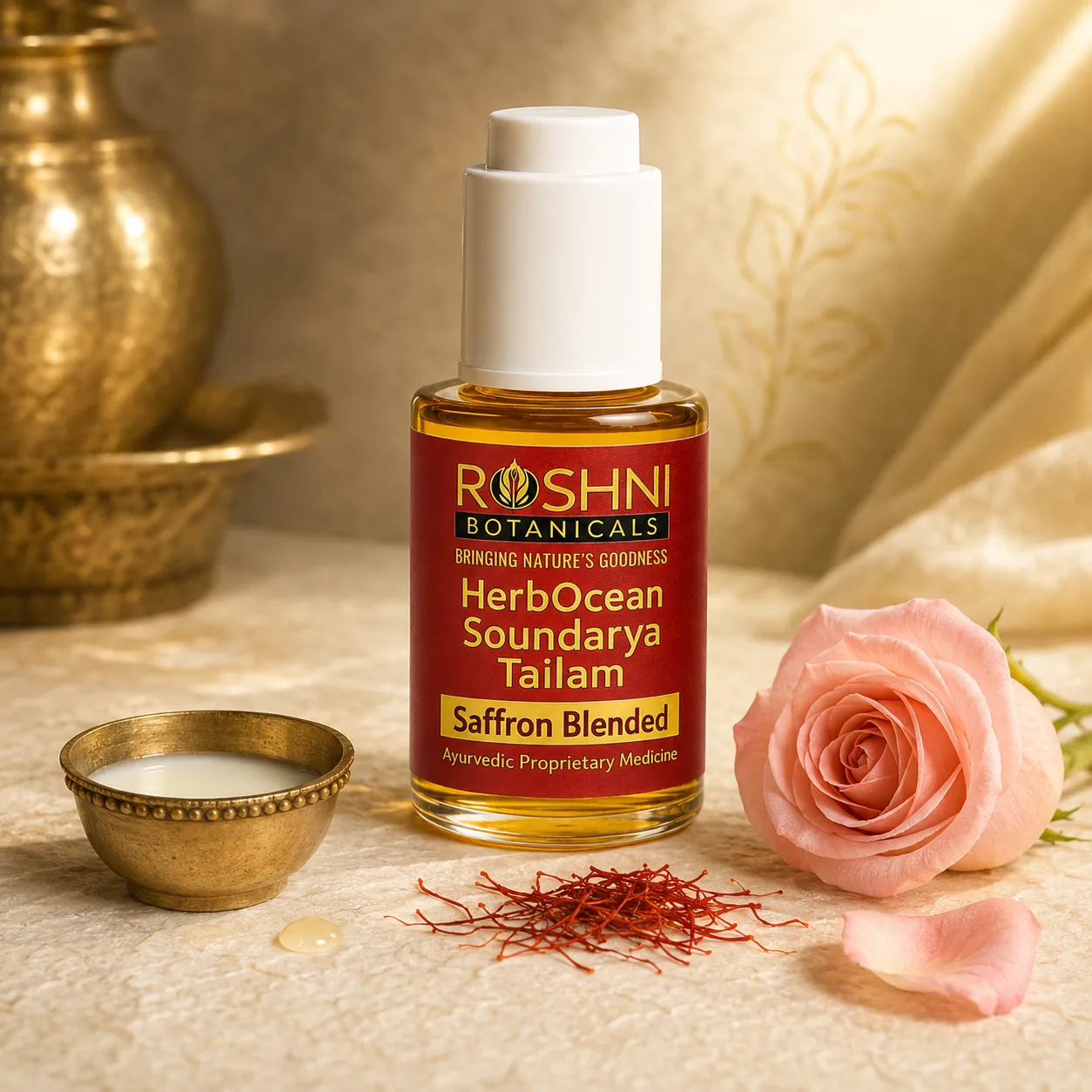
At night, skin is in repair mode. If your skin runs dry, or once Delhi winter sets in, work the HerbOcean Soundarya Tailam into the evening before the cream, a few minutes of Mukha Abhyanga (gentle facial oil massage) in the saffron tradition. Cream over oil, not oil over cream.
If you are new to Ayurvedic formulations, patch-test on the inner forearm for 24 hours first, and give the routine a proper window: at least four to six weeks of consistent twice-daily use before forming a view. And one caveat worth saying plainly: if you notice sudden or unusual changes in skin texture, reactions out of proportion to a new product, or signs of ageing that feel rapid or asymmetric, see a dermatologist. A blog post is not clinical advice.
What to look for before buying a herbal anti-ageing cream in India
Before your next purchase, turn the jar over and check five things:
- AYUSH licence number, printed and verifiable. Not implied by the brand name. An actual number.
- A full INCI list, every ingredient named. “Herbal extract” without naming the herb is a gap, not an ingredient list.
- No parabens, mineral oil, SLS or synthetic fragrance. Their presence does not necessarily make a cream harmful, but it does make the “herbal” claim a stretch.
- In-house manufacturing. Brands that make their own products control the formula batch to batch.
- Claims that fit the law: “traditionally associated with lustre” or “supports radiant skin” rather than “removes wrinkles.” That restraint is a signal of honesty, not of a weaker product.
Roshni Botanicals publishes its AYUSH Licence (DL-474 A&U) openly. It is a small thing, and also the baseline every honest herbal anti-ageing cream in India should be able to meet.
A note on ageing honestly
There is a gentler framing than the usual language of fighting ageing or reversing time. The Rasayana tradition is not interested in reversal. It is interested in nourishment: keeping the dhatu healthy enough that the signs of time arrive on their own terms, not ten years early because the skin has been depleted and over-exposed since thirty.
A cream that is honest about this is worth more than one that promises otherwise. Look for the AYUSH number, read the INCI list, and give the routine the months it deserves. If you want the bigger picture, food, lifestyle and skincare together, our piece on ageing gracefully with Ayurveda is a good place to read next, and you can explore the full Ayurvedic skincare range to build a routine.
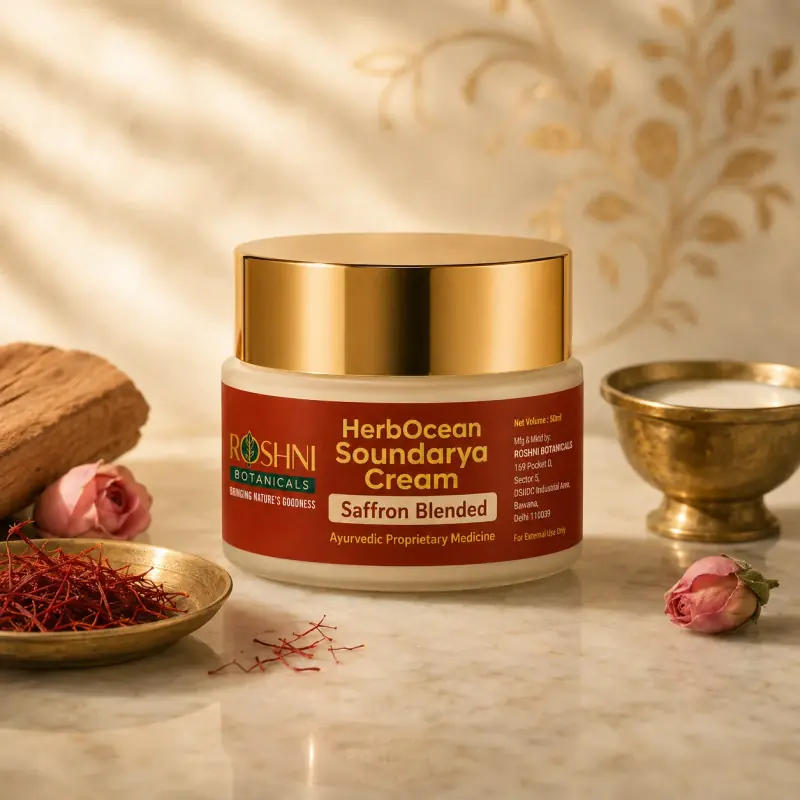
Soundarya Cream
A rich saffron brightening and repair cream with bargad (Vatt) bark on a goat-milk and coconut base, with shea and kokum butters — often reached for where post-acne marks (PIH) linger.
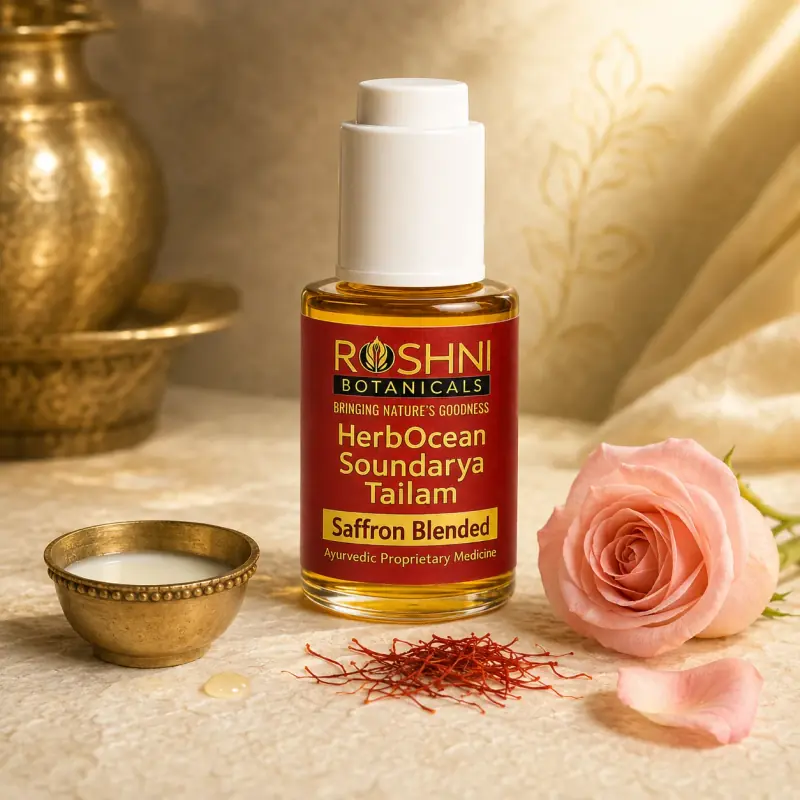
Soundarya Tailam
A saffron-infused facial Taila prepared in the goat-milk Kshira-paka tradition, with Manjistha, Mulethi and Kesar. For soft, bright, even skin.