Glass Skin, the Ayurvedic Way: An Honest Routine for Indian Skin
Glass skin is a layered-hydration ritual, and the layering is worth keeping. But translucency is a low-melanin outcome, and the exfoliation step most guides push is the fastest route to dark marks on Indian skin.
Every few months a new skin ideal crosses over from Seoul to your feed, and glass skin has stayed longer than most. The look itself is real: skin so hydrated and even that it catches light like glass. But before you chase porcelain translucency, it is worth asking what that particular goal means for melanin-rich Indian skin, and what your own tradition has always said about glow.
The short version
- A glass skin routine is really a layered-hydration ritual. The light-reflecting quality comes from a well-hydrated, smooth, even surface, not from any single product.
- Translucency is a low-melanin outcome. On Fitzpatrick IV and V skin, which covers most of India, the honest and achievable goal is evenness and luminosity, not see-through pallor.
- Skip the aggressive exfoliation that most glass-skin guides put at step two. In melanin-rich skin, irritation is the fastest route to post-inflammatory hyperpigmentation (PIH), which means over-exfoliating to look glassy can leave you patchier than you started.
- Classical Ayurveda has pursued this exact outcome for centuries under different names: Prabha (natural radiance) and Kanti (lustre of complexion), governed by Bhrajaka Pitta, the sub-dosha of Pitta (one of the three doshas, the biological energies of Ayurveda) seated in the skin.
- In a study of 1,204 women across Chennai, Mumbai, Kolkata and Delhi, hyperpigmented spots were frequent and appeared early, with more than 70 per cent of the women over thirty showing more than ten of them (Hourblin and colleagues, Indian Journal of Dermatology, Venereology and Leprology, 2014).
What Glass Skin Actually Means, and What It Does Not
Strip away the filters and the mechanism is unglamorous. Light bounces evenly off a surface that is smooth, well-hydrated and uninterrupted. Plump the skin with water it can hold, keep the texture even, and it reflects rather than scatters. That is the whole trick, and the K-beauty routines that popularised it deserve genuine credit for making layered hydration a mainstream habit. Nobody needs to sneer at a category that taught a generation to moisturise properly.
The hydration part is not the problem. The finish line is. Porcelain translucency, the specific quality in the reference photographs, is substantially a function of low melanin density. No amount of hydration unlocks it for Indian skin, because it was never a hydration achievement to begin with. Chasing it sets a target that melanin-rich skin structurally cannot hit, and in practice that chase slides quickly into fairness-seeking, something this brand wants no part of and Indian advertising rules restrict for good reason. Your Chhaya, your own natural complexion, was never the obstacle.
Then there is the step nobody flags. Almost every glass-skin guide places exfoliation second, on the reasoning that removing dead cells creates a smoother, more reflective surface. That reasoning is sound on skin that does not pigment readily. On Fitzpatrick IV and V skin it is a live risk, because melanocytes in melanin-rich skin respond to inflammation by depositing pigment. Scrub, acid-tone and peel your way toward glassiness and the likely result is PIH: flat brown marks that outlast whatever you were treating. If you already have marks left over from breakouts, our guide to the Ayurvedic treatment of acne covers why those marks behave the way they do. So keep the layering and drop the sanding.
The Indian Equivalent: Lit-From-Within Evenness
Here is the plain answer for anyone searching glass skin kaise paye: deeply hydrated, smooth, even-toned skin that reflects light is entirely achievable on Indian skin, and a consistent layered-hydration routine will do most of the work within four to six weeks. Judge it by evenness, not translucency.
Which is, almost word for word, what the classical texts were already after. Ayurveda treats radiance as Prabha and Kanti, qualities seated in Bhrajaka Pitta, the sub-dosha that governs skin colour, lustre and absorption. The logic is worth following, because it explains the routine that comes later. When Bhrajaka Pitta runs hot, whether through sun, heat, irritation or inflammation, the classical texts expect the skin to show it as dullness, uneven colour and dark patches. So the classical answer is consistently a calm, hydrating, non-irritating one, which is exactly why the aggressive-exfoliation route sits against the tradition as well as against the dermatology. The classical goal was never lightness. It was an even, unclouded complexion that looked lit from within, which is really just glass skin, described centuries before anyone coined the phrase.
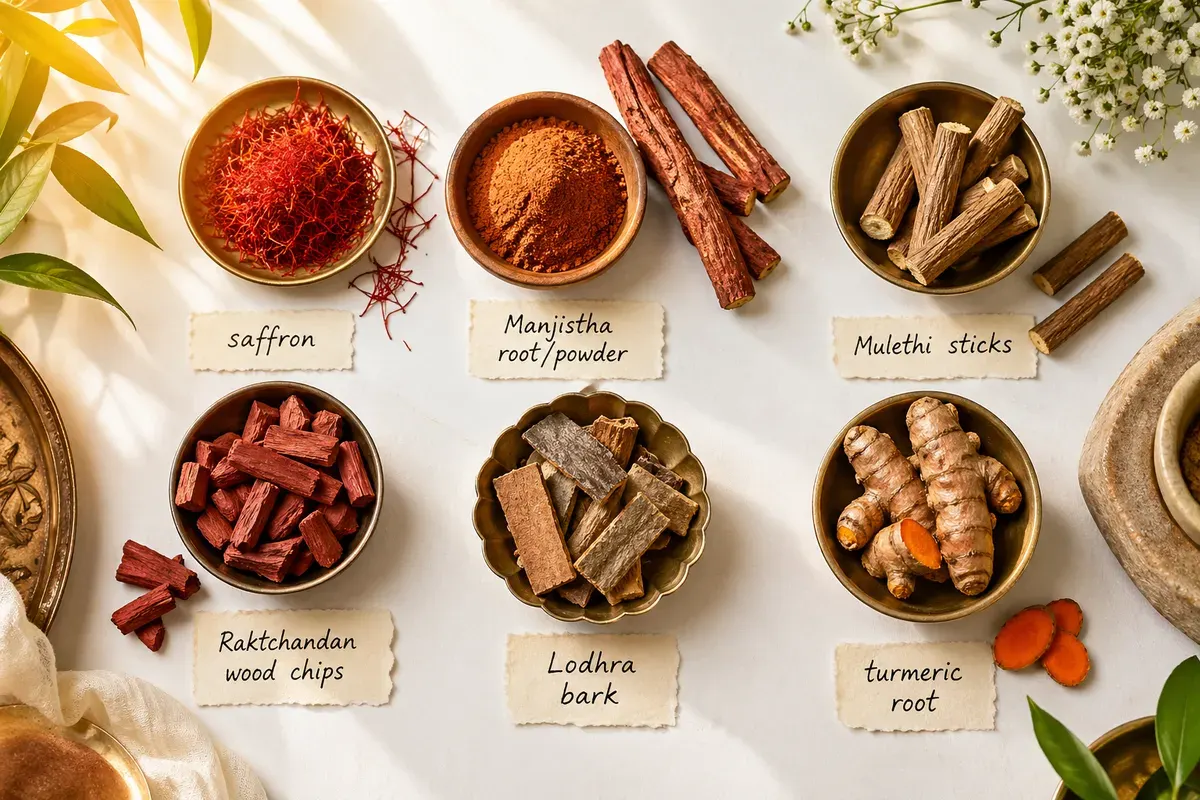
The tradition is specific about ingredients, too. The Charaka Samhita devotes a whole class of herbs to complexion: the Varnya Mahakashaya, a group of ten complexion-supporting herbs set out in Sutrasthana 4, among them Chandana (sandalwood), Padmaka, Ushira, Manjishtha and Sariva. Varnya means complexion-supporting, and it is a formal category in the text rather than a marketing adjective.
And you have almost certainly practised a version of it already. Ubtan, the besan-and-haldi paste, and the milk-and-malai routines your grandmother would not be argued out of, were tone-evenness and hydration practices layered onto damp skin long before anyone counted the steps. These do not need introducing to you as ancient wisdom. They just need recognising for what they already were: the same idea, arrived at first.
A Layered-Hydration Routine for Indian Skin, Monsoon-Smart
The order is what makes it work. Cleanse gently, once at night. Hard water across much of urban India already leaves mineral deposits that stress the barrier, so a harsh cleanser on top of hard water is two insults, not one. If you wear sunscreen and makeup, an oil-based first cleanse is reasonable; the second cleanse should be mild. Then hydrate on damp skin. This is the step that actually produces the look: apply your lightest watery layer while the face is still damp, let it settle for thirty seconds, then add the next. Two or three light layers beat one heavy one. Then seal it. A moisturiser as the final layer stops the water you just added from leaving; without this step the layering evaporates and you are back where you started. In the morning, finish with sunscreen. For pigmentation this is not optional. Every bit of work you put into evenness is undone by unprotected daylight, and India gets a great deal of it year-round.
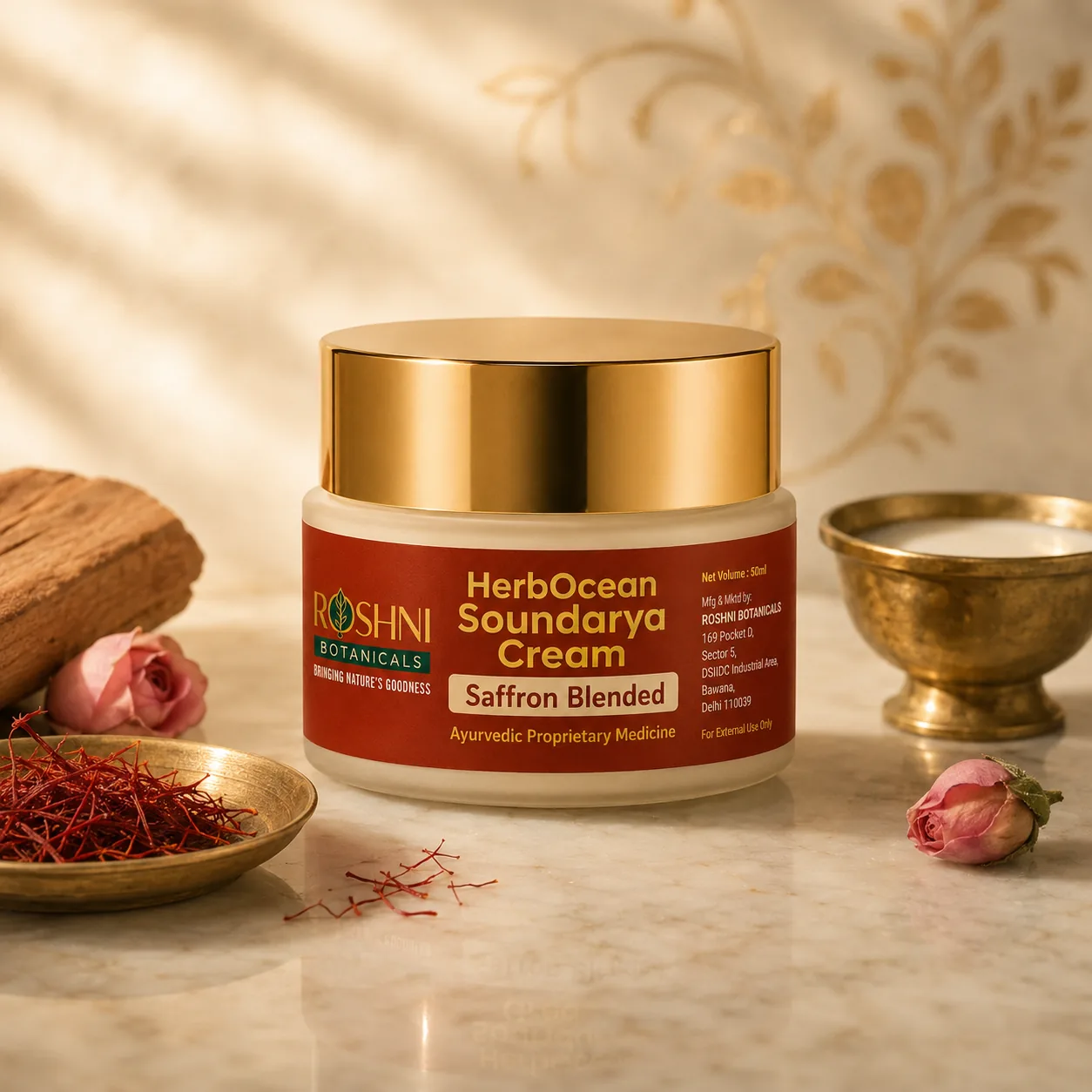
HerbOcean Soundarya Cream is built to be that sealing layer. It is a saffron-led classical preparation: Kesar (saffron), Mulethi (liquorice), Manjistha, Raktchandan (red sandalwood), Nagkesar, Priyangu (beautyberry) and Vatt (bargad bark), carried in Ajadugdh (goat milk) and coconut, and enriched with shea and kokum butters and Vitamin E. Manjistha is worth pausing on, because it is not decorative: it sits inside Charaka's own ten-herb Varnya group, so the formula is not gesturing at the classical complexion tradition but drawing from the actual list. Nagkesar has its own long-standing place in classical complexion care, which is why it recurs across the Soundarya preparations.
The formulations are the work of Vaidya Shri Ram Prakash Ji, the classical vaidya (a master Ayurvedic formulator) whose 40-year Ayurvedic formulation legacy the HerbOcean line is built on. The cream is an AYUSH-licensed Ayurvedic medicine (Licence No. DL-474 A&U), made in-house at Roshni Botanicals' Bawana unit in Delhi under a Schedule-T GMP certificate for Ayurvedic drugs. It is traditionally used in the care of dullness and uneven tone. For external use only; patch-test on the inner forearm first.
If you prefer a facial oil at night instead of a cream, or cannot decide between them, our comparison of face oil and face cream settles the layering question properly. For timing, day versus night Ayurvedic skincare sets out what belongs where.
One more adjustment matters here more than the step count does. A seven-step routine designed for a Seoul winter will suffocate your skin in a Mumbai July. When humidity is high your skin is already holding water, so cut back: one hydrating layer instead of three, a lighter seal, and keep the richer textures for the night. Through a Delhi winter, reverse it. The routine is a principle, not a fixed number of bottles. Pollution deserves its own line too, because it is why the cleanse matters more in Indian metros than most routines assume: fine particulate matter settles on the skin through a Delhi or Mumbai day, and a compromised barrier holds on to it. That argues for cleansing thoroughly at night and gently in the morning, and against stripping the barrier that does the protecting. Layered hydration is not a luxury step in a polluted city; it is barrier maintenance.
Give it a fair trial before you judge it, too. Skin turns over on its own schedule, and a hydration routine shows its first honest result somewhere around the fourth to sixth week, not the fourth day. The temptation when nothing has changed by Friday is to add a step, then an acid, then a scrub, which is exactly the escalation this post is arguing against. If you want a way to tell whether it is working, photograph the same cheek in the same light once a week and compare week one with week six rather than yesterday with today. Evenness is a slow read, and the people who get there are almost always the ones who changed the least.
The Inner-Glow Part Nobody Layers On
Dullness has a side that never shows up in a mirror, and that is exactly where most trend content stops. Refined sugar is the most studied part of this: advanced glycation end products are linked to changes in collagen and elastin, and to skin that resists mechanical stress less well (Nguyen and Katta, Skin Therapy Letter, 2015, a review of skin ageing, with limited human dietary evidence). Sleep is the other. In a study of 60 women, good sleepers showed roughly 30 per cent greater skin barrier recovery at 72 hours than poor sleepers, alongside lower intrinsic ageing scores (Oyetakin-White and colleagues, Clinical and Experimental Dermatology, 2015). Those participants were Caucasian rather than Indian, so read it as a mechanism rather than a local statistic.
Translated into things you can actually try: eat dinner earlier, cut the obvious refined sugar, and protect your sleep window for a month. Some people also find heavy dairy shows up on their skin, and some do not. Treat all of these as patterns worth testing on yourself, not as moral rules. Ayurveda has always read glow as an inside-and-outside outcome, and dermatology has no serious quarrel with that.
When to See a Dermatologist Instead of Adding a Step
Book an appointment if dullness arrives suddenly or in patches; if new brown patches begin spreading symmetrically across the cheeks, forehead or upper lip, which may indicate melasma and is worth reading about in our guide to Ayurvedic treatment for melasma on Indian skin; or if dull skin comes with fatigue, hair fall or menstrual changes. Those patterns want a diagnosis, not another serum, and no routine in this post is a reason to delay one.
Where That Leaves You
The glow worth chasing is the one your skin can honestly hold: even, hydrated and yours. Layer water, seal it, wear sunscreen every single morning, and give it six weeks before you judge anything. Skip the scrub that promises to speed it up. If you want a daily moisturiser grounded in the classical saffron tradition, make HerbOcean Soundarya Cream the last layer of your evening routine.
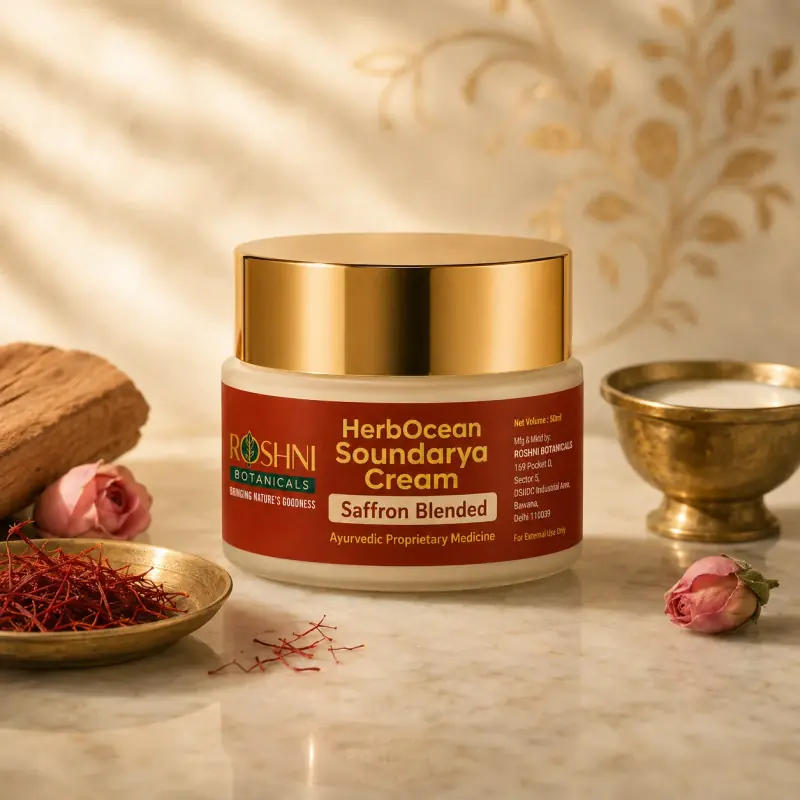
Soundarya Cream
A rich saffron brightening and repair cream with bargad (Vatt) bark on a goat-milk and coconut base, with shea and kokum butters, traditionally used in the care of skin where post-acne marks (PIH) linger.
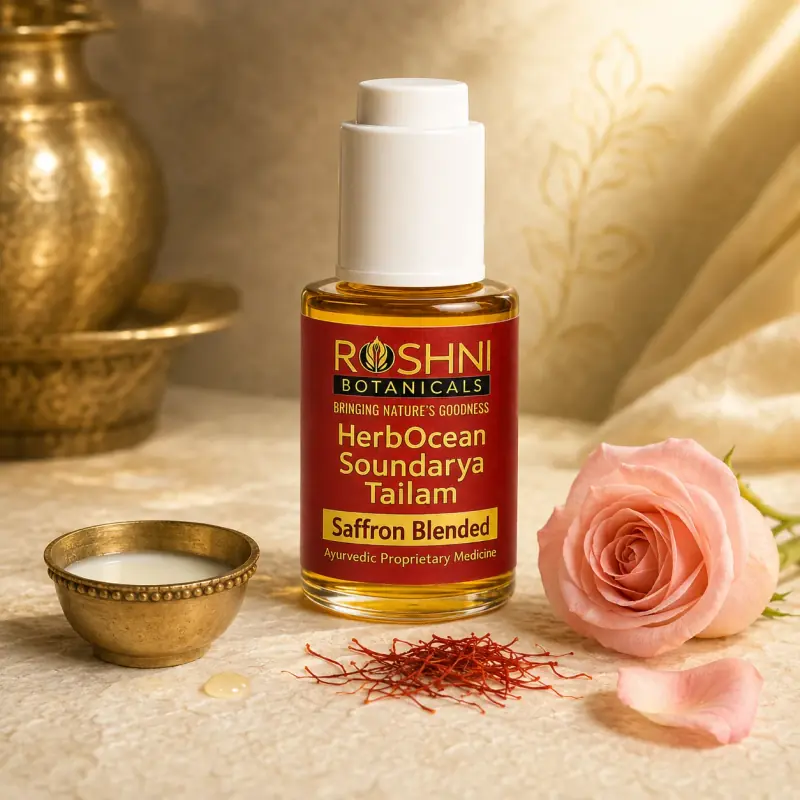
Soundarya Tailam
A saffron-infused facial Taila prepared in the goat-milk Kshira-paka tradition, with Manjistha, Mulethi and Kesar. For soft, bright, even skin.