Pre-Wedding Skincare for Glowing Skin: A 12-Week Ayurvedic Bridal Plan
What to start twelve weeks before the wedding, when to stop adding anything new, what to skip in the last month, and where a daily cream and a night oil fit.
The date is fixed and the hall is booked. Now the question is what to do about your skin, and how early to begin.
For a pre-bridal routine, start early, keep it short, and stop adding new things well before the day. Twelve weeks, about three months, is a sensible length for that. It gives you time to test anything new on your forearm, time to repeat a simple routine until it is a habit, and a last month with no experiments in it.
Key takeaways
- Twelve weeks is our own planning suggestion, not a medical rule: about two weeks to test, a long middle to repeat a short routine, and a last month with nothing new in it.
- Test every new product on the inner forearm before it goes near your face: one product to a patch, morning and night, for at least ten days and up to two weeks.
- On melanin-rich Indian skin, an irritated patch can heal into a flat brown mark that lasts for months, the kind doctors call post-inflammatory hyperpigmentation (PIH). A first facial, a peel or citrus juice close to the day risks exactly that.
- From four weeks out, add nothing new. In the wedding week, change nothing at all.
- Sun cover runs through all twelve weeks: every morning a broad-spectrum sunscreen, and at outdoor functions shade, a dupatta and sunglasses as well.
Why Twelve Weeks
We could find no dermatology body that publishes a wedding timetable, so treat twelve weeks as a plan and not as a finding. The number is our own, but the reasons for starting early come from dermatology.
A new product needs a proper test first, and the American Academy of Dermatology suggests a test spot twice a day for seven to ten days. A reaction, if one comes, needs time of its own: a dermatology review written about Indian skin notes that the flat brown mark that irritation leaves behind can last from months to years. And a routine has to be repeated for a good while before you can judge it.
So the plan is front-loaded. Anything new comes in early, while there is still room to change course, and the last month is kept free.
Ayurveda would recognise the shape of this. Dinacharya (daily routine) is the classical idea that care is built from the same acts, repeated every day, and the weeks before a wedding are a good time to borrow it. The aim is skin that looks calm and rested on the day.
Weeks 12 to 8: Build the Routine and Test It
Keep the routine short enough to repeat when the days get busy: a mild cleanser, a leave-on step for the day, one or two for the night, and a sunscreen in the morning. If you buy five things in one evening and start them together, you will never know which one your skin minded.
Dab a little of one product onto a patch of inner forearm about the size of a coin, morning and night, and leave that spot alone. Every HerbOcean product page asks for a patch test 24 hours before first use. Take that as the starting line and carry the test on for ten days to two weeks, one product to a patch. Anything past the seven to ten days that the American Academy of Dermatology suggests is our own margin. If the spot turns red, itchy, bumpy or sore, that product stays off your face. Our guide to Ayurveda for sensitive skin walks through the forearm test one step at a time.
Start sun cover now as well. Sunlight can start a dark mark and deepen one you already have, so it works against everything else in the plan. That means a broad-spectrum sunscreen every morning, put on again through a long day outdoors, plus shade, a dupatta or a cap, and sunglasses. If you have not settled on one yet, our guide to sunscreen on oily Indian skin covers textures, amounts and topping up through the day.
Book anything that someone else does to your skin in this window too: a facial you have not had before, or waxing or threading at a salon that is new to you. Our page on bumps after waxing or threading explains what can follow hair removal and what to ask the salon.
If the worry is a brown patch across the cheeks, the upper lip or the forehead, that may be melasma, known in Ayurveda as Vyanga (the classical name for pigmentation on the face). It behaves differently from the mark a pimple leaves behind, and our handbook on Ayurvedic treatment for melasma on Indian skin tells the two apart. For a quicker way to sort spots from patches, read our short piece on dark spots versus pigmentation.
Weeks 8 to 4: Repeat the Routine
This is the quiet stretch, and the point of it is repetition. Do the same few things every day, and leave any upgrade until after the wedding.
An ubtan has its place if it is already your habit. Mix besan and haldi into a soft paste, put it on with a light hand, leave it for a short while, and wash it off well with water. Do not scrub, and keep it off any active pimple. If the paste is new to you, try it on your forearm first, like any other new product.
Food is worth a light look, mainly if you are prone to breakouts. The American Academy of Dermatology says small studies suggest a low-glycaemic diet may mean fewer breakouts and that cow milk may be linked with more, though it adds that more research is needed. So if your own skin seems to follow the run of mithai that a wedding brings, ease off where you can. It is a pattern to watch in yourself, not a rule. Our guide to food and pigmentation looks at where the evidence on food and skin is solid and where it is thin.
The Last Four Weeks, and the Wedding Week
From four weeks out, the routine is closed. No new product, no first-time facial, no new salon. What is left to look after is ordinary: regular meals, water through the day, and sleep where the schedule allows it.
Have the make-up trial before this stretch begins, and ask the artist to use the products planned for the day, so that you find out in good time if one of them disagrees with your skin. On function nights, take long-wear make-up off fully before bed, however late it is, and do not share brushes or sponges. Our guide to make-up on acne-prone skin covers bases, brushes and the evening cleanse.
Mehendi belongs to the week itself, so choose the cone with care. A cone that promises jet black in minutes is the one to refuse. Black henna carries an added chemical, and a reaction to it can show within two days in someone already sensitised and leave a mark in the shape of the design. Our guide to mehendi and skin safety shows how to read a cone and how to test one.
The wedding week has one rule: change nothing. Not a sheet mask you have never used, not a new lip balm the night before, not a first facial in the last few days. If something irritates your skin now, there is no time left for it to settle.
If a dermatologist already has you on a prescription, tell them the wedding date early, and check with them before you add or stop anything.
What to Skip Before the Wedding
Some things are better left out of the last months altogether. A first-time facial close to the day is a first test of several new products across your whole face at once. A peel is a bigger version of the same bet. The American Academy of Dermatology puts healing at up to a week for a light, lunchtime peel and one to two weeks for a medium one, with redness that can linger for months, and it warns that on skin of colour a peel from someone without experience of darker skin can leave lasting pigment problems. If you want one, ask a dermatologist who knows skin like yours at the very start of the plan, and let them judge whether there is time.
Lemon or lime juice on the face is the kitchen remedy to drop. Juice from citrus fruit, left on skin that then meets strong sunlight, can leave it red and blistered, and the brown mark that follows may last for years and may be more intense on skin of colour. If the haldi paste has lemon in it, an outdoor function in strong daylight is exactly that setting.
And if you want to take a supplement for your skin or hair, ask a doctor in the first weeks. The last month is too late to start one.
Where Radiance Cream and the Night Oil Fit
A plan like this runs on steps you can repeat every day. If uneven tone or dark spots are part of what you want to look after before the wedding, our two Radiance medicines can be two of those steps.
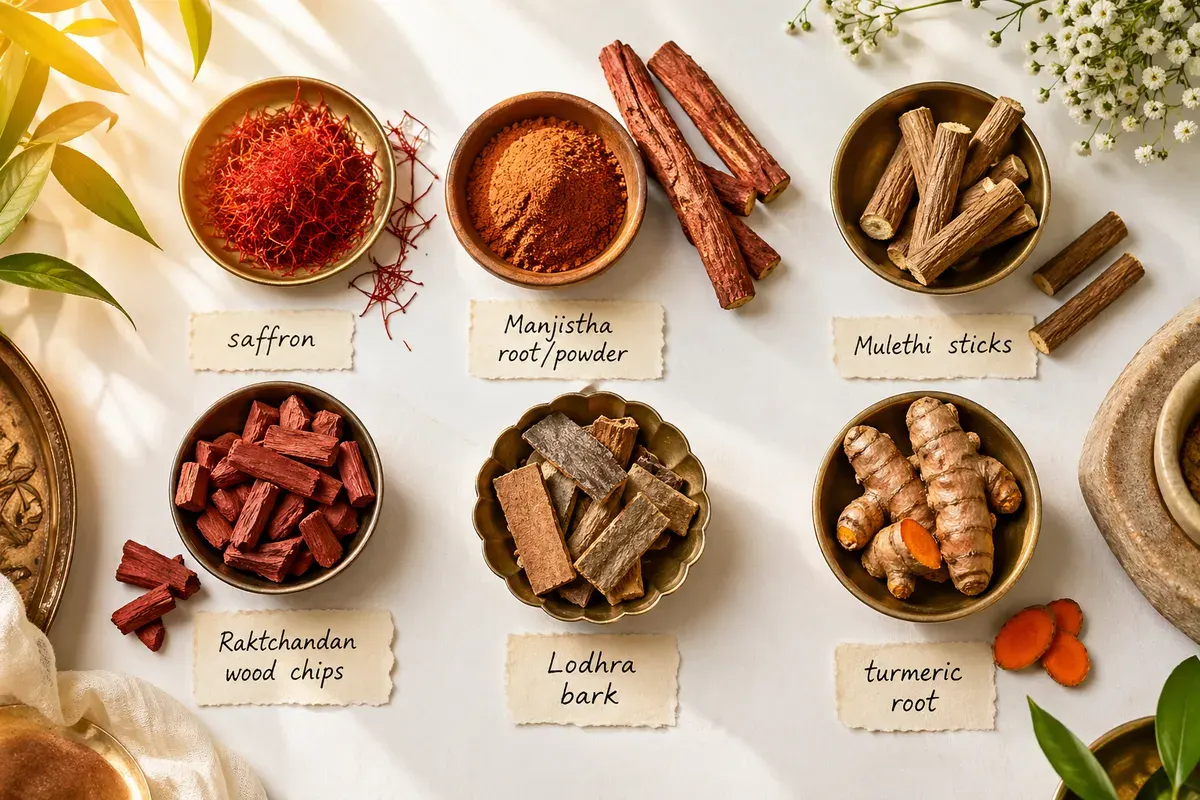
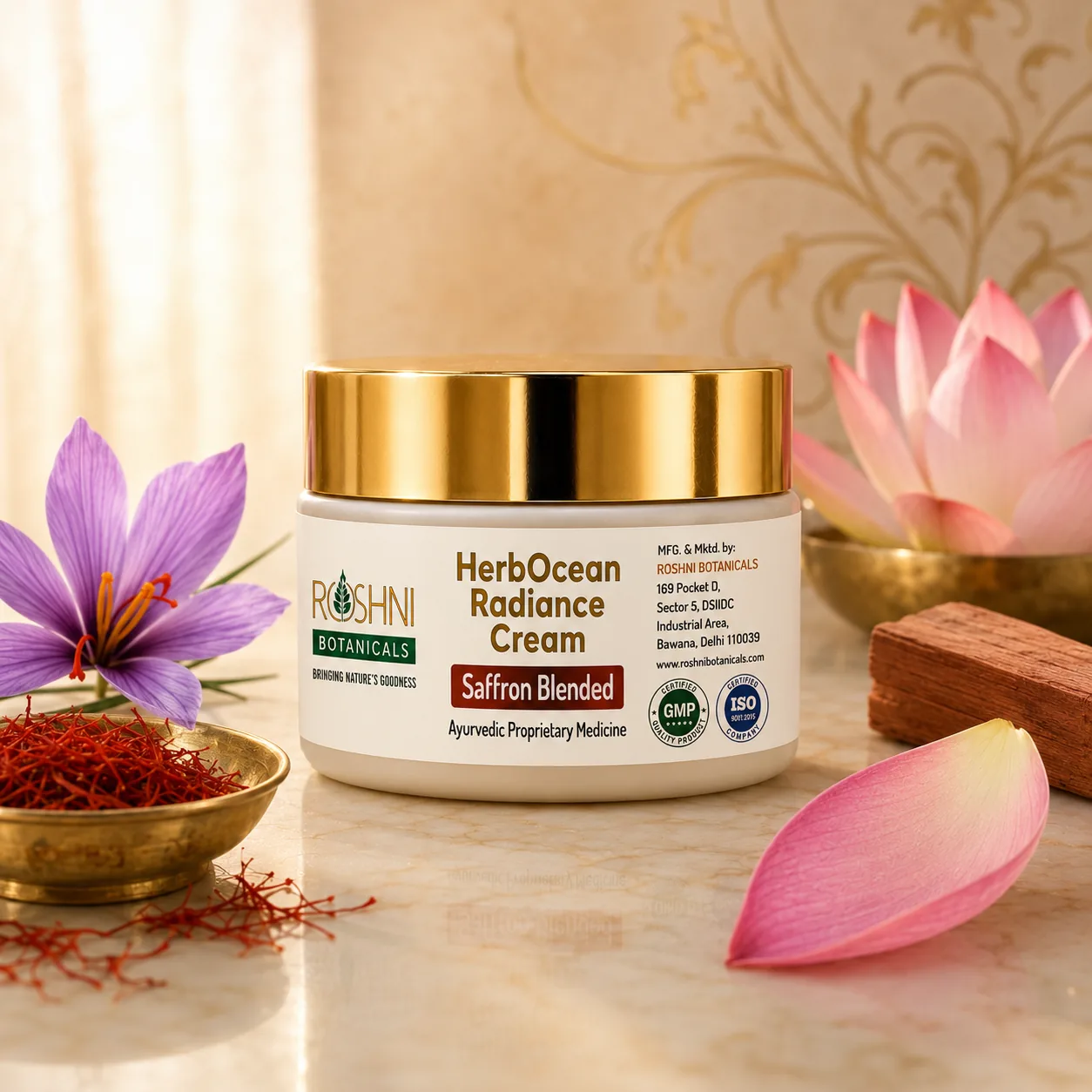
HerbOcean Radiance Cream is an Ayurvedic medicine for external use, classically indicated for facial pigmentation (Vyanga, the patches Hindi homes call jhaiyaan) and traditionally used in the care of dark spots and uneven tone. It is a daily saffron and sandalwood brightening cream with Manjistha, red sandalwood and lotus in a light coconut base. Smooth over clean skin morning and night. HerbOcean does not manufacture a sunscreen, and nothing in the range replaces one, so by day always follow the cream with a broad-spectrum sunscreen.
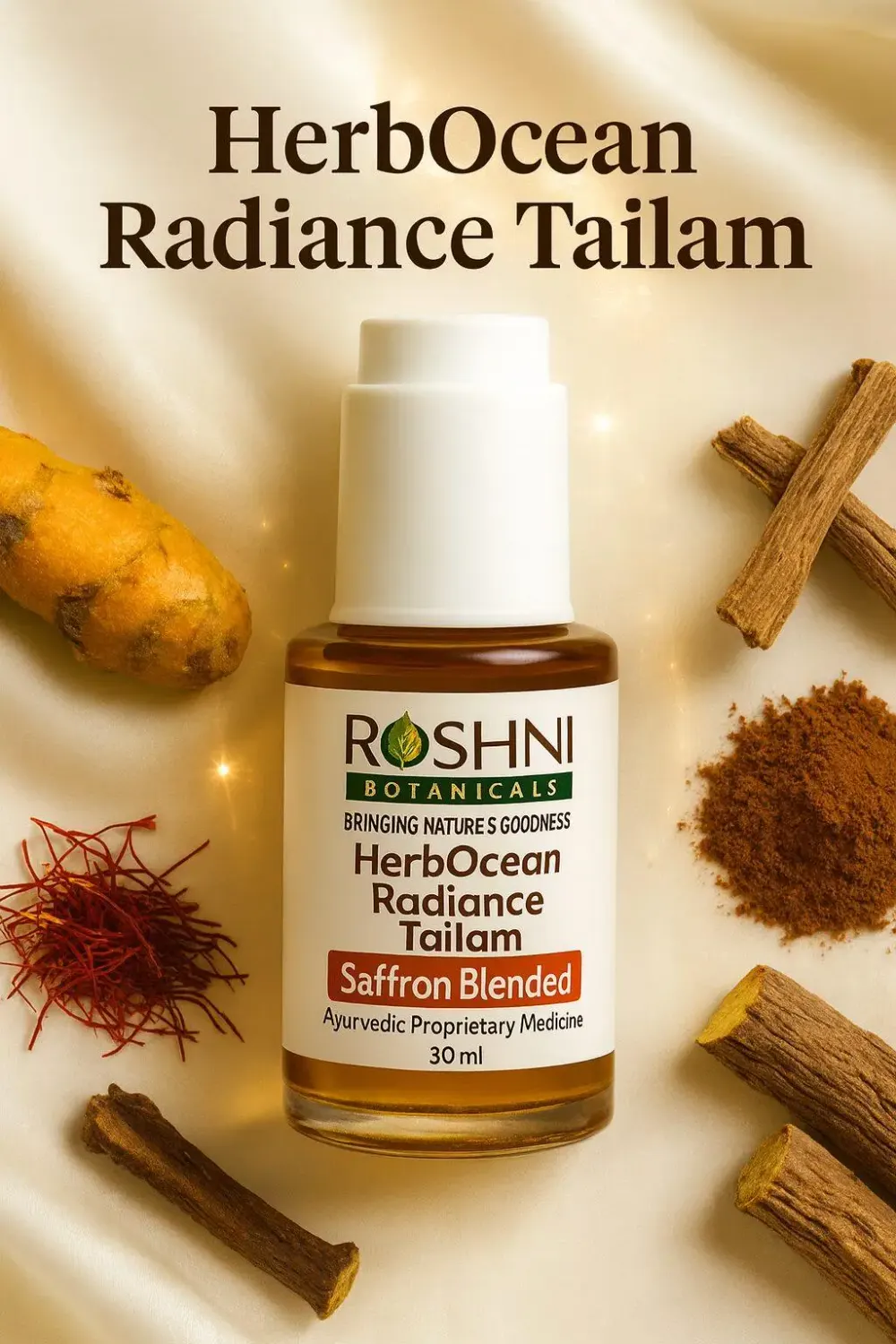
At night there is an oil to go with it, a Taila (medicated oil). HerbOcean Radiance Tailam is an AYUSH-licensed Ayurvedic medicine for external use, classically indicated for melasma (Vyanga) and traditionally used to support even tone where dark spots and post-inflammatory hyperpigmentation (PIH) show on melanin-rich Indian skin. At night, on clean, slightly damp skin, press in a few drops with light upward strokes for about a minute, and leave the oil on overnight. If you use both at night, the oil goes on first and the cream over it.
Give each its own forearm patch in the first weeks, bring them in one at a time once each patch is clean, and both will be part of the routine long before the last month closes it.
Both are made in-house at our GMP-certified unit in Bawana, Delhi, under AYUSH Licence No. DL-474 A&U, and built on the 40-year Ayurvedic formulation legacy of Vaidya Shri Ram Prakash Ji. Patch-test on the inner forearm 24 hours before first use and discontinue if irritation occurs; avoid the eye area. For external use only. Keep both off broken skin, a fresh nick included. Avoid the oil if you are allergic to sesame, the cream if you are allergic to coconut, and either if you are allergic to a listed botanical. If pregnant or breastfeeding, check with your doctor.
If You Are the Groom
The same plan works for a groom, with one addition: the razor. It covers the same jaw and neck each time, and on skin that marks easily, repeated irritation matters. So keep the shave kind in these weeks. Wet the skin and use a shaving cream, shave in the direction the hair grows, and change the blade every five to seven shaves, as the American Academy of Dermatology advises.
Do not try a new barber, a new trimmer or a first clean shave in the wedding week. Our guide to pigmentation in men covers shaving marks and sun on the commute.
Start From Where You Are
With twelve weeks in hand, begin with the forearm test and a short routine. With six weeks, keep to what your skin already knows, and bring in one new thing only if its test can finish before the last four weeks begin. With three weeks or less, change nothing, keep up the sunscreen, and sleep.
See a dermatologist for patches that keep widening month on month, for pigmentation that arrives suddenly or changes quickly, for a patch that looks different from the rest or that itches, bleeds or changes its shape or border, for new pigmentation after a new medicine, and for any reaction to a new oil that does not settle within a few days of stopping it. See one too for deep, painful breakouts along the jaw, or for acne that has arrived suddenly in adult life. And go early: a dermatologist who meets you twelve weeks before the wedding has room to act.
The whole plan fits in one line. The early weeks are for testing, the middle is for repeating, and the last month is for leaving well alone. For our other skin medicines, the Ayurvedic skincare range is the place to look.
References: Sushruta Samhita, Nidana Sthana 13 (Kshudra Roga Nidana), on Vyanga among the forty-four minor diseases, a thin, painless patch that appears on the face, brown in the Bhishagratna translation. Ashtanga Hridaya, Sutrasthana 2 (Dinacharya Adhyaya), on the classical daily routine. Nouveau S, Agrawal D, Kohli M, Bernerd F, Misra N, Nayak CS. Skin hyperpigmentation in Indian population: insights and best practice. Indian Journal of Dermatology. 2016;61(5):487-495 (narrative review, so no sample size and no single study population; four of its six authors employed by a skincare company; post-inflammatory hyperpigmentation can follow irritant and allergic contact dermatitis, can be induced by aesthetic procedures, more so on darker skin, can last from months to years, with ultraviolet exposure playing a part in starting and worsening it). American Academy of Dermatology. How to test skin care products (patient guidance, United States; a test spot on the underside of the arm or the bend of the elbow, twice daily for seven to ten days; non-Indian). American Academy of Dermatology. Chemical peels: FAQs (patient guidance, United States; healing of 1 to 7 days after a refreshing or lunchtime peel and 7 to 14 days after a medium peel; persistent redness that may last for months; lasting pigment problems on skin of colour without a dermatologist experienced in peeling darker skin; non-Indian). American Academy of Dermatology. Sunscreen FAQs (fact sheet, United States; broad-spectrum sunscreen, reapplied about every two hours outdoors, with shade when the sun is strongest; non-Indian). American Academy of Dermatology. Can the right diet get rid of acne? (patient guidance, United States; small studies suggest a low-glycaemic diet may lead to fewer breakouts and that cow milk may be linked to more; other studies found no link, and more research is needed; non-Indian). American Academy of Dermatology. Hair removal: How to shave (patient guidance, United States; shave in the direction the hair grows, and change the blade after 5 to 7 shaves; non-Indian). DermNet. Phytophotodermatitis; Black henna tattoo reactions (clinical reference pages, New Zealand; plant juice such as lime juice followed by sunlight turns the skin red and can blister it, and the pigmentation that follows may last for years and may be more intense on skin of colour; black henna is henna with para-phenylenediamine added; in someone already sensitised a reaction develops within 48 hours, and it can leave increased pigmentation or a pale outline of the design; non-Indian). Educational, not medical advice.
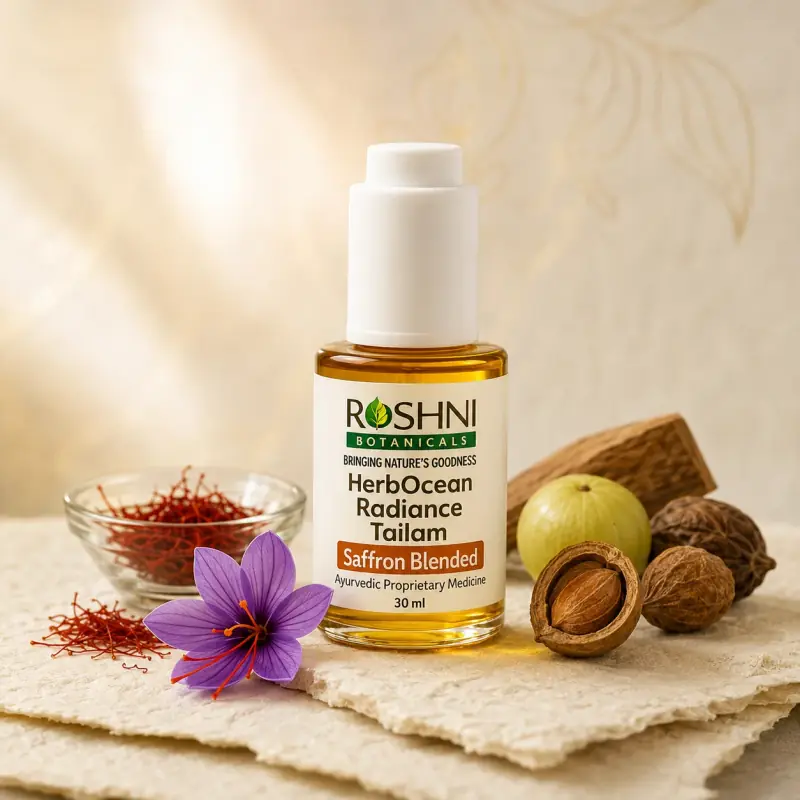
Radiance Tailam
A saffron brightening facial Taila with Manjistha and red sandalwood, traditionally used to support even tone where melasma, dark spots and PIH show.
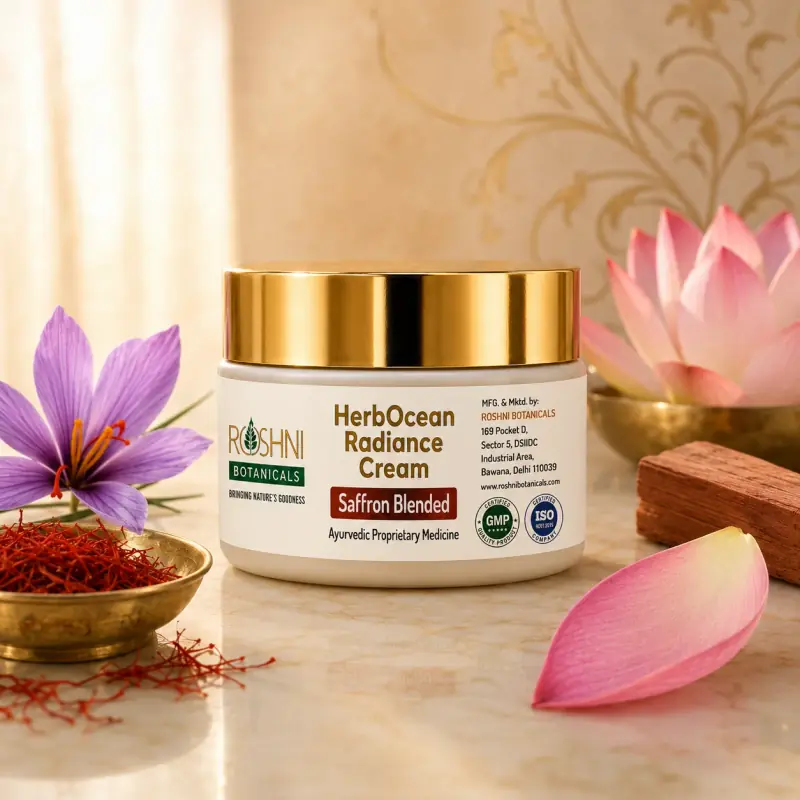
Radiance Cream
A daily saffron and sandalwood brightening cream with Manjistha, red sandalwood and lotus in a light coconut base. Supports a luminous, even-looking skin tone.
Part of our guide: Ayurvedic treatment for melasma on Indian skin.