Manjistha for Skin: Traditional Uses, the Powder and Manjistha Oil
What Manjistha is, how to use its powder at home, how the oils sold under its name differ, and where it sits as one of twelve herbs in Radiance Tailam.
Manjistha oil is any oil prepared with Manjistha (Rubia cordifolia, Indian madder), on its own or with other herbs. On the skin, the herb has its traditional place in the care of uneven tone, dark spots and the marks that pimples leave behind, and classical Ayurveda puts it in the Varnya group, herbs linked to the colour and look of the skin.
Three quite different things are sold under the name manjistha oil: a simple oil made with Manjistha alone, oils sold as Manjishtadi Taila, the name of a separate classical formula (a Taila is a medicated oil), and facial oils in which Manjistha is one herb among several. So it helps to start with the herb itself, then the powder you may already stir into ubtan, and then the oils, including where Manjistha sits in our own Radiance Tailam.
Key takeaways
- Manjistha is Rubia cordifolia, or Indian madder, a climbing plant used in India and China to colour cloth red for centuries and valued in Ayurveda as a skin herb.
- In the Charaka Samhita, Manjistha belongs to the Varnya group of Sutra Sthana 4, a set of ten herbs with sandalwood among them.
- Ayurveda traditionally uses Manjistha in the care of uneven tone, dark spots, Vyanga (the classical Ayurvedic term for melasma) and post-acne marks.
- Manjistha oil can mean three things: a single-herb oil, an oil sold as Manjishtadi Taila, or a multi-herb facial Taila, so read the label before the name.
- Radiance Tailam is its own formula, separate from any Manjishtadi Taila: Manjistha is one of its twelve herbs, all in equal measure, with saffron in a sesame base.
What Manjistha Is: Indian Madder in Ayurveda
Manjistha is a climbing plant with red running through it, and its names say so. Several of them in the Bhavaprakasha Nighantu mean reddish or red-bodied, though its verses name the plant rather than a part. The Ayurvedic Pharmacopoeia of India makes the dried stem the official drug, red inside with a pink powder, and a 2022 review of the plant describes its long red roots. So when you buy the powder, check that the pack prints Rubia cordifolia and says which part it holds.
That colour has a working past. Indian madder coloured cloth red in India and China for centuries, and the Bhavaprakasha list of its names even includes vastraranjini, the one that colours cloth. That review, by Wen and colleagues in Frontiers in Pharmacology, records the use for clothing, and notes that in Ayurveda the plant has also lent its colour to medicated oils.
Its classical standing goes back to the Charaka Samhita, which lists Manjistha in the Varnya group of Sutra Sthana 4, with chandana (sandalwood) and madhuka, read as licorice, beside it.
How Ayurveda Uses Manjistha on the Skin
Manjistha is traditionally used on the face in the care of uneven tone, dark spots, Vyanga and the marks pimples leave behind. The Ayurvedic Pharmacopoeia of India names Vyanga among the uses in its Manjistha monograph. The conditions have a classical home of their own. The Sushruta Samhita, in Nidana Sthana 13, lists Vyanga, and acne under the name Yuvanpidika, among its minor conditions, the Kshudra Roga, and it reads acne through Rakta, the blood, along with Vata and Kapha, two of what Ayurveda calls doshas, the biological energies of the body.
Why do these marks matter on Indian skin? In a 2009 review of Fitzpatrick skin typing, Sachdeva lists type V ahead of type IV for Indian skin, and both sit toward the melanin-rich end of the scale. Skin like that can answer inflammation or injury, whether a pimple, an insect bite, a burn or an irritant, by making more pigment. The pimple or the bite calms down, and a brown mark can stay on well after the spot has gone.
Doctors call the result post-inflammatory hyperpigmentation, or PIH. In a 2010 review, Davis and Callender describe it as arising with greater frequency and severity in darker skin, and they count acne among the conditions that set it off. Patches like these are where Manjistha has its traditional place, as one herb among several.
On the modern side, the 2022 review by Wen and colleagues gathered the traditional uses, chemistry and pharmacology of Rubia cordifolia, and its pharmacology comes from laboratory and animal studies, with little work in people. We found no well-designed human study of Manjistha applied to facial skin. Its place on your face rests on classical use.
Manjistha Powder at Home: Ubtan, Face Packs and Cautions
Manjistha powder goes into ubtan and simple face packs alongside haldi and besan. So how do you use it on your face, or, in Hinglish, manjistha powder kaise use kare chehre ke liye?
Test a little of the powder, mixed with water, on the inside of your elbow a day before it touches your face, and if that skin itches or reddens, leave the face out. Then mix the powder into a smooth paste with water or rose water. Spread it thin, and wash it off with plain water while it is still soft. If the paste starts to crack and tug, it has stayed on too long. Keep lemon out of the bowl, too.
If your tap water is hard, rinse the paste away with plain water rather than a face wash. A UK washing study by Danby and colleagues found that hard water leaves more cleanser on the skin after washing. One practical point: this is the plant that once coloured cloth red, so the paste can tint a pale towel; reach for an old towel and a bowl you do not mind marking. Taking Manjistha by mouth is a different matter, one to put to an Ayurvedic physician who knows your health.
Manjistha Oil, Manjishtadi Taila and Facial Tailas: How They Differ
The powder paste is the plainest form: dried Manjistha powder mixed fresh with water or rose water, spread thin and rinsed off. A single-herb manjistha oil is Manjistha prepared in a base oil, to whatever recipe the maker chooses, and used as its label directs. An oil sold as Manjishtadi Taila carries the name of a separate classical formula, but more than one oil is sold under that name and recipes vary by maker, so check its label for the use and the contents. A multi-herb facial Taila is the third kind of oil, with Manjistha as one herb among several.
Classical oil making rests on a simple idea, which the Sharngadhara Samhita sets out in Sneha Kalpana, its chapter on medicated oils and ghees: herbs and a liquid are cooked into a base oil until no water is left, and what the herbs gave stays behind in the oil. Radiance Tailam belongs to the third group: its own formula of twelve herbs and saffron in a sesame base, separate from any Manjishtadi Taila, though both contain Manjistha, and used the way its product page directs.
Where Manjistha Sits in Radiance Tailam
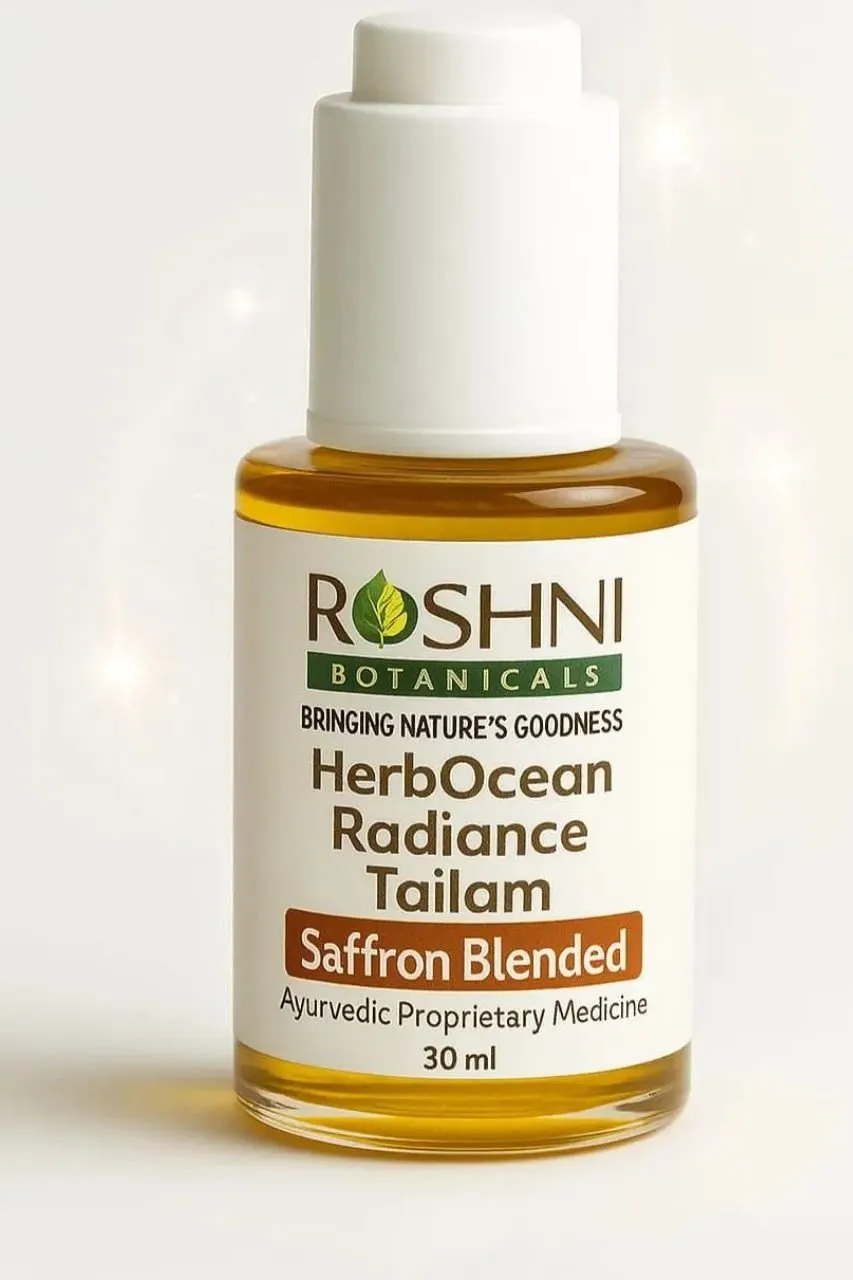
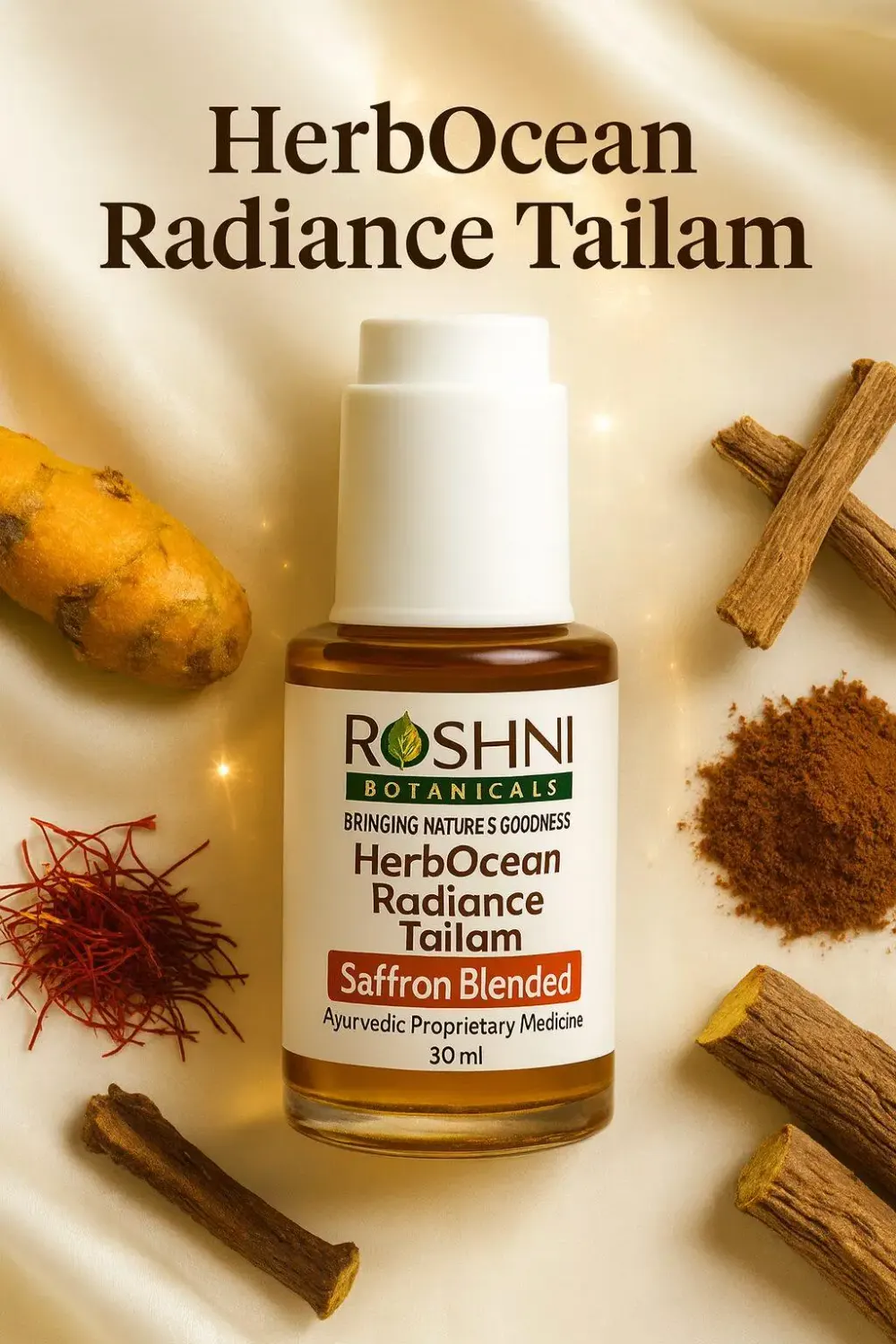
HerbOcean Radiance Tailam is an AYUSH-licensed Ayurvedic medicine for external use, classically indicated for melasma (Vyanga) and traditionally used to support even tone where dark spots and post-inflammatory hyperpigmentation (PIH) show on melanin-rich Indian skin. It is a facial Taila in which Manjistha sits among equals.
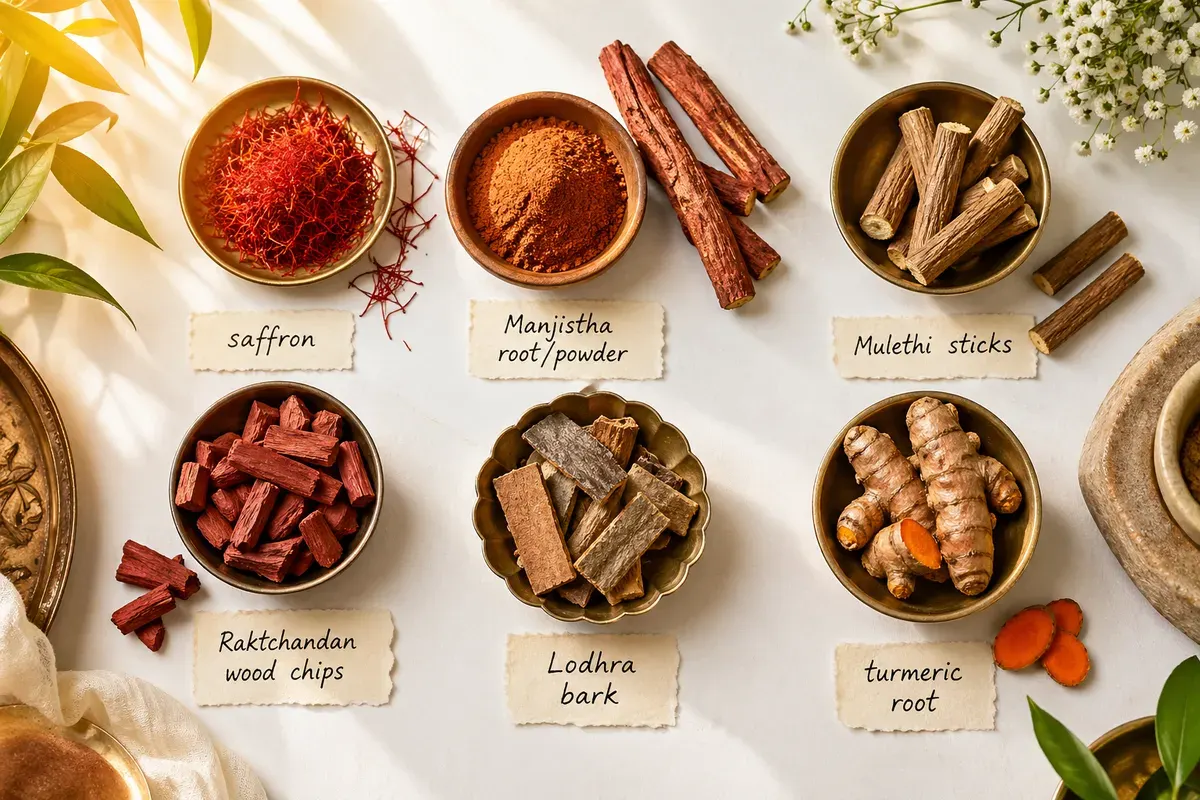
Its twelve herbs, in equal measure, are Amla, Baheda, Harad, Chandan (sandalwood), Raktchandan (red sandalwood), Haldi (turmeric), Manjistha, Kuth (costus root), Kamal (lotus), Padmaakh (wild Himalayan cherry) bark, Kakoli and Palash (flame of the forest) flower, with Kesar (saffron) and with lavender, rose and mogra oils, in a sesame (Til tail) base. It is made in-house at our GMP-certified unit in Bawana, Delhi, under AYUSH Licence No. DL-474 A&U, and built on the 40-year Ayurvedic formulation legacy of Vaidya Shri Ram Prakash Ji. Three of the twelve, the Triphala fruits, have a page of their own: Amla, Baheda and Harad for skin.
On the product page, the direction for use opens with this line. At night, press a few drops over clean skin, concentrating on areas of uneven tone. Then come the cautions. Patch-test on the inner forearm 24 hours before first use and discontinue if irritation occurs; avoid the eye area. For external use only. Avoid it if you are allergic to sesame or a listed botanical. If pregnant or breastfeeding, check with your doctor.
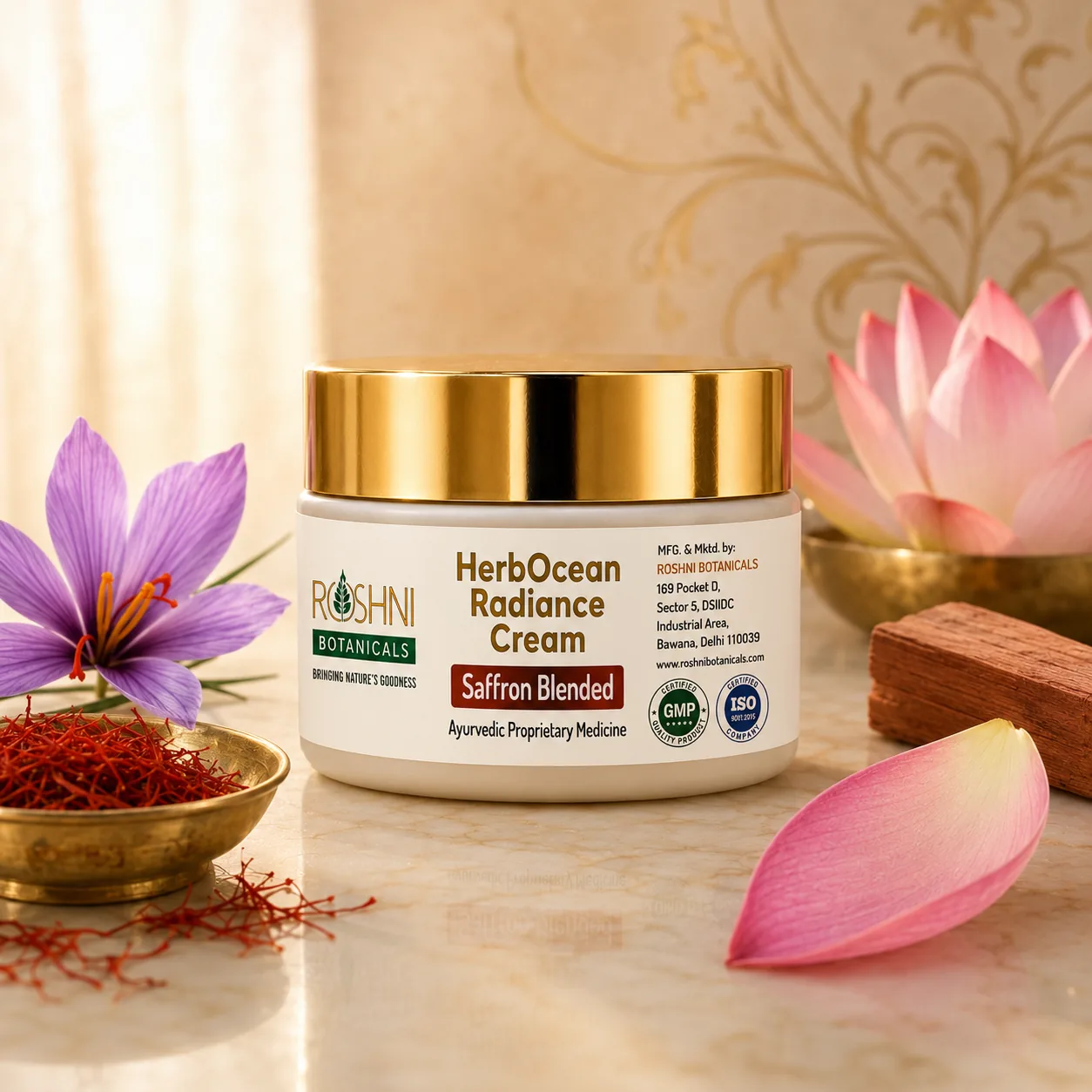
Prefer a cream to an oil? The same twelve herbs and Kesar also go into a cream, made on coconut oil and a cream base. HerbOcean Radiance Cream is an Ayurvedic medicine for external use, classically indicated for facial pigmentation (Vyanga, the patches Hindi homes call jhaiyaan) and traditionally used in the care of dark spots and uneven tone. If you are just starting out, pick one of the two, which is the whole idea behind one concern, one product.
Pimples and the Marks They Leave
Pimples are the other place you will meet Manjistha, in Ayurvedic medicines made today for acne. On melanin-rich skin, the mark a pimple leaves can bother you as much as the pimple did.
HerbOcean Anti-Acne Roll-On is an AYUSH-licensed Ayurvedic medicine for external use, classically indicated for acne and pimples (Yuvanpidika, the classical Ayurvedic term for acne, literally youthful eruption) and traditionally used in the care of post-acne marks and pigmentation (PIH). Manjistha is one of its six herbs.
Once a pimple settles, it may leave a flat brown mark rather than a scar; for where that colour comes from, read why a pimple leaves a brown mark. Some acne should go straight to a dermatologist: painful, deep or cystic breakouts, acne that leaves pitted scars, and acne that appears suddenly in adult life.
The Sun and When to Visit a Dermatologist
Sun exposure can deepen pigment patches, so wear a broad-spectrum sunscreen every day; the morning and night order puts it in its place among the rest. HerbOcean does not manufacture a sunscreen, and nothing in the range replaces one, so your sun protection stays a separate step. When the sun is strong, add shade, a hat and long sleeves as well.
A patch that is new, spreading quickly, changing shape or colour, raised, itchy or bleeding needs a dermatologist, who can also tell melasma apart from the other kinds of dark patch when the kind is unclear to you. So does melasma that has not settled despite steady care and sun protection every day. Patches can also arrive with a pregnancy, and melasma that comes with one is worth taking to your doctor. For the wider picture, read Ayurvedic treatment for melasma on Indian skin.
Choosing Your Manjistha
Which Manjistha you choose depends on what you want from it. For an ubtan or a face pack at home, the powder is enough, from a pack that names the plant and the part it holds. For an oil, start with the label: it tells you whether you hold a single-herb oil, an oil sold as Manjishtadi Taila or a facial Taila with several herbs, and what else is in the bottle.
If melasma or dark spots are what you are caring for, Radiance Tailam brings Manjistha together with saffron and the other eleven herbs of its formula. Would you rather try it on a smaller bottle first? The Radiance Tailam 10 ml trial holds the same oil. And if you are weighing it against our other face oil, choosing between our two face oils compares them.
References: 1. Charaka Samhita, Sutra Sthana 4 (Shadvirechanashatashritiya Adhyaya): five hundred herbs in fifty groups of ten, Varnya among them. 2. Sushruta Samhita, Nidana Sthana 13 (Kshudra Roga Nidana), Bhishagratna translation, 1911: Vyanga and Yuvanpidika among the minor conditions. 3. Bhavaprakasha Nighantu, Haritakyadi Varga: the Manjishtha entry and its names. 4. The Ayurvedic Pharmacopoeia of India, Part I, Volume III: the Manjishta monograph, Government of India. 5. Sharngadhara Samhita, Madhyama Khanda 9 (Sneha Kalpana), Tripathi edition: the oil and ghee chapter. 6. Wen M, Chen Q, Chen W and colleagues. A comprehensive review of Rubia cordifolia L.: Traditional uses, phytochemistry, pharmacological activities, and clinical applications. Frontiers in Pharmacology, 2022. A review of laboratory and animal work, with little in people. 7. Sachdeva S. Fitzpatrick skin typing: applications in dermatology. Indian Journal of Dermatology, Venereology and Leprology, 2009. Review; type V, then type IV, for Indian skin. 8. Davis EC, Callender VD. Postinflammatory hyperpigmentation: a review of the epidemiology, clinical features, and treatment options in skin of color. Journal of Clinical and Aesthetic Dermatology, 2010. Narrative review. 9. Danby SG and colleagues. The effect of water hardness on surfactant deposition after washing and subsequent skin irritation in atopic dermatitis patients and healthy control subjects. Journal of Investigative Dermatology, 2018. Case-control washing study, 80 participants, United Kingdom. Educational, not medical advice.
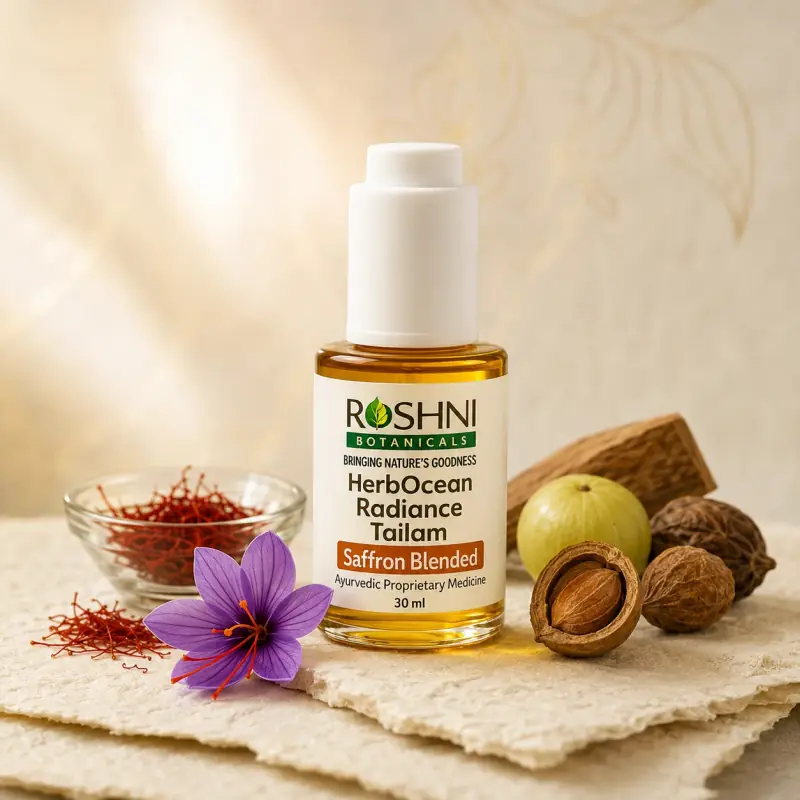
Radiance Tailam
A saffron brightening facial Taila with Manjistha and red sandalwood, traditionally used to support even tone where melasma, dark spots and PIH show.
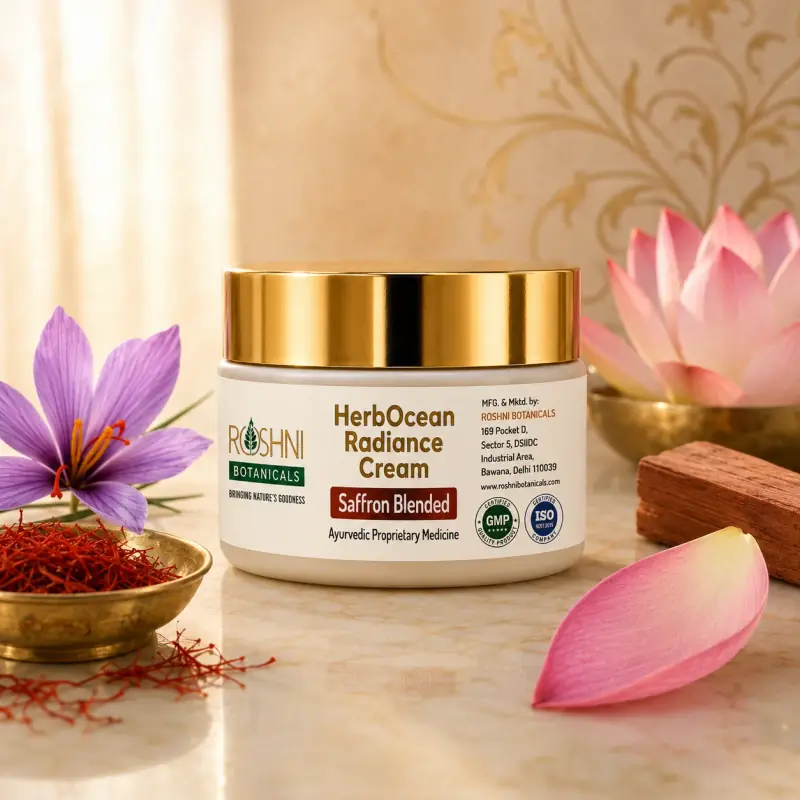
Radiance Cream
A daily saffron and sandalwood brightening cream with Manjistha, red sandalwood and lotus in a light coconut base. Supports a luminous, even-looking skin tone.
Part of our guide: Ayurvedic treatment for melasma on Indian skin.