Harad Benefits for Skin: Amla, Baheda and Harad in Ayurvedic Skin Care
Harad, amla and baheda are the three Triphala fruits. What the classical texts record, what the few modern studies found, and how to use the powder with care.
Harad (Terminalia chebula) is a classical Ayurvedic skin herb. The classical texts place it among the herbs set against skin disease, and they also count it as a Rasayana (the classical category of tonic medicines). Together with amla (Emblica officinalis) and baheda (Terminalia bellerica), it makes up Triphala. Its modern record on the skin is short: we found three human studies of a harad extract on its own, two in a cream and one taken by mouth, looking at redness, moisture, oil and pigment.
Triphala is also a classical churna for the gut, the kind kept in a steel dabba beside the ajwain. The same three fruits turn up in face packs, ubtan recipes and Ayurvedic skin medicines too. So it helps to keep two things apart: what the old texts record, and what the studies have found.
Key takeaways
- Triphala means three fruits, harad, amla and baheda, and in each case it is the dried fruit that goes into the powder, not the leaf or the bark.
- Charaka Samhita, Sutra Sthana 4, places harad and amla in the Kushtaghna group, the ten herbs it sets against skin disease; baheda comes into skin care through Triphala.
- The human studies of harad on skin that we found are small: two topical extract cream studies, one of them a melasma trial completed by thirty women, and one oral trial completed by thirty-eight women.
- Melanin-rich Indian skin marks more often after inflammation: rub a gritty powder over inflamed skin and post-inflammatory hyperpigmentation (PIH) can follow, so keep a home paste thin and rinse it off with plain water.
- All three fruits sit in both Radiance medicines, the cream and the oil, in equal measure with nine other classical herbs.
What Harad, Amla and Baheda Are
Harad is the dried fruit that Sanskrit calls Haritaki, and the classical texts also call it Abhaya. Amla (Amalaki) is the Indian gooseberry you know from murabba and pickle. Baheda (Bibhitaki) completes the three, and the classical texts give it an entry of its own.
It is the dried fruit of each that is ground into the churna, and whether you should take that churna by mouth is a question for an Ayurvedic physician who has seen you.
What the Classical Texts Record About the Triphala Fruits
Sutra Sthana 4 of the Charaka Samhita lists fifty groups of medicines, ten herbs in each, and names every group for the action its herbs share. In the Kushtaghna group, the ten set against skin disease, you will find abhaya, which is harad, and amalaka, which is amla. Baheda is not on that list.
Charaka opens the Chikitsa Sthana with the Rasayana chapter, and its first quarter is named for haritaki and amalaka, harad and amla under their Sanskrit names. Baheda sits beside them in the same chapter, where Charaka also gives a Triphala Rasayana made of all three fruits, a medicine taken by mouth.
The Sushruta Samhita, Sutra Sthana 38, names Triphala as a group of the three fruits and lists it for skin disease (Kushtha), and the Bhavaprakasha Nighantu gives each fruit its own entry in the Haritakyadi Varga. That section opens with haritaki and names the three together as triphala. So baheda comes into the skin texts through the formula it belongs to.
Charaka also lists a Varnya group, the ten herbs classically linked to the colour of the skin. Chandana (sandalwood), padmaka (Padmaakh, the wild Himalayan cherry) and manjishtha (Manjistha) are in it; the three fruits are not. A classical placement tells you how the texts grouped a herb. What modern studies have found is a separate question.
What the Modern Studies Found, and How Small They Are
We found three human studies that tested a harad extract on its own, and two of them used a cream. Akhtar and colleagues, writing in Forschende Komplementarmedizin in 2012, tested a cream with a concentrated harad extract against its plain base on the cheeks of volunteers for eight weeks. Skin moisture rose compared with the base, and the authors report less redness. The change in melanin, though, was not statistically significant.
Kheirieh and colleagues, in the Avicenna Journal of Phytomedicine in 2024, ran a randomised triple-blind trial in women with melasma in Iran, which thirty completed. One group used a harad extract cream and the other a standard dermatology cream for melasma, at bedtime for twelve weeks, and both groups were asked to wear sunscreen by day. Both groups improved on the melasma severity score. The authors ran it as a pilot and named its small size as the main limitation.
Chakkalakal and colleagues, in the Journal of Clinical Medicine in 2023, ran a randomised double-blind placebo-controlled trial in the United States that thirty-eight women completed. The women, aged twenty-five to sixty-five, swallowed either a standardised harad extract or a placebo for eight weeks, and the researchers reported changes in forehead oil and cheek redness, among other skin measures. The company that supplies the extract funded the study. This was a supplement, so it tells you about the extract taken by mouth, not about a face pack.
A concentrated extract in a laboratory cream is not kitchen churna stirred into water, and antioxidant work in a test tube is not a result on skin. Set the three fruits side by side and the record is uneven. Harad has its two classical placements and all three of these studies. Amla shares those placements, but we found no study of amla fruit powder on the face. For baheda on its own, we found no human study on facial skin.
What Melanin-Rich Skin Means for a Home Paste
An Indian dermatology review of Fitzpatrick skin typing puts type V first among Indian skin types, with type IV after it. A second review, on skin of colour, reports that skin in that range marks more often after inflammation, and more severely. When a pimple settles, it can leave a flat brown spot where it was. That mark is PIH, and on darker skin it can stay long after the pimple behind it has gone. For how that mark forms, read why a pimple leaves a brown mark.
That is why a home Triphala paste needs a light hand. Rub a gritty powder over active pimples and you add friction to inflamed skin, and the American Academy of Dermatology says that strong scrubbing on darker skin can leave dark spots. So let the paste sit on the skin, rinse it away, and leave the scrubbing out of it.
Then there is the water you wash in. In a washing study, hard water left more cleanser residue on the skin, and that residue raised water loss and irritation, especially in people with eczema who carry a change in filaggrin, a skin barrier gene. Irritated skin is a poor place for a gritty paste, and on darker skin, irritation itself can leave a mark. On a dry day, or if your skin runs dry anyway, mix the paste with curd rather than plain water.
Ubtan and the face packs of an Indian home are household practices, and they deserve to be done well. If melasma is your main worry, start with Ayurvedic treatment for melasma on Indian skin.
Triphala Powder on Your Face, Used With Care
In Hinglish, triphala chehre par lagane ke fayde means the benefits of putting Triphala on your face, and what matters first is how you put it on. Take a small pinch and mix it into a paste with plain water, curd or rose water. Never lemon. Lime and lemon juice carry plant compounds that react with sunlight on the skin, a reaction called phytophotodermatitis, and the dark mark it can leave may last for months.
Spread a thin layer, do not scrub, and rinse with plain water. Before you use it the first time, try a little on your inner forearm and give it at least a full day before it goes near your face. Keep it off broken skin, cuts and active eczema.
What about side effects, the nuksan side of the question? Harad and baheda contain tannins, and a paste of the powder may feel drying. Beyond that, any plant powder can irritate the skin or set off an allergy. Stop at the first sign of redness, itching, stinging or scaling, and rinse the paste away.
Where the Triphala Fruits Sit in the Radiance Medicines
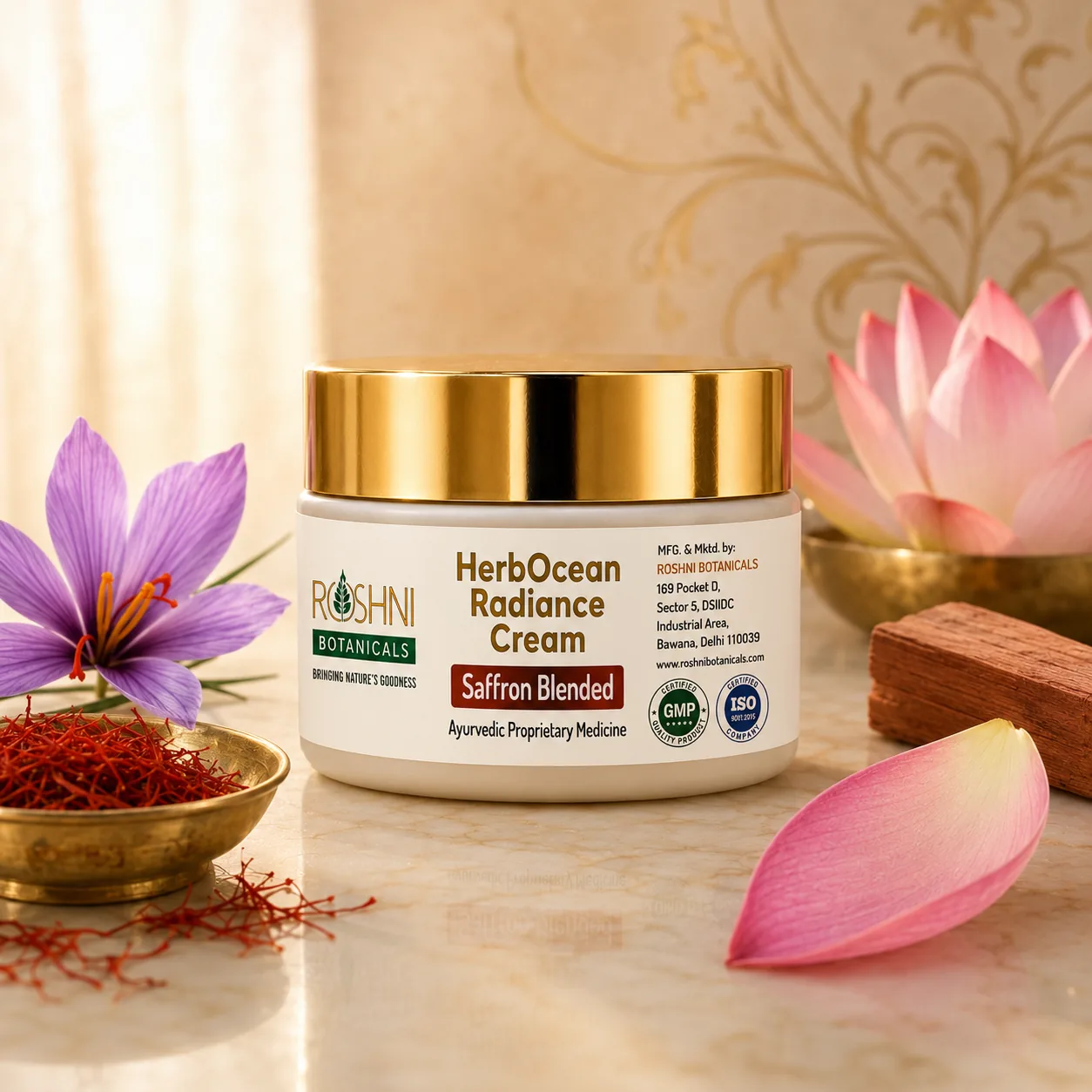
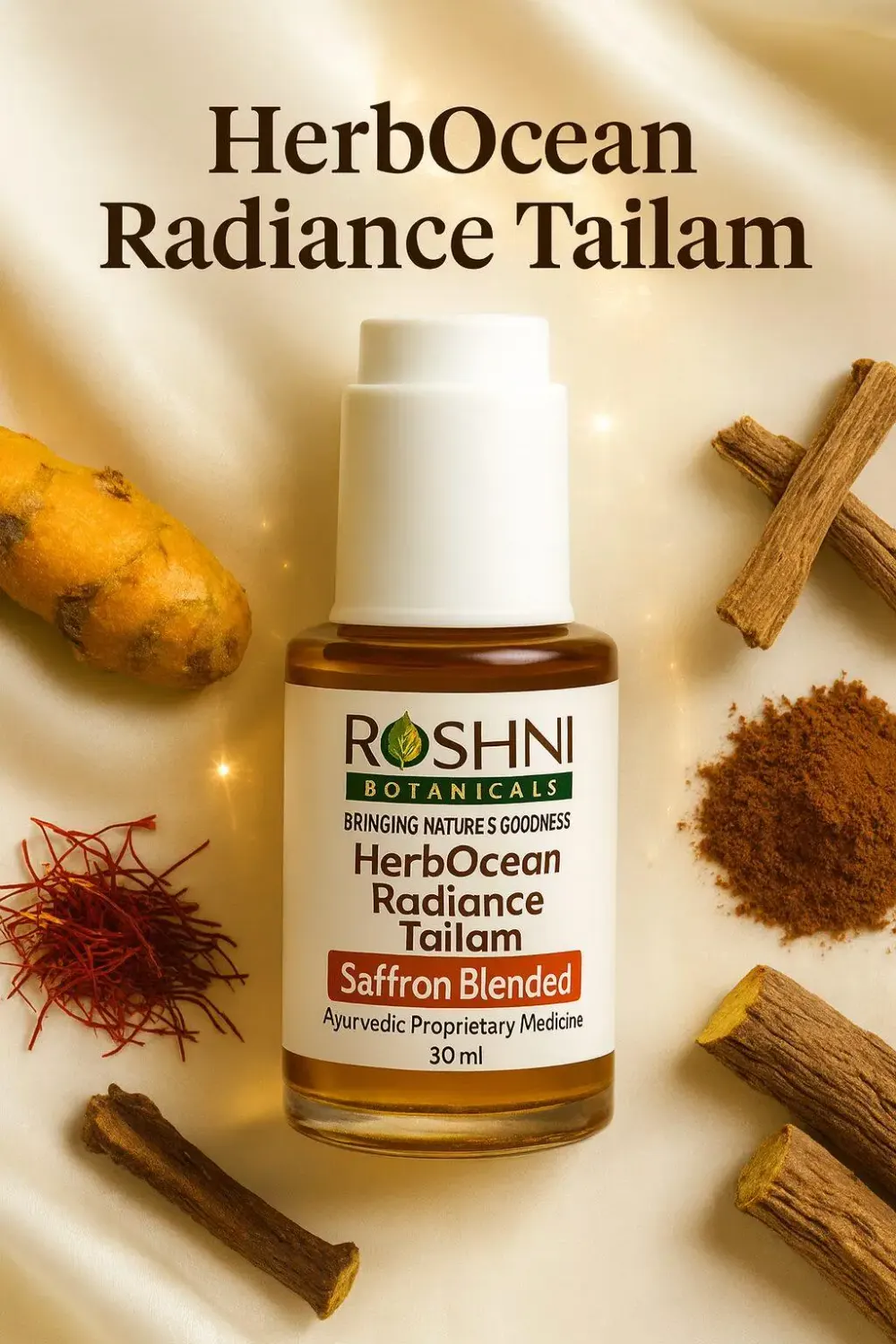
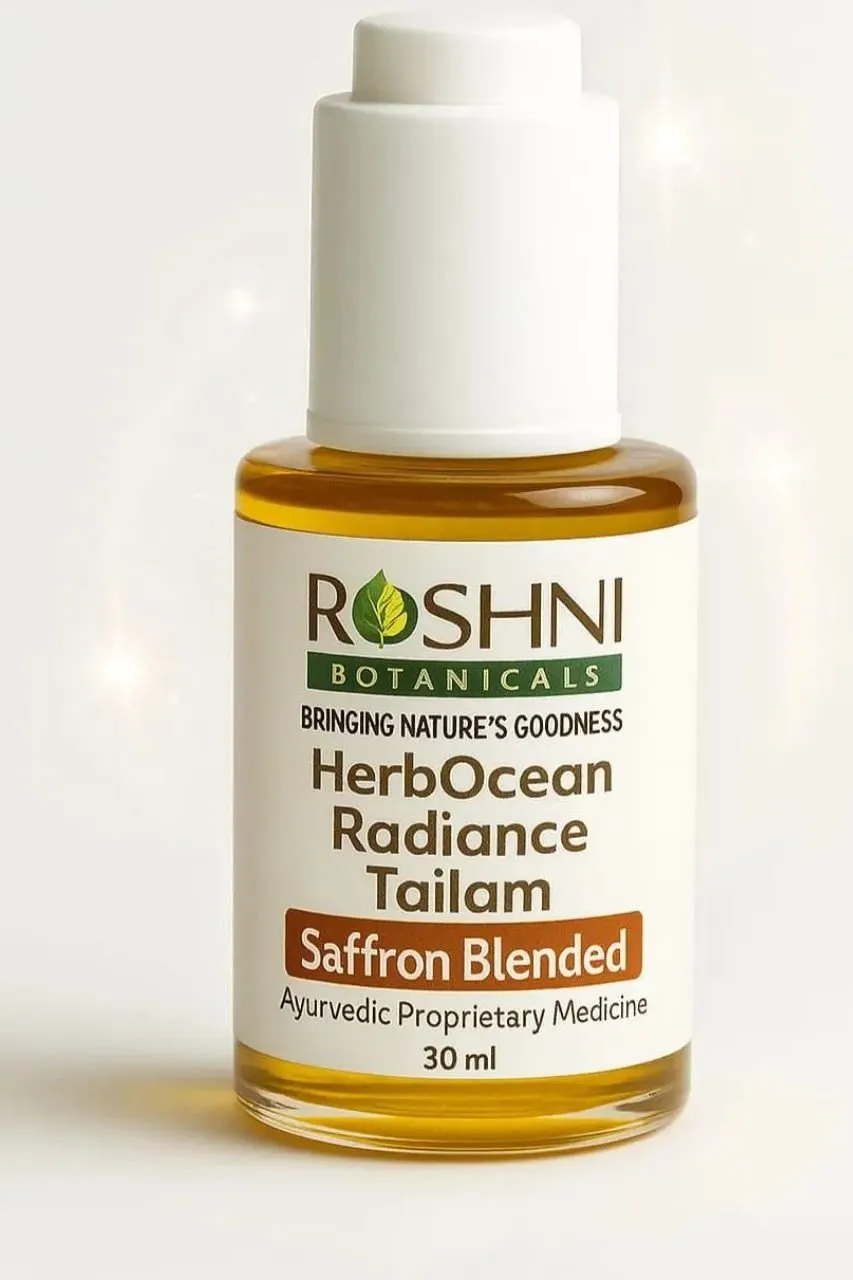
On our own shelf, all three fruits go into both Radiance medicines. HerbOcean Radiance Cream is an Ayurvedic medicine for external use, classically indicated for facial pigmentation (Vyanga, the patches Hindi homes call jhaiyaan) and traditionally used in the care of dark spots and uneven tone. HerbOcean Radiance Tailam is an AYUSH-licensed Ayurvedic medicine for external use, classically indicated for melasma (Vyanga) and traditionally used to support even tone where dark spots and post-inflammatory hyperpigmentation (PIH) show on melanin-rich Indian skin. If it is the oil you are weighing, read choosing between our two face oils, and if you would rather start small, there is a Radiance Tailam 10 ml trial.
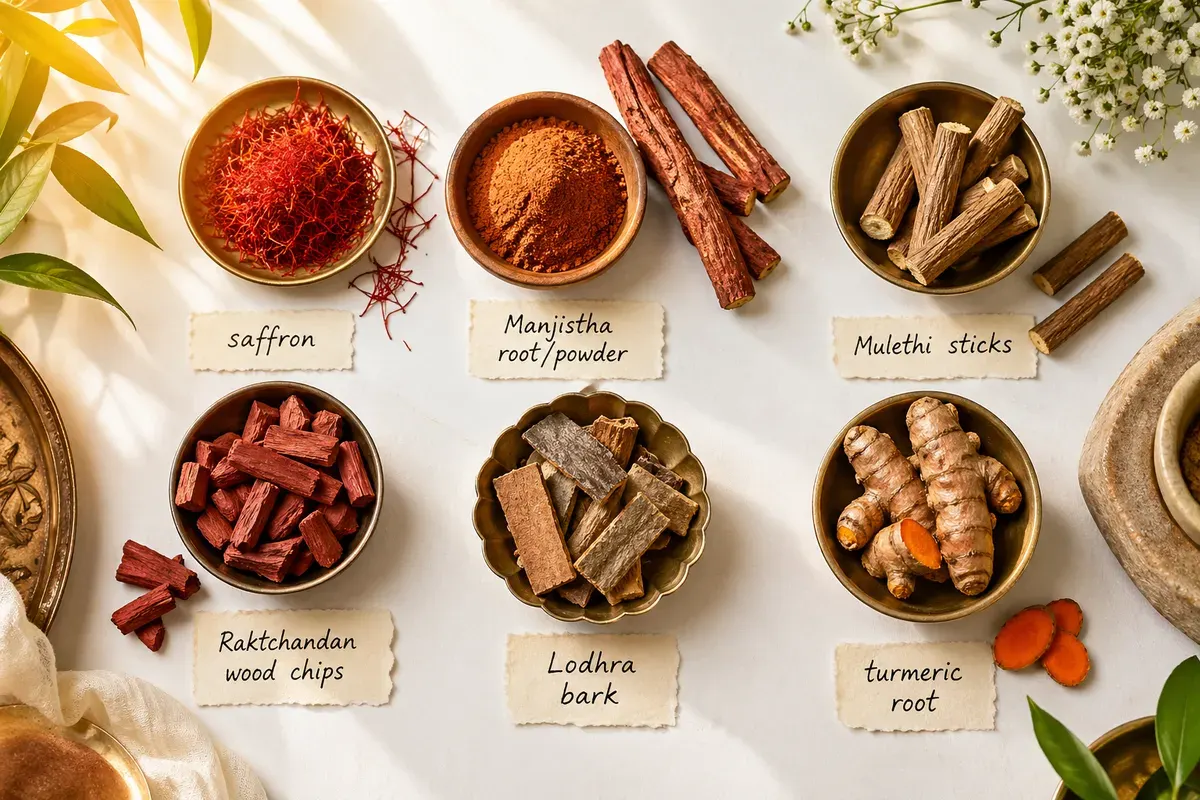
Both carry the same twelve herbs in equal measure: Amla, Baheda, Harad, Chandan (sandalwood), Raktchandan (red sandalwood), Haldi (turmeric), Manjistha, Kuth (costus root), Kamal (lotus), Padmaakh (wild Himalayan cherry) bark, Kakoli and Palash (flame of the forest) flower, with Kesar (saffron) and with lavender, rose and mogra oils. The Tailam sits in a sesame (Til tail) base, while the Cream is made with coconut oil and a cream base. Both are made in-house at our GMP-certified unit in Bawana, Delhi, under AYUSH Licence No. DL-474 A&U, and built on the 40-year Ayurvedic formulation legacy of Vaidya Shri Ram Prakash Ji.
The product page tells you how to use the Cream. Smooth over clean skin morning and night. HerbOcean does not manufacture a sunscreen, and nothing in the range replaces one, so by day always follow the cream with a broad-spectrum sunscreen.
Like any medicine, both come with cautions. Patch-test on the inner forearm 24 hours before first use and discontinue if irritation occurs; avoid the eye area. For external use only, and keep both off broken skin. Avoid the oil if you are allergic to sesame, the cream if you are allergic to coconut, and either if you are allergic to a listed botanical. If pregnant or breastfeeding, check with your doctor.
When to See a Dermatologist
Go to a dermatologist the same day if a home paste leaves blistering, swelling or a spreading burn. Book an appointment if pigmentation comes on suddenly or shows on only one cheek, or if a patch is getting bigger or changing in colour or texture.
A dermatologist should also see melasma that is not easing with consistent care and daily sun protection, melasma that started with a new medicine such as birth control pills, and pigmentation that comes with signs of a thyroid problem. Ayurvedic care sits alongside clinical care, not instead of it. Day to day, sunscreen has its own step in the morning and night order.
The Short Version
Harad, amla and baheda are the three fruits of Triphala. The classical texts file harad and amla among the herbs for skin disease and among the Rasayana medicines, and baheda comes into skin care through Triphala itself. The modern record is small: three human studies of a harad extract, two in a cream and one taken by mouth.
At home, keep Triphala to a thin paste on unbroken skin, never with lemon, and only after a forearm test. Both Radiance medicines carry all three, alongside nine other classical herbs. And if a mark changes, spreads or stays put despite steady care, a dermatologist is the right person to see.
References: 1. Charaka Samhita, Sutra Sthana 4 (fifty groups of ten herbs, among them Kushtaghna and Varnya) and Chikitsa Sthana 1 (the Rasayana chapter). 2. Sushruta Samhita, Sutra Sthana 38 (the Triphala group); Bhavaprakasha Nighantu, Haritakyadi Varga. 3. Longvah T and colleagues. Indian Food Composition Tables 2017. National Institute of Nutrition, Hyderabad: amla and vitamin C. 4. Akhtar N and colleagues. Formulation and characterization of a cream containing Terminalia chebula extract. Forschende Komplementarmedizin, 2012. Extract cream against its base, cheeks of volunteers, eight weeks. 5. Kheirieh AE and colleagues. Avicenna Journal of Phytomedicine, 2024. Randomised triple-blind pilot of a harad extract cream against a standard melasma cream; thirty of thirty-six women completed, Iran, twelve weeks. 6. Chakkalakal M and colleagues. Journal of Clinical Medicine, 2023. Double-blind placebo-controlled trial of an oral harad extract; thirty-eight women completed, aged twenty-five to sixty-five, United States, eight weeks; funded by the extract supplier. 7. Danby SG and colleagues. The effect of water hardness on surfactant deposition after washing and subsequent skin irritation in atopic dermatitis patients and healthy control subjects. Journal of Investigative Dermatology, 2018. Case-control washing study, 80 participants, United Kingdom. 8. Davis EC, Callender VD. Postinflammatory hyperpigmentation: a review of the epidemiology, clinical features, and treatment options in skin of color. Journal of Clinical and Aesthetic Dermatology, 2010. Narrative review. 9. Ellis CR, Elston DM. Psoralen-induced phytophotodermatitis. Dermatitis, 2021. Narrative review. 10. Hankinson A and colleagues. Lime-induced phytophotodermatitis. Journal of Community Hospital Internal Medicine Perspectives, 2014. Case report, one patient, United States. 11. Sachdeva S. Fitzpatrick skin typing: applications in dermatology. Indian Journal of Dermatology, Venereology and Leprology, 2009. Review; commonest Indian type V, then type IV. Educational, not medical advice.
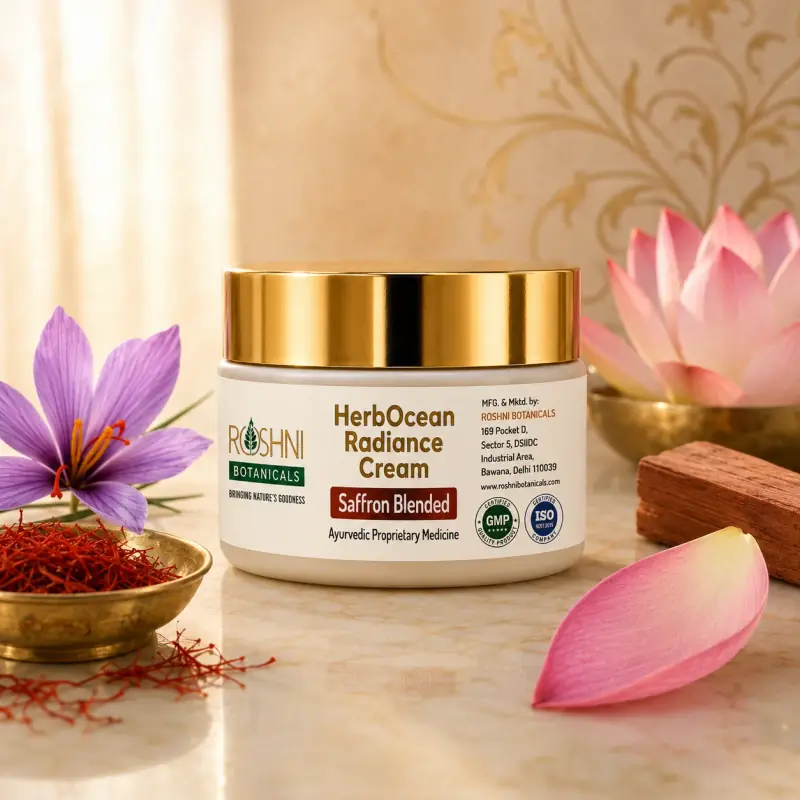
Radiance Cream
A daily saffron and sandalwood brightening cream with Manjistha, red sandalwood and lotus in a light coconut base. Supports a luminous, even-looking skin tone.
Part of our guide: Ayurvedic treatment for melasma on Indian skin.