
Jatamansi for Hair: The Himalayan Root in Your Evening Head Massage
What this Himalayan root actually is, what the Ayurvedic Pharmacopoeia records for it, why its sourcing matters, and its measured place in a sixteen-botanical hair oil.
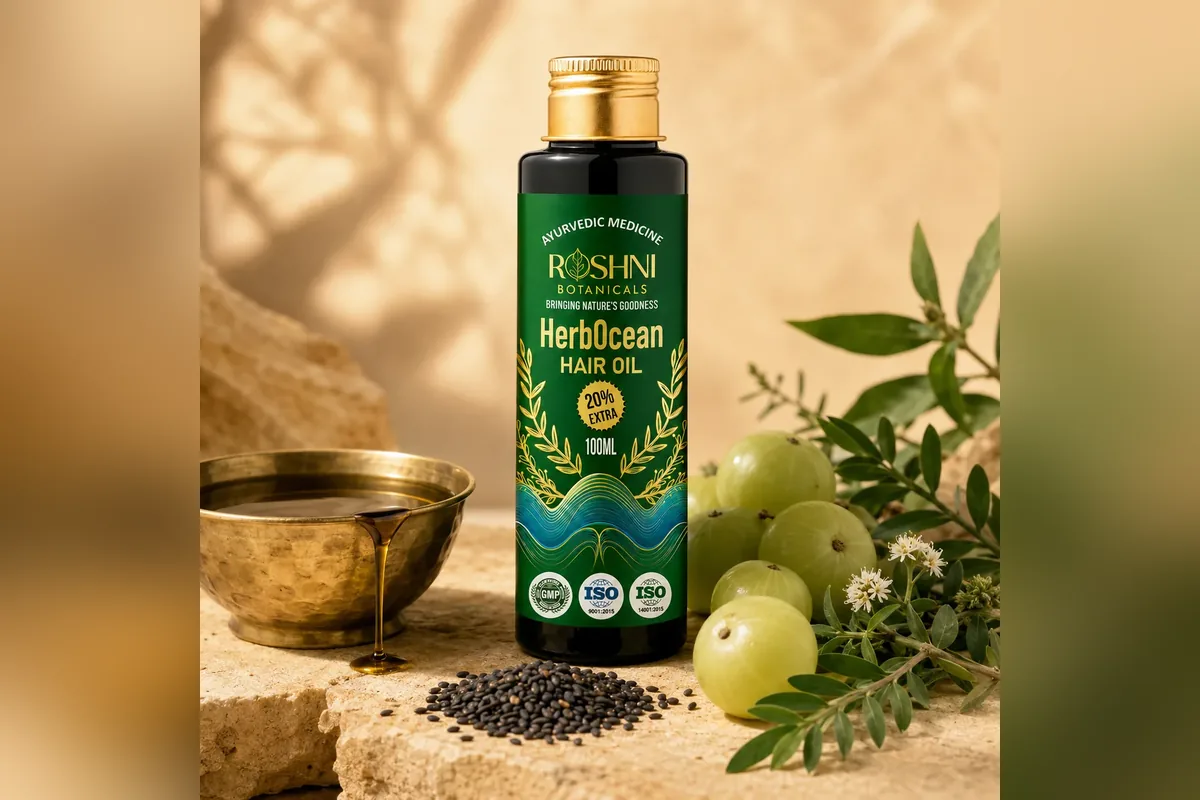
Most Indian households have a champi oil somewhere, and somewhere in its ingredient list, usually unread, sits Jatamansi. It is a Himalayan root, it is one of sixteen botanicals in our own hair oil, and it is genuinely rare in the wild. What follows is what it is, what the pharmacopoeia actually records for it, and why the question of where it came from deserves as much attention as what it does.
Key takeaways
- Jatamansi (Nardostachys jatamansi, spikenard) is the rhizome of an alpine Himalayan plant, harvested above three thousand metres.
- The Ayurvedic Pharmacopoeia of India records it as cooling in potency, and as a Medhya (intellect-promoting) and Nidrajanana (sleep-inducing) drug. Its recorded actions are on the skin rather than the scalp.
- The species is assessed Critically Endangered on the IUCN Red List, and its international trade is regulated under CITES Appendix II. Indian law is stricter still.
- In HerbOcean Hair Oil it sits in equal measured weight with each of the other eleven herbs. No single herb carries the formula.
- No effect on hair growth is claimed for it here. The routine we suggest is a 45 to 60 minute application before a wash, twice a week.
What Jatamansi Is, and What the Pharmacopoeia Records
Jatamansi is the rhizome of Nardostachys jatamansi, known in English as spikenard, a small alpine plant of the high Himalaya. It grows in a narrow band of altitude, roughly three thousand metres and above, across the ranges of Bhutan, China, India, Myanmar and Nepal. The part used is the underground rhizome and its dense mat of rootlets, which carries the heavy, earthy, slightly sweet smell that anyone who has opened a jar of it will remember.
If you have bought it loose, you will know it by smell before sight. The dried rhizome comes as short, dark, hairy pieces, matted with the fibrous remains of old leaf bases, and the scent is heavy and earthy in a way that stays on your fingers. That smell is the reason it has been traded across the Himalaya for a very long time, and it is also why a hair oil carrying it announces itself the moment the bottle is opened. In an oil, that character does not disappear behind the sesame; it sits underneath everything else.
Here is where we would rather be accurate than flattering. The Ayurvedic Pharmacopoeia of India, which is the statutory standard, records Jatamansi with a shita (cooling) potency, and lists it as Medhya, intellect-promoting, and Nidrajanana, sleep-inducing. Its recorded actions in the pharmacopoeia fall on the skin rather than the scalp. In other words, the classical record places this as a mind-and-sleep drug rather than a hair drug, and this article will not stretch it into something it is not. What it brings to a hair oil is its own settling character and that unmistakable smell, in a formula where the sesame base and fifteen other botanicals are doing their own work.
The published research on hair specifically is thin, and it is worth saying so plainly rather than gesturing at studies. There is no human trial we would put in front of you. Anyone quoting you a percentage for this root and hair growth is quoting something that does not exist in a form that applies to your head.
A Himalayan Root Under Real Collection Pressure
Jatamansi is a slow-growing alpine species, and the way it is harvested is the problem. Collectors uproot the whole plant to take the rhizome, and the plant does not survive it. Wild collection across its range has already cost several known subpopulations. The IUCN Red List, in an assessment published in 2021, lists the species as Critically Endangered under criterion A2cd (Chauhan, IUCN Red List of Threatened Species, 2021, assessment e.T50126627A88304158). That is the second-highest category of extinction risk there is.
The regulation around it is more specific than most writing admits, and the detail matters. Its international trade is regulated under CITES Appendix II, under annotation #2: all parts and derivatives are covered, except seeds and pollen, and except finished products packaged and ready for retail trade. So the rhizome moving upstream is permit-controlled; a bottled oil made in Delhi and sold in India is not. We are spelling that out because it would be easy, and flattering to us, to imply that every bottle sits inside an international permit regime. It does not.
Indian law is what governs here, and it is stricter. The species sits in Schedule IV of the Wild Life (Protection) Act, 1972, and India's export policy prohibits the export of wild-origin material outright. The honest question, then, is not about permits at a border. It is whether the rhizome was legally and traceably collected in the first place.
There is a hopeful side to this that deserves mention. Cultivation and certified sustainable-collection schemes for this species do exist and have been documented in the Himalaya, including work recorded in the IUCN assessment itself. A plant that can be farmed rather than dug out of a hillside is a plant with a future, and demand that steers towards cultivated material is doing something useful rather than merely feeling bad about itself.
What that means in practice is that the pressure on this plant is a demand problem before it is a supply problem. A rhizome dug from a hillside and a rhizome grown on a farm look the same in a jar, cost differently, and carry entirely different consequences. Nobody buying a bottle of hair oil can inspect that themselves, which is precisely why it is worth asking brands to say more than they are currently asked to say.
Two questions are worth putting to any brand that names this root on its label. First: is the herb given a stated place in the formula, or buried inside a proprietary blend? Second: is the root used in measured proportion, or shouted about on the front of the pack as if scarcity were the selling point? A formula that leans on rarity as its headline should make you pause, whoever is selling it.
Where Jatamansi Sits in HerbOcean Hair Oil
HerbOcean Hair Oil carries Jatamansi at a measured weight. That is the same share as each of the other eleven herbs in the formula, and we are saying so plainly rather than leaving you to guess at it. A classical Taila works as an ensemble: each herb simmered into the sesame base in a specified proportion, so it contributes to the character of the whole oil rather than carrying it. Nothing here claims the root acts on hair fall (Khalitya, the classical Ayurvedic term).
That ensemble point is worth dwelling on, because it runs against how ingredient marketing usually works. A classical medicated oil is not a delivery vehicle for one active with decoration around it. The sesame base is doing real work of its own, the herbs are simmered into it rather than stirred in afterwards, and the finished oil is the product of the whole process rather than the sum of its most marketable component. Pulling one name out of that and putting it on the front of a pack tells you more about the marketing than the formulation.
The full formula is sixteen botanicals: twelve herbs at equal measured weights, being Bhringraj, Jatamansi, Brahmi, Shikakai, Amla, Nagarmotha, Chharila, Sugandhbala, Gudal, Tulsi, Gulab and Neem, in a sesame oil (Til tail) base, finished with lavender, curry leaf and rosemary oils. The full ingredient list is on the HerbOcean Hair Oil page. It is made in-house at Bawana, Delhi under AYUSH Licence No. DL-474 A&U, which requires a batch manufacturing record for every lot produced, and the formulation rests on the forty-year Ayurvedic formulation legacy of Vaidya Shri Ram Prakash Ji.
Stress, Sleep and the Scalp: What an Oil Can and Cannot Do
Jatamansi's pharmacopoeial standing is as a mind-and-sleep herb, so the temptation is to draw a straight line from a calmer evening to a fuller head of hair. We are not going to draw it. The evidence connecting ordinary poor sleep to hair fall is associative rather than causal, and a head massage that helps you wind down is worth having on its own terms without being asked to carry more than that. Shedding that follows a genuine physiological shock, an illness or a high fever, behaves differently and on its own timeline, which our post on hair fall after fever or illness covers properly.
What a slow champi does reliably is the unglamorous part: it gets oil onto the mid-lengths before a wash, it slows you down for an hour, and it makes detangling gentler afterwards. The routine we suggest is 45 to 60 minutes before washing, twice a week, rather than leaving oil on overnight; in humid weather a shorter, pre-wash application tends to sit more comfortably on the scalp. Warm the oil slightly, work it along the mid-lengths and ends, use fingertips rather than nails on the scalp, and wash it out properly. Our Ayurvedic hair oiling routine sets out the method in full, and if your water runs hard, our piece on hard water covers what that does to hair and how to work around it.
A few practical points, since this is where most of the benefit actually sits. Use less oil than feels right the first time; the aim is a light film on the lengths, not a soaked head that needs three washes to clear. Warm the bottle in a bowl of hot water rather than heating the oil directly. Section the hair and work along the mid-lengths and ends first, then the scalp, because the ends are the oldest and driest part of the hair and usually get the least attention. Use the pads of the fingers in slow circles rather than nails, and do not scrub. When you wash it out, wet the hair thoroughly before the shampoo goes anywhere near it, which lifts a good deal of the oil before you start.
Some things are not an oiling question at all. See a dermatologist if you notice coin-sized round bald patches, if your parting is visibly widening, if the scalp is painful, oozing or thickly scaly, if hair is snapping off at the hairline where it is pulled back tightly, or if heavy shedding after an illness has not settled after six months. If active breakouts or scalp trouble are the real problem, our complete guide to Ayurvedic hair oils for hair fall is the place to start.
A Rare Root, Used in Measure
Jatamansi is worth knowing about for what it is: a slow-growing Himalayan rhizome with a long classical standing as a settling, sleep-supporting drug, and a species under enough pressure that how it reaches a bottle matters. In our oil it sits at a measured weight, one of sixteen botanicals, named openly and claimed for nothing it cannot do. That is a smaller promise than the category makes, and it is the one we can stand behind.
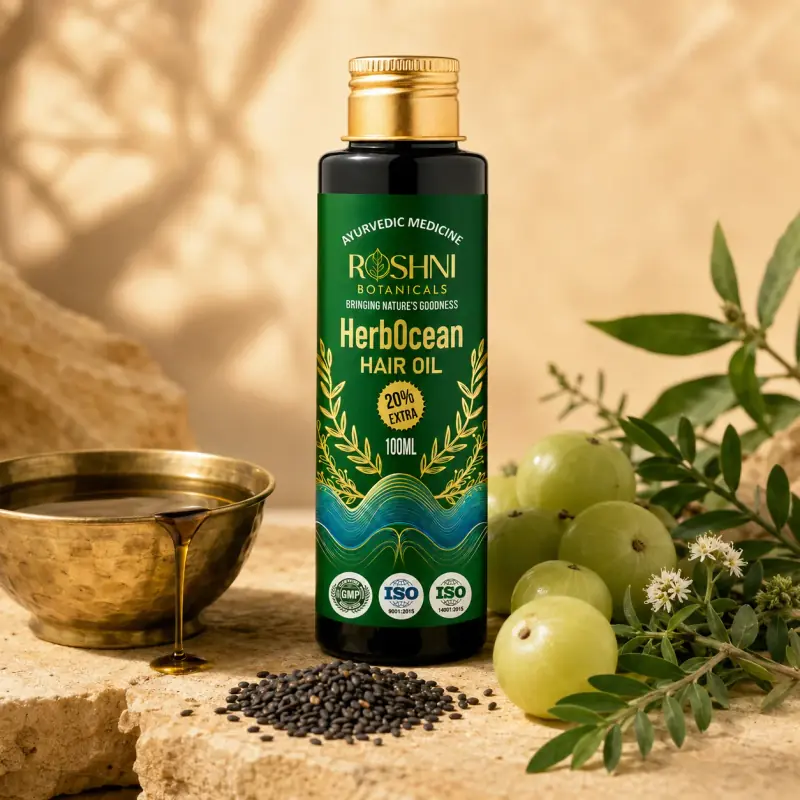
HerbOcean Hair Oil
A classical Taila for hair fall, dullness and a flaky scalp, with sixteen botanicals like Brahmi, Jatamansi, Amla and Neem in a slow sesame base.
Part of our guide: The definitive guide to Ayurvedic hair oils for hair fall.