
Hair Fall in Autumn: Why Shedding Often Peaks in September and October
Why hair fall often peaks after the monsoon, what the European studies do and do not show, and a six-week autumn routine for washing, oiling and counting.

You wash your hair on a Sunday and the drain tells a story you did not want to read. The rains are over, the weather is finally pleasant, and still your hair keeps coming away in the comb. It feels backwards.
It is not. Much of what you count in October was set in motion back in July, and once that lag makes sense, the shedding of early autumn is far less alarming. It also tells you what to change: how often you wash, how often you oil, and how you count.
Key takeaways
- Studies that tracked hair through the year found the largest share of resting hairs at the end of summer and the start of autumn, with shedding following the same curve. The strands falling then stopped growing two to three months earlier.
- Those studies were done in Europe, on small or selected groups, and we could find no comparable study from India. Read the autumn rise as a tendency the studies point to, not a rule.
- Count on one fixed wash day a week. A wash gathers several days of already-released hair at once, which is why the drain looks alarming while the pillow looks fine.
- Autumn asks for a change of cadence: washes come down as sweat drops, and oiling goes up as the air dries.
- A widening parting, a smooth patch of scalp with no hair, visible scalp at the crown, or heavy fall that runs past six months is not seasonal and belongs with a dermatologist.
What Autumn Shedding Looks Like
Start with a baseline. Fifty to a hundred strands a day is the range usually quoted as ordinary, so a count inside it is not, on its own, a reason to worry.
Two things make autumn shedding look heavier than it is. One is wash-day clumping: a wash collects several days of hair that had already let go. The other is length, because a hundred strands that reach halfway down your back look like far more than a hundred short ones.
So count the same way every week. Pick one wash day, gather what comes out in the wash and the comb, and note roughly how many strands there are. The exact number matters less than where it is heading from one week to the next.
Look closely and a strand shed from the root often carries a small white bulb at its end, the mark of a hair that finished its cycle and let go. If you want to tell that apart from breakage, hair fall in the monsoon has a simple check.
The Lag: Why October Shedding Starts in July
Every strand runs a cycle: a long growing phase, a short transition, then a resting phase. A resting hair has stopped growing, but it does not drop straight away. It stays anchored for roughly two to three months and lets go after that, usually as a new hair pushes up beneath it. The hair growth cycle names each phase and how long it usually lasts.
So if more of your strands went into rest in July and August, they let go in September and October. The count is set up while the rains are still on, and you see it once they are over.
Three studies from Europe found a seasonal peak. A French team followed ten men for between eight and fourteen years, photographing the same patch of scalp, and found the share of resting hairs highest at the end of summer and the start of autumn. A Belgian study read the hair-root samples of 2,857 people over two years and found this kind of shedding most often between July and October. A Swiss hospital looked back over six years of hair-root samples from 823 women and found the resting share highest in summer, with a smaller peak in spring and the lowest values in late winter.
Now the caveats. The Belgian and Swiss groups were people who had come in complaining of hair loss, so they are not a cross-section of everybody, and the French study was small. The Belgian authors suggest summer sunlight may play a part, so what sets the count up in an Indian July is not settled, and we could find no comparable study from India. So read the autumn rise as a tendency that may match what you are seeing. Your scalp is under no obligation to follow it.
Autumn in the Ayurvedic Calendar
The classical seasonal routine (Ritucharya) reads the Indian year in six seasons, not just hot and cold. The rains are read as the season when Vata is aggravated, and early autumn as the season when the heat stored up through the rains comes out as Pitta. Vata and Pitta are two of the three doshas, the biological energies in Ayurveda. Meanwhile the air outside starts to dry.
You can feel that switch in North India without knowing a word of Sanskrit. A scalp that turned greasy by the second day in August feels tight by the third day in October. Pull a kurta over your head and the hair crackles with static, and the ends look duller. You sweat less, so you reach for the shampoo less often.
The texts set out a regimen for each season, from food to sleep to time in the sun, and the principle behind it is simple: when the season moves, your routine moves with it.
What to Change for Autumn
Wash a little less often. A scalp that needed three washes a week in August may be comfortable on two by the middle of October, because there is less sweat to shift. Let your scalp overrule the calendar, though: if it starts to itch or flake, wash more often and more gently, not less. For the detail, see how often to wash your hair.
Oil a little more often. As the air dries, add a session, so that you are oiling two or three times a week with a medicated oil (Taila). Warm it, work it in with the pads of your fingers, keep your nails out of it, and give it at least an hour before you wash, or leave it overnight. The full method is in the Ayurvedic hair oiling routine.
Look at the scalp once a week. Part your hair in three places in daylight, look at the skin itself for flaking or redness, and press lightly to feel for any sore spots. A seasonal shed and a scalp problem can feel much the same from the outside, and a quick weekly look is how you catch the difference early. A scalp that stays red, sore or flaky despite gentler washing is one to show a dermatologist.
Handle wet hair gently. Use a wide-tooth comb once the hair is partly dry, skip tight ties on damp hair because wet hair stretches and then snaps, and squeeze the length through a towel without rubbing. Gentle handling can take some avoidable breakage off the pile, so the number you write down on wash day sits closer to the shed itself.
HerbOcean Hair Oil in the Autumn Routine
HerbOcean Hair Oil is an AYUSH-licensed Ayurvedic medicine for external use, classically indicated for hair fall and dullness. It nourishes the scalp, helps keep it clean and flake-free, and is traditionally used to support the scalp against dryness and seasonal hair fall. It is a classical Taila of sixteen botanicals in a sesame (Til tail) base: twelve herbs, namely Bhringraj, Jatamansi, Brahmi (Bacopa monnieri), Shikakai, Amla, Nagarmotha, Chharila, Sugandhbala, dried hibiscus (Gudal), Tulsi, rose (Gulab) and Neem, finished with lavender, curry leaf and rosemary oils. No single herb leads the formula; the twelve are declared at the same weight. It is made in-house at our GMP-certified unit in Bawana, Delhi, under AYUSH Licence No. DL-474 A&U, and built on the 40-year Ayurvedic formulation legacy of Vaidya Shri Ram Prakash Ji.
The finished oil is a deep reddish amber, and that colour comes from the herbs cooked into the sesame base. Warm a little, part the hair and work it into the scalp with your fingertips for a few minutes, then take what is left down the lengths. Leave it for at least an hour, or overnight, and wash it out with a mild shampoo. Two or three sessions a week is the rhythm.
Because this is a medicine, the cautions come with it. For external use only. Patch-test on the inner forearm 24 hours before first use and discontinue if irritation occurs; avoid the eye area. Anyone with a known allergy to sesame or to a listed botanical, or with an active scalp infection or broken skin, should not use it without medical advice. If you are pregnant or nursing, check with your doctor before use. Keep the oil off your breasts, and never use it on the baby.
For the herbs themselves, see the botanicals in a classical Ayurvedic hair oil, and for the rest of the year, how HerbOcean Hair Oil suits each part of the Indian year.
Seasonal, or Something Else?
Shedding after an illness follows the event and not the calendar. Fever, dengue, typhoid, surgery or a crash diet can push a large share of strands into rest at once, and the fall shows up two to three months later on its own timeline. If you had a fever or another illness a couple of months before the shedding began, read hair fall that starts two to three months after a fever.
Traction shows up where the pull is. Tight buns, braids and daily tension at the hairline thin the temples and the front edge while the rest of the scalp stays dense. Seasonal shedding is spread across the whole scalp. Traction is local, and you usually see it in the mirror before you see it in the drain. More on that in tight hairstyles and hair fall.
Hard water mostly shows up in texture and breakage: rough hair, more tangles, lather that refuses to build. If your water comes from a borewell, it may well be hard, as much of the groundwater in Delhi is, and hard water and hair fall explains what to do about it. A scalp that flakes heavily, stays itchy or hurts is its own condition, and it belongs with a dermatologist before any change to your oiling.
See a dermatologist for sudden heavy shedding, a widening parting, a smooth patch of scalp with no hair, or a scalp that stays sore, itchy or flaking despite gentler washing. Visible scalp at the crown, or heavy fall that has run past six months, belongs there too, in any month of the year.
A Steady Six Weeks: Your Autumn Plan
Start from two oiling sessions and two washes a week, oiling before each wash. Count once, on one fixed wash day, and write the number down. Use the same day for the scalp check: three partings, in daylight. At week six, ask one question: is the weekly number coming down, or at least holding steady? If it is, keep the cadence. If it is still climbing, see a dermatologist rather than adjusting the routine again. Six weeks is a judgement call and not a studied figure; it is simply long enough to see which way the count is heading.
On the plate, protein spread across the day and regular meal times make sense whatever your hair is doing. If you are tired all the time, breathless on the stairs or have heavy periods, ask your doctor about a blood test for iron. What to eat for stronger hair has the everyday Indian foods and the iron-and-vitamin-C pairing.
The One Idea Worth Keeping
What you count in autumn was mostly set in motion two or three months earlier, so the useful response is a steadier cadence. Count once a week, on the same day, for six weeks. See a dermatologist if the warning signs are there. And for hair fall across the whole year, our definitive guide to Ayurvedic hair oils for hair fall is the place to go.
References: Courtois M, Loussouarn G, Hourseau S, Grollier JF. Periodicity in the growth and shedding of hair. British Journal of Dermatology. 1996;134(1):47-54 (ten men with or without alopecia, followed for 8 to 14 years by phototrichogram; authors at an industry research laboratory in France; resting hairs highest at the end of summer and the beginning of autumn, with shedding following the same pattern; the authors link it to sunshine hours). Piérard-Franchimont C, Piérard GE. Actinic telogen effluvium: a facet of human chronobiology (title translated from the French). International Journal of Cosmetic Science. 1999;21(1):15-21 (trichograms of 2,857 people who complained of increased hair loss, over two years; authors in Liège, Belgium; telogen effluvium most frequent between July and October; the authors suggest ultraviolet light may play a part). Kunz M, Seifert B, Trüeb RM. Seasonality of hair shedding in healthy women complaining of hair loss. Dermatology. 2009;219(2):105-110 (a retrospective review of trichograms from 823 women with a hair-loss complaint at the University Hospital of Zurich, over six years; resting hairs highest in summer, a smaller peak in spring, lowest in late winter). Headington JT. Telogen effluvium: new concepts and review. Archives of Dermatology. 1993;129(3):356-363 (a review of the mechanisms of telogen effluvium, including the delayed release of resting hairs). Rebora A. Telogen effluvium: a comprehensive review. Clinical, Cosmetic and Investigational Dermatology. 2019;12:583-590 (a resting hair stays about three months before it is shed; shedding that runs past six months is the chronic form). Grover C, Khurana A. Telogen effluvium. Indian Journal of Dermatology, Venereology and Leprology. 2013;79(5):591-603 (a review from a Delhi medical college; notes that a seasonal rise in shedding has not been reliably evaluated). American Academy of Dermatology. Do you have hair loss or hair shedding? Patient guidance (normal shedding given as 50 to 100 hairs a day). Educational, not medical advice.
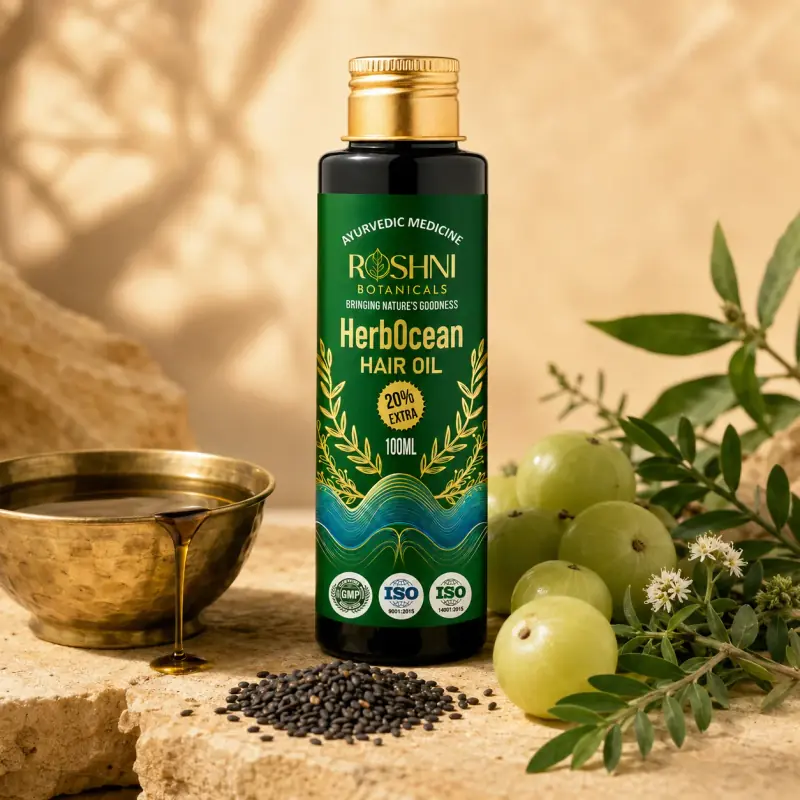
HerbOcean Hair Oil
A classical Taila for hair fall, dullness and a flaky scalp, with sixteen botanicals like Brahmi, Jatamansi, Amla and Neem in a slow sesame base.
Part of our guide: The definitive guide to Ayurvedic hair oils for hair fall.