Turmeric (Haldi) for Skin: Brightening, Pigmentation and How to Use It Well
Haldi is the most familiar skin herb in any Indian kitchen, and the most over-promised. Here is what turmeric honestly offers.
The haldi in your kitchen has been on Indian skin for as long as anyone can remember. It goes into the ubtan before a wedding, into the paste an aunt mixes the moment a spot appears, into the first suggestion anyone offers when marks refuse to settle. That familiarity deserves to be taken seriously. It also deserves precision, because much of what is written about turmeric and pigmentation promises more than turmeric has ever been shown to do.
Key takeaways
- Haldi is Curcuma longa. Charaka Samhita, Sutra Sthana 4, lists it among the Kushtaghna dravyas (substances used as medicine) for skin disease.
- Melasma is Vyanga (the classical Ayurvedic term for facial pigmentation), set out in the Sushruta Samhita, Nidana Sthana 13, as Vata surcharged with Pitta (two of the three doshas, the biological energies of Ayurveda) rising to the face.
- Brightening is not a change of complexion, and on melanin-rich Indian skin a post-acne mark outlasts the pimple by months.
- A 2018 systematic review of natural ingredients for hyperpigmentation reviewed turmeric without listing it as effective.
- Kasturi manjal is a different species, Curcuma aromatica, not haldi. Turmeric sits in HerbOcean Radiance Cream.
Where classical Ayurveda actually places haldi
Turmeric is not a fringe herb in the classical literature, and not a member of the classical complexion group either. The Charaka Samhita, in Sutra Sthana 4, sorts several hundred dravyas into groups of ten by what they do. Haridra, turmeric, appears in the Kushtaghna group, the ten classically assembled for skin disease, and again in the Lekhaniya group, the scraping or reducing herbs. That is the placement: a categorisation of the herb, not a promise for any modern preparation.
The pigmentation most Indian readers are searching about has its own classical entry. Vyanga is the term, and the Sushruta Samhita sets it out in Nidana Sthana 13 among the minor disorders: Vata, aggravated by anger and overexertion and surcharged with Pitta, rises to the face and leaves thin, circular, painless brown patches. Two things are worth noticing: it is specific to the face, and it is painless, which is why pigmentation gets ignored for years while an itch sends someone to a doctor in a week.
Bhrajaka Pitta, the sub-dosha seated in the skin and held responsible for its lustre and its absorption of what is applied, bridges the two ideas. Herbs that settle Pitta are the ones classical practice reaches for when the skin looks heated, reactive and marked. Haldi is one of them. Our fuller account sits in the guide to Ayurvedic treatment for melasma on Indian skin.
Why melanin-rich skin changes the question
Skin with more melanin pigments more readily in response to injury, and holds the result longer. Post-inflammatory hyperpigmentation, or PIH, is the brown mark left after the inflammation has gone: after a pimple, a scratch, a wax, an aggressive scrub. On Indian skin the mark frequently outlasts the spot that caused it, and most readers meet it first after a breakout, which our guide to Ayurvedic treatment for acne covers from the inflammation end.
Epidermal PIH, where the extra pigment sits in the upper layers, is more likely to settle than pigment that has gone deeper. Even once the inflammation behind it has stopped, though, the course is slow and unpredictable, and without treatment it can run from months into years. Pigment that has dropped deeper into the dermis looks blue-grey, improves far more slowly, and may not clear completely. So the useful question is not which herb erases a mark, but what keeps the next round of inflammation from starting and what keeps ultraviolet light from deepening the marks already there. The latitudes we live at deliver meaningful ultraviolet through the year, on overcast days and through car windows too.
Humidity and heat push the same cycle along: sweat, congestion, a breakout, another mark. Delhi groundwater is hard, and hard water is associated with barrier disruption rather than with pigment. A barrier under strain inflames more easily, and inflammation is what leaves the mark.
The last India-specific risk comes from our own kitchens, where turmeric packs are often mixed with lemon juice. Citrus juice left on the skin before sun exposure is a documented trigger of phytophotodermatitis, a phototoxic reaction to plant-derived furocoumarins under ultraviolet A light. On melanin-rich skin it settles into exactly the marks the pack was meant to address. If you are unsure which mark you have, our note on the difference between dark spots and pigmentation helps.
Brightening is not a change of complexion
No herb changes the colour you were born with, turmeric included, and a preparation that claimed to would be making a claim it cannot keep. A great many readers arrive at this subject looking for exactly that promise, so it is worth answering directly rather than politely stepping around it. Your complexion is yours, and it is not a defect awaiting correction.
What brighter-looking honestly means is narrower and more useful. Skin that is calm rather than inflamed reflects light more evenly. Skin that is not carrying a fresh layer of dead surface cells looks clearer. Skin that is not accumulating new marks every few weeks gradually looks less patchy, because the older marks are following their own slow course while fewer new ones arrive. None of that is a change in your natural colour, and all of it is visible.
Once you accept that brightening describes an appearance and not a change in the colour you were born with, the timelines stop being absurd. Anything promising a visible change in a week is describing a surface exfoliation or a photograph. Pigmentation that took two years to gather does not leave in ten days, and the honest version of this care is measured in months of consistency plus daily sun protection.
Kachi haldi on the face: what it does, and what it stains
Can you put turmeric directly on your skin? You can, and Indian households have for generations. Four things are worth knowing first.
It stains. Curcumin is a dye: haldi leaves a lasting mark on a kurta and a yellow cast on skin for a day or two. The tint is harmless and washes off.
The dose is unknowable. A pinch from a steel dabba is not a measured quantity, and kitchen haldi is milled for cooking, not for a face. A besan and haldi ubtan is a real practice with real logic behind it, best kept as an occasional ritual, and mixed with curd, milk or plain water instead of lemon.
It can cause a genuine allergic reaction. A 2023 case report in Contact Dermatitis from a dermatology department in Coimbatore described allergic and photoaggravated contact dermatitis to the turmeric on a mangalsutra, a cultural dermatosis in the words of the authors. Two cases of contact urticaria from curcumin were reported in Dermatitis in 2006. Patch-test on the inner forearm and wait twenty-four hours before anything goes on your face.
And kasturi manjal is not haldi. It is a separate species, Curcuma aromatica, recorded as Kasthurimanjal by the State Medicinal Plants Board of Kerala. It is traditionally chosen for the face because it stains less, but it is not what your kitchen jar contains, and not what the research is about.
What the modern literature actually shows
Here is where honesty costs something. The best-known survey is a 2016 systematic review in Phytotherapy Research by Vaughn, Branum and Sivamani, a United States review which screened 234 articles and included 18 clinical studies of turmeric and curcumin. Nine of those eighteen studies tested turmeric taken by mouth, eight tested it applied to the skin, and one tested both. The conditions studied were acne, alopecia, atopic dermatitis, facial photoaging, oral lichen planus, pruritus, psoriasis, radiodermatitis and vitiligo. Melasma is not on that list, and neither is post-inflammatory hyperpigmentation.
A 2023 review of topical curcumin in Skin Pharmacology and Physiology makes the problem plain: most clinical literature concerns curcumin taken by mouth, and only a few studies describe topical application. That split matters, because curcumin taken by mouth is poorly absorbed and a result from swallowing is not a result from a paste on the face. When a turmeric study is quoted at you, it is worth asking which of the two it was.
The most directly relevant paper is the least flattering. A 2018 systematic review in the Journal of Clinical and Aesthetic Dermatology by Hollinger, Angra and Halder, another United States review, searched specifically for natural ingredients in hyperpigmentation and melasma, selected thirty clinical studies, and named turmeric among the ingredients reviewed. The ingredients it concluded had shown efficacy as depigmenting agents were azelaic acid, soy, lignin peroxidase, ascorbic acid iontophoresis, arbutin, ellagic acid, licorice extracts, niacinamide and mulberry. Turmeric is not in that list. Liquorice is, which is why we cover liquorice for hyperpigmentation as a separate subject.
Turmeric has a long classical record in skin care and a modest, early modern record for inflammatory skin conditions. The one systematic review that searched specifically for natural depigmenting agents did not find it effective, and we would rather say so than repeat the tyrosinase paragraph that circulates on every other page about haldi.
Turmeric inside the Radiance preparations
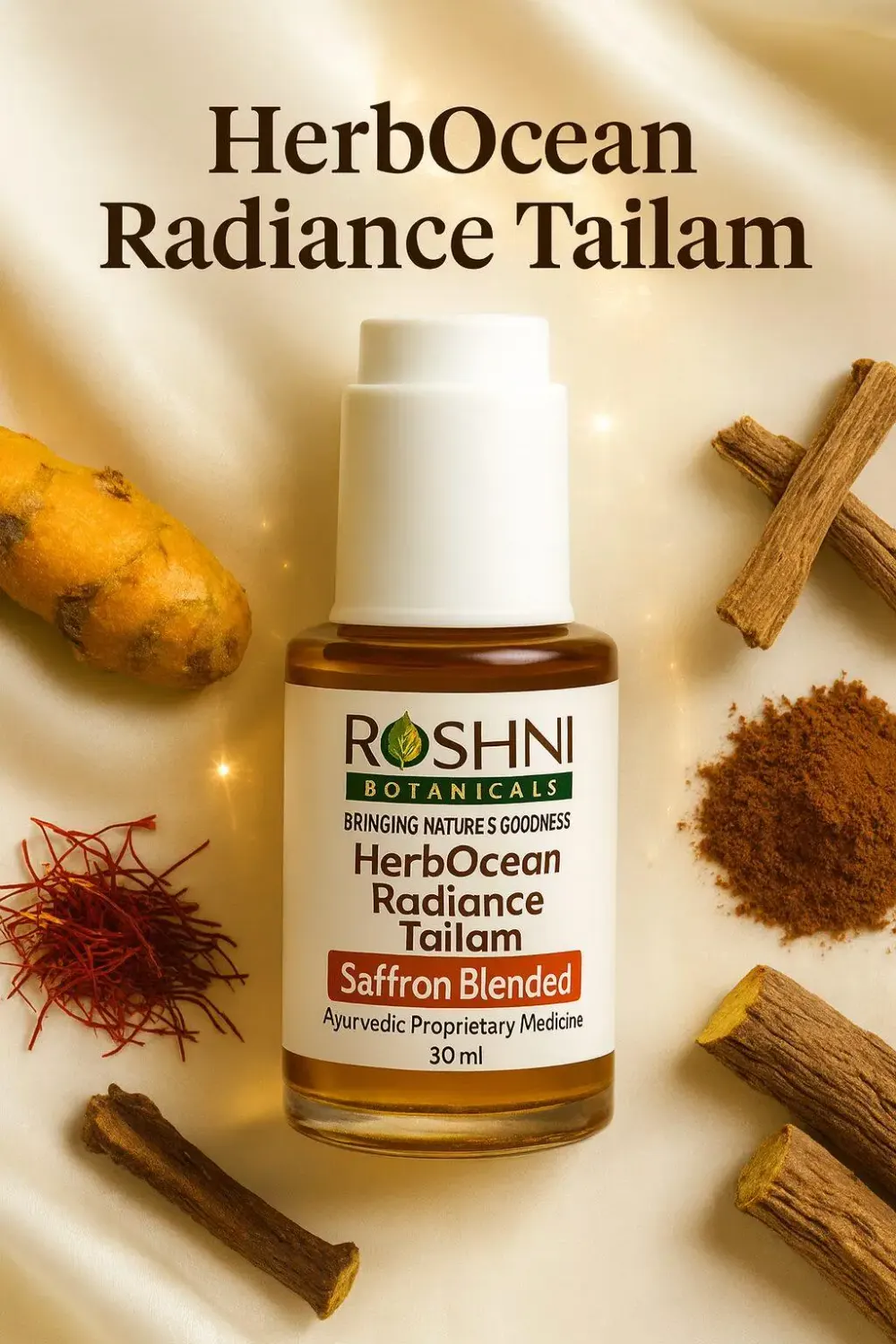
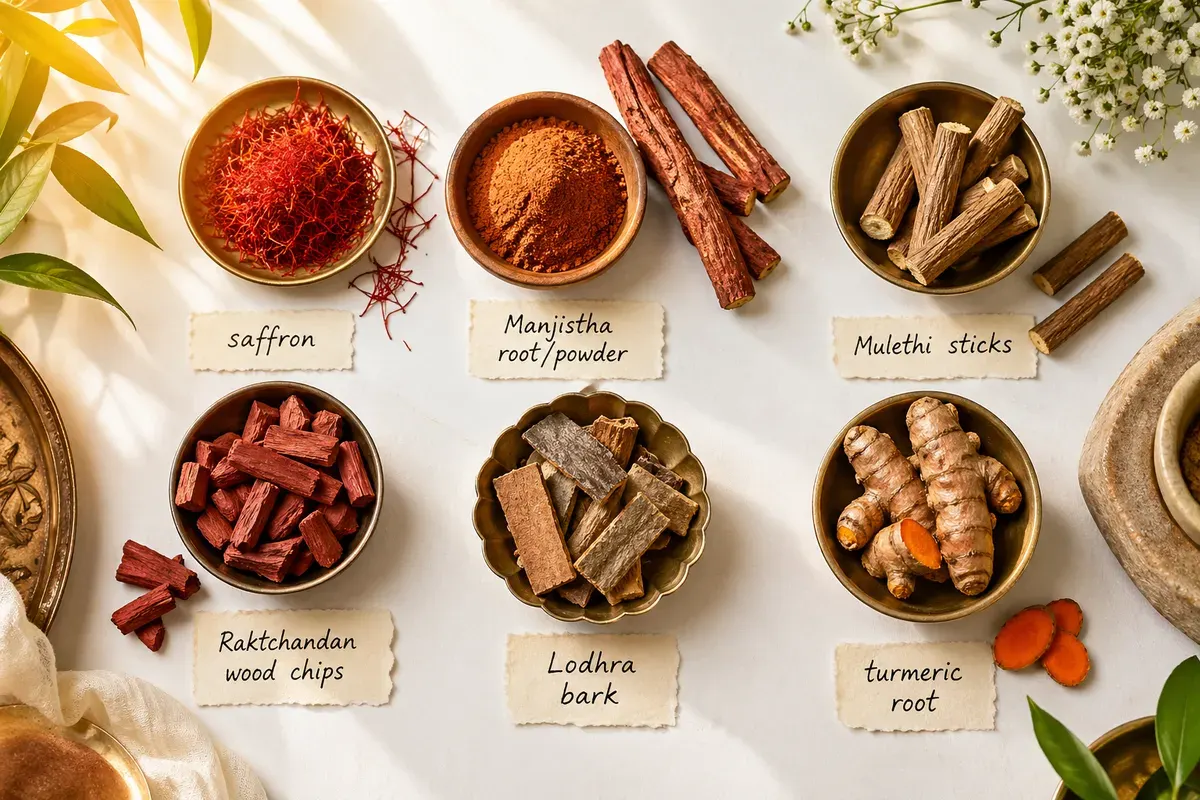
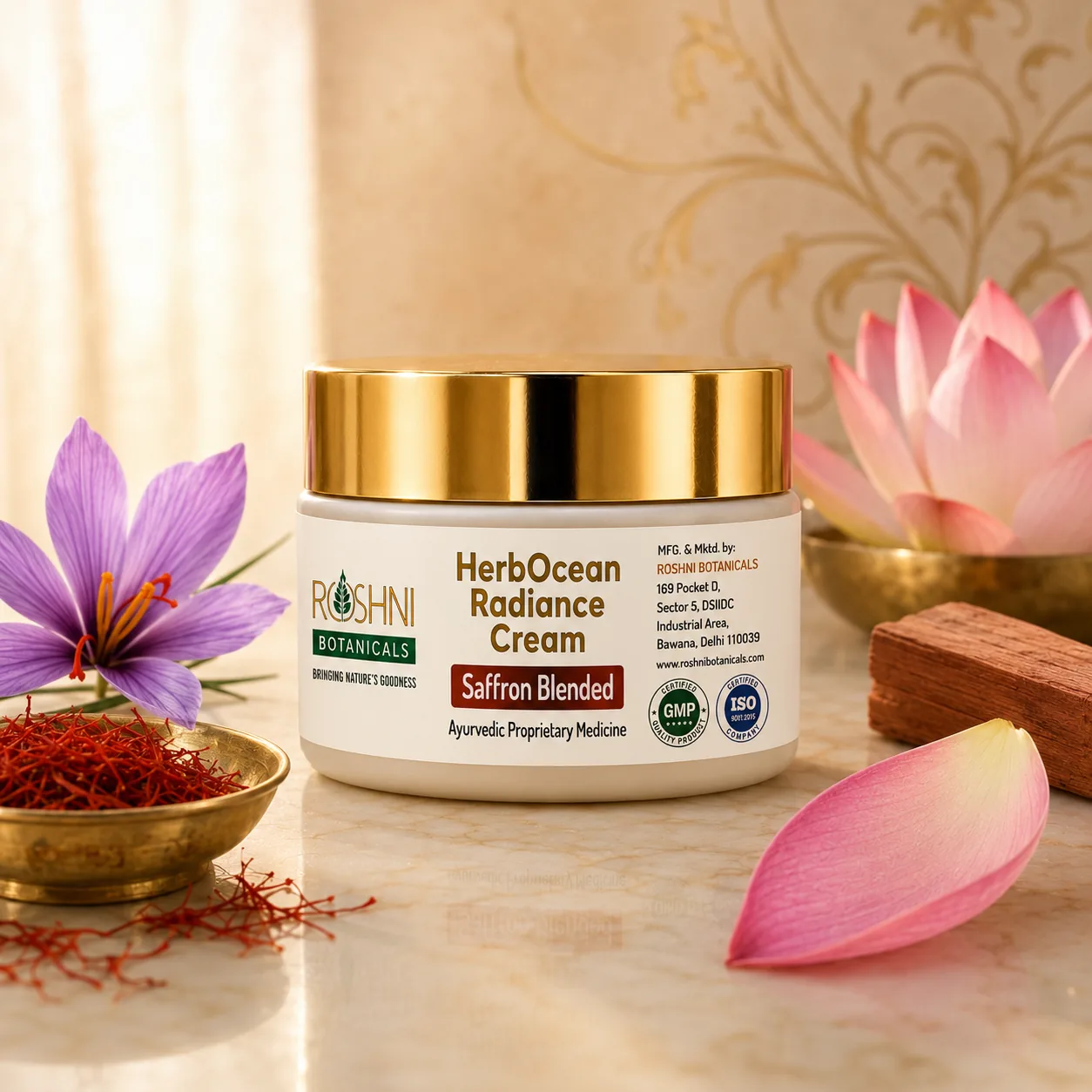
Turmeric earns its place in our formulations as one calming botanical among others, not as a headline. HerbOcean Radiance Cream is an Ayurvedic medicine for external use, classically indicated for facial pigmentation (Vyanga, the patches Hindi homes call jhaiyaan) and traditionally used in the care of dark spots and uneven tone. Saffron, sandalwood, Manjistha, red sandalwood, lotus and Padmaakh sit in that cream alongside Haldi, Kuth, Kakoli, Palash flower and the Triphala fruits amla, baheda and harad, in a coconut base finished with lavender, rose and mogra oils. No single herb leads this formula.
HerbOcean Radiance Tailam carries the same botanical family in a sesame Taila (medicated oil) instead of a cream base, which is the difference between a night oil and a daily one. Both are made in-house at our GMP-certified unit in Bawana, Delhi, under AYUSH Licence No. DL-474 A&U, and both are built on the 40-year Ayurvedic formulation legacy of Vaidya Shri Ram Prakash Ji.
A formulated preparation solves the two problems raw haldi cannot. The quantity is fixed rather than guessed, and the herb is carried in a base made for the face rather than mixed in a kitchen bowl. For why turmeric and Manjistha are so often used together, see our post on Manjistha and turmeric for pigmentation, and for the third herb in this family, chandan for the skin.
How to use it well
Smooth the cream over clean, dry skin morning and night, a thin layer over the whole face rather than dabbed on the marks, since pigmentation is usually more diffuse than it looks. Order matters more than quantity: in the morning the cream goes on first and sunscreen last. If you prefer an oil at night, press a few drops of the Tailam in with an upward massage, last of all, and leave it overnight. The cream by day and the oil at night is the pairing the two are made for. In humid weather a lighter hand with the oil sits better; when the air is dry, a fuller layer suits.
Sunscreen every single morning is the non-negotiable half of this. A 2020 review in the Indian Journal of Dermatology, drawing on nine publications, concluded that broad-spectrum protection covering ultraviolet A, ultraviolet B and visible light plays an adjuvant role in melasma and PIH on skin of colour. Without it, the ultraviolet exposure of one afternoon undoes the patient work of months, whether your routine is Ayurvedic, dermatological or both. Reapply if you are outdoors. HerbOcean does not manufacture a sunscreen, and nothing in the range replaces one. Our note on daily sun protection for Indian skin covers the practical version, and a night routine for dark spots sets out the order of application.
These are Ayurvedic medicines for external use. Patch-test on the inner forearm and wait twenty-four hours before the first full application. If pregnant or breastfeeding, check with your doctor. Keep the preparation away from the eye area, and stop if you see redness, itching or scaling.
When to see a dermatologist
Some pigmentation needs a clinician, and Ayurvedic care alongside it rather than instead of it. Book an appointment if pigmentation has appeared suddenly, if it is clearly asymmetrical or confined to one side of the face, or if a patch is growing, thickening or changing texture rather than simply sitting there.
See a dermatologist if melasma is not settling after three months of consistent care with daily sun protection, since the hormonal and vascular contributions to melasma are not addressed by a topical alone. Go sooner if pigmentation has arrived alongside hormonal symptoms such as irregular periods or unexplained weight change, or if it began after a new medication.
And go straight away if a home paste has left you with blistering, swelling or a burn that is spreading. Go too if itching, scaling or burning has not settled within a day. A reaction to turmeric is uncommon but it is documented, and it is not something to answer with more turmeric.
Haldi deserves its place in Indian skin care. It has a real classical placement and centuries of household use behind it. What it does not have is the power to change the colour you were born with. The useful version of turmeric care is unglamorous: a measured preparation such as HerbOcean Radiance Cream morning and night, sunscreen every morning without exception, patience measured in months, and a dermatologist consulted when the pattern looks unusual. If melasma is what brought you here, the fuller picture is in our guide to Ayurvedic treatment for melasma on Indian skin.
References: Classical loci: Charaka Samhita, Sutra Sthana 4; Sushruta Samhita, Nidana Sthana 13; Sushruta Samhita, Sutra Sthana 21. Modern sources, with design, size and population where the design carries one: Anand P, Kunnumakkara AB, Newman RA, Aggarwal BB. Bioavailability of curcumin: problems and promises. Molecular Pharmaceutics, 2007. Pharmacokinetic review. Babu D, Rai R. Allergic and photoaggravated contact dermatitis from turmeric in mangalsutra: a cultural dermatosis. Contact Dermatitis, 2023. Case report, dermatology department in Coimbatore, India. Chaowattanapanit S, Silpa-Archa N, Kohli I, Lim HW, Hamzavi I. Postinflammatory hyperpigmentation: a comprehensive overview: treatment options and prevention. Journal of the American Academy of Dermatology, 2017. Narrative review. Danby SG, Brown K, Wigley AM, Chittock J, Pyae PK, Flohr C, Cork MJ. The effect of water hardness on surfactant deposition after washing and subsequent skin irritation in atopic dermatitis patients and healthy control subjects. Journal of Investigative Dermatology, 2018. Experimental washing study, 80 participants, United Kingdom. Davis EC, Callender VD. Postinflammatory hyperpigmentation: a review of the epidemiology, clinical features, and treatment options in skin of color. Journal of Clinical and Aesthetic Dermatology, 2010. Narrative review, skin of colour populations. Di Lorenzo R, Forgione F, Bernardi A, Sacchi A, Laneri S, Greco G. Clinical studies on topical curcumin. Skin Pharmacology and Physiology, 2023. Narrative review of clinical studies. Ellis CR, Elston DM. Psoralen-induced phytophotodermatitis. Dermatitis, 2021. Narrative review. Fatima S, Braunberger T, Mohammad TF, Kohli I, Hamzavi IH. The role of sunscreen in melasma and postinflammatory hyperpigmentation. Indian Journal of Dermatology, 2020. Literature review drawing on nine publications, skin of colour populations. Hankinson A, Lloyd B, Alweis R. Lime-induced phytophotodermatitis. Journal of Community Hospital Internal Medicine Perspectives, 2014. Case report, one patient, United States. Hollinger JC, Angra K, Halder RM. Are natural ingredients effective in the management of hyperpigmentation? A systematic review. Journal of Clinical and Aesthetic Dermatology, 2018. Systematic review, thirty clinical studies selected, United States review. Liddle M, Hull C, Liu C, Powell D. Contact urticaria from curcumin. Dermatitis, 2006. Case report, two patients, United States. Vaughn AR, Branum A, Sivamani RK. Effects of turmeric (Curcuma longa) on skin health: a systematic review of the clinical evidence. Phytotherapy Research, 2016. Systematic review, 234 articles screened and 18 clinical studies included, United States review. State Medicinal Plants Board, Kerala, herbal database record for Curcuma aromatica (Kasthurimanjal).
Radiance Cream
A daily saffron and sandalwood brightening cream with Manjistha, red sandalwood and lotus in a light coconut base. Supports a luminous, even-looking skin tone.
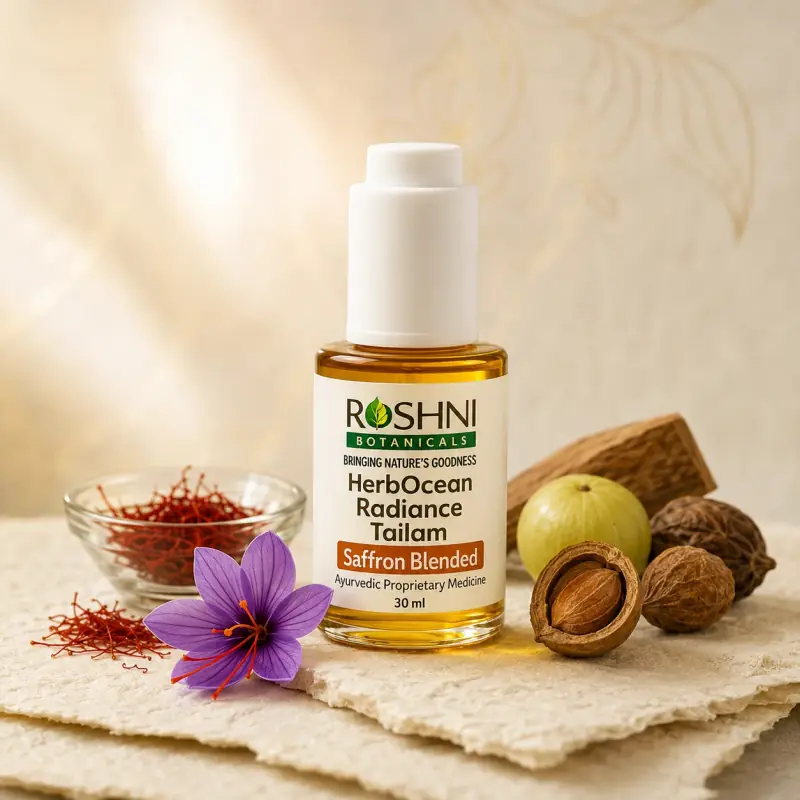
Radiance Tailam
A saffron brightening facial Taila with Manjistha and red sandalwood, traditionally used to support even tone where melasma, dark spots and PIH show.
Part of our guide: Ayurvedic treatment for melasma on Indian skin.