Licorice (Mulethi) for Hyperpigmentation on Indian Skin
Liquorice is Yashtimadhu, a Varnya herb of the Charaka Samhita. What classical practice says about Mulethi, pigmentation and post-acne marks.
Most of what you will read about mulethi online promises a result the root has never claimed for itself. Classical texts are quieter, and far more useful. They file Yashtimadhu (the Sanskrit name for liquorice root, Glycyrrhiza glabra) under Varnya, the classical complexion-care group of herbs, and among the herbs reached for when skin turns irritated and reactive. That pairing is close to what pigmentation-prone Indian skin actually needs, with one boundary stated at the start: nothing applied from outside changes the colour of skin. So: what Mulethi is for, what the research does and does not establish, and where the root sits in the HerbOcean range.
Key takeaways
- Mulethi, Yashtimadhu and liquorice are three names for the root of the same plant, Glycyrrhiza glabra, and Ayurveda groups it under Varnya, the classical complexion-care group of herbs.
- Classical practice values the root for calming irritated skin as much as for its Varnya placement, and reached for it on skin that is easily irritated.
- Glabridin and liquiritin, the two constituents every modern article cites, have been studied as purified compounds, mostly in the laboratory and once in a twenty-woman split-face trial, which is a long way from whole root sitting inside a multi-herb preparation.
- On melanin-rich Indian skin, inflammation of almost any kind can leave a brown mark that outlasts the original event by months. That is post-inflammatory hyperpigmentation, or PIH.
- In the HerbOcean range Mulethi sits in the Soundarya formulations only, as one herb among several inside an AYUSH-licensed Ayurvedic medicine for external use.
What Varnya means, and where Yashtimadhu sits inside it
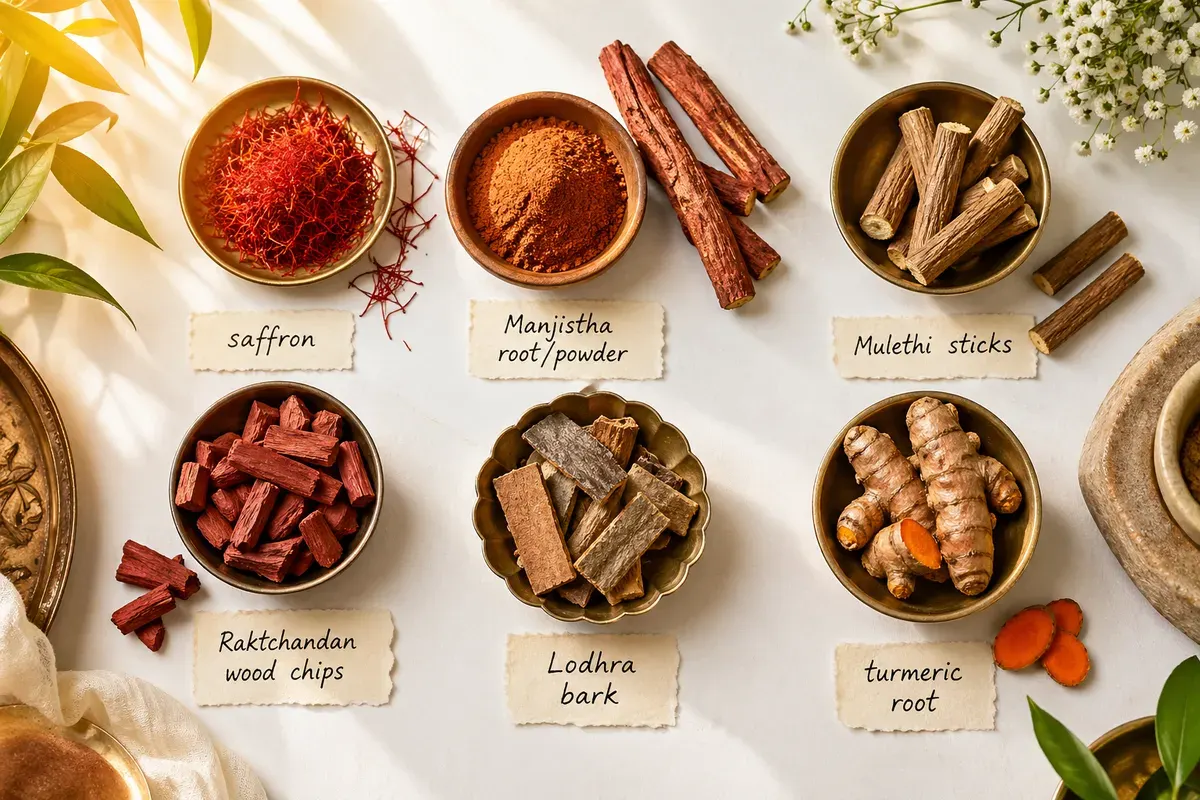
Varnya is a gana (a named group in classical Ayurvedic pharmacology). Charaka Samhita, Sutra Sthana 4 sorts herbs into fifty such groups of ten by the action classical practice expects of them, and Varnya, the classical complexion-care group of herbs, is the eighth of them. Liquorice root (Yashtimadhu) is one of its ten, and so is Manjistha, which matters further down.
Among the groups in that chapter that bear on skin, liquorice appears in three: Varnya; Kandughna, the group reached for when skin itches and is irritated; and Sandhaniya, the group of classical wound care. Its sweet taste (madhura rasa) is part of the reason. Charaka Samhita, Sutra Sthana 26 describes madhura rasa as bala-varna-kara, strengthening and lustre-giving, and as promoting the union of wounds.
The entry in each of the three lists reads Madhuka, and standard Ayurvedic practice reads that as Yashtimadhu, liquorice root. The competing identification is the mahua tree, Madhuca longifolia, also written Madhuca indica, which carries the same drug name in dravyaguna (classical Ayurvedic pharmacology) teaching. What scholars debate is which plant the name Madhuka points to. The text itself is not in doubt.
Four names, one root. Mulethi is the Hindi word, Yashtimadhu the Sanskrit one, and English writes it liquorice or licorice depending on which side of the Atlantic the dictionary came from. All four point at Glycyrrhiza glabra, the sweet root sold in Indian kirana shops in sticks and as a fine buff powder. Knowing that saves confusion when a label says licorice root extract, an Ayurvedic text says Yashtimadhu, and your grandmother says mulethi.
One boundary closes the section. Varnya is a classical category of gradual care, not a category of colour change, and neither the classical texts nor any HerbOcean preparation makes a claim about the colour a person was born with.
What the glabridin research shows about licorice and hyperpigmentation
Glabridin is a prenylated isoflavan isolated from liquorice root. Laboratory work has looked at how it interacts with tyrosinase, the enzyme central to melanin production, and that interaction is why the ingredient turns up in nearly every pigmentation article of the past decade. Liquiritin is the second constituent the category pages cite, usually credited there with acting on pigment that has already formed.
Two papers sit under most of what is written about liquorice and pigmentation, so here they are with their designs stated. Yokota and colleagues, in Pigment Cell Research in 1998, worked in cultured murine melanoma cells and on guinea-pig skin. There were no human participants at all. Amer and Metwalli, in the International Journal of Dermatology in 2000, ran the human study: twenty Egyptian women aged eighteen to forty with symmetrical epidermal melasma, liquiritin cream on one side of the face and the base cream alone on the other, twice daily for four weeks. Twenty women, one side of one face, four weeks, one country. That is a starting point and not a settled result, and the indexed abstract sets out the method without an outcome figure.
The limits matter more than the mechanism. A purified constituent at a known strength is a different object from whole root sitting inside a multi-herb Ayurvedic medicine alongside goat milk, saffron and several other botanicals, and a result from the first cannot be read across to the second. A 2025 scoping review of the clinical trials on herbal remedies for melasma found twenty-one in all, with liquorice the most studied of them, and concluded that the evidence on effectiveness and safety remains limited. One claim circulates widely enough to name without naming a source: an eight-week result attributed to a dermatology journal, quoted across this category with neither sample size nor study population stated. A figure missing both of those is not a citation.
Liquorice and the pharmaceutical agents used for pigmentation work in different ways and carry different tolerances, and an adult can weigh that without being told which one wins. Two boundaries hold regardless of ingredient. The first is the one stated at the start: nothing applied from outside changes the colour of skin. The second: HerbOcean does not manufacture a sunscreen, and nothing in the range replaces one.
Melanin-rich Indian skin, PIH, and why gentler is the pragmatic route
Here is why Indian readers search this at all. On melanin-rich skin, inflammation of almost any kind, a spot, a scratch, a wax, an aggressive peel, tends to leave a brown mark behind, and that mark can outlast the event that caused it by months. That is post-inflammatory hyperpigmentation, PIH for short, and it is what most people are looking at when they photograph their cheeks in daylight.
It is also why the calming half of what classical practice saw in Mulethi matters as much as the Varnya half. Classical practice reached for it at the irritation stage, before the mark.
Do your marks sit patchy and symmetrical across the cheeks and upper lip, in a mask-like spread that no single spot explains? Then the pattern may be melasma (Vyanga) instead, which is approached differently, and the preparations positioned for it are the Radiance pair rather than the Soundarya ones. Our longer guide to the ayurvedic treatment for melasma on Indian skin covers that ground, and Radiance Tailam is the oil that guide routes to. If you are not sure which you have, the difference between dark spots and pigmentation is the shorter read.
Two things make PIH harder on melanin-rich skin than the brochures admit. The pigment is laid down more readily and clears more slowly, so a mark left by a spot that healed in a week can still be visible after several months. And the skin that marks easily is usually the skin already being scrubbed, peeled or rubbed raw in the hope of speeding it up, which restarts the inflammation that made the mark. That is why the aggressive route so often disappoints, and why gentler and slower is the pragmatic choice on skin that pigments readily. Over-washing belongs in that conversation, and so does the hard water running through much of North India. Both leave the barrier uncomfortable and easily irritated, and skin in that state marks more readily than calm skin.
Season shifts the job without changing it. Through humid weeks skin swings between oily by afternoon and tight by night, and once the air turns dry the same face wants more oil than it did a few weeks earlier. As the cloud cover thins after the monsoon, sun exposure climbs again. Unprotected sun undoes patient pigmentation care faster than any herb supports it. Steady sun protection from a separate product does more for hyperpigmentation than any change of oil or cream, and a night routine for dark spots is usually where that steadiness lives.
Kitchen mulethi packs, formulated preparations, and when to see a doctor
Nobody reading this needs an ubtan explained to them. Mulethi powder mixed with besan, or with curd, or with a spoon of honey, is a real household practice and there is nothing to sneer at in it. Four caveats apply, none of them a sales point. A rinse-off pack sits on the surface for a few minutes and is then washed off, so contact time is short. How much root ends up in a spoonful varies batch to batch, so no two applications carry the same amount.
Loose root and powder bought by weight vary a great deal in quality, and adulteration is common enough to be worth buying carefully. Packs are also messy, which is most of why people give up on them early. Patch-test on the inner forearm before any home mix goes near the face.
Classical practice largely used Yashtimadhu inside compound preparations, worked into a medicated oil or paste that stays on the skin rather than being rinsed away. That format difference is worth knowing before you pick a route. Mulethi never works alone here. Manjistha and saffron sit in the same Soundarya preparations, and a finished Ayurvedic medicine is judged as a whole, not as a roll-call of single herbs. That is the honest reason a kitchen spoonful of one root and a licensed compound preparation are not the same object. If you enjoy reading one herb at a time, Manjistha for skin is the companion read.
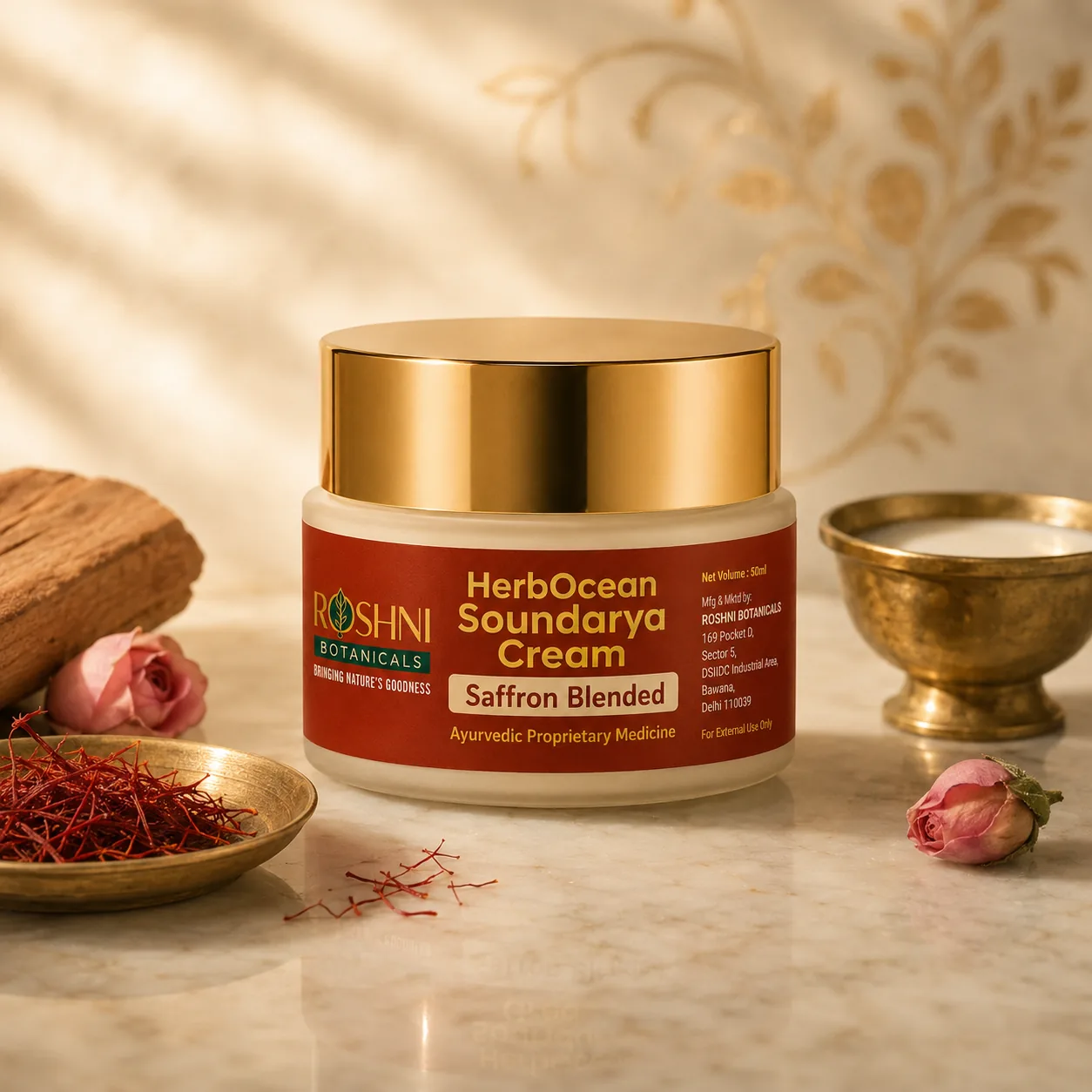
HerbOcean Soundarya Cream is an Ayurvedic medicine for external use, traditionally used in the care of post-acne marks (PIH): a rich saffron repair cream with bargad (Vatt) bark on a goat-milk and coconut base, with shea and kokum butters, best paired with daily sun protection. It makes no claim about skin tone or shade, and no claim of any kind on textural scarring; the aim is calm, settled, comfortable skin. Very oily or acne-prone skin may find it rich. Mulethi sits in it as one of the classical botanicals, alongside Manjistha and saffron. Reach for it once active spots have settled, and only on settled skin: press a small amount into clean skin, morning or night.
HerbOcean Soundarya Tailam is the night companion: a saffron-infused facial Taila (medicated oil) prepared in the goat-milk Kshira-paka tradition, with Manjistha, Mulethi and Kesar, its herbs simmered with goat milk in the oil until the water has evaporated. At night, on clean, slightly damp skin, press three to four drops between the palms and pat over the face and neck. Dry and mature skin gets the most from it, and very oily or actively breaking-out skin may prefer a lighter option. Both are AYUSH-licensed Ayurvedic medicines for external use, made in-house at our GMP-certified unit in Bawana, Delhi, under AYUSH Licence No. DL-474 A&U, and built on the 40-year Ayurvedic formulation legacy of Vaidya Shri Ram Prakash Ji.
People search this in Hindi too, usually as mulethi se pigmentation par kya farak padta hai, and the phrasing is always a hope about the outcome. The classical framing holds: traditionally used in the care of hyperpigmentation and post-acne marks, over months, as one herb inside a finished medicine. For the saffron side of these formulations, what saffron is used for on skin goes further, and saffron compared with vitamin C answers the question that usually comes next.
The honest position, and what to do with it
Mulethi is a Varnya herb. It is traditionally used in the care of hyperpigmentation and the dark marks left behind after a spot settles, and classical practice always described that as slow work, months of consistent use alongside daily sun protection from a separate product. Anyone offering a faster version of that story is selling something the root itself has never promised.
Then the practical part. Both Soundarya preparations are for external use. Patch-test and wait a day before anything new goes on the face, particularly if your skin is reactive. Press a small amount of the cream into clean skin, morning or night, and use the oil at night if you want both, or either alone. If you are pregnant or breastfeeding, check with your doctor before adding new products.
Stop the home routine and see a dermatologist if a patch spreads quickly, changes shape or colour, itches or bleeds, if pigmentation follows soon after a new medicine, or if a symmetrical mask across the cheeks and upper lip has not shifted after months of careful home care. The rest of the Ayurvedic skincare range sits alongside these two if you are building a longer sequence.
References: Charaka Samhita, Sutra Sthana 4 (Shadvirechanashatashritiya Adhyaya), the fifty Mahakashaya groups: Madhuka is listed in Varnya, Kandughna and Sandhaniya, and standard practice reads Madhuka here as Yashtimadhu, Glycyrrhiza glabra. Charaka Samhita, Sutra Sthana 26, on madhura rasa. Yokota T, Nishio H, Kubota Y, Mizoguchi M. The inhibitory effect of glabridin from licorice extracts on melanogenesis and inflammation. Pigment Cell Research, 1998 (cultured murine melanoma cells and guinea-pig skin; no human participants). Amer M, Metwalli M. Topical liquiritin improves melasma. International Journal of Dermatology, 2000 (split-face, vehicle-controlled; 20 women aged 18 to 40; Egypt; four weeks). Parvizi MM and colleagues. Clinical trials conducted on herbal remedies for the treatment of melasma: a scoping review. Journal of Cosmetic Dermatology, 2025 (21 trials across all herbal remedies; liquorice the most studied; evidence on effectiveness and safety limited). Davis EC, Callender VD. Postinflammatory hyperpigmentation: a review of the epidemiology, clinical features, and treatment options in skin of color. Journal of Clinical and Aesthetic Dermatology, 2010 (population: skin of colour, not specifically Indian).
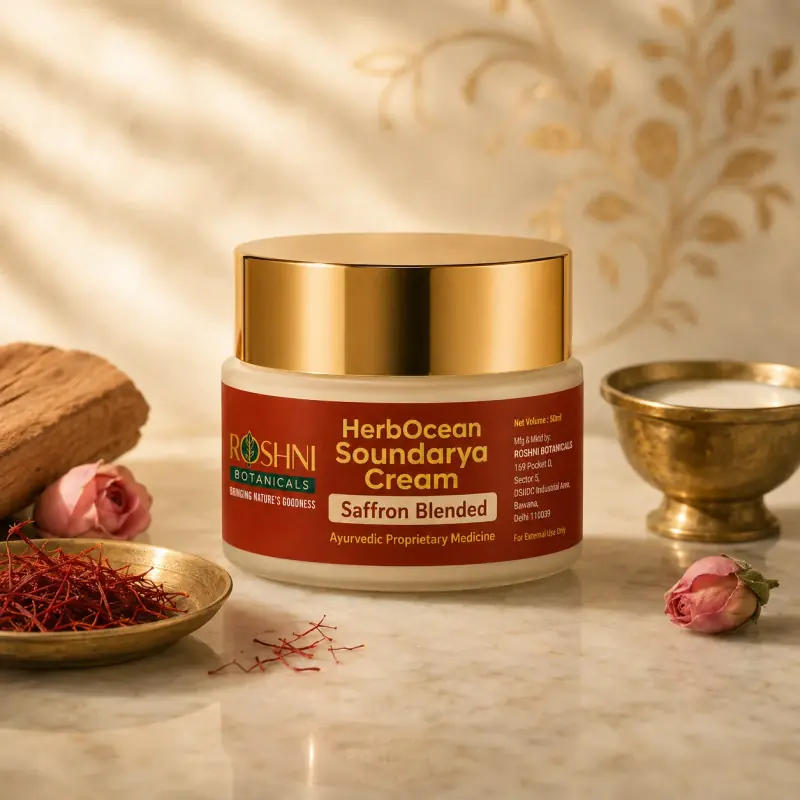
Soundarya Cream
A rich saffron brightening and repair cream with bargad (Vatt) bark on a goat-milk and coconut base, with shea and kokum butters, traditionally used in the care of skin where post-acne marks (PIH) linger.
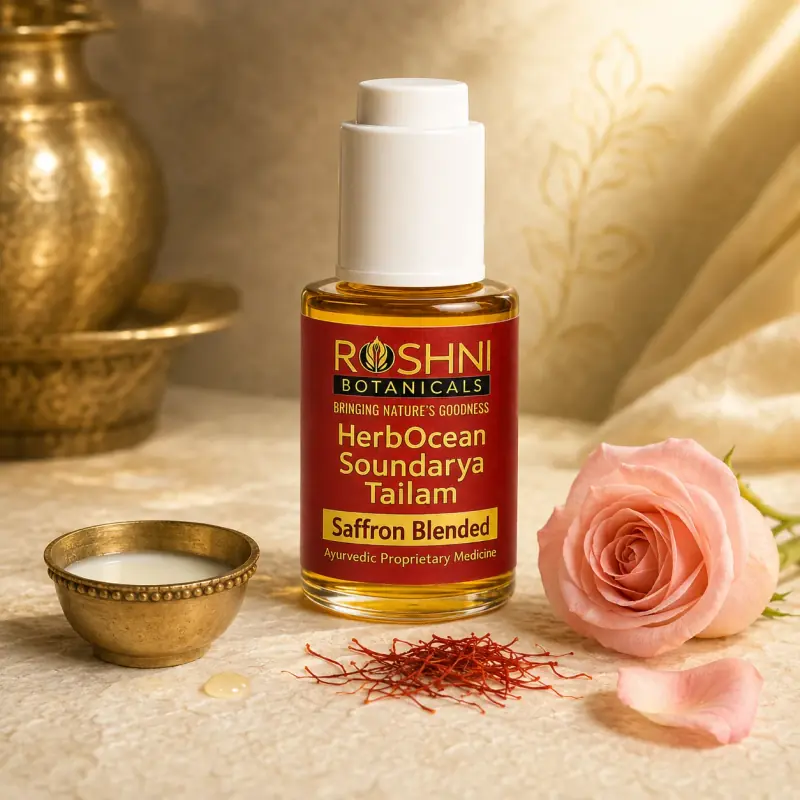
Soundarya Tailam
A saffron-infused facial Taila prepared in the goat-milk Kshira-paka tradition, with Manjistha, Mulethi and Kesar. For soft, bright, even skin.