Manjistha and Turmeric for Pigmentation: Two Classical Herbs on Indian Skin
Where the Charaka Samhita places Manjistha and Haldi, what the research on each herb covers, and how to use the two in a home pack on melanin-rich Indian skin.
Manjistha (Rubia cordifolia, Indian madder) and turmeric (Haldi, Curcuma longa) are two classical Ayurvedic herbs, and both are traditionally used where pigmentation is the concern: uneven patches, dark spots and melasma. Both are also familiar in an Indian ubtan. The Charaka Samhita names each of them in three of its herb groups, Manjistha in the group for the colour and appearance of the skin and Haldi among the herbs for skin disease.
You have likely met the pair at home long before you read about them. Haldi sits in almost every Indian kitchen, and reddish Manjistha powder goes into the family ubtan beside it.
Key takeaways
- Manjistha is Indian madder and Haldi is turmeric. Both have a classical place in the care of pigmentation, and both are old friends of the Indian ubtan.
- The Charaka Samhita names each herb in three groups of ten: Manjistha in Varnya, for skin colour and appearance, and Haldi in Kushthaghna, for skin disease. The one group that lists both is Vishaghna, the herbs against poison.
- A 2016 systematic review of 18 clinical studies of turmeric did not count melasma or PIH among its conditions, and the research on Manjistha is preclinical for the larger part.
- A home pack begins with a test on your forearm and stays away from active pimples and broken skin.
- Wear sun protection every day, and a patch that comes on suddenly, spreads or persists goes to a dermatologist.
Manjistha, Haldi and Where the Old Texts Place Them
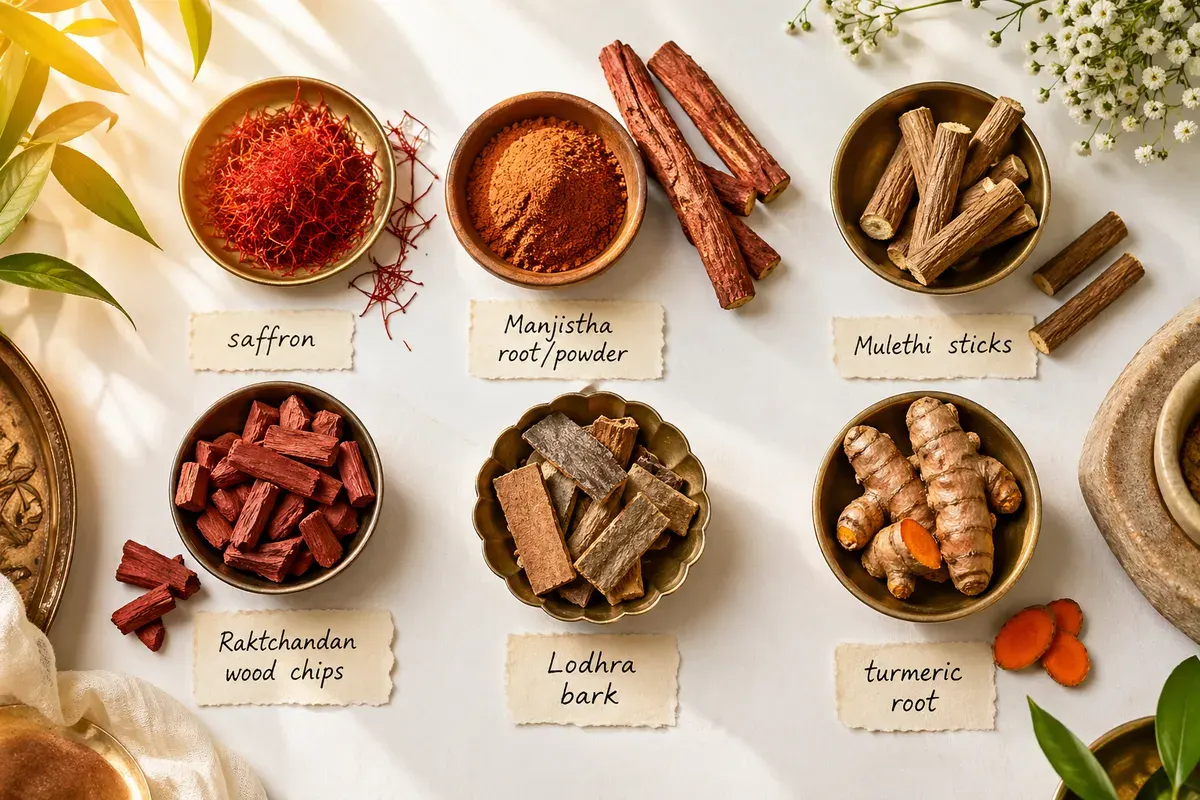
Manjistha is Indian madder, a climbing plant that reaches the kitchen shelf as a reddish powder, and you may know it by its everyday name, Manjith. Haldi needs less introduction. It is the turmeric in your masala dabba, the one you add to dal without thinking, and the classical texts call it Haridra.
Both herbs turn up in the same chapter of the Charaka Samhita, the one that arranges herbs into fifty groups of ten. Manjistha, spelt Manjishtha in the text, is named in three of those groups: Varnya, the group that concerns the colour and appearance of skin; Vishaghna, the herbs against poison; and Jwarahara, the herbs for fever. Varnya is where it touches the skin. Haridra is also named in three: Lekhaniya, the group of emaciating herbs; Kushthaghna, the herbs for skin disease, which is its skin placement; and Vishaghna.
Lay the two lists next to each other and a small detail stands out. Only one group carries both names, and it carries them together at the head of its list. That group is the one for herbs against poison, and it is not a group about the look of the skin at all. It is simply how the chapter is arranged.
If you want the single plant in more depth, the piece on Manjistha for skin covers the plant, the powder and its oils. The journal also carries a longer read on turmeric for skin, for when haldi is the herb you want to know better.
Vyanga, PIH and Pigmentation on Indian Skin
Classical Ayurveda calls melasma Vyanga, and the Sushruta Samhita lists it among its minor conditions: a patch on the face, thin and painless. In Hindi, these patches are called jhaiyaan. When melasma is the patch in question, the longer read is Ayurvedic treatment for melasma on Indian skin.
Not every dark patch is melasma, though. Melanin-rich Indian skin can hold on to a small injury as colour. A pimple, an insect bite, a small burn or a harsh product can leave a patch of extra pigment behind after the skin itself has settled, and doctors call that post-inflammatory hyperpigmentation, or PIH. If you are unsure whether you are looking at a single spot or a wider patch, the piece on the difference between dark spots and pigmentation explains how to tell them apart.
Where you live counts as well. The sun over India is strong, and sun exposure can deepen patches that are already there. Water matters in a different way. In parts of Delhi the groundwater is hard, and a face rinsed in it can feel tight and drawn once you towel off. That is about feel, not colour, but it is one more reason to go easy on scrubbing a patch you are already worried about.
Both herbs have their traditional place in caring for patches that look darker than the skin beside them. No herb changes the colour you were born with.
What the Research Covers for Each Herb
Each modern source cited for this article looks at a single herb. Take Manjistha first. In 2022, Wen and colleagues published a review in Frontiers in Pharmacology that brings together what is known of Rubia cordifolia: its traditional uses, its chemistry and its pharmacology. The authors note that the work it gathers is preclinical for the larger part, meaning laboratory and animal work, and that clinical safety data are lacking. A PubMed search made for this article turned up no trial in people of Manjistha on its own applied to facial skin.
Turmeric has more work in people behind it. In 2016, Vaughn, Branum and Sivamani published a systematic review in Phytotherapy Research of clinical studies in which turmeric or curcumin was swallowed, applied to the skin, or both. They found 234 articles and kept 18 studies, which looked at psoriasis, vitiligo, acne, pruritus and facial photoaging, along with a few other conditions, and melasma and PIH were not among them. The authors describe the evidence as early and the studies as limited.
Then there is a laboratory study. In 2012, Tu and colleagues reported in Phytotherapy Research that curcumin, the yellow compound in turmeric, lowered the melanin content of human pigment cells grown in culture. That is a finding in cultured cells, and it cannot tell you how a paste behaves on a face. On the face, then, both herbs stand on their classical use.
Making a Manjistha and Haldi Pack at Home
In Indian homes this mix goes by a plain name, manjistha aur haldi ka face pack, and it deserves the same care you would give anything you put on your face. Begin with your arm. A day before you use the pack for the first time, put a small amount of the mixed paste on the inside of your forearm and leave it be. If that skin stays quiet through the day, you can go ahead.
Mix the two powders with plain water until the paste is smooth. Curd and milk are familiar choices in Indian kitchens too, and if you would rather make a full ubtan, besan forms its base. Spread a thin layer over clean skin, keeping clear of active pimples and of any broken skin. Rinse with plain water while the pack is still soft, so it comes away easily and never pulls at the skin. Leave lemon out of the bowl altogether.
Expect a little colour along the way. Haldi leaves a yellow cast on skin and on cloth, and Manjistha powder can tint a pale towel too, so an old towel is the sensible choice when you rinse.
Watch how your skin takes it. A pack that leaves redness, itching, swelling or blistering is rinsed off and not used again, and a reaction that keeps spreading goes to a dermatologist.
Manjistha and Haldi in Radiance Tailam and Radiance Cream
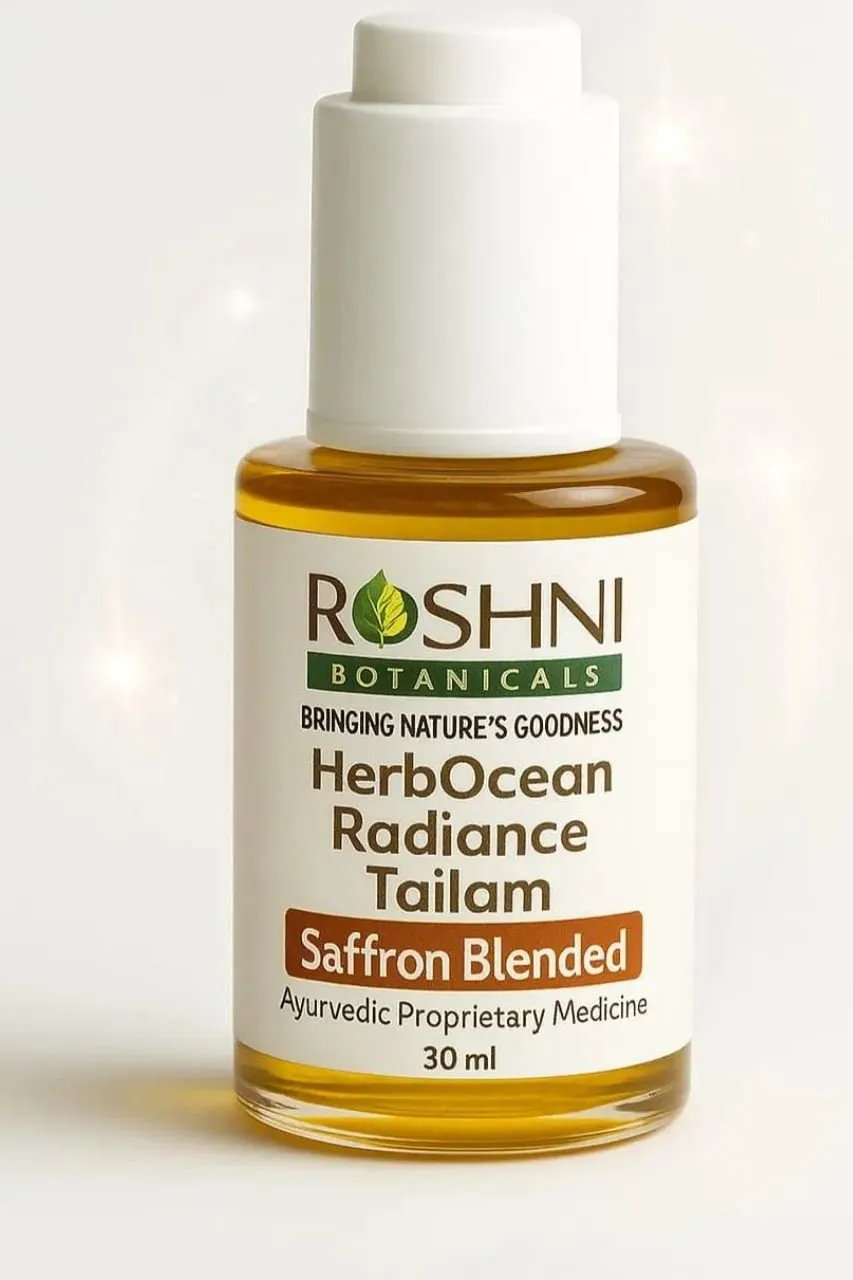
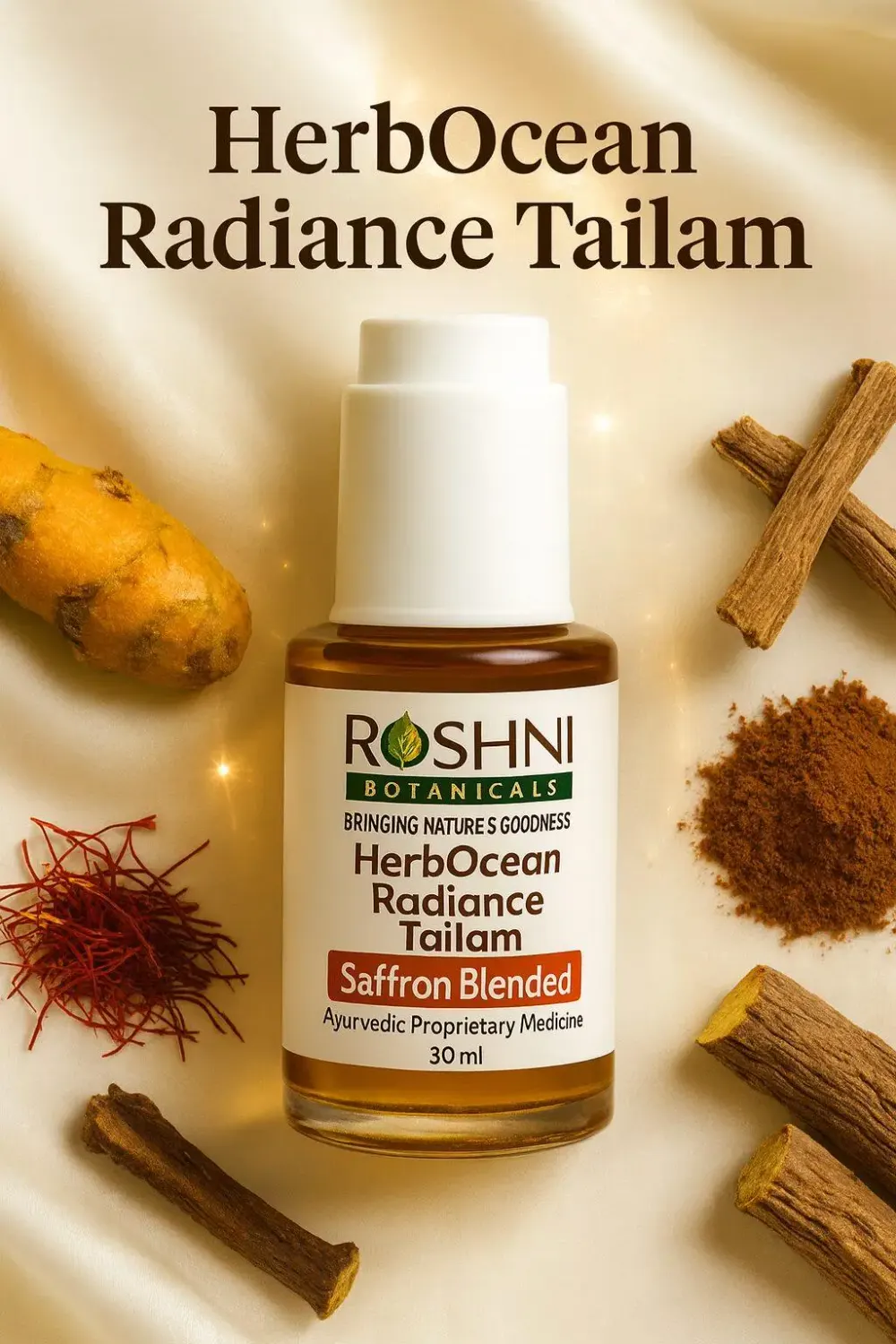
The two herbs also meet inside two finished Ayurvedic medicines from the range. HerbOcean Radiance Tailam is an AYUSH-licensed Ayurvedic medicine for external use, classically indicated for melasma (Vyanga), the patches Hindi homes call jhaiyaan, and traditionally used in the Ayurvedic care of post-inflammatory hyperpigmentation (PIH), dark spots and dullness. The second medicine is a cream. HerbOcean Radiance Cream is an AYUSH-licensed Ayurvedic medicine classically indicated in the care of Vyanga, the Ayurvedic term for melasma, and traditionally used where dark spots and uneven tone linger. Both carry the same twelve herbs in equal measure: Chandan (sandalwood), Manjistha, Raktchandan (red sandalwood), Kamal (lotus), Padmaakh (wild Himalayan cherry) bark, Haldi (turmeric), Kuth (costus root), Kakoli, Palash (flame of the forest) flower, Amla, Baheda and Harad, with Kesar (saffron) and with lavender, rose and mogra oils. Manjistha and Haldi are two of those twelve. The Tailam sits in a sesame (Til tail) base, while the Cream is made with coconut oil and a cream base. Both are made in-house at our GMP-certified unit in Bawana, Delhi, under AYUSH Licence No. DL-474 A&U, and built on the 40-year Ayurvedic formulation legacy of Vaidya Shri Ram Prakash Ji. Two other sets of herbs on that list have journal pieces to themselves, one on red sandalwood and white sandalwood and one on Amla, Baheda and Harad for skin.
At night, press a few drops over clean skin, concentrating on areas of uneven tone. By day, wear a broad-spectrum sunscreen, as pigmentation responds strongly to UV. The right amount differs from person to person.
Warm it between your fingertips and press it gently into clean skin, morning and night. By day, follow with sunscreen, because steady sun protection matters when you are caring for uneven tone. Not for skin with active pimples: wait until they have settled, then use it on the marks they leave.
Patch-test on the inner forearm 24 hours before first use and discontinue if irritation occurs; avoid the eye area. Avoid the oil if you are allergic to sesame, the cream if you are allergic to coconut, and either if you are allergic to a listed botanical. If pregnant or breastfeeding, check with your doctor.
One medicine is enough to begin with, and the thinking behind that is set out in the piece on one concern, one product.
Sunscreen, Active Pimples and a Steady Pace
Sun protection runs alongside everything else you do for pigmentation. Use a broad-spectrum sunscreen daily, reapply it when you are outdoors, and add shade, a hat and sleeves when the sun is strong. HerbOcean does not manufacture a sunscreen, and nothing in the range replaces one, so your sun protection stays a separate step.
Active pimples change things. An active pimple takes spot care made for pimples and nothing else, so no oil or cream for pigmentation belongs on it. Moisturiser and sunscreen belong only on the clear skin that surrounds it, and care for the marks starts only once the pimples have settled. When that point comes, your skin type points the way. On oily or acne-prone skin, the oil of the two medicines suits those marks. On normal or dry skin, look to the piece on brown and red marks after pimples.
Care in the Ayurvedic way is gradual, and the pace varies between one person and another. Keep your routine steady and simple, and if you would like the evening steps laid out in order, look at a night routine for dark spots.
When to Show Pigmentation to a Dermatologist
See a dermatologist for pigmentation that is sudden, spreading or persistent. Go sooner if a patch is new or growing fast, if its shape or colour changes, or if it is raised, itchy or bleeding, and for pigmentation that sits clearly on one side of the face.
Patches that arrive with a pregnancy, or soon after you begin a new medicine, belong with your own doctor. Do not stop a medicine on your own. A reaction to a home pack that brings blistering, swelling or a burning feeling that spreads should be seen the same day. A dermatologist can also tell melasma apart from other kinds of dark patch, which matters, because each one calls for different care.
Kitchen Practice and a Finished Medicine
Manjistha and Haldi both hold a classical place in the care of skin with darker patches. A pack mixed in your kitchen is household practice, made fresh and rinsed away, while a finished Ayurvedic medicine is a fixed formula that comes with its own label, cautions and instructions.
References: 1. Charaka Samhita, Sutra Sthana 4 (Shadvirechanashatashritiya Adhyaya). Fifty groups of ten herbs: Manjishtha in the Varnya, Vishaghna and Jwarahara groups; Haridra in the Lekhaniya, Kushthaghna and Vishaghna groups. Classical text, chapter level. 2. Sushruta Samhita, Nidana Sthana 13 (Kshudra Roga Nidana). The minor conditions; Vyanga, a thin and painless patch on the face. Classical text, chapter level. 3. Wen M, Chen Q, Chen W, et al. A comprehensive review of Rubia cordifolia L.: traditional uses, phytochemistry, pharmacological activities, and clinical applications. Frontiers in Pharmacology, 2022; 13: 965390. Review; the studies it gathers are preclinical for the larger part. 4. Vaughn AR, Branum A, Sivamani RK. Effects of turmeric (Curcuma longa) on skin health: a systematic review of the clinical evidence. Phytotherapy Research, 2016; 30(8): 1243 to 1264. Systematic review: 234 articles found, 18 clinical studies included. 5. Tu CX, Lin M, Lu SS, Qi XY, Zhang RX, Zhang YY. Curcumin inhibits melanogenesis in human melanocytes. Phytotherapy Research, 2012; 26(2): 174 to 179. Laboratory study in cultured human pigment cells. Educational, not medical advice.
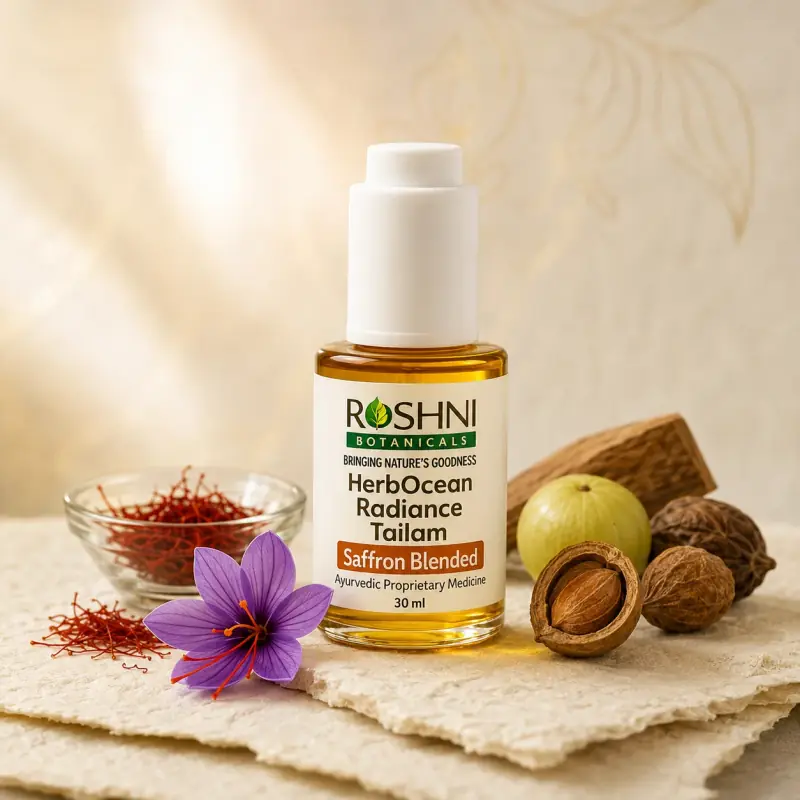
Radiance Tailam
A brightening saffron facial oil (Taila), an Ayurvedic medicine traditionally used in the care of melasma (jhaiyaan), dark spots, tanning and uneven tone.
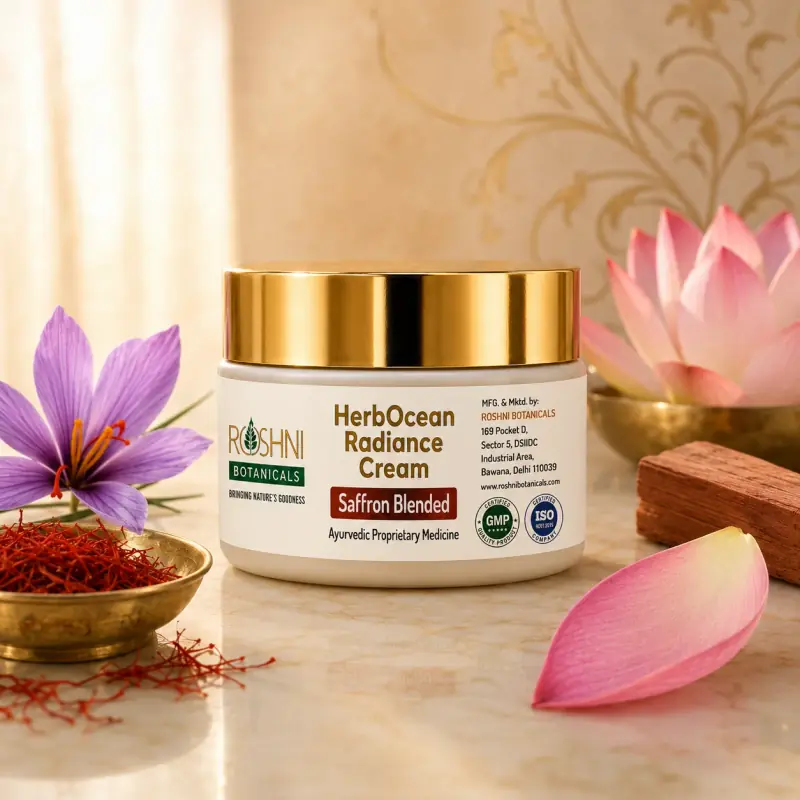
Radiance Cream
A daily brightening cream with saffron, sandalwood, Manjistha, red sandalwood and lotus in a light coconut base. It is an Ayurvedic medicine traditionally used in the care of melasma (jhaiyaan) and dark spots, for a luminous, even-looking skin tone.
Part of our guide: Ayurvedic treatment for melasma on Indian skin.
Frequently asked
This article is general educational content about Ayurvedic skin and hair care. HerbOcean products are classical Ayurvedic preparations for external use, made under AYUSH Licence DL-474 A&U and traditionally used to support healthy skin and hair. This is educational and not a substitute for professional medical advice; for persistent or worsening concerns, please consult a qualified dermatologist.