
Milia: White Bumps on the Face That Are Not Pimples
Milia are keratin bumps, not pimples: squeezing has nowhere to push, and nothing you can buy for yourself clears one. The honest route, plus the newborn answer.
You spotted them while putting on kajal. Two or three tiny white bumps under the eye, sitting there for months now, and they do not hurt. They also will not pop. The steamer had a turn, so did the scrub, so did the pimple patch, and every suggestion from the family group chat has bounced straight off them. Chehre par safed dane, the search bar says at eleven at night. Most likely these are milia. And most pages selling you a solution will not say the plain thing that follows.
Key takeaways
- Milia are tiny keratin-filled bumps sealed just under the surface of the skin. You will usually find them on the eyelids, the upper cheeks and the forehead. There is no route out that pressure can use, which is why they look pearly and never come to a head.
- Squeezing has nowhere to push. All that pressure does is injure the skin around the bump, and on melanin-rich Indian skin that injury can darken into post-inflammatory hyperpigmentation (PIH), a mark that can outlast the bump by months.
- Nothing you can buy for yourself clears an existing milium, ours included. Where milia are numerous or stubborn, a dermatologist may consider a prescription topical retinoid. Some milia settle on their own; others simply stay.
- Sterile extraction by a dermatologist, using a fine needle to de-roof the bump, is the dependable route for the ones that stay. It is one of several routes a clinic can take, and it is never a home procedure.
- Milia in newborns are a recognised and harmless finding. They settle on their own over the early weeks to months, and the correct care is to leave them alone: no oil over the bumps, no besan, no rubbing.
White Bumps That Are Not Pimples: What Milia Actually Are
Milia are small keratin-filled bumps that sit just below the surface of the skin. Keratin is the protein your skin and nails are made of, and in a milium a little of it gets sealed into a smooth pocket with no route out. That one fact explains everything else. They look pearly rather than angry, and on deeper skin tones they can carry a faint bluish cast rather than a stark white one. Nothing ever comes to a head, and a milium can sit in exactly the same spot from one festival season to the next without changing at all. That is normal for a milium. It is also why a single bump that stays put deserves a proper look rather than a guess, especially if it is the only one. We have not found a settled classical equivalent term for milia, and we will not invent one.
The bump most often confused with a milium is the closed comedone, better known as the whitehead. A whitehead is a blocked hair follicle: the pore is plugged rather than absent, and acne care works by unblocking that follicle and settling the way it sheds keratin. A milium is not a follicle at all. It is a small keratin cyst walled off under the skin, which is why acne care has nothing to act on and squeezing has nowhere to send it. So if your bumps arrive in crops before your period, sit along the chin and jawline, and respond at all to spot care, that is acne territory rather than milia, and our complete guide to the Ayurvedic treatment of acne is the more useful page for you. For those active spots the HerbOcean Anti-Acne Roll-On is classically indicated for acne and pimples; it has nothing to act on in a milium.
Three more look-alikes sit in the same zone. Sebaceous hyperplasia is the one dermatology references list first: small, soft, slightly yellowish bumps, often with a dimple in the centre, common from middle age onward. Syringomas are small skin-coloured or yellowish bumps, usually on the lower lids, that tend to appear around puberty and slowly increase with age. Xanthelasma is a soft yellowish patch nearer the inner corner of the lid, and that one is worth showing to a doctor rather than a beautician, because it is often associated with raised blood lipids. We cannot tell you from a description which of these you have. This page describes what milia usually look like; it cannot rule anything else out.
One more pattern turns up in hot, sticky, sweat-heavy stretches. Fungal folliculitis arrives as uniform, itchy crops of small bumps, usually across the forehead, the hairline and the upper back, often after weeks of sweaty commutes in damp clothes. Milia do not itch. They also do not arrive in neat rows. Bumps that do both need a doctor’s eye rather than a new routine.
Why Squeezing Fails, and What It Costs Melanin-Rich Skin
A milium offers no route out that pressure can use, so squeezing has nowhere to send it. Press until the skin goes white, and the keratin pocket will still be sitting there afterwards, intact, with a ring of bruised tissue around it. That ring is the part that costs you. Injury to melanin-rich skin can set off post-inflammatory hyperpigmentation (PIH), and a brown mark under the eye, right where you were digging with a fingernail, can take many months to settle. If pigmentation is what actually worries you, our guide to ayurvedic care for melasma on Indian skin covers how pigmentation behaves on Indian skin more generally. Melasma is a different condition from a post-inflammatory mark, but the patience it asks of you is the same.
Can You Remove Milia at Home? The Honest Answer
No cream, oil, medicated paste (Lepa) or serum you can buy for yourself will clear an existing milium. Not ours, and we know of nothing on a shelf that does. One qualification, because you deserve the whole picture: where milia are numerous or stubborn, a dermatologist may prescribe a topical retinoid. That is a prescription decision taken in a clinic after somebody has actually looked at the bumps, and we hold no evidence that any Ayurvedic preparation, ours included, does the same. Some milia settle on their own; others simply stay. For the ones that stay, a dermatologist can lift them out by sterile extraction: a fine needle makes a tiny opening and the keratin comes away. Clinicians call it de-roofing, and it is one of several routes they can take. There is nothing here for you to buy.
Not a home procedure, and not a salon one. This is skin a few millimetres from your eye; it needs sterile instruments and somebody who can see what they are doing. Expect a small crust and a few days of redness afterwards, and on Indian skin a temporary darkening at the spot is possible.
This is also why the things you already tried bounced off. Steam opens what has an exit; a milium has none for it to use. A pimple patch draws from an open lesion; nothing here is open, and our comparison of pimple patches and an Ayurvedic roll-on sets out what a patch can and cannot do. A scrub only abrades the roof of the pocket, leaving the keratin where it was, on skin now raw enough to mark. None of those failures was your technique.
Why milia form is only partly understood. The documented causes are skin injury, such as burns, dermabrasion and blistering rashes, and certain medications, including prolonged topical steroids and some acne treatments.
See a doctor, not a beautician, about any of these: a single bump rather than a crop; a bump that is yellowish rather than white, especially near the inner corner of the eye; a bump with tiny visible blood vessels running over it; one that grows, bleeds, crusts or oozes, or keeps healing and breaking down; one that is sore or tender; any loss of eyelashes at the spot; a lump on the eyelid that keeps coming back in the same place after being treated as a stye; bumps that itch or arrive in uniform crops; or bumps that have sat unchanged for many months in an adult. Anything on the eyelid margin itself belongs with an eye specialist.
White Bumps on a Newborn’s Face: What Parents Should Do
Transient milia are a recognised and harmless finding in newborns, seen across the nose, cheeks and around the eyes at birth or within the first days of life, and they settle on their own over the early weeks to months. The skin there is the thinnest on the body, which is why nothing should be applied or pressed over the bumps at all: no malish, no besan, no home paste, and no attempt to press them out. Malish is a normal part of a baby’s routine in most Indian homes; the point here is only that these bumps are not the place for it. No needle, no thread, and no beautician on a baby’s face, by anyone.
If the bumps look red or swollen, if they seem to bother the baby, or if you are simply unsure, ask your paediatrician rather than trying anything at home. In a baby under a month old, any blister, any pus-filled or crusted spot, or any skin change alongside fever, poor feeding or unusual sleepiness needs same-day medical review. And one word that gets mixed up with this one: miliaria, or heat rash, is a different thing entirely and far commoner in Indian heat, showing as small red prickly bumps in an oiled, swaddled baby. Cool the baby, loosen the layers, and ask if you are unsure.
What a Realistic Routine Can Do
So what can a routine actually do? It can look after the skin around the bumps while time, or a clinic, deals with the bumps themselves. Cleanse gently twice a day. Do not scrub the bump zone, and keep walnut granules and every gritty exfoliant away from the under-eye area entirely. Ubtan is a serious practice and deserves to stay in your routine on the rest of the face if it suits your skin. But abrasion dragged across milia on Indian skin is a direct route to a dark mark, and the bump will not have moved an inch.
In a hard-water home, skin can feel filmy however long you wash. That feeling is its own trap, because it tempts people into scrubbing harder. Resist it. In humid weather, thick layering around the eyes is uncomfortable anyway, so keep a thinner texture near that zone.
Daily sun protection matters here for one specific reason: any existing mark, including PIH left behind by picking, darkens further with sun exposure. HerbOcean Soundarya Cream carries no sun protection factor and is not a sunscreen, so a separate sunscreen is needed in daylight whatever else you apply. Our article on sun protection in the monsoon for Indian skin sets out the full method, including why an overcast morning is not a day off.
Where Soundarya Cream Fits, and Where It Honestly Does Not
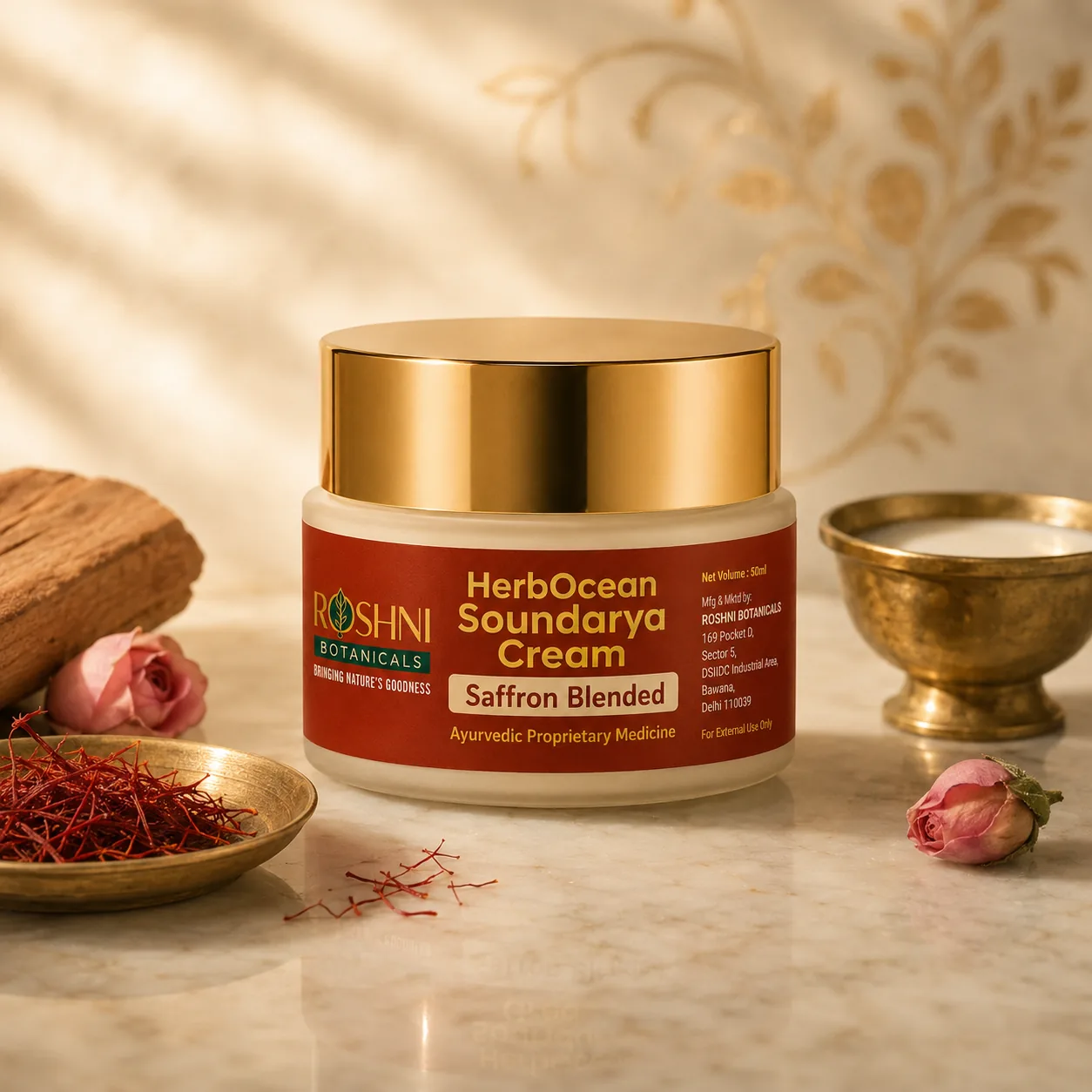
Here is the boundary, up front rather than buried. HerbOcean Soundarya Cream is not indicated for milia and makes no claim on them. If you have read this far hoping a HerbOcean product is the answer to the bumps under your eyes, it is not.
Where the Cream does belong is the general care of the skin around those bumps: dull and marked skin, including the care of post-acne and post-injury marks that make two small bumps look like ten. It is an AYUSH-licensed Ayurvedic medicine (Licence No. DL-474 A&U) for external use, traditionally used in the care of skin comfort, softness and natural lustre. Patch-test on the inner forearm 24 hours before first use and discontinue if irritation occurs. Avoid the eye area. Do not use if you are allergic to coconut, goat milk or any listed botanical.
The Cream is a rich saffron repair cream on a goat-milk and coconut (Nariyal) base, with shea butter, kokum butter and vitamin E. Among the declared botanicals are bargad bark (Vatt), Indian madder (Manjistha), liquorice (Mulethi), red sandalwood (Raktchandan), goat milk (Ajadugdh) and saffron (Kesar), among others; Nagkesar, Priyangu, Laksha, Palash and Daruhaldi sit alongside them, and the full declaration is on the product page. Formulated on the 40-year legacy of Vaidya Shri Ram Prakash Ji and made in-house at our GMP-certified unit in Bawana, Delhi.
Two things about applying it. The skin at the orbital rim is the thinnest on the face, so keep a richer cream on the cheeks and the rest of the face, away from the immediate lash line. One boundary, plainly: neither saffron nor Manjistha nor any HerbOcean product carries a skin-tone claim, here or anywhere else. The goal is calm, settled and comfortable skin with its own natural lustre.
The Plain Next Step
If the bumps are milia, the next step is patience or a dermatologist’s sterile extraction, and not another purchase. Book a dermatologist appointment if any of the red flags above apply, and see an eye specialist for anything sitting on the eyelid margin itself.
References: Gallardo Avila PP, Mendez MD. Milia. StatPearls, NCBI Bookshelf NBK560481 (PMID 32809316). Acne Vulgaris. StatPearls, NCBI Bookshelf NBK459173. Stokkermans TJ, Prendes M. Benign Eyelid Lesions. StatPearls, NCBI Bookshelf NBK582155. Lawrence E, Syed HA, Al Aboud KM. Postinflammatory Hyperpigmentation. StatPearls, NCBI Bookshelf NBK559150. DermNet, Milium, milia (dermnetnz.org/topics/milium). DermNet, Malassezia (pityrosporum) folliculitis.
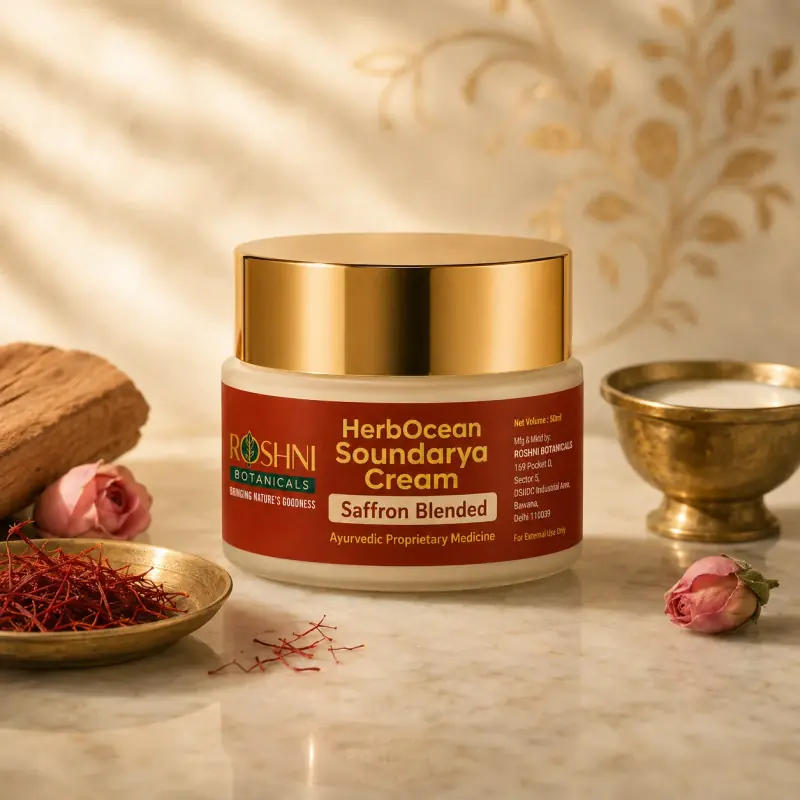
Soundarya Cream
A rich saffron brightening and repair cream with bargad (Vatt) bark on a goat-milk and coconut base, with shea and kokum butters — often reached for where post-acne marks (PIH) linger.