Open Pores on Face: What Really Changes How They Look, and What No Cream Can Do
Pore size is set more by inheritance and ethnicity than by your routine, and on Indian skin it shifts with age. What the evidence actually supports, and what no cream can do.
Stand close to a mirror in good light and the pores along your nose and cheeks look larger than you remembered. Most of us reach, at that point, for something that promises to close them. Almost everything on that shelf, Ayurvedic or modern, is sold on the same four verbs: shrink, close, tighten, refine. You will not find any of them on this page, and not on our own products either.
The largest study of facial pores to include Indian women found something more useful than any of those promises, and rather less comfortable.
Key takeaways
- Pore size is set by things you did not pick: inherited tendency, skin type, ethnicity and age among them. Your routine is not the main variable.
- On Indian skin specifically, pore size does rise with age. In the study below it rose significantly among Indian women while the Chinese, Japanese and French groups held steady, so a change over the years is ordinary rather than a sign you have gone wrong somewhere.
- Ice works, briefly. Cold constricts the small vessels at the surface, the skin looks momentarily taut, and the follicle opening is never involved.
- Prescription actives and clinic procedures do measurably reduce the counted area of pores while you are using them. Nothing in that literature holds once you stop.
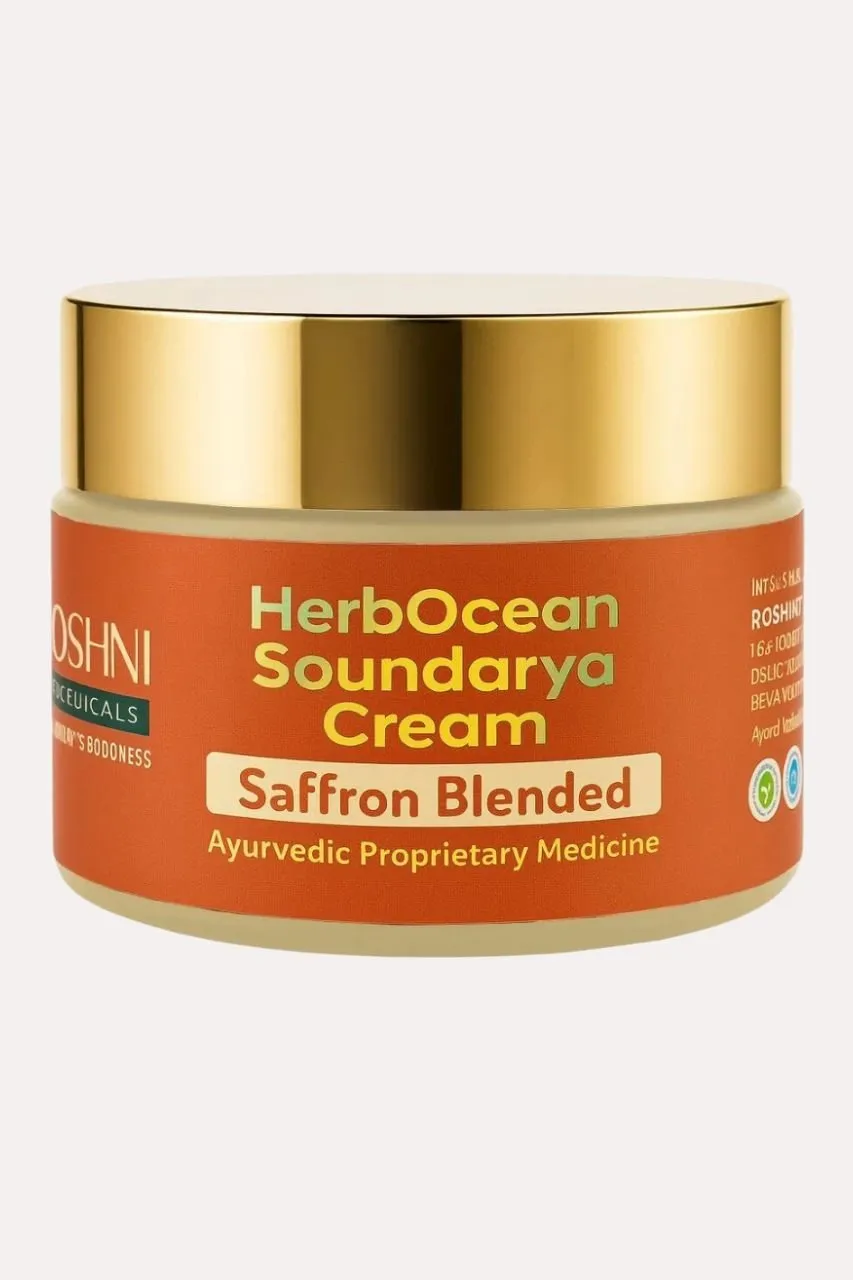
- HerbOcean Soundarya Cream is an AYUSH-licensed Ayurvedic medicine for external use (Licence No. DL-474 A&U), traditionally used in the care of dull, uneven and marked skin. It is not a pore product, and we make no pore claim for it.
What a Pore Actually Is, and Why Its Size Is Largely Out of Your Hands
A pore is the visible opening of a hair follicle, with an oil gland emptying into it. How many you have, and how wide they sit at rest, comes down mostly to inherited tendency and skin type. Nothing applied to the surface, classical preparation or laboratory-made active, has been shown to make that opening permanently narrower. That is the ceiling for the whole category, ours included, and we would rather say it at the top than bury it.
Two separate things get muddled here. One is how wide a pore actually is. The other is how obvious it looks. The width barely moves. The appearance shifts week to week. Visibility rises when the opening fills with oil and shed skin cells, and the plug darkens where it meets air. A two-wheeler commute leaves sweat and grime on the surface, which is reason enough to cleanse properly, but that grit does not fill the follicle.
Now the study. In 2015 a multiethnic team measured facial pores on the cheeks of 2,585 women across four countries, and Indian women were the largest group in it by some distance: 1,194 women aged 18 to 70, measured in Mumbai, Delhi, Chennai and Kolkata. Pore density ranged roughly eightfold between the groups, from about ten to eighty pores per square centimetre. The authors' summary was that pore size varies far more with ethnicity than with age. Density itself barely moved across the decades in any group, and among the Indian women it edged very slightly downwards.
Size was the one place Indian skin behaved differently. Pore size rose significantly with age among the Indian women, where the Chinese, Japanese and French groups stayed fairly stable. Two things follow from that, and both are worth holding on to. Comparing your nose to a friend's from a different background is comparing two different baselines, not two different routines. And if your pores look more obvious at forty than they did at twenty-five, that is a documented pattern on Indian skin, not evidence that you have mismanaged your face. (Flament F, François G, Qiu H, and colleagues, Clinical, Cosmetic and Investigational Dermatology, 2015. Cheeks only, women only; the authors are affiliated to L'Oréal Research and Innovation, which we mention because you should weigh it.)
So what are those four verbs describing? On a shelf product, usually a temporary optical change: lift the surface oil off skin and it catches light differently for a few hours. A clay pack does that. Loose powder does that. It is worth being straight that prescription actives go further than an afternoon. Reviews of the trial literature find that topical medicines, along with several in-clinic procedures, do measurably reduce the counted area of facial pores while a person is using them. What that literature does not show is any of it holding once you stop, or the opening itself being rebuilt narrower. That is the honest ceiling, and it is why those four verbs appear on nothing we make.
What Actually Changes How Open Pores Look on Indian Skin
The habit that helps most is also the dullest. Cleanse twice a day with something mild, and then stop. Not a stripping wash that leaves your face squeaking. Not a fourth wash because the shine came back by four o'clock. A pore kept clear of old oil and dead skin throws less shadow, and that is most of the visible difference right there.
Humidity makes this harder than it sounds. Sweat that never quite dries, sunscreen sitting on the skin all day, grime settling onto a damp face: through a humid Indian summer that is most of the year's difficulty in one week. Hard water complicates it further. A great deal of Delhi runs on borewell supply, and groundwater hardness across the city sits well above the Bureau of Indian Standards acceptable limit. The minerals reduce the solubility of the surfactants in your cleanser, so instead of rinsing away cleanly some of it precipitates onto the skin, which leaves the barrier less comfortable than it should be. The practical answer is a longer, more patient rinse, and ion-exchange softening at the inlet if you already have it.
Sun protection is the other habit that earns its keep, and it earns it even through a week of grey skies. UVA comes through cloud and through window glass, so an overcast stretch is not a week off. Daily broad-spectrum protection, topped up if you are out through the day, is worth the habit for reasons that reach well beyond pores. It will not change the width of a follicle opening, and nobody can give you a timeline.
The habit to drop is the aggressive one. Gritty walnut-shell scrubs, pore strips, a daily acid stacked on top of daily physical exfoliation. All of it irritates the skin and roughs up the barrier, and on melanin-rich Indian skin, inflammation can settle into post-inflammatory hyperpigmentation (PIH), the dark marks that outlast whatever you were scrubbing at. If uneven tone and old marks are the real complaint rather than texture, the Ayurvedic approach to melasma on Indian skin covers that ground properly, and HerbOcean Soundarya Cream is traditionally used in the care of skin that looks dull, uneven and marked.
Ice Cubes, Besan and Multani Mitti: Taking the Home Remedies Seriously
Half the country is already rubbing ice on its face, so it deserves a straight answer. Cold constricts the small vessels near the surface and the area looks taut for a short while. That effect is real. It is also over once your skin comes back to its own temperature, and the follicle opening was never part of it. If you enjoy the ritual, keep it. Just do it safely: wrap the cube in a clean cotton cloth, keep it brief and keep the cube moving, never bare ice against skin, and not at all on skin that is already inflamed.
Besan with haldi, and multani mitti with rose water, work the same way. They soak up surface oil and leave the skin matte, and a matte surface scatters light instead of bouncing it straight back, so pores look less obvious for a few hours until the oil returns. There is nothing dishonest about liking that.
The trouble is frequency. Three or four times a week, a clay pack leaves your face over-dried and uncomfortable, and irritated skin usually looks worse than oily skin did, with the PIH risk waiting at the end of it. Once or twice a week, on the T-zone rather than the whole face, is plenty. We have written at length on how multani mitti really behaves on oily skin. And if the worry underneath all this is that anything oily will block a pore, we have worked through whether face oils actually clog pores, with the barrier science attached.
Then there is steaming, which most of us learnt as step one of a home facial: steam to open the pores, pack to close them. The practice is useful. The explanation attached to it is not. A pore cannot open or shut on command, because there is no ring of muscle around the mouth of it and no lid. The follicle does have a muscle, the arrector pili, but it attaches halfway down, it is what raises the hair in gooseflesh, and it has nothing to do with the width of the opening. Warmth and moisture plausibly soften the plug of compacted skin cells and oil so it lifts more easily during cleansing, since water is a documented softener of keratin. We have not found a controlled trial testing that on faces, and we are not going to write it up as though we had. The damage usually comes after the steam rather than from it: squeezing at home, especially on the nose where the skin is thin and the follicles sit close together, leaves marks that stay far longer than the blackhead ever would have.
A Simple Routine That Supports Calm, Comfortable Skin
Classical Ayurveda organises this as a daily routine, dinacharya (the daily routine), adjusted by a seasonal one, Ritucharya (the seasonal routine), for the weather you are actually living in. Through a humid stretch that adjustment runs towards less rather than more.
Mild cleanse morning and night. Sun protection in the morning, topped up if you are out. A light hand with actives, one at a time, and never a salicylic acid and a retinol on the same night while you are still learning what your skin will take. One gentle exfoliation a week instead of three. The full step-by-step sits in our day and night Ayurvedic skincare routine, so treat this as the humid-weather edit of it.
At night, on cleansed skin, a small quantity of cream goes on last. HerbOcean Soundarya Cream is an AYUSH-licensed Ayurvedic medicine for external use (Licence No. DL-474 A&U), traditionally used in the care of dull, uneven and marked skin. It is not a pore product, and we make no pore claim for it. A rich cream suits some skins and not others in high humidity, and there is no sense pretending otherwise. Use a small quantity at night rather than a heavy layer, skip it in the morning if your face feels weighed down by eleven o'clock, and give it a fortnight before you decide.
The cream is a rich saffron repair cream on a goat-milk and coconut (Nariyal) base. The formula names bargad bark (Vatt), saffron (Kesar), goat milk (Ajadugdh), Indian madder (Manjistha), liquorice (Mulethi), red sandalwood (Raktchandan), Ceylon ironwood (Nagkesar), beautyberry (Priyangu), lac resin (Laksha), flame of the forest (Palash) and Indian barberry (Daruhaldi), with lavender, rose and mogra oils, enriched with shea butter, kokum butter and vitamin E. It is made in-house at our GMP-certified unit in Bawana, Delhi, under AYUSH Licence No. DL-474 A&U, and built on the 40-year Ayurvedic formulation legacy of Vaidya Shri Ram Prakash Ji. Patch-test on the inner forearm first, and keep it to external use.
Some of this is not a skincare-shelf problem at all. See a dermatologist if you have painful deep nodules along the jaw or cheeks. Go too if blackheads and open comedones have not settled after six to eight weeks of steady, gentle care, or if you can see pitted or ice-pick scarring starting to form, because a scar is not a pore and no topical answers it. And if oiliness has come on suddenly in adulthood alongside irregular periods or coarse new hair on the chin, jaw or chest, that is worth investigating with a dermatologist or gynaecologist for an underlying hormonal cause.
What to Expect, and What Not To
Nobody grows new pores, and nobody closes them for good. What everything above actually gets you is skin that looks calmer and more even, with openings that draw less attention because they are clear, protected and no longer being scrubbed at. It is a smaller promise than the shelf makes. It is also the only one that survives contact with your bathroom mirror.
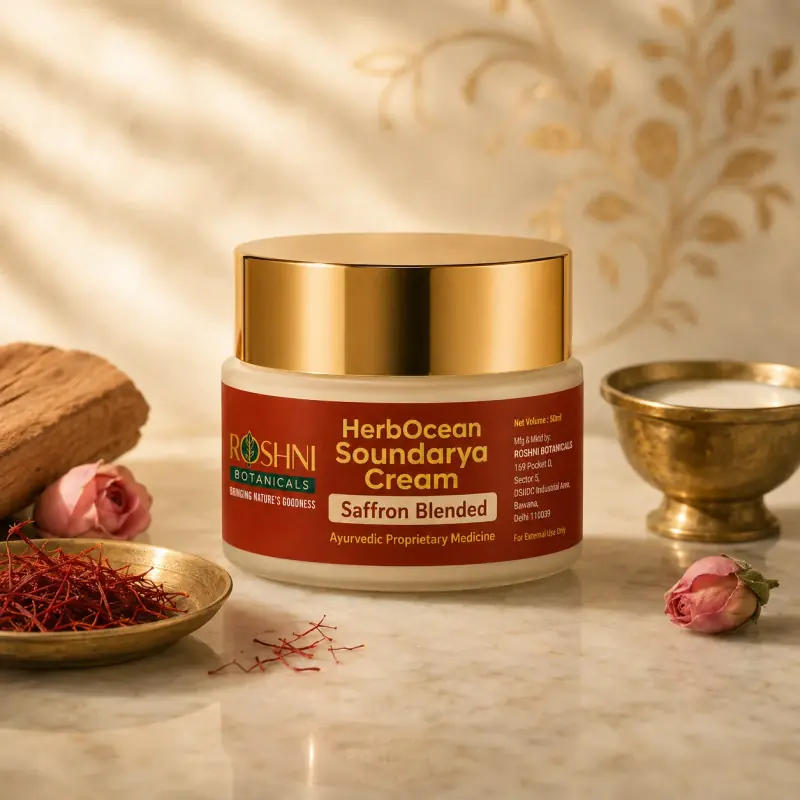
Soundarya Cream
A rich saffron brightening and repair cream with bargad (Vatt) bark on a goat-milk and coconut base, with shea and kokum butters — often reached for where post-acne marks (PIH) linger.