Rose Water for the Face: What Gulab Jal Really Does
Every Indian home has a bottle. Here is what a hydrosol is, what gulab jal does for the face, and how to spot scented water on a label.
There is a bottle of gulab jal in almost every Indian home. On the dressing table, in the fridge beside the mithai, in the pooja cupboard behind the diya. Very few things in our skincare walked from the kitchen to the bathroom shelf on their own, without a brand having to push them there. Gulab jal is one of them.
It is also the most over-promised bottle on that shelf. Search for it today and you will be told that a bottle from the corner chemist balances your skin’s pH, shrinks your pores and settles old marks. So let us sort out what rose water genuinely offers your face in sticky, humid air, what it cannot do, and how to buy or make a bottle worth keeping.
Key takeaways
- A hydrosol is the fragrant water that condenses out of a distillation. Distil rose petals, in a steam still or the copper deg of Kannauj, and the water that comes over with the vapour is what a true bottle of gulab jal holds.
- Rose water soothes, refreshes and gives light surface hydration that fades within minutes. That is the honest list, and for a household liquid it is a good one.
- Pore size is set by things you did not pick, inherited tendency, skin type and age among them. No mist or splash of rose water changes it, whatever the label suggests.
- Rose water in India covers two different things in the same bottle shape: a true rose distillate, and scented water. The ingredient list, not the front of the bottle, tells you which one you are holding.
- Rose water simmered at home is a rose infusion, not a distillate. It has no preservative system, so it lives in the fridge, gets used quickly, and goes down the sink at the first sign of cloudiness or an off smell.
How Rose Water Is Made, and What Is Actually in the Bottle
Distillation is a simple idea, done carefully. Petals go into a still with water, or steam is passed through them, and the vapour that comes off is cooled back into liquid. In Kannauj, where Indian gulab jal has been made for centuries, this happens in a copper deg over a fire, with the vapour led into a receiver called a bhapka. What condenses separates into two parts: a thin layer of aromatic oil floating on top, and beneath it the fragrant water. That condensed water, the hydrosol, is real gulab jal.
It carries only the trace water-soluble aromatic material that the vapour could lift out of the petal. A study of damask rose grown in the North Indian hills measured exactly this split: the rose water is dominated by a soft, honeyed rose alcohol, while the punchier aromatics and the waxes concentrate in the oil (Verma and colleagues, Natural Product Research, 2011, North Indian cultivars). It is also why a true bottle tends to smell soft and faintly sweet, closer to the flower than to a perfume counter. A useful clue at the shelf, though not proof on its own.
So what does it do on your face, really? It soothes and refreshes. You get a light film of surface hydration that fades within minutes, and a few seconds of genuine pleasure. Most of the relief a chilled bottle gives is the coolness itself, and that is a perfectly good reason to keep it in the fridge.
Now the boundaries. Gulab jal does not change the size of your pores. Pore size is set by things you did not pick, inherited tendency, skin type and age among them, and nothing applied to the surface has been shown to make the opening permanently narrower. How obvious a pore looks is a different question, and a more answerable one; our piece on open pores on the face separates the two.
Your skin’s pH is not its business either. A splash of rose water is far too dilute to hold the surface anywhere, and skin drifts back to its own setting within an hour or two of anything mild. Dark spots, old acne marks and melasma are outside its reach too. And a mist is not a moisturiser: the water sits on the surface and within a few minutes it has gone. One honest qualification for dry days and dry skin: a mist that is not followed by a moisturiser can leave skin feeling tighter than before, so let the splash open the routine and let the moisturiser close it.
How to Read a Rose Water Label
Rose water in India covers two different things in the same bottle shape. One is the rose distillate. The other is a water base carrying a rose fragrance, sometimes with a pink tint, sold under the same name. The front of the bottle will not tell you which one you are holding.
The test is not where water sits in the ingredient list, because several genuine products are hydrosol diluted in water and honestly open with Aqua. The test is whether a rose distillate appears in the list at all. It may be written as rose water, gulab jal, gulab arka, rose hydrosol or rose flower water, and some brands add the botanical name, Rosa damascena or Rosa centifolia. The botanical name is a nice sign rather than a test; plenty of genuine bottles, particularly Ayurvedic-licensed ones, never print it. A list whose only rose is a perfume or fragrance entry is scented water, whatever the front says.
Price is a weak guide, in both directions. A well-known brand at a mid-market price can be a fragrance product, and a small distiller’s bottle can be the real distillate and cost less. Rose water has always been a co-product of attar distillation, not a luxury.
And a new bottle deserves the same courtesy as anything else that goes on your face. Put a little on the inner forearm, leave it, and look at that patch again the next day before the bottle comes anywhere near your cheeks or your eyes. Fragrance, added or natural, is a common thing for skin to object to.
Gulab Jal in the Indian Home: Ubtan, Kitchen and Pooja
None of this will be news to you. Gulab jal is the mixing liquid that turns besan and haldi into an ubtan that spreads instead of crumbling, and it is the reason a homemade ubtan smells like something you want on your face. A spoonful goes into kheer, and into sherbet on a hot afternoon. Sprinkled at pooja, sprinkled over guests at a wedding.
That range is the point: a household liquid that earns its shelf space without ever needing to be a skincare active.
There is one place the dressing-table bottle should not go, and family habit often says otherwise. Do not put a cosmetic bottle of gulab jal into your eyes. A bottle made for the face is not sterile, and once it has been opened and handled, ordinary microbes join whatever fragrance and preservative were already inside. None of that belongs on the eye. Sterile rose-water eye drops, made and sealed for the eye, do exist at the chemist; that is a different product. On the face, freely. In the eyes, only something made for the eye.
Homemade rose water deserves the same straight talk, starting with the roses. Do not use florist or bouquet roses, and think twice about petals from a pooja garland: cut flowers are grown as a non-food crop, and they carry sprays no kitchen ingredient would be allowed to carry. Desi gulab from a home garden, or petals sold for eating, are the right starting point. Simmer the petals, strain the cooled liquid, and what you have is a fragrant rose infusion. It is lovely. It is not a distillate, so do not expect it to behave or keep like one.
Bottle it, refrigerate it, and use it quickly. There is no preservative system in it at all, so cloudiness, floating specks or any off smell means the batch goes down the sink without debate. If your skin stings or reddens after a batch, stop and let the skin settle rather than pushing through. A sealed commercial bottle keeps longer, but the same rule applies from the day it is opened: cold storage, clean hands, and the sink at the first sign of change.
Humid Air, Hard Water and Where a Mist Fits
On a heavy, humid day in North India, by evening there is a film of sweat and oil sitting on the face that no amount of blotting quite settles. A cold gulab jal mist does help here. It is cool on the skin, it takes the edge off a heavy evening, and it makes a wash feel finished.
Keep the expectation where it belongs, though. This is comfort, and comfort is worth having. The repairing steps of a routine sit at night, when skin is left alone for hours. The protecting step sits in the morning, and on melanin-rich skin it is the one that matters most: daily sun protection, in any season, because a mark prevented is far easier than a mark fading.
Hard water is the quieter problem in most Indian cities, and it works mainly through your cleanser rather than on its own. Mineral-heavy water lets more of the cleanser settle onto the skin and stay there through the rinse, and that residue is what pulls at the barrier and leaves the tight, squeaky feeling people read as cleanliness. A rose water splash afterwards makes the face feel calmer, and comfort is a fair reason to use it. Putting the barrier back together is different work: that happens with your moisturiser, and at night with an oil.
One more reason the expectation matters more here than it would elsewhere. On melanin-rich Indian skin, inflammation settles into post-inflammatory hyperpigmentation (PIH), so a reaction to a badly made mist or an aggressive scrub is not only a fortnight of discomfort; the mark it leaves can outlast the rash itself. Marks from acne are the best-studied version of this: in an evaluation of 324 acne patients across seven Asian countries, more than half of those with post-inflammatory pigmentation had carried it for a year or longer (Abad-Casintahan and colleagues, 2016).
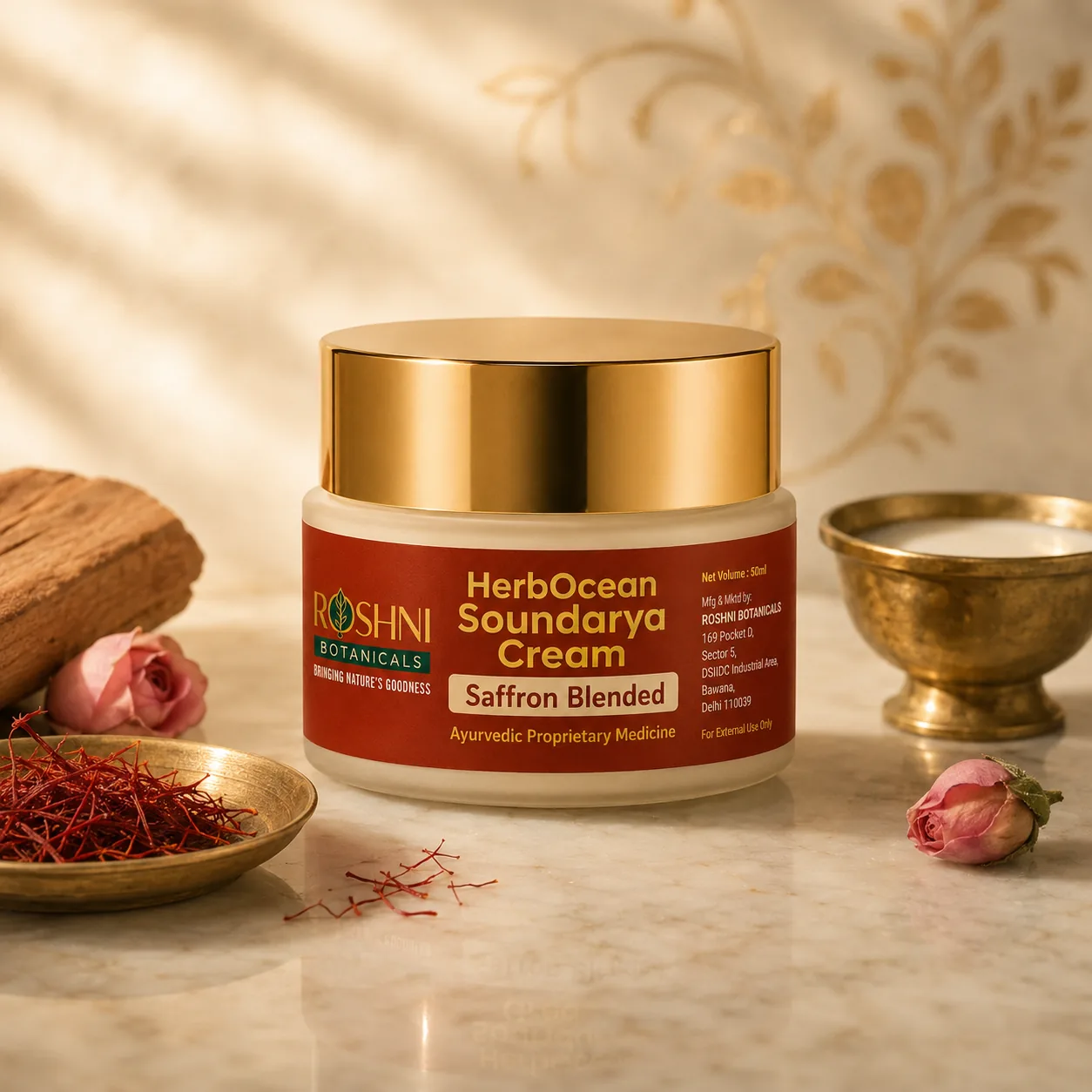
Where marks are the actual concern, HerbOcean Soundarya Cream is traditionally used in the care of post-acne marks. It is a rich saffron repair cream with bargad (Vatt) bark on a goat-milk and coconut base, with shea and kokum butters.
Some things are not home territory at all. Patchy pigmentation that spreads quickly, marks that itch or scale, stinging or a rash after any new product including rose water, or pigmentation that appeared after starting a new medicine: each of those belongs with a dermatologist. Melasma that deepens in pregnancy is different. It is common, and it often eases after delivery; mention it at an antenatal visit, and see a dermatologist if it distresses you or keeps spreading.
Rose in Our Own Formulations, and the Night Step for Pigmentation
Rose sits in two different places in our own formulations, and the two are not the same thing. Rose as a herb, Gulab, is one of the sixteen botanicals in HerbOcean Hair Oil. Rose oil is something else: one of the finishing oils in our skin preparations, including Radiance Tailam, where it works alongside lavender and mogra. Finishing oils shape how a preparation feels and smells as you apply it. On this page, that is as far as we take it.
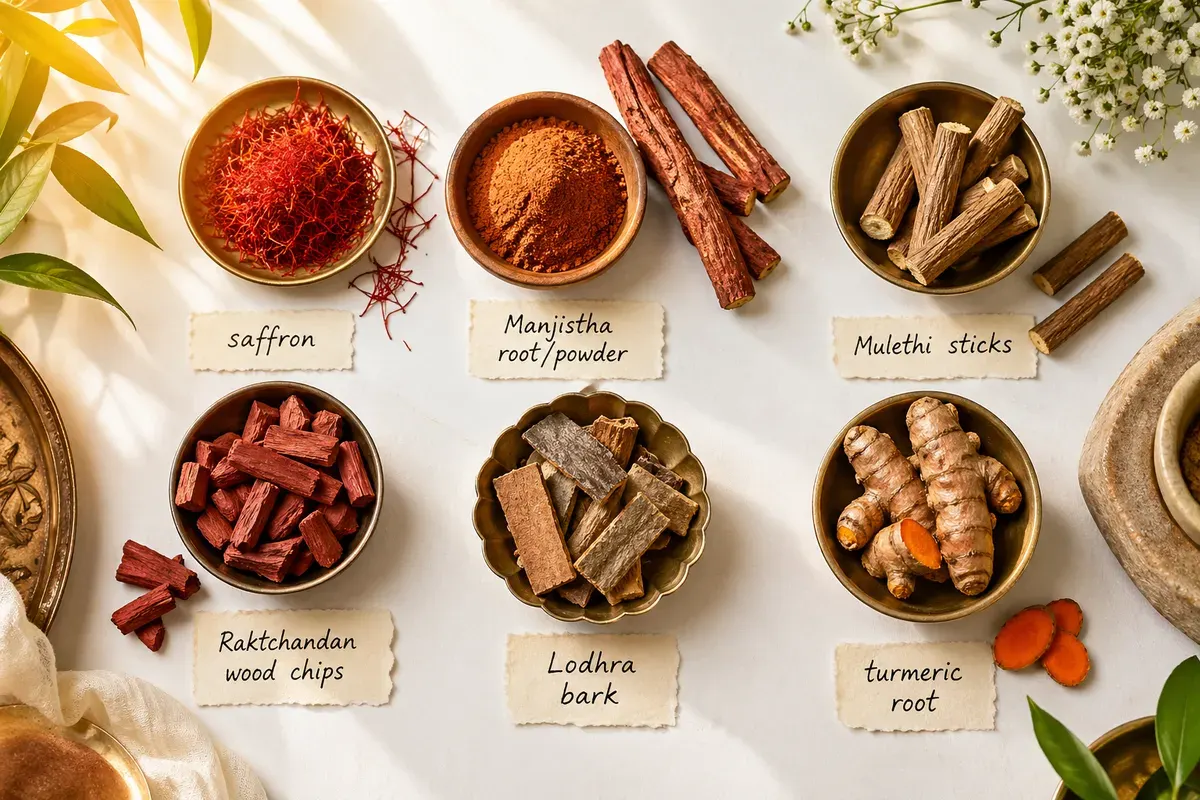
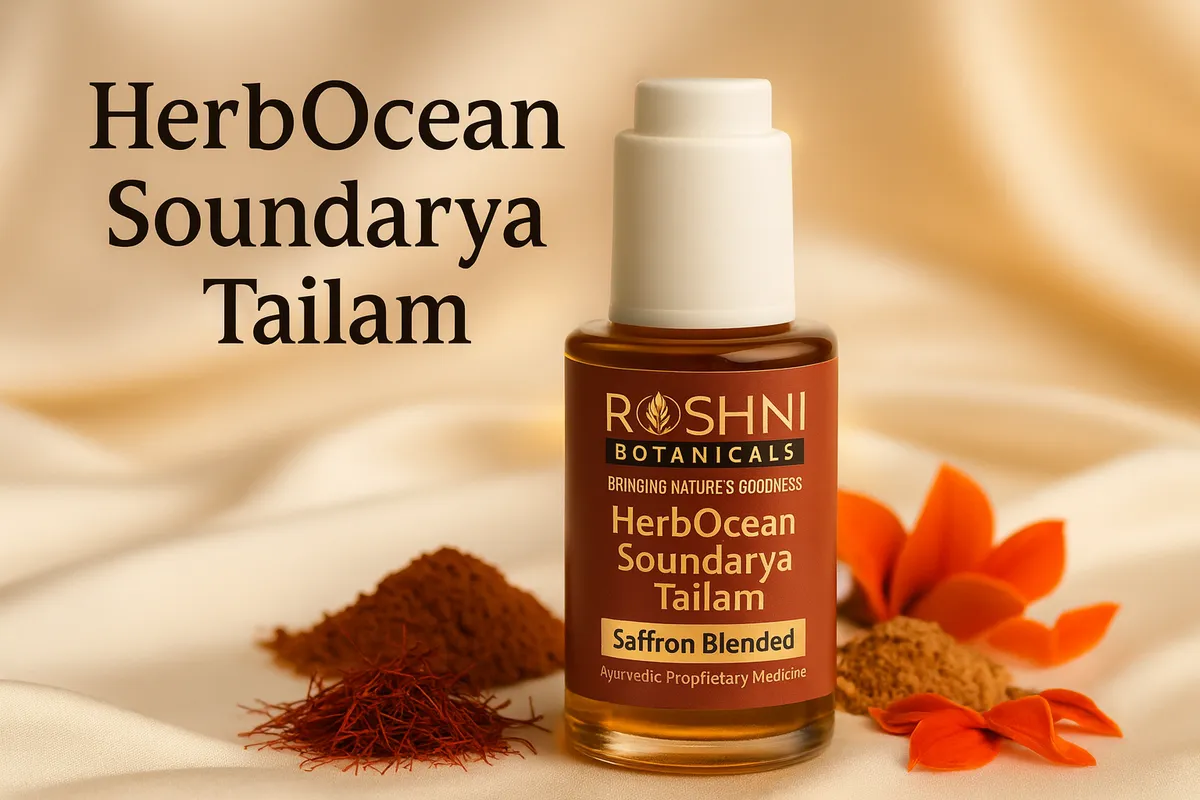
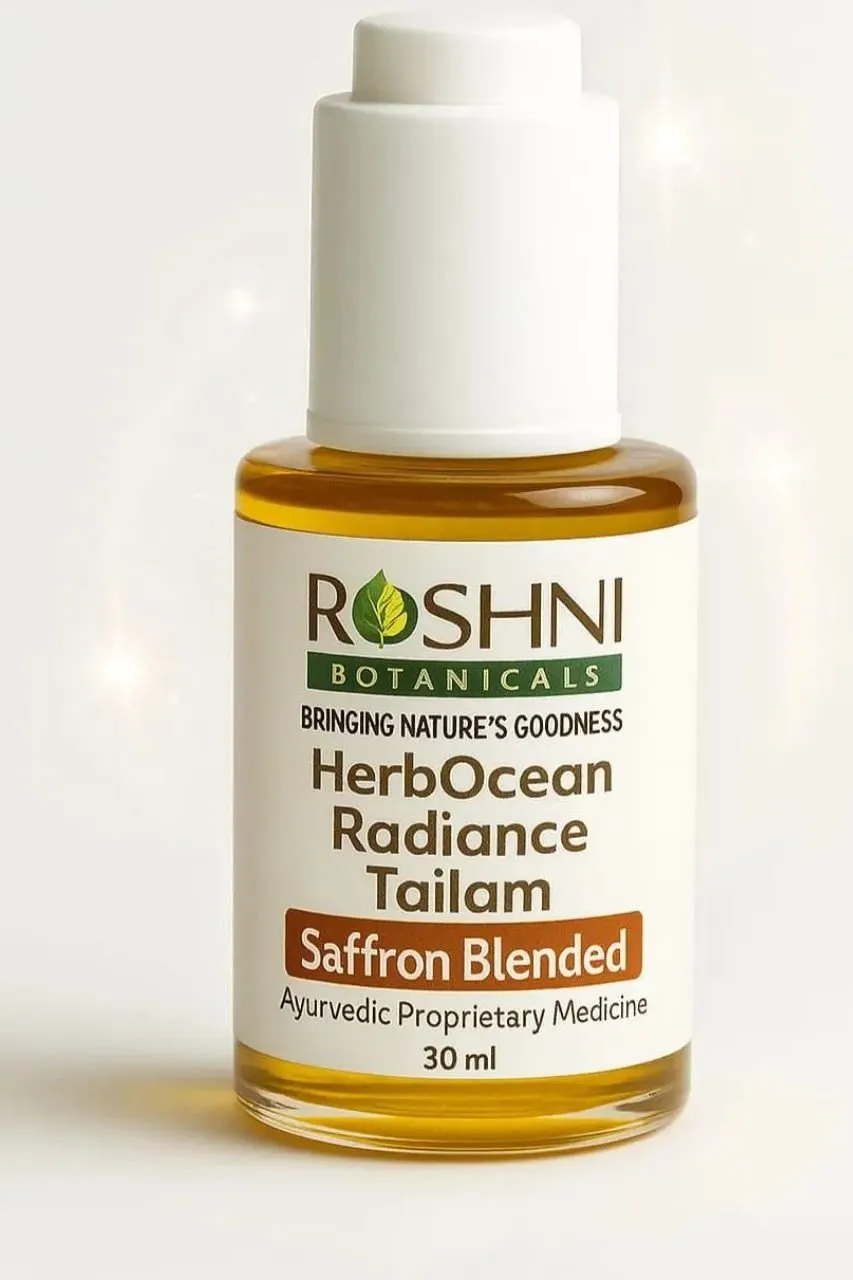
The night step itself is HerbOcean Radiance Tailam, an AYUSH-licensed Ayurvedic medicine (Licence No. DL-474 A&U) for external use, classically indicated for melasma (Vyanga) and traditionally used in the care of dark spots. Inside it sit saffron (Kesar), sandalwood (Chandan), red sandalwood (Raktchandan), Indian madder (Manjistha), turmeric (Haldi), costus root (Kuth), lotus (Kamal), wild Himalayan cherry (Padmaakh), Kakoli, Palash and the Triphala fruits, Amla, Baheda and Harad, in a sesame oil (Til tail) base.
It is formulated on the 40-year classical formulation legacy of Vaidya Shri Ram Prakash Ji and made in-house at our GMP-certified unit in Bawana, Delhi. Sensible cautions apply as they would with any medicine: it is for external use, patch-test on the inner forearm before the first full application, and stop if the skin reacts.
It does its best work at night, and it carries no sun protection of any kind. Daytime sun care stays a separate step, and on Indian skin, in any season, it is a step worth taking seriously.
We make no skin-tone claim for rose water, for saffron, or for any HerbOcean preparation. This preparation is not offered for changing your skin’s tone or shade, and nothing on this page promises that. Every mention of Kesar, Chandan or Manjistha here stays inside that boundary.
Where the Bottle Belongs
Put gulab jal back where it has always been happiest: a soothing, refreshing splash that asks nothing more of itself, and nothing more of you than opening the fridge. Buy the honest kind, keep it cold, keep the cosmetic bottle out of your eyes, and enjoy it.
If pigmentation is what actually brought you here, three things are worth your time next. Read our full guide to the Ayurvedic approach to melasma on Indian skin, see how a night routine for dark spots is put together, and look at HerbOcean Radiance Tailam, the night preparation classically indicated for melasma, in which rose plays its part as a finishing oil.
References: Verma RS, Padalia RC, Chauhan A, Singh A, Yadav AK. Volatile constituents of essential oil and rose water of damask rose (Rosa damascena Mill.) cultivars from North Indian hills. Natural Product Research. 2011;25(17):1577-1584 (GC-MS composition study; Indian cultivars). Labadie C et al. Hydrosols of orange blossom and rose flower support the growth of a heterogeneous spoilage microbiota. Food Research International. 2015;76:576-586 (laboratory microbiology; France). Abad-Casintahan F et al. Frequency and characteristics of acne-related post-inflammatory hyperpigmentation. Journal of Dermatology. 2016;43(7):826-828 (preliminary evaluation by the Asian Acne Board; 324 acne patients across seven Asian countries).
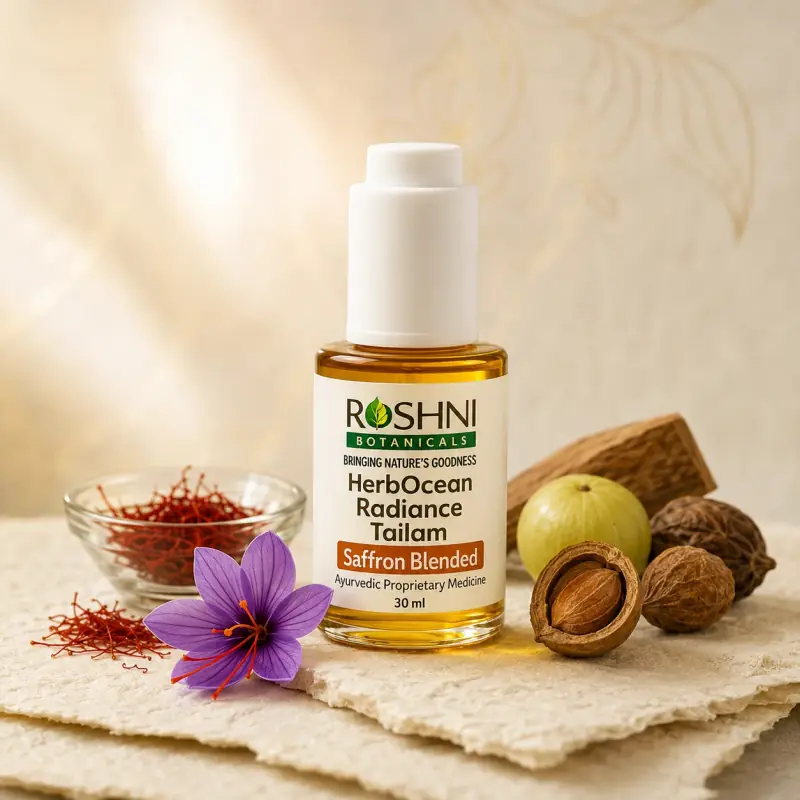
Radiance Tailam
A saffron brightening facial Taila with Manjistha and red sandalwood, traditionally used to support even tone where melasma, dark spots and PIH show.
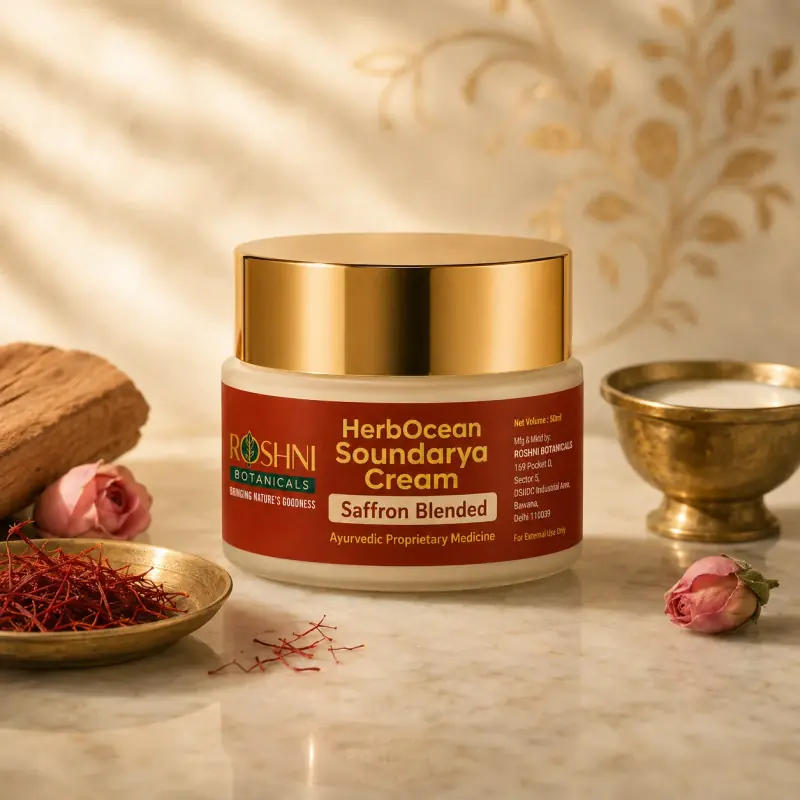
Soundarya Cream
A rich saffron brightening and repair cream with bargad (Vatt) bark on a goat-milk and coconut base, with shea and kokum butters, traditionally used in the care of skin where post-acne marks (PIH) linger.
Part of our guide: Ayurvedic treatment for melasma on Indian skin.