Blackheads and Whiteheads: What Helps Indian Skin, and When One Becomes a Pimple
Both are pores plugged with oil and shed skin cells. How to tell them from look-alikes, why squeezing can mark Indian skin, and when to see a dermatologist.
Blackheads and whiteheads are both comedones: pores plugged with oil and shed skin cells. A blackhead is an open comedone whose exposed plug darkens in the air, so the colour is not dirt. A whitehead is a closed comedone, sealed under a thin layer of skin. On melanin-rich Indian skin, squeezing either one can leave a dark mark that stays long after the comedone itself has gone.
You lean into the bathroom mirror and there they are: a scatter of dark dots across your nose, a few tiny bumps along your forehead. Your fingers are already on their way up. Pause there. What you do next can decide whether that pore settles down by itself or leaves a brown mark behind.
Key takeaways
- Blackheads (open) and whiteheads (closed) are both comedones, pores plugged with oil and shed skin cells that have built up inside the follicle.
- On melanin-rich Indian skin, where type V leads the Fitzpatrick count and type IV comes next, the inflammation that squeezing sets off can leave a dark mark that lingers.
- Salicylic acid and topical retinoids each work on the pore in their own way, and either can irritate, which on Indian skin can leave a mark, so bring in one at a time.
- A comedone that turns red, raised and sore has become an inflamed pimple, a papule or a pustule, and that stage is where spot care fits.
What a Comedone Is: Open Blackheads and Closed Whiteheads
A pore on your face is the opening of a hair follicle, and an oil gland empties into it. The lining of the follicle keeps shedding cells, and normally those cells slip out with the oil. When they clump together with it instead, the plug they form is a comedone. It starts too small to see and can grow from there.
Whether you end up with a blackhead or a whitehead depends on the top of that plug. Left open at the surface, it becomes a blackhead, and the dark tip is the plug itself. A 2021 review by Leung and colleagues traces the colour to oxidised melanin. Sealed under a thin layer of skin, the same plug becomes a whitehead, a small pale or skin-coloured bump with no opening you can see. Both gather on the forehead, nose and chin, where oil glands sit closest together.
Look closely before you decide what you are dealing with, because not every dot is a comedone. Some of the small, evenly spaced dots across the nose are sebaceous filaments, the normal column of oil and skin cells that sits in those pores, and they can look much like blackheads. They fill again soon after you press them out, so leave them be. A true blackhead is darker, a black plug in a widened opening, and for that, as for a whitehead, the plan is simple: hands off, and a plain cleanse.
A hard, pearly bump that will not budge may be a milium, a tiny pocket of keratin under the skin. A dermatologist can open it with a sterile needle if it bothers you. A spot that is red, raised and tender is something else again: it has moved past the comedone stage into an inflamed pimple, and it needs a different kind of care.
Why Squeezing Can Mark Indian Skin
Indian skin can answer injury with extra pigment. A 2009 review by Sachdeva on Fitzpatrick skin typing puts the largest share of Indian skin at type V, with type IV next, both of them rich in melanin. Press a comedone hard with your nails or a home extractor and the wall of the follicle can split, pushing the plug into the skin around it, where inflammation takes hold. Picking at bumps after waxing or threading can leave a mark too, through the inflammation it sets off.
In their 2010 review of post-inflammatory hyperpigmentation (PIH) in skin of colour, Davis and Callender name acne among its very common causes, describe the marks as more frequent and more severe on darker skin, and note that a brown mark of this kind can take months, even years, to settle. So if your question is blackheads kaise nikale, how to get a blackhead out, start by leaving it where it is. If you want one out, a dermatologist can extract it with sterile tools and the right pressure. Pore strips lift some of the plug and some surface oil.
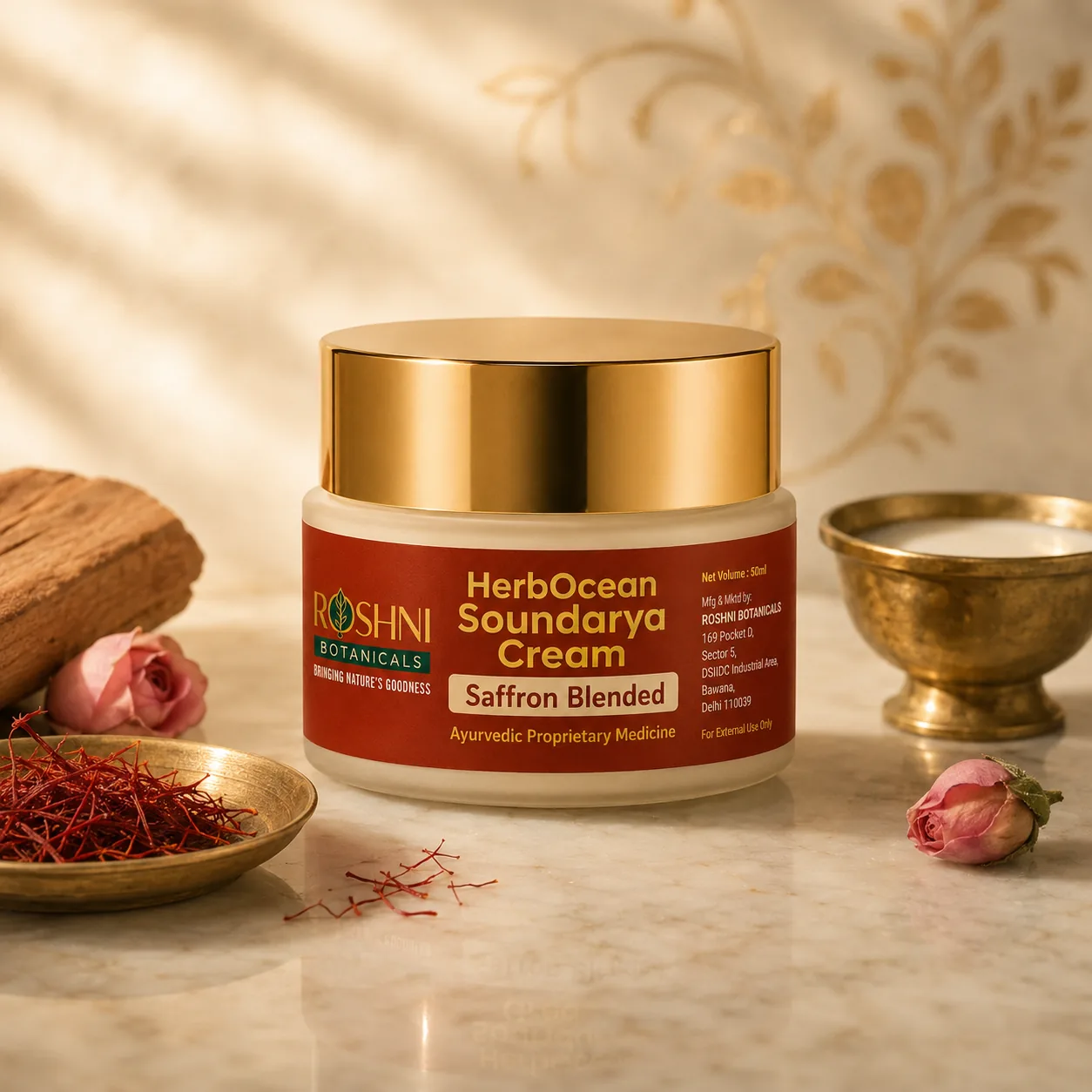
For a brown mark that an old pimple has left behind, HerbOcean Soundarya Cream is traditionally used in the care of post-acne marks: a rich saffron repair cream with bargad (Vatt) bark on a goat-milk and coconut base, with shea and kokum butters. It is rich, so very oily or acne-prone skin may not want it during an active phase.
What Salicylic Acid and Retinoids Do in the Follicle
Two actives are worth understanding when you have comedones. The first is salicylic acid, an acid that mixes with the oil in your skin, and you will find it in face washes, toners and leave-on gels. A 2015 review by Arif calls it lipophilic and comedolytic: it can work into the oily lining of the follicle and loosen the bonds that hold shed cells together. It can also leave the skin dry or stinging.
The second is the topical retinoids, such as adapalene and tretinoin, which are vitamin A derivatives. A 2017 review by Leyden and colleagues explains that they act on the microcomedone, the tiny plug that forms before anything shows, help the follicle lining shed normally by slowing how fast its cells are made, and calm some of the inflammation. Leung and colleagues add that they make skin more sensitive to the sun. A dermatologist prescribes them, decides whether one suits you, and starts you slowly, because early on they can leave skin dry and flaky.
Whichever you try, bring in one at a time, and check how to patch test a new face product before it goes on your face. Do not layer the two at once while your skin is new to them, since irritation can leave a mark of its own. HerbOcean does not manufacture a sunscreen, and nothing in the range replaces one, so your sun protection stays a separate step.
Steam, Toothpaste, Lemon, Scrubs and Ubtan
Steam to open the pores, a pack to close them. The pore itself has no muscle and no lid, so it cannot follow that saying, though warm, moist air may soften the plug a little before you cleanse. The harm comes afterwards, when steamed skin is squeezed.
Toothpaste is another matter: its ingredients are made for teeth, so keep it for your teeth. Lemon juice on skin that then meets the sun can burn, and on Indian skin that burn can leave a mark that lasts. Leave out the gritty walnut-shell scrubs: the plug sits inside the follicle, and scrubbing irritates the skin.
Besan, haldi and multani mitti come from the ubtan tradition, where they go on oily skin as a pack. Use them now and then rather than daily, let the paste sit and rinse it away, and never rub it hard into the nose. Where the tap runs on hard groundwater, its minerals can leave more cleanser residue on the skin after rinsing, so a mild cleanser makes sense there.
A Daily Routine for Skin That Clogs
Ayurveda looks at a breakout as a whole. In its chapter on minor conditions, the Sushruta Samhita reads acne as one eruption, arising from Kapha and Vata (doshas, the biological energies Ayurveda sees at work in every body) together with Rakta, the blood. The chapter gives no separate name for a blackhead. Elsewhere, the Charaka Samhita describes Kapha as oily and sticky, and a T-zone that clogs fits that picture.
Keep your Dinacharya (daily routine) plain: a gentle cleanse, then a light moisturiser, and the morning and night order tells you where sunscreen fits in. Between washes, leave your face alone. Hair oil and styling products belong on the hair rather than the forehead, since product resting on the skin there can show up as pimples along the hairline and under the hair. Rinse sweat off after exercise or a sticky commute. When you shop for a moisturiser, a non-comedogenic label is a useful pointer for skin that clogs.
When a Blackhead Turns Into a Pimple
A blocked pore can also become inflamed. Oil and dead cells stay trapped, the bacteria that normally live on the skin multiply in that oil, and the spot turns red, raised and tender. Doctors call it a papule, or a pustule once it fills with pus, and in Hindi it is a muhansa. Squeezing now can push the inflammation deeper and raise the risk of a scar, and this is the stage where spot care fits.
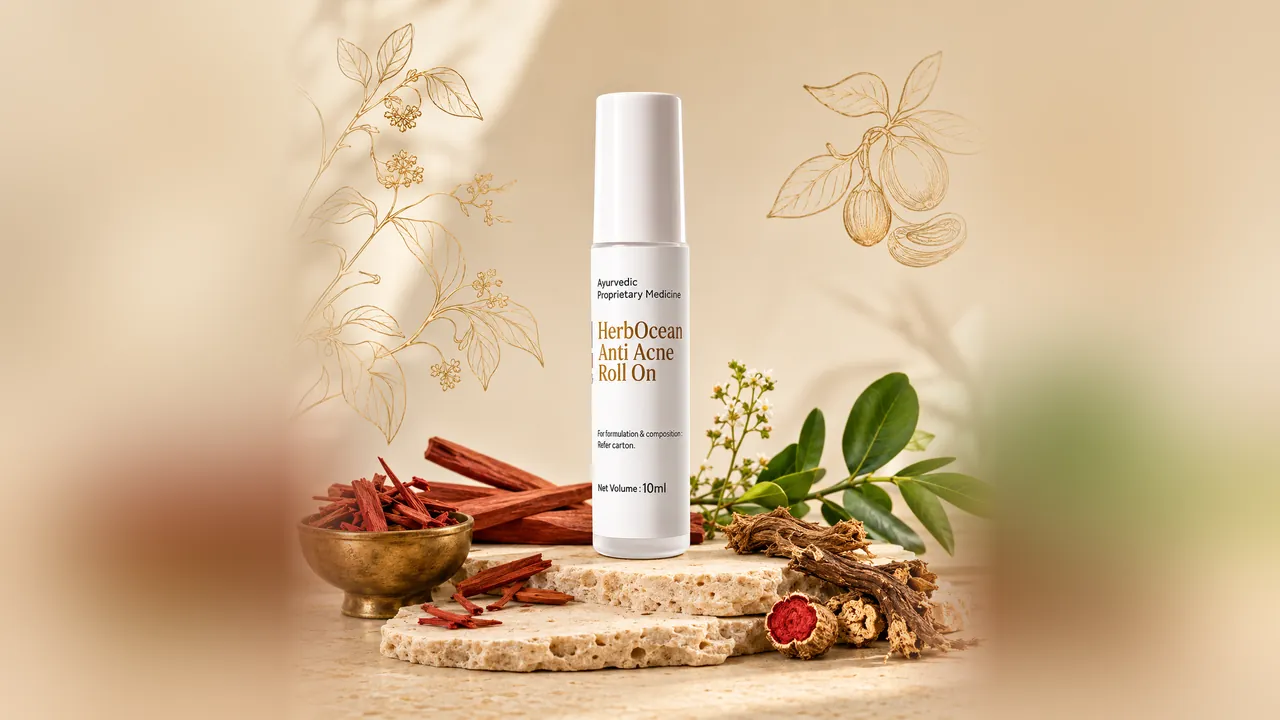
HerbOcean Anti-Acne Roll-On is an AYUSH-licensed Ayurvedic medicine for external use, classically indicated for acne and pimples (Yuvanpidika, the classical Ayurvedic term for acne, literally youthful eruption) and traditionally used in the care of post-acne marks and pigmentation (PIH). It carries six herbs in equal measure, Manjistha (Rubia cordifolia), Lodhra (Symplocos racemosa), Jaiphal (Myristica fragrans), Raktchandan (Pterocarpus santalinus), Daruhaldi (Berberis aristata) and Kuth (Saussurea lappa), in a glycerine and water base with lavender oil. It is made in-house at our GMP-certified unit in Bawana, Delhi, under AYUSH Licence No. DL-474 A&U, and built on the 40-year Ayurvedic formulation legacy of Vaidya Shri Ram Prakash Ji.
The direction on its product page is short. Cleanse and pat dry. Roll a thin layer directly over the pimple, morning and night. Follow with your moisturiser. For spot use, not full-face application. For external use only. Patch-test on the inner forearm 24 hours before first use and discontinue if irritation occurs. Avoid it if you are allergic to a listed botanical, and keep it off broken skin and the eye and lip area. If pregnant or breastfeeding, check with your doctor. If you are adding your first medicine, one concern, one product is a sensible way to begin.
When to See a Dermatologist
Some patterns need a dermatologist rather than more home care: a dense field of closed comedones that is not settling with steady, gentle care, deep and painful lumps under the skin, or pitting and scarring that is starting to form. Keep the two words apart: a mark is colour, while a scar is a change in the surface itself, which is why pitting is worth an early appointment.
If acne begins in adulthood and comes with periods that have turned irregular or new, coarse hair on the face, ask a dermatologist to look for a hormonal cause. Itchy bumps that all look alike and carry no blackhead or whitehead may be folliculitis rather than acne, and a dermatologist can find its cause. If comedones showed up after a new cream or hair product, take it along to the appointment.
Before Your Fingers Move
Back at the mirror, then. Whatever those dark dots and tiny bumps turn out to be, the best thing your fingers can do for them is nothing at all. Leave the comedone alone, keep your cleansing gentle, and bring in any active you choose one at a time.
When one of those bumps does turn into a red, sore pimple, keep your nails well away from it. For the wider picture of how the tradition reads a breakout, turn to our complete guide to ayurvedic treatment for acne.
References: 1. Sushruta Samhita, Nidana Sthana 13 (Kshudra Roga). The chapter on minor conditions; acne from Kapha, Vata and Rakta. 2. Charaka Samhita, Sutra Sthana 1. The qualities of Kapha, among them oily and sticky. 3. Leung AKC, Barankin B, Lam JM, Leong KF, Hon KL. Dermatology: how to manage acne vulgaris. Drugs in Context, 2021. Narrative review; the follicular plug, the colour of the open comedo, squeezing and scars, and retinoids and the sun. 4. Plewig G, Wolff HH. Sebaceous filaments. Archives of Dermatological Research, 1976. Light and electron microscopy study, in German. 5. Sachdeva S. Fitzpatrick skin typing: applications in dermatology. Indian Journal of Dermatology, Venereology and Leprology, 2009. Review; type V, then type IV, for Indian skin. 6. Davis EC, Callender VD. Postinflammatory hyperpigmentation: a review of the epidemiology, clinical features, and treatment options in skin of color. Journal of Clinical and Aesthetic Dermatology, 2010. Narrative review. 7. Arif T. Salicylic acid as a peeling agent: a comprehensive review. Clinical, Cosmetic and Investigational Dermatology, 2015. Narrative review. 8. Leyden J, Stein-Gold L, Weiss J. Why topical retinoids are mainstay of therapy for acne. Dermatology and Therapy, 2017. Narrative review. 9. Hankinson A, Lloyd B, Alweis R. Lime-induced phytophotodermatitis. Journal of Community Hospital Internal Medicine Perspectives, 2014. Case report, one patient, United States. 10. Danby SG and colleagues. The effect of water hardness on surfactant deposition after washing and subsequent skin irritation in atopic dermatitis patients and healthy control subjects. Journal of Investigative Dermatology, 2018. Case-control washing study, 80 participants, United Kingdom. Educational, not medical advice.
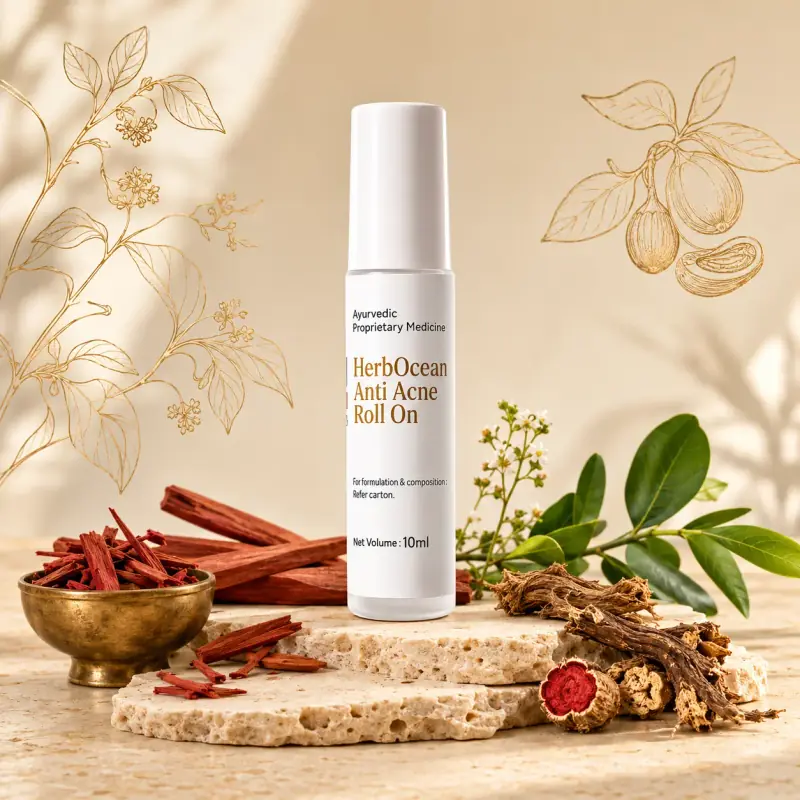
Anti-Acne Roll-On
Ayurvedic spot care for active pimples and post-acne marks (PIH) — a herbal roll-on classically indicated for acne (Yuvanpidika). Made in-house in Delhi.
Part of our guide: Ayurvedic treatment for acne: the complete guide.