
Pimple Patch or Ayurvedic Roll-On? An Honest Guide to Spot Care
Pimple patch or Ayurvedic roll-on? The real question is the stage of the spot: a hydrocolloid patch for the opened pimple, a herbal roll-on for the rising one, and how both fit one routine.
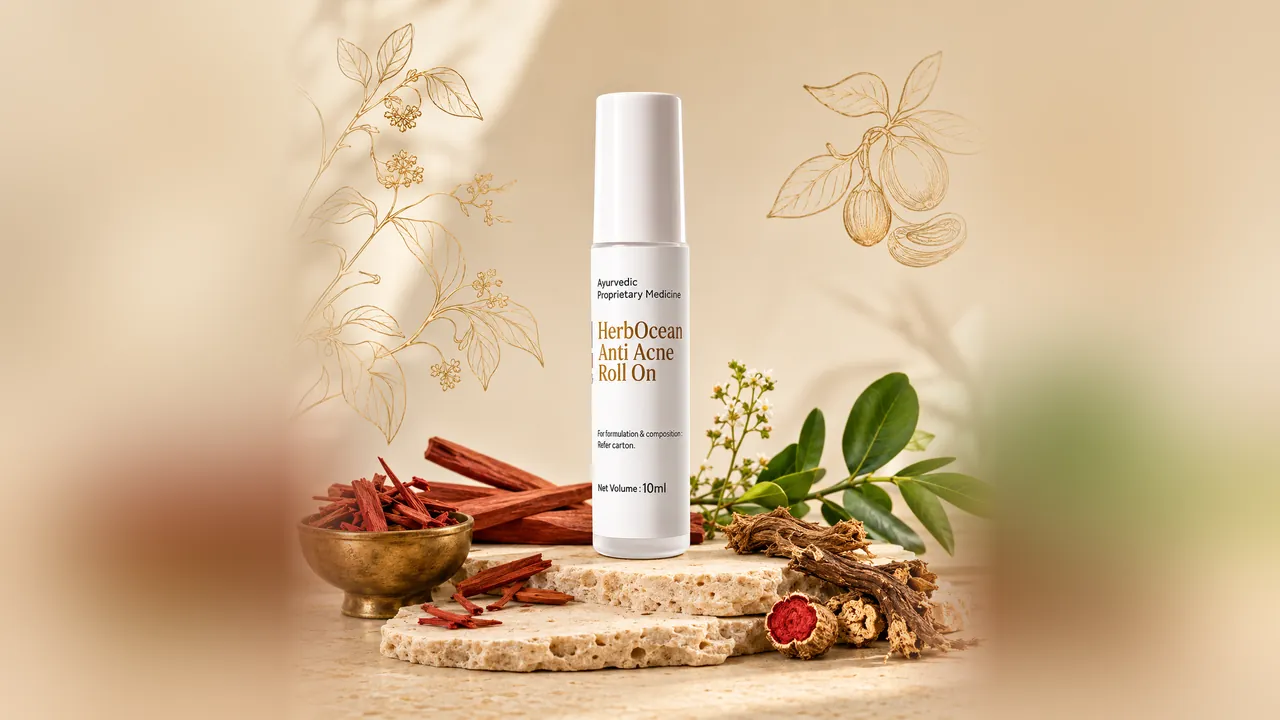
It is 11 pm, a pimple is rising on your chin, and your bathroom shelf offers two very different answers: a translucent sticker and a herbal roll-on. Both get called spot care, yet they do entirely different jobs at entirely different moments, and choosing correctly matters more on Indian skin, because the cost of the wrong tool, or of picking the spot itself, is a dark mark that outstays the pimple by months. This is the honest which-to-use-when guide the shelf never came with.
Key takeaways
- The real question is not patch versus roll-on; it is the stage of the pimple. A hydrocolloid pimple patch, a modern wound-care dressing, works on a spot that has already opened, drawing out fluid and acting as a physical barrier against picking.
- A herbal spot preparation such as the HerbOcean Anti-Acne Roll-On, an Ayurvedic medicine classically indicated for acne and pimples (Yuvanpidika, the classical term), delivers measured herbs to an unbroken, rising pimple, before it comes to a head.
- Neither is for cystic acne, the deep, painful bumps that never surface; those sit too far down for any surface tool and belong with a dermatologist.
- In humid Indian weather a patch’s edges lift on sweaty skin within hours, which is why many people get better wear overnight in a cool room than through a monsoon commute; a roll-on has no such limit.
- On melanin-rich Indian skin, the marks a pimple leaves (post-inflammatory hyperpigmentation) outlast the pimple, so the point of both tools is the same: settle the spot without your fingers ever touching it.
What a Hydrocolloid Pimple Patch Actually Does
A hydrocolloid patch is not a medicine; it is a dressing borrowed from wound care. Hydrocolloid is a gel-forming material that draws fluid out of an open surface, so when a pimple has already come to a head or been opened, the patch soaks up the discharge into itself, keeps the area moist and clean, and, just as usefully, forms a physical lid that your fingers cannot get under. That last part is the quiet genius of the format: for a compulsive picker, a patch is a promise you cannot break.
There is a genuine skin-kindness in that moist seal, worth naming because it connects to marks. A pimple left to dry out and scab often knits together more roughly, and every rough recovery is a chance for melanin-rich skin to lay down pigment; the patch’s damp, covered environment lets an opened spot close more evenly, which is part of why the format earned its following. That benefit, though, is real only once the spot has opened. It is a dressing for an aftermath, not a treatment for a beginning.
But its talent is also its limit, and the honest version matters. A hydrocolloid patch works on an opened spot; on a closed, unbroken pimple with nothing yet to draw out, it mostly just sits there. It does nothing for blackheads or the deep congestion under the skin, it cannot prevent the next breakout, and on cystic acne it is simply the wrong instrument. And there is an Indian-weather catch the glossy reviews skip: hydrocolloid grips best on clean, dry skin, so through a sweaty July commute the edges lift, curl and collect grime by mid-morning. A patch is at its best overnight, in a cool room, on a spot that has already surfaced.
What an Ayurvedic Roll-On Does Differently
A herbal roll-on works at the opposite end of a pimple’s life: the beginning. When you feel that tender, rising bump before it has come to a head, there is no fluid for a patch to draw and nothing for it to grip, but there is a pore you can still reach with measured herbs. The HerbOcean Anti-Acne Roll-On delivers those herbs to the unbroken spot through a rollerball, so a metered dose lands exactly where it is needed and your fingers never touch the pimple, the single habit that most reliably sets up a mark on melanin-rich skin.
This is not a new instinct; it is a very old one, delivered without the mess. Indian households have always practised targeted spot care: the overnight dab of haldi paste on a stubborn pimple, the fingertip of multani mitti pressed onto an oily spot before a function. The logic was always right, reach for a measured, classical herb rather than panic or a squeeze; what a roll-on changes is only the delivery, a clean, no-stain, metered dose that will not colour your pillow cover or your dupatta and needs no mixing at 11 pm. The Anti-Acne Roll-On is an AYUSH-licensed Ayurvedic medicine (Licence No. DL-474 A&U) classically indicated for acne and pimples (Yuvanpidika) and traditionally used in the care of the post-acne marks and pigmentation (PIH) they leave behind. Manjistha leads it, Ayurveda’s foremost blood-purifying (rakta shodhana) herb, with astringent Lodhra, warming Jaiphal, cooling Raktchandan (red sandalwood), bitter Daruhaldi and Kuth, in a light glycerine base with gluconolactone and a trace of lavender oil; no neem, no tea tree. It was formulated by Vaidya Shri Ram Prakash Ji, the master vaidya (a classical Ayurvedic physician and formulator) whose 40-year formulation legacy the HerbOcean line is built on, and made in-house at Roshni Botanicals’ GMP-certified unit in Bawana, Delhi.
When to Reach for Which (and When for Neither)
Put the pimple’s stage first and the choice becomes simple. Read your spot, then read the row.
| The spot in front of you | Reach for | Why |
|---|---|---|
| A tender, rising, unbroken pimple | The Ayurvedic roll-on | Measured herbs reach the pore before it opens; nothing to picking-proof yet, but everything to soothe |
| A pimple that has come to a head or opened | A hydrocolloid patch | There is fluid to draw and a surface to seal against your fingers |
| An oily, congested area, no single spot | A weekly clay ritual (not either tool) | Manage the terrain with multani mitti; spot tools are for spots, not fields |
| A deep, painful bump that never surfaces | Neither, see a dermatologist | Cystic acne sits too deep for any surface dressing or roll-on |
Notice the comparison this guide will not make: it does not claim either tool is better than the other, because they are not doing the same job. The patch is a dressing for an open wound; the roll-on is a classical preparation for a rising one. Ask what stage your pimple is at, not which product has the louder reviews.
Why This Choice Matters More on Indian Skin
Three Indian realities raise the stakes on getting this right. First, melanin: our skin answers inflammation with pigment, so a pimple that is picked, or left angry when a rising spot could have been soothed early, leaves a flat brown mark that can linger for months. Both tools exist, in the end, to keep hands off the spot and let it settle quietly; that is their shared purpose on melanin-rich skin, and it matters more here than anywhere. For marks that have already settled, HerbOcean Soundarya Cream is traditionally used in the care of post-acne pigmentation while time does the rest.
Second, the weather, which decides how a patch behaves. Through the humid months a patch worn out of the house is fighting sweat the whole day, while a roll-on absorbs in a minute and is done; know which your day suits. Third, the plain practicality of an Indian life on the move: a strip of patches is easy to forget and awkward to apply without a mirror in a hostel bathroom or an office loo, while a pocket roll-on needs no mirror, no fingers and no privacy, and rides in a bag without fuss. None of this makes one tool superior; it makes each better for a particular pimple on a particular day.
One Routine, Both Tools, and When to See a Dermatologist
The tidiest answer, for many people, is to own both and never confuse their jobs. The simplest tell for which one a spot is due is touch: a firm, tender lump still sitting under the skin wants the roll-on, while a spot that has softened to a head, or been nicked open, wants the patch. Keep the roll-on for the rising spot you catch early, morning and night on clean, dry skin; keep a few patches for the one that has already opened, worn overnight. The one firm rule is not to layer them on the same spot at the same time, a patch over a wet roll-on grips nothing and the roll-on under a patch is wasted; let each work its own shift on its own spot. Patch-test the roll-on on your inner arm before first use, and keep it for external use only.
Building this two-tool kit costs little and travels light, which suits the way most of us actually live. A single roll-on rides in a handbag or a hostel drawer for months of the occasional rising spot, and a small sheet of patches tucks into a wallet for the mornings you wake to one that has opened overnight. Between them they cover the two moments a pimple is most tempting to touch, the rising ache and the ripe head, without a mirror, a mess or a squeeze; and on skin that marks as readily as ours, keeping fingers off in both those moments is most of the battle already won.
And keep the honest line in view, because some spots outrank both tools. See a dermatologist for recurring painful, deep or cystic bumps; for acne that appears suddenly in adulthood after clear years; for jawline breakouts that track with irregular cycles, which deserve a hormonal work-up; and for anything that is scarring rather than marking. A patch and a roll-on are for the everyday pimple; a pattern that keeps returning is a conversation for a doctor. For the fuller classical picture, our complete guide to the Ayurvedic treatment of acne sets out the whole framework, and our practical guide to Ayurvedic acne spot care walks through using the roll-on well.
The Sticker, the Roll-On, and the Spot in Front of You
There is no single best spot-care product, only the right one for the spot on your face tonight. A hydrocolloid patch for the pimple that has opened, an Ayurvedic roll-on for the one still rising, a weekly clay ritual for the oily terrain, and a dermatologist for the deep and stubborn: that is the whole map. If the herbal half of that shelf is what your routine is missing, the HerbOcean Anti-Acne Roll-On carries the old household instinct, a measured classical herb on the spot, into a clean, no-mess format built for exactly the pimple you feel rising right now. Read the stage, reach for the right tool, and keep your fingers, gently, out of it.
References: Sushruta Samhita, Nidana Sthana 13 (Kshudra Roga), on Yuvanpidika, and Chikitsa Sthana 1 (Dvivraniya), on the management of wounds (Vrana) that frames the classical parallel to a modern dressing. The Science Behind a Viral Trend: Demonstrating Safety and Efficacy of Hydrocolloid Patch for Facial Acne. Journal of the American Academy of Dermatology. 2024 (a controlled study, n = 41: hydrocolloid patches improved the healing appearance of opened, “popped” pimples versus a wash-only control; no comparison was made with any herbal preparation). Davis EC, Callender VD. Postinflammatory Hyperpigmentation: A Review of the Epidemiology, Clinical Features, and Treatment Options in Skin of Color. Journal of Clinical and Aesthetic Dermatology. 2010;3(7):20–31 (a review of post-inflammatory hyperpigmentation in skin of colour).
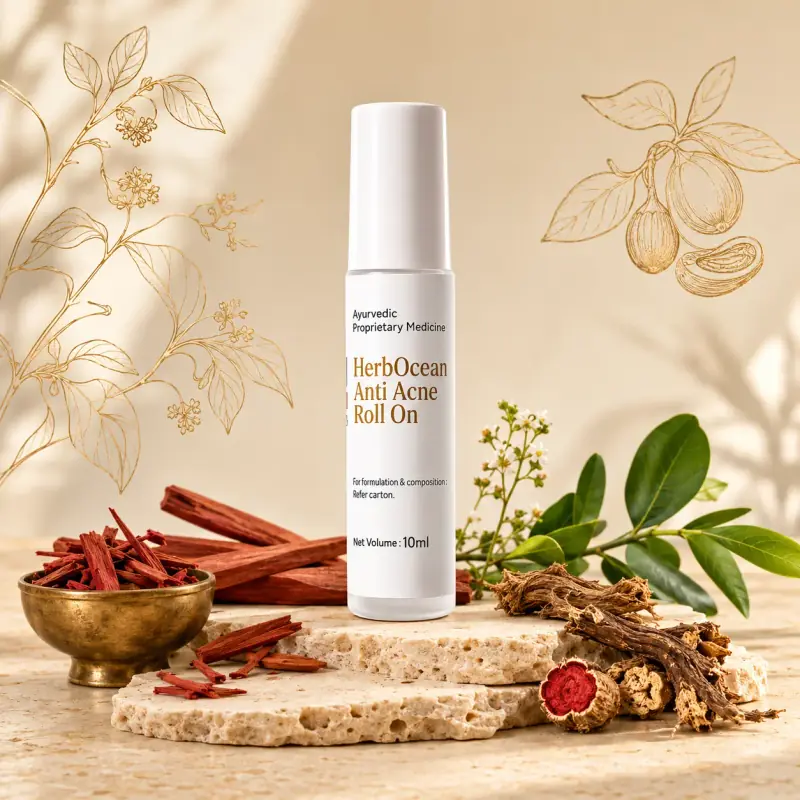
Anti-Acne Roll-On
Ayurvedic spot care for active pimples and post-acne marks (PIH) — a herbal roll-on classically indicated for acne (Yuvanpidika). Made in-house in Delhi.
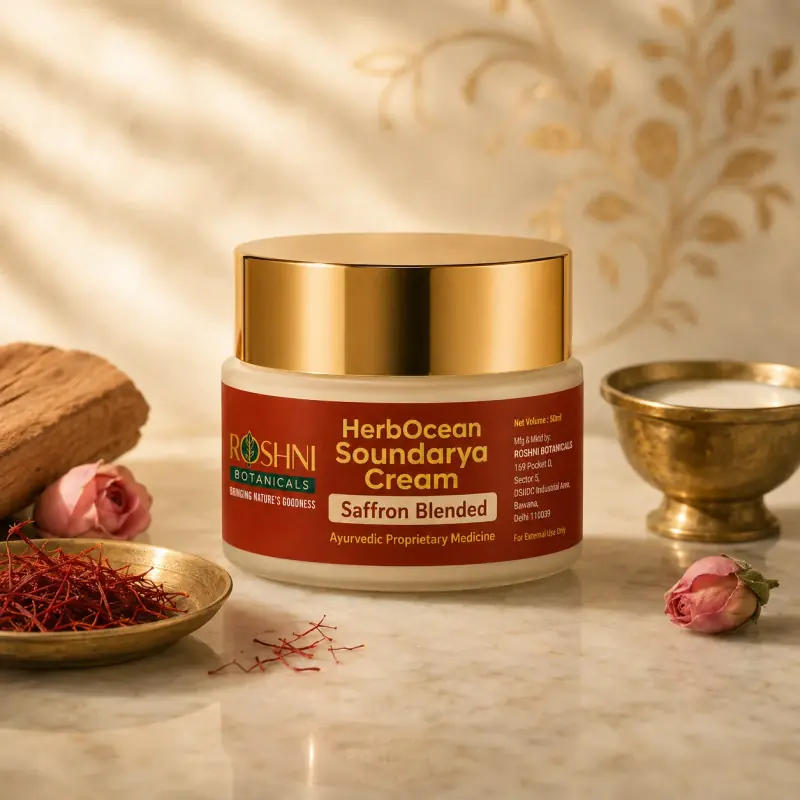
Soundarya Cream
A rich saffron brightening and repair cream with bargad (Vatt) bark on a goat-milk and coconut base, with shea and kokum butters, traditionally used in the care of skin where post-acne marks (PIH) linger.
Part of our guide: Ayurvedic treatment for acne: the complete guide.