Dark Circles Under Eyes: Three Different Causes, Three Different Answers
Dark circles come in three kinds: pigmented, vascular and structural. A self-check to tell them apart, what drives each in Indian homes, and where topical care genuinely fits.

The chilled teaspoon from the fridge, the concealer that never quite matches, and still the same shadow under your eyes on every video call. Most under-eye advice misses this: dark circles are not one problem. Extra pigment in the skin, blood vessels showing through it, or a shadow cast by the shape of the face can all produce the same tired look, and each asks for something different. This guide walks through a self-check to name which one you are looking at, the drivers that matter in Indian homes, and a plain statement of where care helps and where it does not.
Key takeaways
- Three causes account for most of what people see in the mirror: pigmented (extra melanin in the thin under-eye skin), vascular (vessels showing through it) and structural (a shadow from tear-trough hollowing). Mixed presentations are common (Roh and Chung, Dermatologic Surgery, 2009).
- A gentle stretch in daylight helps separate the three, but read it the right way round: pigment stays put, vessels look deeper and more spread out, and a shadow lightens or disappears.
- Constitutional and familial pigmentation is common. In 200 patients attending a hospital skin OPD in India, 63 per cent reported a family history, and the constitutional type was the commonest at 51.5 per cent (Sheth, Shah and Dave, Indian Journal of Dermatology, 2014). That is a clinic sample, not the general population.
- Structural hollowing is anatomy. No topical product or home remedy changes the underlying anatomy, and a clinician's assessment is the useful next step.
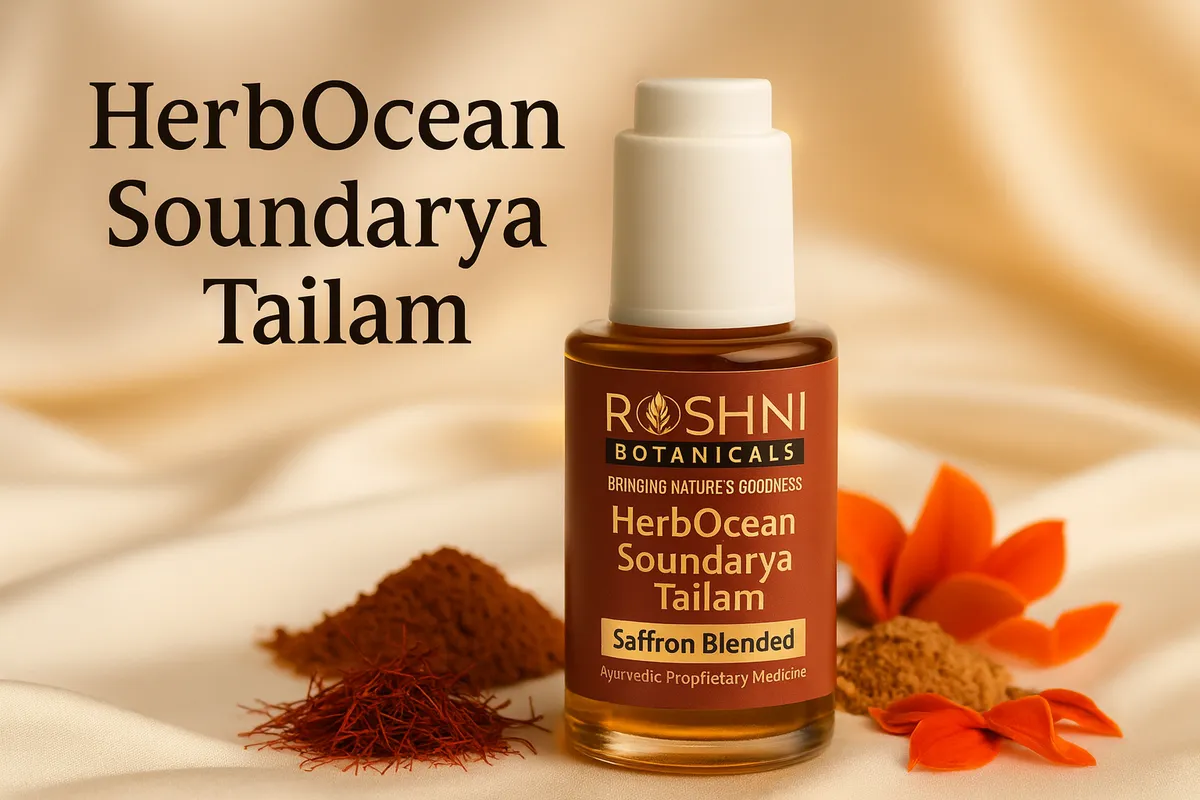
- HerbOcean Soundarya Tailam is an AYUSH-licensed Ayurvedic medicine for external use, traditionally used in the care of dull, uneven skin. It is not a skin-lightening preparation and is not offered as one.
Three Kinds of Dark Circles, and Why the Difference Matters
Pigmented circles are periorbital hyperpigmentation: extra melanin sitting in the skin itself. Vascular circles are blue-purple vessels and pooled blood showing through skin that is the thinnest on the whole face. Structural circles are a shadow, cast by hollowing along the tear trough where the lower lid meets the cheek. Most people carry a mix of at least two, which is why a remedy that helped a cousin does nothing for you.
The pigmented type deserves particular attention on melanin-rich Indian skin. Our skin lays down pigment readily after inflammation, a response called post-inflammatory hyperpigmentation (PIH), and the under-eye area is one of the most rubbed parts of the face. Constitutional and familial pigmentation is also common: in that Indian clinic series of 200 patients, nearly two-thirds reported a family history, so you may have carried it since your teens with no sleep debt involved at all. If your main concern is marks on the cheeks rather than under-eye darkening, HerbOcean Soundarya Cream is the corresponding classical preparation for general facial care, a rich saffron repair cream with bargad (Vatt) bark on a goat-milk and coconut base, and the Ayurvedic approach to melasma on Indian skin covers facial pigmentation in depth.
The structural type asks for candour. Tear-trough hollowing is bone, fat pad and volume; it becomes more visible with age and with weight loss, and no topical product or home remedy changes the underlying anatomy. If the self-check points to shadow, the useful next step is a clinician's assessment, and it is better said plainly than sold around.
Those three do not cover everything. Darkening can also follow eye drops used to lower pressure in glaucoma, or eye cosmetics and their removal, or long-standing uncorrected vision problems that keep someone squinting. Puffiness from a systemic cause can throw its own shadow. There is also dermal melanocytosis, pigment sitting deeper in the skin, which behaves differently from the surface kind. If nothing here fits what you see, that is a reason to ask a doctor rather than to keep shopping.
The Self-Check: A Stretch Test, a Light Test and an Honest Mirror
Start with the stretch test, and read it carefully, because it is commonly explained backwards. Stand near a window in daylight, place two fingers beside the outer corner of one eye and draw the skin gently sideways, then watch what the darkness does. If the colour stays exactly where it was, pigment is sitting in the skin itself. If the darkness spreads out without lightening and the blue or purple tone looks deeper, thin skin with vessels showing through is the larger contributor. If the darkness lightens or disappears as the skin is drawn taut, you are looking at a shadow cast by hollowing. Keep the hand genuinely gentle, and treat this as a one-time check rather than a habit, because tugging at this skin is itself a driver of pigmentation.
Then the light test. Look in the mirror under an overhead light, then hold your phone torch at face level, pointing straight at your face. Darkness that softens when lit from the front and deepens under overhead light is a shadow rather than a colour held in the skin. Between the two checks most readers can form a reasonable impression, though a mixed picture is the commonest result of all, and none of this replaces an examination. Pigment that stays put points towards strict gentleness in everything that touches the area. Vessels point towards sleep and allergy control before anything applied from a bottle. Shadow points to a clinician.
What Drives Each Type in Indian Homes
Begin with sleep, because it is the one with the clearest evidence behind it. In a controlled study, faces photographed after sleep deprivation were rated as having more hanging eyelids, redder and more swollen eyes, darker circles beneath them and paler skin, and observers judged those faces as looking more tired and sadder (Sundelin and colleagues, Sleep, 2013). A fixed sleep window is unglamorous, and it shows under the eyes faster than anything sold for the job.
Screens belong in the conversation for eye comfort rather than as a proven cause of dark circles. Long stretches of close work reduce blink rate and leave eyes tired and dry. The standard guidance is the 20-20-20 rule: every twenty minutes, look at something about twenty feet away, roughly six metres, for twenty seconds (American Optometric Association).
Allergic rubbing deserves more attention than Indian skincare writing gives it. Damp cupboards feed mould, dust rises through the dry months, and city pollution sits over both. All of it feeds allergic rhinitis and itchy eyes, and habitual rubbing is a plausible contributor to pigmented circles, though the chain from rubbing to pigment is not something we have found measured directly. Allergic shiners are a recognised clinical observation in their own right: in a Taiwanese study of 126 children with allergic rhinitis against 123 controls, the shiners were significantly darker and larger in the allergic group (Chen and colleagues, Journal of Allergy and Clinical Immunology, 2009). If your eyes water and itch for months on end, managing that allergy counts as skincare, and a physician can help you do it properly.
Bathroom water matters too. Delhi's groundwater is the measured case for hardness, and hard water paired with a high-foaming face wash leaves the delicate orbital skin tight and reactive, which invites more rubbing. Cleanse the under-eye area last, with lukewarm water and minimal product, and pat dry rather than scrubbing with a towel. Cold compresses and chilled spoons are worth a word: they settle morning puffiness for a while through simple vasoconstriction, which is a genuine if short-lived effect, and they do nothing for pigment. Acidic kitchen remedies are the ones to leave alone near the eye. Lemon juice on skin exposed to sunlight can cause phytophotodermatitis, a blistering reaction that heals leaving pigment behind, which is the opposite of the intended result.
A Gentle Under-Eye Routine, and Where Soundarya Tailam Fits
The night sequence is short. Cleanse, pat the face dry, and take one or two drops of oil. Warm them between your fingertips, then tap with the ring finger along the orbital bone, from the inner corner outwards, staying on the bone. Keep the oil away from the immediate lash line. Apply at night, after contact lenses are out, and use less than you think you need.
The safety detail matters more here than anywhere else on the face, because eyelid skin reacts where the rest of you does not. Patch-test on the inner forearm twice a day for four or five days, then on the outer cheekbone for four or five nights before going anywhere near the orbital rim; the forearm is only a first screen. This preparation contains lavender, rose and mogra essential oils in a sesame oil base. Do not use it if you react to fragrances, essential oils or sesame, and do not use an old bottle around the eyes. Stop using it if you get redness, itching, stinging, swelling or scaling. Do not use it around the eyes with active blepharitis, a stye, conjunctivitis, flaring eyelid eczema or broken skin, and not on children. If you have had eye surgery recently or use prescription eye drops, ask your eye doctor first. If oil gets into the eye, take contact lenses out first, then rinse with clean running water for several minutes; some blurring is expected while the film clears, and if pain, redness, light sensitivity or blurred vision carries on after rinsing, see an eye doctor the same day.
For spots and marks elsewhere on the face, an evening routine for dark spots is covered in its own post; here the focus stays on the under-eye area, where the skin is thinner and the causes differ.
HerbOcean Soundarya Tailam is a medicated facial oil (Taila) whose register reads: goat milk (Ajadugdh), Manjistha (Indian madder), liquorice (Mulethi), Raktchandan (red sandalwood), Palash (flame of the forest), bargad bark (Vatt), beautyberry (Priyangu), lac resin (Laksha), Daruhaldi (Indian berberry) and Ceylon ironwood (Nagkesar), carried in sesame oil (Til tail) with saffron (Kesar) and lavender, rose and mogra oils. It is made in the goat-milk (Kshira-paka) tradition: the herbs are simmered with goat milk in the sesame base until the water evaporates and only the medicated oil remains.
It is an AYUSH-licensed Ayurvedic medicine, Licence No. DL-474 A&U, for external use, made in-house at Bawana, Delhi, within the 40-year formulation legacy of Vaidya Shri Ram Prakash Ji. Separately from anything above about dark circles, it is traditionally used in the care of dull, uneven skin, as one unhurried step in a night routine. It is not a skin-lightening preparation and is not offered as one. It is a facial oil rather than an eye preparation, and it provides no sun protection of any kind; daytime sun protection over the under-eye and upper cheek is a separate step and a separate product.
Set expectations without numbers: classical oils work slowly, and consistency over weeks matters far more than quantity. Sleep, daily sun protection and allergy control will do more for most readers than any topical.
When to See a Doctor Rather Than Buy Something
Get emergency help straight away if swelling comes on with swelling of the lips, tongue or throat, or with any difficulty in breathing. Go to an eye hospital or casualty the same day if the area around one eye swells quickly and is painful or red, if there is fever, if it hurts to move the eye, if the eye looks pushed forward, or if your vision changes in any way. Seek same-day care if morning eyelid puffiness comes with breathlessness or with passing much less urine than usual.
See a doctor without waiting for it to settle if the darkening is on one side only, if it has come on over weeks rather than years, if there is a lump, a growing or bleeding lesion, loss of eyelashes, or a lid on one side that stays red or crusted, if the upper eyelids look purple or violet, or if the circles arrive with unusual tiredness, breathlessness on stairs or pallor. Let the doctor decide which tests are needed.
Let the Self-Check Choose the Next Step
Return to the mirror before you return to the shop. Once you can name the kind of darkness you are looking at, the next step is easier to choose. Its full ingredient register sits on the HerbOcean Soundarya Tailam page. Whatever the self-check suggested, guard your sleep and book the appointment without guilt.
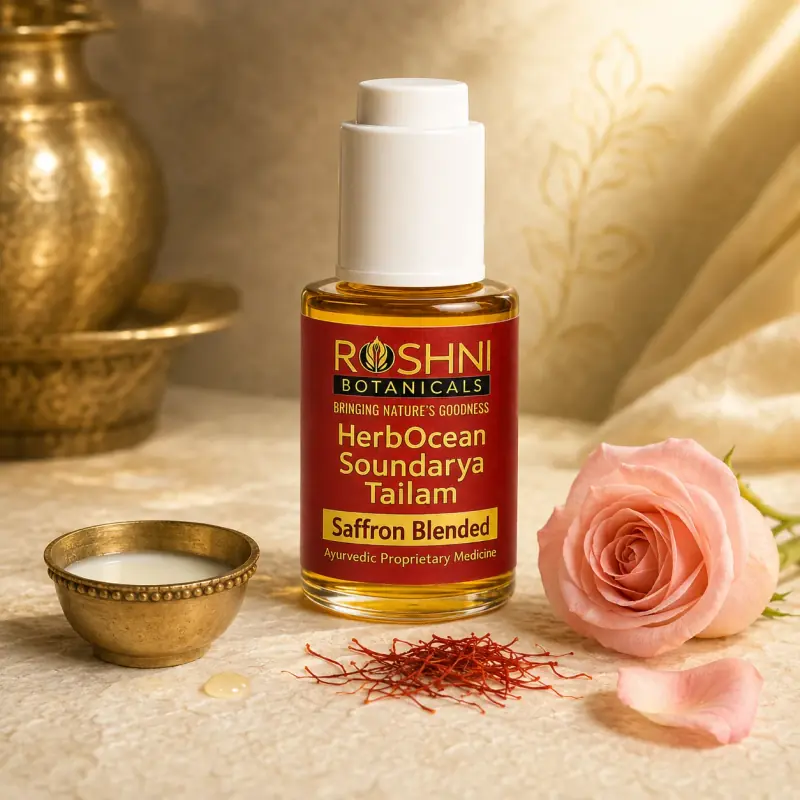
Soundarya Tailam
A saffron-infused facial Taila prepared in the goat-milk Kshira-paka tradition, with Manjistha, Mulethi and Kesar. For soft, bright, even skin.