
Ayurvedic Face Pack: What a Mukha Lepa Is, and the Classical Way to Apply One
A Lepa is the classical medicated face paste that sits beside the ubtan bowl: the three kinds in the texts, how to apply one, and where home packs slip.
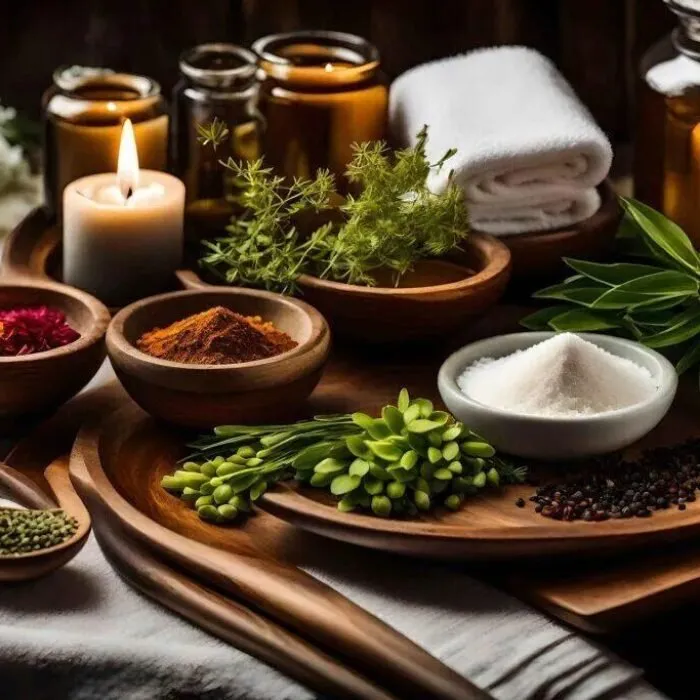
An Ayurvedic face pack is a medicated face paste (Lepa): herbs ground fine and mixed into a smooth paste, spread on the face in an even layer and rinsed off before it dries hard. The classical texts call the face paste Mukha Lepa, and the home ubtan bowl is the everyday habit nearest to it. The texts sort face pastes into three kinds by purpose.
In an Indian home, nobody needs the bowl explained: besan, haldi and gulab jal stirred together before a family function, or a multani mitti pack mixed on a sticky afternoon. The habit is old, and it has a classical name. It helps to know what the texts meant by it, and where the home version can slip on melanin-rich Indian skin.
Key takeaways
- The classical texts sort face pastes by what each is meant to do, and the skin tone has a kind of its own.
- A face paste goes on in an even layer over clean, clear skin and comes off with water while it is still soft.
- On melanin-rich Indian skin, a pack that is scrubbed off dry, mixed with lemon or left to crack can leave a dark mark behind.
- An active pimple stays out of any face pack until it has settled.
What Is a Lepa in Ayurveda?
In Ayurveda, a Lepa is a medicated paste applied externally, one of the classical forms of medicine for the outside of the body. It sits right beside a form you may already know from your own hair: the Taila (medicated oil). Sushruta Samhita, Sutra Sthana 18, describes medicated pastes for swellings and wounds on the body, while the face paste has its own passages in Ashtanga Hridaya, Sutra Sthana 22, and in Sharngadhara Samhita, Uttara Khanda 11.
Mukha means the face, so Mukha Lepa is simply the face paste. Think of the ubtan your mother mixed, besan or ground masoor with haldi, chandan and gulab jal or milk. It is the same gesture. What the texts add is intention. A classical face paste is made for a stated purpose, and that purpose decides the herbs that go into it and how thick the layer is.
Medicated Face Paste, Home Ubtan and Clay Mask: How They Differ
A medicated face paste is a classical external dosage form. It is made from herbs chosen for a stated purpose, and its formula stays the same from one batch to the next. A home ubtan is the family paste of the Indian kitchen, mixed from whatever the home keeps (besan, masoor, haldi, chandan, milk, curd or gulab jal), so it changes from home to home. A plain clay mask is a mineral clay and the water or gulab jal it is mixed with. One trap sits inside the word chandan, which covers red sandalwood and white sandalwood, two different trees, and both of them end up in home packs.
The handling is where all three meet. Each is mixed smooth just before use and spread over clean, clear skin, away from the eyes. Each comes off with water while it is still soft, and none of them is scrubbed off dry. What sets the medicated paste apart is that the classical texts name it and sort it by purpose, while the ubtan and the clay pack are home practice.
The Three Kinds of Face Paste in the Classical Texts
Face pastes come in three kinds in the classical texts, each named for its purpose: one for a dosha (Ayurveda counts three doshas, its biological energies), one to counter a poison and one for the skin tone. The last is the Varnya kind, named with the same word Ayurveda uses for its classical group of skin-tone herbs. Ashtanga Hridaya, Sutra Sthana 22, sorts the face paste this way, and Sharngadhara Samhita, Uttara Khanda 11, opens its chapter on medicated pastes with the same three.
The sorting decides how the paste is worn. Sharngadhara sets the thickness of the layer by purpose, and the skin-tone kind goes on the thickest of the three. In the texts, then, a face paste is never just a paste. Its purpose comes first, and the herbs and the layer follow from it.
How to Apply a Face Pack, and When to Take It Off
Start with clean skin and a fresh paste. A mix you have not used before gets a small test on the inside of your arm the day before it touches your face. Wash your face and pat it almost dry, so the paste sits on skin and not on a film of oil or sunscreen. Mix the paste just before you use it, smooth enough to spread without dragging, and throw away anything left over from yesterday. Spread an even layer with your fingertips or a soft brush, and keep it off the eye area and the lips.
Then rinse it away while the paste is still soft. How long does that take? The Hinglish version of the question, face pack kitni der lagana chahiye, has a short answer: until it is just touch-dry, and no longer. Touch a fingertip to your cheek. If nothing comes away on your finger, and the paste has not yet turned pale, cracked or tight, it is ready to come off.
And if it has dried? It happens. The phone rings, and you come back to a pack that has set hard on your face. Do not scrape it off. Press a wet cloth over it, let it soften, then rinse with plain water and pat dry. A face pack is never worn overnight, either. It goes on and comes off in the same sitting.
What Can a Face Paste Sensibly Be Asked to Do?
A face paste is an occasional step in your care, not the whole of it. A paste that is rinsed off soon after it goes on does not reach pigment that sits deep. Dark patches on the cheeks or forehead need a reading of their own, the kind that Ayurvedic treatment for melasma on Indian skin gives them. Two herbs from home packs come with their own patch test and cautions, set out in Mulethi in a home face pack and Manjistha powder at home.
Where a Home Face Pack Goes Wrong on Melanin-Rich Skin
Irritation and colour are closely tied on melanin-rich Indian skin. In a 2010 review of skin of colour from the United States, Davis and Callender describe post-inflammatory hyperpigmentation (PIH), the darker patch left where skin was inflamed, as more frequent on darker skin and more severe there too. Irritation, they add, can make it worse. So a small slip costs more on this skin, and four of them matter more than the rest.
The first slip is scrubbing a dry pack off. Rubbing the crumbs away with a towel feels thorough, but dried paste is abrasive, and on melanin-rich skin that friction can show up later as a dull brown patch, right where you rubbed hardest. When a pack has set, soften it first with a wet cloth and let the water loosen it, then rinse and press the face dry with a soft towel.
The second slip is lemon or baking soda in the bowl. Both turn up in home recipes for a quick result. Lemon juice is strongly acidic and baking soda is alkaline, and the sting you feel is irritation, not the pack doing its job. Leave both out of the bowl, then, and loosen the paste with plain water or gulab jal.
The third slip is leaving a pack to crack and pull. Once it has turned pale and split into little plates, it is past its moment, and the face underneath can feel stripped and a little raw after the rinse. Dry air gets it there faster, and skin care for dry, cold air has more on that. The water matters as well. If the tap water at home is hard, the cleanser you used before the pack can rinse off less cleanly, so rinse well and pat dry.
The fourth slip is a pack spread over an active pimple. A raised, sore pimple is inflamed skin, and drying and rinsing a paste over it adds friction exactly where the skin can least take it. So the pack goes on the clear skin only, and the pimple is left out until it has settled. Caring for the pimple itself is a separate step, and Ayurvedic treatment for acne covers it. Any mark it leaves is another step again, once the pimples have settled: brown marks and red marks after pimples each need a different reading, and Ayurvedic skincare for hyperpigmentation explains the care of a mark that is already there.
Soundarya Lepa and Radiance Lepa: Two Classical Face Pastes
We make two medicated face pastes, both in the HerbOcean Ayurvedic skincare range, and the cautions after them apply to both.
The first is HerbOcean Soundarya Lepa. Soundarya Lepa is a classical medicated face paste (Lepa) of Mulethi, Masoor, aloe and white sandalwood, a weekly mask that helps maintain calm, cared-for skin. It carries Mulethi (Glycyrrhiza glabra), Masoor (Lens culinaris), aloe (Aloe vera), white sandalwood (Svetchandan, Santalum album) and Kuth (Saussurea lappa) in a bentonite clay and purified water base, with lavender, rose and mogra oils. Mix with a little water or rose water into a smooth paste. Apply an even layer over clean skin, leave for 10 to 15 minutes, then rinse with cool water. Once or twice a week.
The second is HerbOcean Radiance Lepa. Radiance Lepa is a classical medicated face paste (Lepa) with red sandalwood and Manjistha, an Ayurvedic medicine traditionally used in the care of uneven skin tone. It carries red sandalwood (Raktchandan, Pterocarpus santalinus), Manjistha (Rubia cordifolia), Kuth (Saussurea lappa), barley (Jaukaatta, Hordeum vulgare), lotus (Kamal, Nelumbo nucifera), Indian jujube (Baer, Ziziphus jujuba) and blue lotus (Neelkamal) in a bentonite clay and purified water base, with lavender, rose and mogra oils. Blend with water or rose water into a smooth paste. Apply evenly, leave 10 to 15 minutes until just touch-dry, then rinse with cool water. Once or twice a week.
Not for skin with active pimples: keep the paste to the clear skin until they have settled. Patch-test on the inner forearm 24 hours before first use and discontinue if irritation occurs; avoid the eye area. Avoid it if you are allergic to a listed botanical, keep it off broken skin, and keep contact brief if your skin is very sensitive. If pregnant or breastfeeding, check with your doctor. Both are made in-house at our unit in Bawana, Delhi, under AYUSH Licence No. DL-474 A&U, and built on the 40-year Ayurvedic formulation legacy of Vaidya Shri Ram Prakash Ji.
After a Face Pack, and the Signs That Need a Dermatologist
Afterwards your usual moisturiser goes on the clear skin, and sunscreen by day.
A few signs belong with a dermatologist, not the kitchen. Book a visit if a pack leaves a burning feeling, an itch or a red rash that stays on after you stop using it. The same goes for patches that keep spreading or darkening over the cheeks, the forehead or the skin of the upper lip without any pimples coming first, and for pimples that are painful, deep or cystic. White patches, or skin that has lost its colour, should be seen straight away. So should a mole or spot that grows, bleeds, itches, changes its shape or colour, or stays open as a sore.
So keep the bowl, and keep the habit. Just hold it to a few plain rules: a fresh paste each time, an even layer on clear skin, and a rinse before it dries hard. Done that way, the face pack stays one quiet step in how you care for your face.
References: 1. Sharngadhara Samhita, Uttara Khanda 11 (Lepa Vidhi). 2. Ashtanga Hridaya, Sutra Sthana 22. 3. Sushruta Samhita, Sutra Sthana 18. 4. Davis EC, Callender VD. Postinflammatory hyperpigmentation: a review of the epidemiology, clinical features, and treatment options in skin of color. Journal of Clinical and Aesthetic Dermatology. 2010;3(7):20 to 31. A review; United States. PMID 20725554. Educational, not medical advice.
Frequently asked
This article is general educational content about Ayurvedic skin and hair care. HerbOcean products are classical Ayurvedic preparations for external use, made under AYUSH Licence DL-474 A&U and traditionally used to support healthy skin and hair. This is educational and not a substitute for professional medical advice; for persistent or worsening concerns, please consult a qualified dermatologist.