Skin Cycling, the Ayurvedic Way: A 7-Night Rhythm for Indian Skin
Skin cycling is the rare trend your nani would recognise. A concrete seven-night rhythm of ubtan, oil and rest nights, built for melanin-rich Indian skin, where the recovery nights are the whole point.
Skin cycling is the rare global skincare trend your nani would recognise on sight. The idea, coined by a dermatologist and everywhere on your feed, is simple: instead of using strong actives every night, you rotate one exfoliation night and one retinoid night with recovery nights, so the skin is not endlessly irritated. Sound familiar? Indian homes have run their own version for generations, ubtan once a week, oiling nights, rest, never the same intense thing daily. This guide turns that instinct into a concrete seven-night rhythm built for melanin-rich skin, where the recovery nights are not the boring bit but the whole point.
Key takeaways
- Skin cycling means rotating one exfoliation night with recovery and rest nights instead of using strong actives daily; classical Ayurveda organised care in exactly these weekly rhythms long before the trend had a name.
- On melanin-rich Indian skin, over-exfoliation does not just damage the barrier; it can trigger post-inflammatory hyperpigmentation (PIH), which is why recovery nights tend to be protective, not lazy.
- The Ayurvedic version swaps the chemical work night for a gentle home ubtan and the recovery night for a facial oil, so the whole cycle is kinder and does not depend on prescription-strength actives.
- A workable seven-night cycle: one gentle ubtan night, two recovery oil nights, and four rest or light nights, adjusted lighter in humid monsoon weeks and fuller in dry winter.
- Whatever the cycle, morning sunscreen is non-negotiable, because exfoliated skin is more sun-sensitive and unprotected sun deepens exactly the pigment this rhythm is trying to protect.
What Skin Cycling Is, and Why Ayurveda Got There First
The modern trend is a four-night loop: exfoliate on night one, apply a retinoid on night two, and recover on nights three and four with only hydration, then repeat. Its real insight, and it is a good one, is that skin does not want to be worked every single day; spacing the hard nights out heads off the irritation and barrier damage that daily actives so often cause. Dermatology points the same way. A 2015 review of topical-retinoid tolerability in the Journal of Cutaneous Medicine and Surgery concluded that how a patient actually uses a retinoid likely accounts for more variation in how the skin responds than the differences between one formulation and another. Put plainly: the rhythm matters at least as much as the bottle.
But the principle is far older than the hashtag. Classical Ayurveda never treated the skin as something to be processed nightly. Its framework of the daily routine (Dinacharya) and the seasonal routine (Ritucharya) organised care into rhythms: a weekly ubtan, regular oiling, and plenty of ordinary days in between, timed to the body and the season rather than to a shelf of actives. The Charaka Samhita lays out that daily regimen in Sutrasthana 5, the Matrashiteeya chapter, where oiling, cleansing and unhurried self-care are set down as ordinary everyday medicine rather than occasional treatment, and gives the seasonal regimen its own chapter in Sutrasthana 6, Tasyashiteeya. Read side by side, skin cycling is a rediscovery rather than an invention, and the Ayurvedic version simply works differently: its work night is a herbal paste rather than a chemical exfoliant, so the lift is mechanical and mild rather than acid-driven. Which of the two suits you is a decision to make with how your own skin responds.
Why Recovery Nights Matter More on Melanin-Rich Skin
Here is the argument the Western guides mostly miss, and it is the reason this post exists. When most skincare content warns against over-exfoliation, it frames the risk as a damaged barrier, redness, flaking, tightness. On melanin-rich Indian skin, there is a second, longer-lasting cost: irritation itself can switch on pigment. An over-scrubbed, over-treated face does not just get sore; it can answer that inflammation with post-inflammatory hyperpigmentation (PIH), the flat brown marks that outlast the irritation by months. A 2010 review of post-inflammatory hyperpigmentation in skin of colour, by Davis and Callender in the Journal of Clinical and Aesthetic Dermatology, describes inflammation of almost any kind, acne, eczema, friction or simply an irritating product, as the usual trigger, and notes that it is both more common and more persistent in darker skin. It is a narrative review drawn from skin-of-colour populations broadly rather than from Indian-specific data. Our skin's own liveliness, governed in classical terms by Bhrajaka Pitta (the Pitta sub-dosha of skin lustre, colour and absorption), is exactly what makes it mark so readily.
The clinic data hints in the same direction. A 2024 retrospective cohort in JAAD International reviewed 753 patients prescribed topical retinoids for acne and found that tolerability was not the same across groups: Asian patients recorded significantly lower tolerability than Black patients. That was a single American centre studying an American population, so read it as a signal rather than a verdict about Indian skin. Still, it argues for spacing and caution rather than for pushing through the sting.
Which flips the whole trend on its head for us. The recovery nights are not the filler between the important nights; on melanin-rich skin they tend to be the protective heart of the routine, because they are what keeps the skin from being pushed into pigment in the first place. The correct instinct here is not more exfoliation done carefully, but less exfoliation surrounded by more recovery. And the one rule that makes any pigmentation-aware routine work sits in the morning: a broad-spectrum sunscreen of SPF 30 or higher, every day, because freshly exfoliated skin is more sun-sensitive and unprotected sun deepens the very marks this rhythm is protecting against.
The 7-Night Ayurvedic Skin Cycle
Here is the week, one gentle work night, two recovery nights and four light nights, in a rhythm melanin-rich skin can hold indefinitely. Adjust the exact nights to your life; the shape is what matters.
| Night | What you do | The idea |
|---|---|---|
| Night 1 (work) | A gentle besan (gram-flour) ubtan, massaged lightly, rinsed with cool water | The classical, non-acid exfoliation; patch-test first, no hard scrubbing, never daily |
| Nights 2 & 3 (recovery) | Cleanse, then 2 to 3 drops of Radiance Tailam pressed into damp skin | Nourish and calm; a facial oil (Taila) traditionally used in the care of dark spots and uneven tone |
| Nights 4 & 6 (rest) | Cleanse only, then a light moisturiser; nothing active | The skin's own repair time, undisturbed |
| Night 5 (oil) | Cleanse, then 2 to 3 drops of Radiance Tailam again | A second nourishing night to carry the week |
| Night 7 (rest) | Cleanse only; let the skin simply be | One truly bare night before the cycle begins again |
Two things to hold on to. The ubtan night is a mild, respectful version of a practice you likely grew up with, besan with a little curd or rose water, massaged gently and rinsed, not scoured; on melanin-rich skin, scrubbing hard is exactly the mistake that this whole rhythm exists to avoid. And if you are already using a dermatologist-prescribed retinoid, do not swap it for ubtan on your own; keep your doctor's plan and simply borrow the recovery-forward spirit around it. This cycle is for the reader building a gentle routine from scratch, not for overriding clinical care.
Since the ubtan night carries the week, it is worth making it well. A workable gentle mix is a tablespoon of besan loosened with a little curd, rose water or plain milk into a soft, spreadable paste, no grit, no lemon, nothing that stings. Smooth it on, leave it a few minutes, and rinse it off with cool water using soft circular motions of the fingertips rather than a scrub or a brush; the point is a light lift of dull surface skin, not an abrasion. A pinch of haldi or a little sandalwood can join it if your skin already knows them, but plainer is safer while you learn how your skin responds. Patch-test any new addition on the inner forearm first, and if the ubtan ever leaves the face pink or tight, that is your cue to soften it or space it further apart.
Adjusting the Cycle: Monsoon, Winter and When to Pause
The seven-night shape stays the same; the intensity moves with the Indian year. In humid monsoon weeks, when the skin barrier is already softened by moisture, go lighter: soften the ubtan, or drop it to a fortnightly rhythm, and cut the oil to two drops, since a heavy hand sits poorly on damp, sweaty skin. In dry North Indian winter, the fuller three drops and the weekly ubtan earn their place, because the air itself is doing the drying and the skin wants feeding. Read your skin, not the calendar alone: if it feels tight, stripped or reddened at any point, add a rest night and drop the next ubtan. A good cycle bends.
The recovery oil is chosen for this protective role. HerbOcean Radiance Tailam is a sesame-based facial oil built on the classical complexion-supporting (Varnya) herbs, Triphala (Amla, Baheda and Harad) with saffron (Kesar), Manjistha, sandalwood (Chandan), turmeric (Haldi), lotus (Kamal) and wild Himalayan cherry (Padmaakh), and it is traditionally used in the care of dark spots and uneven tone rather than sold as a scrub or an acid. It is an AYUSH-licensed Ayurvedic medicine (Licence No. DL-474 A&U) for external use, formulated by Vaidya Shri Ram Prakash Ji, the master vaidya (a traditionally trained Ayurvedic physician) whose 40-year formulation legacy the HerbOcean line is built on, and made in-house at Roshni Botanicals' GMP-certified unit in Bawana, Delhi. Patch-test on the inner forearm before first use. If a single-night pigmentation ritual is more your speed than a whole-week cycle, our night routine for dark spots is the companion piece; this post is the weekly architecture that ritual can live inside.
When to See a Dermatologist
A gentle cycle is skincare, not a substitute for a diagnosis. See a dermatologist if pigmentation appears suddenly or spreads quickly across the cheeks, which is the pattern our guide to Ayurvedic treatment for melasma on Indian skin describes in detail; if a patch changes shape or colour, itches or has an irregular border; if marks have not eased after about three months of consistent, gentle, sun-protected care; or if your skin reacts badly to a product with burning or spreading redness. And if you suspect you have already over-exfoliated into a flare of dark marks, the answer is not to push harder but to stop the actives, lean entirely on recovery and sun protection, and let a doctor guide anything stubborn. Our guide to brown marks versus red marks helps you read what you are seeing before you act on it.
The Oldest Trend in the Book
Skin cycling did not need inventing in India; it needed remembering. One gentle ubtan night, two nourishing oil nights, and the rest of the week left kindly alone is a rhythm your grandmother would nod at, and it happens to be exactly what melanin-rich skin, so quick to mark, actually wants. Let Radiance Tailam carry the recovery nights, keep the morning sunscreen unbreakable, and judge the whole thing by a calm, even complexion over a season rather than a dramatic result by Friday. The trend will pass; the rhythm underneath it is centuries old, and it was always yours.
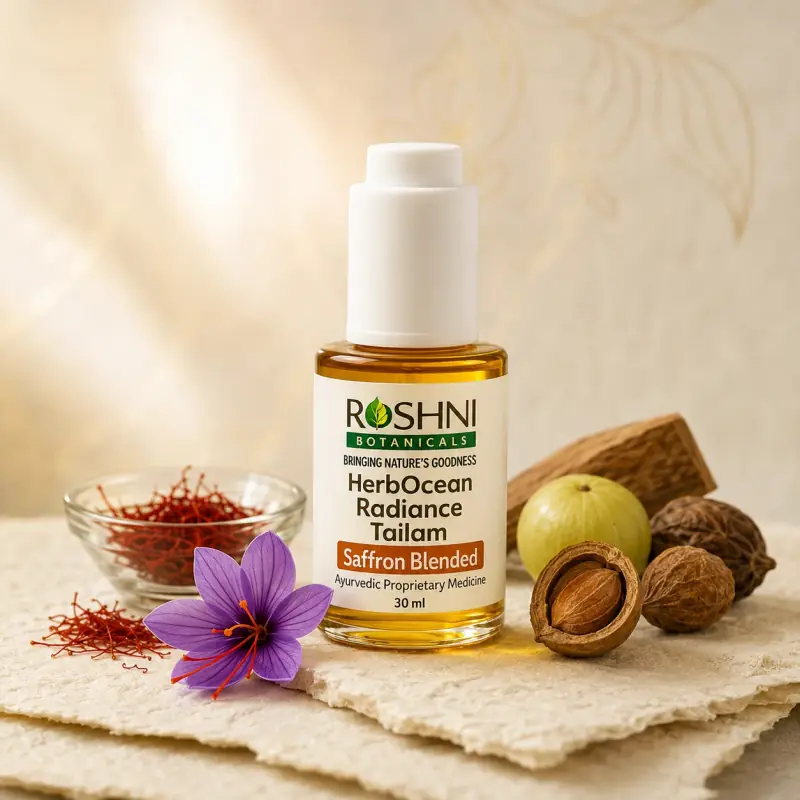
Radiance Tailam
A saffron brightening facial Taila with Manjistha and red sandalwood, traditionally used to support even tone where melasma, dark spots and PIH show.
Part of our guide: Ayurvedic treatment for melasma on Indian skin.