Pigmentation in Men: Shaving Marks, Sun and an Evening Routine
Where the marks on your jaw and neck come from, how to tell a flat mark from a scar, what the razor and the commute add, and one steady step at night.

There is a patch along your jaw that never quite matches the rest of your face. Or a band on your neck, right where the razor drags.
In men, pigmentation like this is often colour left behind after the skin was irritated: a razor nick, an ingrown hair, a breakout inside the beard. Sun then keeps it there. So the work comes down to a shave that irritates less, proper sun cover on the commute, and one steady step at night.
Key takeaways
- A flat brown mark left behind once a razor nick, an ingrown hair or a breakout has settled is post-inflammatory hyperpigmentation (PIH).
- A flat mark sits level with the skin around it. A dip, a pit or a ridge points to a scar, and that is a question for a dermatologist.
- On melanin-rich skin these marks can stay for months, so judge any routine in months and not in days.
- Sun keeps a mark going. On a two-wheeler that means a sunscreen, a full-face helmet and a covered neck.
- Men get melasma too, and Ayurveda has a name for it, Vyanga (the classical term for facial pigmentation). A mark left by a razor is a different thing.
Where the Marks Come From
The colour comes from ordinary things. A blade drawn over the same jaw and neck, shave after shave. Breakouts inside the beard. A long commute under open sky, perhaps on two wheels, with no sunscreen on.
Skin that carries a lot of melanin tends to answer irritation by making pigment. A dermatology review of pigmentation on Indian skin notes that this kind of mark can last from months to years, and that ultraviolet light both sets it off and makes it worse. So the razor starts the story and the sun extends it.
Melasma is a separate pattern. It shows as matching patches on both sides of the face, across the cheeks and the forehead and sometimes along the jaw, and it is what the classical texts call Vyanga. If that is closer to what you see in the mirror, Ayurvedic care for melasma on Indian skin is the guide to read. If you are not sure whether you are looking at a spot or a patch, dark spots and pigmentation, explained separates the two.
Is It a Mark or a Scar?
Before you buy anything, find out which one you have. Stand side-on at a window so that the light rakes across your cheek, and run a clean fingertip slowly over the spot. If you can see the colour but cannot feel anything, it is most likely a flat mark. If you can feel a dip, a pit or a ridge, it points to a scar.
The difference decides what is realistic. A flat mark is pigment, and pigment is what sun cover and a steady night step are for. A scar is changed texture, and that belongs with a dermatologist. You may well have both on one face, which is why a routine can seem to work on one cheek and not on the other. Our guide on how to tell an acne scar from a mark walks through the check, and if your marks look pink rather than brown, start with brown marks and red marks.
One thing matters more on melanin-rich skin: the mark stage runs long. A dermatology review of skin of colour records that marks of this kind can take months, and sometimes years, to settle when left alone. So the slow pace says nothing bad about your skin. It is also why any routine for these marks is judged in months.
The Shaving Zone, Where Marks Get Made
Your jaw, chin and upper neck meet a blade again and again, year after year. Each pass is a small irritation, and skin that pigments readily can keep the colour once the irritation has settled. The bumps themselves, the ingrown hairs and the sore raised spots along the neck, are a different problem, and our guide to beard pimples and shaving bumps sorts them out.
Keep the shave short and kind. Soften the hair first with warm water. Go with the direction the hair grows, above all on the neck, and do not pull the skin taut with your free hand. Change the blade before it starts to tug.
Water plays a part as well. If the water at home is hard, and Delhi groundwater is the case that has been measured, more cleanser can stay on your skin after rinsing, and in a British study skin washed in hard water irritated more easily. So rinse a little longer with plain water and pat your face dry with a soft towel.
If your first instinct is to scrub the patch away, hold back. A hard besan scrub, neat lemon juice or a rough towel can add a fresh round of irritation to a patch that is already marked. A smooth ubtan, left on briefly and rinsed off without rubbing, is a different matter, and it has its place on a day when you have not shaved.
Then there is aftershave. If your face burns after every shave, take the hint and switch to something that does not sting. And if every shave leaves your neck sore, put the blade down for a while and use a guarded trimmer until the skin settles.
Sun on the Commute
Think about where your sun comes from. The ride to work on a two-wheeler, with a helmet that leaves the lower face open. A site visit in the middle of the afternoon. Cricket on a Sunday. None of it feels like sunbathing, and all of it lands on the same jaw and the same neck.
Ultraviolet light makes a mark darker and keeps it visible for longer. That is why a patch can look worse after a stretch of open-sky commuting, even when you have changed nothing else.
What helps is simple. Put sunscreen on the face, the ears and the back of the neck before you leave. Wear a full-face helmet if you ride, and a cap for the stretches you walk. For how much to use and how to reapply on a commute, read our guide to sunscreen for oily Indian skin.
An Evening Routine You Can Keep
Two steps, on purpose, short enough to keep after a long day. Start by rinsing your face at night with plain water or a mild cleanser, and pat it lightly so that the skin stays slightly damp.
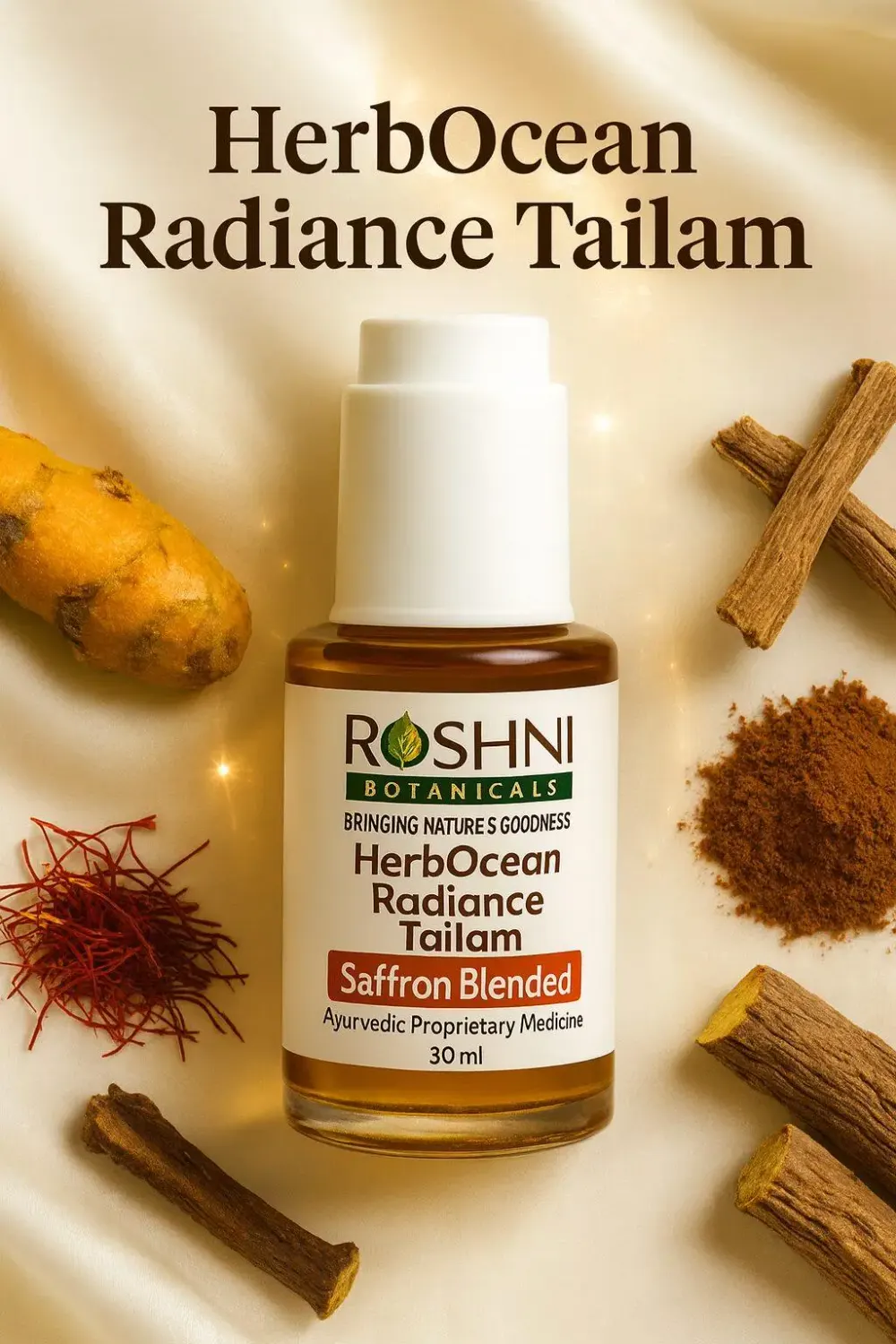
Then comes the oil, a Taila (medicated oil). HerbOcean Radiance Tailam is an AYUSH-licensed Ayurvedic medicine for external use, classically indicated for melasma (Vyanga) and traditionally used to support even tone where dark spots and post-inflammatory hyperpigmentation (PIH) show on melanin-rich Indian skin. It is a saffron-led Taila of twelve herbs at equal weight, sandalwood (Chandan), Manjistha, red sandalwood (Raktchandan), lotus (Kamal), Padmaakh bark, Kakoli, Palash flower, Kuth, turmeric (Haldi) and the three Triphala fruits, Amla, Baheda and Harad, in a sesame (Til tail) base, with saffron (Kesar) and three finishing oils, lavender, rose and mogra. The saffron is cold-macerated: it is steeped into the finished oil once the cooking is over, not boiled with the herbs.
Night suits an oil for a simple reason. Nothing else is asking for your face at that hour: no sunscreen to layer over it, no helmet, no sweat, no dust from the road.
At night, on clean, slightly damp skin, press in a few drops with light upward strokes for about a minute, and leave the oil on overnight. Keep it off any nick or graze from the morning shave until the skin has closed. It comes in a 30 ml bottle and in a 10 ml trial bottle, which is the size to begin with if the oil is new to you.
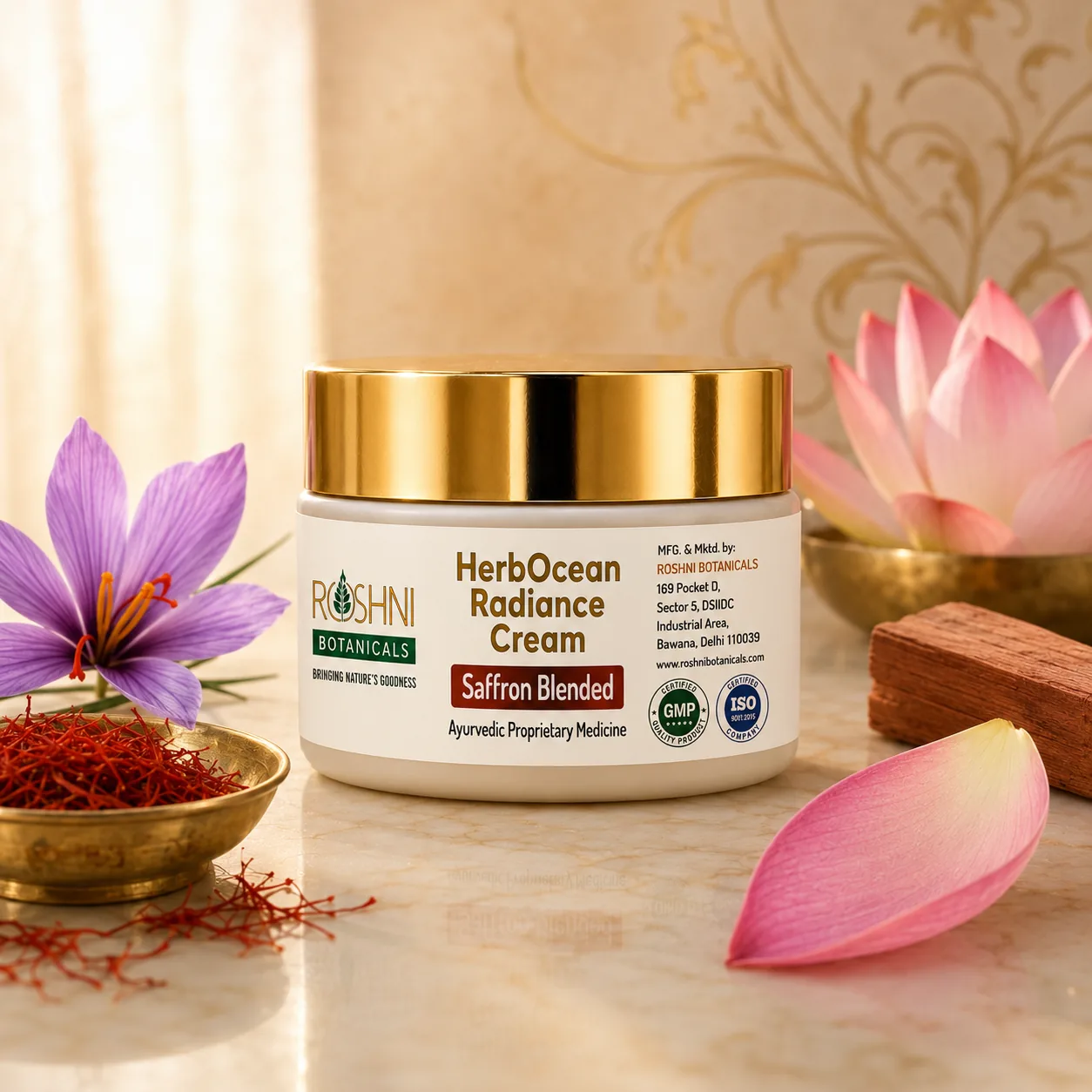
If you would like a cream alongside the oil, there is an optional partner. HerbOcean Radiance Cream is an Ayurvedic medicine for external use, classically indicated for facial pigmentation (Vyanga, the patches Hindi homes call jhaiyaan) and traditionally used in the care of dark spots and uneven tone. It is a daily saffron and sandalwood brightening cream with Manjistha, red sandalwood and lotus in a light coconut base. Smooth over clean skin morning and night. HerbOcean does not manufacture a sunscreen, and nothing in the range replaces one, so by day always follow the cream with a broad-spectrum sunscreen.
Both are made in-house at our GMP-certified unit in Bawana, Delhi, under AYUSH Licence No. DL-474 A&U, and built on the 40-year Ayurvedic formulation legacy of Vaidya Shri Ram Prakash Ji.
They are medicines, so a few cautions come with them. Patch-test on the inner forearm 24 hours before first use and discontinue if irritation occurs; avoid the eye area. For external use only. Keep both off broken skin, a fresh nick included. Avoid the oil if you are allergic to sesame, the cream if you are allergic to coconut, and either if you are allergic to a listed botanical. If pregnant or breastfeeding, check with your doctor.
What to Expect, and When
Pigmentation is slow to shift. Think in months of steady nights, with sun cover every morning. Marks built up over years of shaving tend to take longer, and the pace differs from person to person.
Two things in your hands affect the pace. One is the razor: if the blade keeps irritating the same patch, new colour arrives while the old colour is still settling. The other is the sun that reaches that patch on the way to work. So the shave and the sun cover are part of the routine, alongside the night oil.
Do not judge it in the mirror every morning. Take one photograph a month, at the same window and at the same hour, and compare those. A daily look tells you very little, and it can talk you out of a routine that needed more time.
When It Is Not Just a Mark
Some of what gets called a daag is not a mark at all, and the signs are specific. See a dermatologist for patches that keep widening month on month, for pigmentation that arrives suddenly or changes quickly, for a patch that looks different from the rest or that itches, bleeds or changes its shape or border, for new pigmentation after a new medicine, and for any reaction to a new oil that does not settle within a few days of stopping it.
One more, and it is easy to wave away. If the skin of your neck, your underarms or your knuckles turns dark, thick and velvety, show it to a physician before you put anything on it. Our guide to neck pigmentation care has the texture check.
And if you are on isotretinoin or a prescribed cream, ask the doctor who prescribed it before you add anything new.
Where to Start Tonight
Check whether the spot is flat or textured. Change the blade, and shave your neck the way the hair grows. Keep the sunscreen where you will see it in the morning, next to your helmet if you ride. Then press in the oil each night, and give it months.
References: Sushruta Samhita, Nidana Sthana 13 (Kshudra Roga Nidana), on Vyanga among the forty-four minor diseases, a thin, painless patch that appears on the face, brown in the Bhishagratna translation. Nouveau S, Agrawal D, Kohli M, Bernerd F, Misra N, Nayak CS. Skin hyperpigmentation in Indian population: insights and best practice. Indian Journal of Dermatology. 2016;61(5):487-495 (narrative review, so no sample size and no single study population; four of its six authors employed by a skincare company; ultraviolet exposure initiates and worsens post-inflammatory hyperpigmentation, which can last from months to years; marks after acne reported in both women and men in India; melasma mainly in women, with about one case in ten in men). Davis EC, Callender VD. Postinflammatory hyperpigmentation: a review of the epidemiology, clinical features, and treatment options in skin of color. Journal of Clinical and Aesthetic Dermatology. 2010;3(7):20-31 (review; epidermal post-inflammatory hyperpigmentation may take months to years to settle without treatment, and deeper dermal pigment may take far longer or may not settle; ultraviolet light and persistent or recurrent inflammation can worsen it, and razor bumps are named among its causes; clinic data from the United States, the United Kingdom, France, South Africa, Jamaica, Singapore and Kuwait, with Indian patients in the Singapore, Johannesburg and Kingston series; one author declares consulting for several drug companies). Ogunbiyi A. Pseudofolliculitis barbae; current treatment options. Clinical, Cosmetic and Investigational Dermatology. 2019;12:241-247 (review, Nigeria; post-inflammatory hyperpigmentation a common complication of razor bumps on darker skin; the front of the neck the commonest site in men; stretching the skin, shaving against the grain and blunt blades each raise the risk, and stopping shaving or a guarded clipper lowers it; the author declared an honorarium from Procter and Gamble; non-Indian). Danby SG, Brown K, Wigley AM, Chittock J, Pyae PK, Flohr C, Cork MJ. The effect of water hardness on surfactant deposition after washing and subsequent skin irritation in atopic dermatitis patients and healthy control subjects. Journal of Investigative Dermatology. 2018;138(1):68-77 (80 participants, United Kingdom, healthy volunteers and atopic dermatitis patients; skin washed in hard water kept more cleanser, lost more water and was more easily irritated; non-Indian). Acharya S, Sharma SK, Khandegar V. Assessment of groundwater quality by water quality indices for irrigation and drinking in South West Delhi, India. Data in Brief. 2018;18:2019-2028 (50 groundwater samples from South West Delhi). Educational, not medical advice.
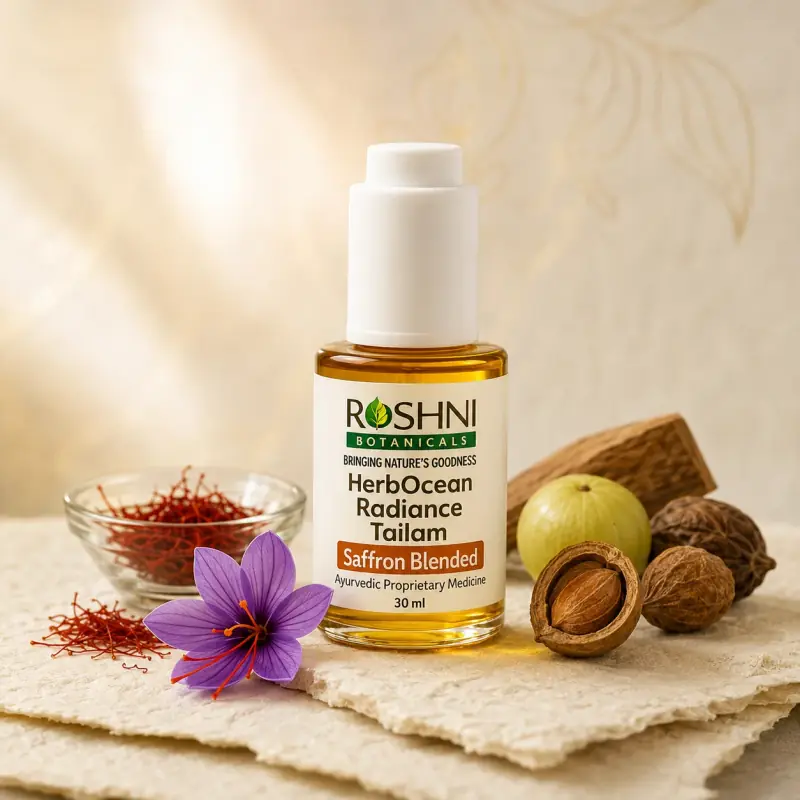
Radiance Tailam
A saffron brightening facial Taila with Manjistha and red sandalwood, traditionally used to support even tone where melasma, dark spots and PIH show.
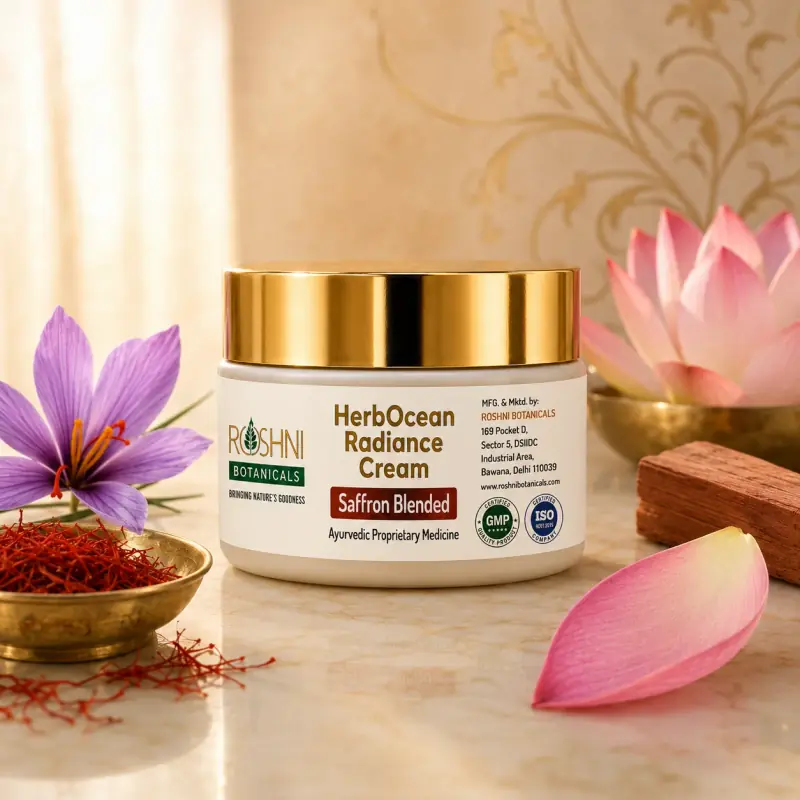
Radiance Cream
A daily saffron and sandalwood brightening cream with Manjistha, red sandalwood and lotus in a light coconut base. Supports a luminous, even-looking skin tone.
Part of our guide: Ayurvedic treatment for melasma on Indian skin.