Oil Cleansing for Dry Skin: An Ayurvedic Night Method, Step by Step
Oil cleansing suits dry skin when the oil is plain and the medicated oil comes after. The night method, who should skip it, and the evidence on pores.
Oil cleansing means massaging a plain plant oil over a dry face to loosen sunscreen and the grime of the day, then lifting it away with a soft cloth wrung out in warm water. For dry skin it can stand in for a foaming wash in the evening, because it does not depend on lather to do its work. The habit sits comfortably beside Dinacharya (daily routine), which in Ayurveda already makes room for oil on the skin.
If your face feels tight and papery after you wash it, the problem may not be your moisturiser. It may be the wash. A plain oil and a warm cloth can take the place of the lather, with a classical Taila (medicated oil) kept for the step after the cleanse.
Key takeaways
- Oil cleansing uses a plain plant oil and a warm, damp cloth to lift sunscreen, makeup and sebum without lather.
- A medicated facial oil is a leave-on step for after the cleanse, never the cleanser itself.
- In a UK study of 80 people, washing in hard water left more cleanser on the skin, with more water loss and irritation.
- Pore-clogging ratings come from an older animal model, and finished products do not always behave like their ingredients.
- Very oily skin, an active breakout, a history of fungal folliculitis or broken skin are reasons to skip it, or to ask a dermatologist first.
What Oil Cleansing Is, and Why Dry Skin Takes to It
Oil cleansing works on a simple fact: oily things loosen oily things. Sunscreen, makeup and sebum mix into a plain oil, along with the dust caught in them, and a warm, damp cloth then carries the lot away. Nothing has to foam, which suits skin that feels stretched after a lathering wash.
Ayurveda reads roughness, flaking and that papery tightness as signs of Vata, the dosha of dryness and movement (Ayurveda counts three such biological energies), and its answer to Vata is Sneha (oiliness, the quality that oil brings). Dryness, in other words, is met with its opposite.
What the classical texts describe is oil as part of the day: Abhyanga (classical full-body oil massage) sits inside Dinacharya, and the oil cleanse is a habit that grows from the same idea.
Hard Water, Hot Water and the Tight Feel After Washing
Hard tap water carries dissolved minerals, and a foaming cleanser does not rinse away as cleanly in it. In one UK study of 80 participants, forearm skin rinsed in hard water kept extra cleanser on its surface, and that leftover cleanser increased the water lost through the skin and caused irritation, particularly in people with atopic eczema who carry an inherited filaggrin gene change. The study did not look at oil cleansing or at Indian skin. Still, it fits the tight feel you may know after washing.
Hot water makes it worse. A steaming bath feels best when the air turns dry and cold, which is just when dry skin can least afford it. Keep the water warm, not hot.
One more reason matters on melanin-rich Indian skin: marks left behind by irritation, called post-inflammatory hyperpigmentation (PIH), can linger. A scrub can irritate skin that is already marked, so keep scrubbing out of the cleanse.
Each cleanser has its place. A foaming face wash lifts sweat, dust and oil through lather and suits oily and combination skin; in hard water it leaves more behind on the skin, and dry skin can be left feeling tight. Micellar water takes light makeup and sunscreen off on a cotton pad with no rinse, so it meets less tap water, though the pad means some rubbing, as any pad or cloth does, and a light hand helps. Oil cleansing with a plain oil and a warm cloth lifts oil-soluble sunscreen, makeup and sebum without lather and suits dry, easily tight skin; the things to watch are residue, new bumps and sticky, humid weather.
Choosing Your Cleansing Oil
Keep it plain: a plant oil your skin already knows, with no added fragrance. Sesame oil, til tail (Sesamum indicum), is the classical household oil and an easy first choice. You need only a little, enough to glide without dripping, and it earns the same inner-forearm patch test as anything else that goes near your face.
If you grew up with oil before your bath, or with an ubtan of besan and haldi, you already know the idea. The one difference is the scrubbing: in an oil cleanse a warm, damp cloth takes everything off, so nothing needs to be rubbed away.
One caution: if you have ever had fungal folliculitis, ask a dermatologist before you put any oil on your face.
Keep the two jobs apart. A cleansing oil is wiped away. A leave-on Taila belongs to the step after.
The Night Method, Step by Step
Step 1: Start with a dry face. Tie your hair back and dry your hands, because oil spreads and loosens best on dry skin. Take off eye makeup and kajal first, on their own, with a light touch and a soft cloth or pad, so the oil that follows can stay well away from your eyes and the lash line.
Step 2: Warm a little plain oil between your palms. There is no amount to measure out. You want just enough for your fingertips to glide across your face without tugging, and not so much that it runs down your neck. The warmth takes the chill off and spreads the oil in a thinner, more even layer. If you keep reaching for more, you may need less.
Step 3: Massage slowly, in small circles. Work wherever sunscreen and sebum settle: the sides of the nose, the hairline, the jaw and the chin. No pressure, no scrubbing. The point is to loosen what sits on the skin, not to press anything into it, so keep your fingertips soft. If you have ever searched tel se chehra kaise saaf kare, this step and the warm cloth that follows are the answer.
Step 4: Lift it away with a warm cloth. Wring out a soft cotton cloth in warm water, not hot, and rest it over your face for a moment. Then wipe gently, outward from the centre. Rinse the cloth and go again until your skin feels clean rather than slick. The cloth does the lifting, not your fingers, so there is no need to rub.
Step 5: Use a mild wash only if you need one. A heavy or water-resistant sunscreen can leave a faint film even after the cloth. If your skin still feels coated, follow with a mild, non-foaming cleanser and warm water. Dry skin may not need this second wash at all, so let the feel of your skin decide, not habit.
Step 6: Pat almost dry. Press a clean, soft towel lightly over your face and leave the skin a little damp, neither dripping nor bone dry. Press rather than rub, because the cloth has already done the work and a rough towel only adds friction. Keep that towel for your face alone, and wash it along with the cloth. This is where the cleanse ends and the care begins.
Where Soundarya Tailam Fits: After the Cleanse
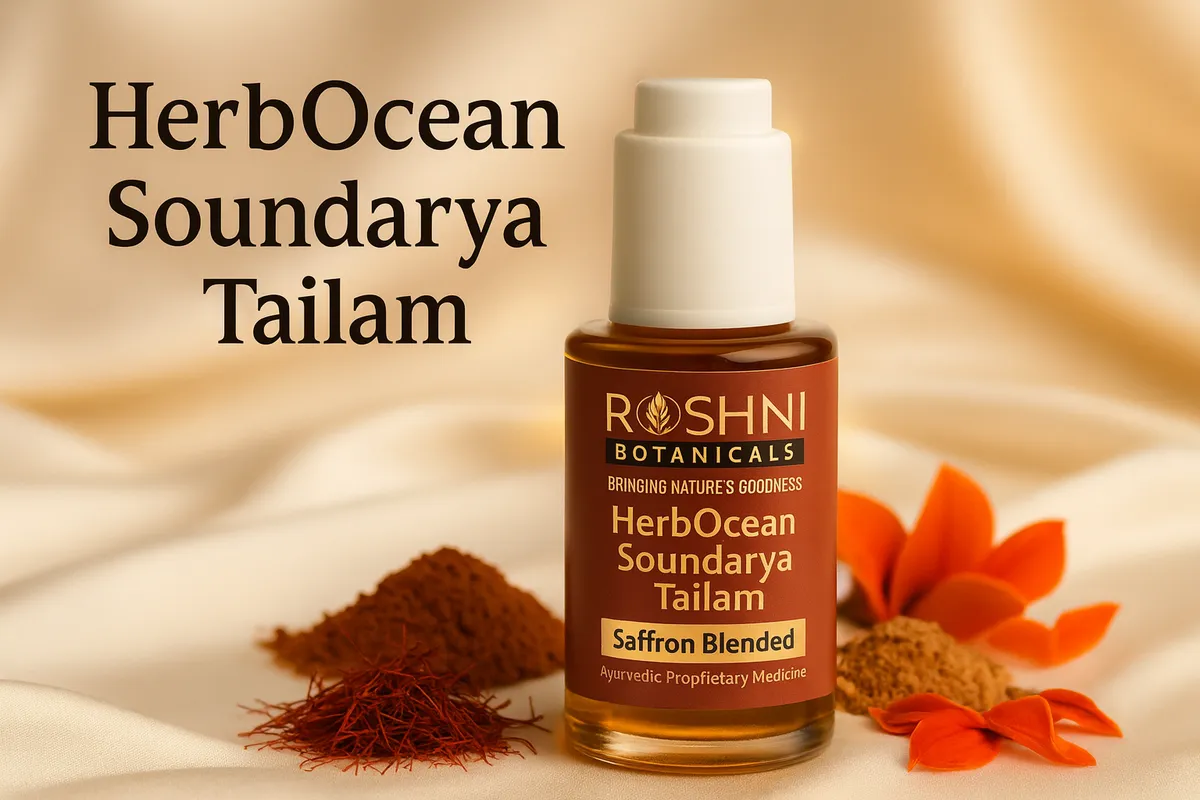
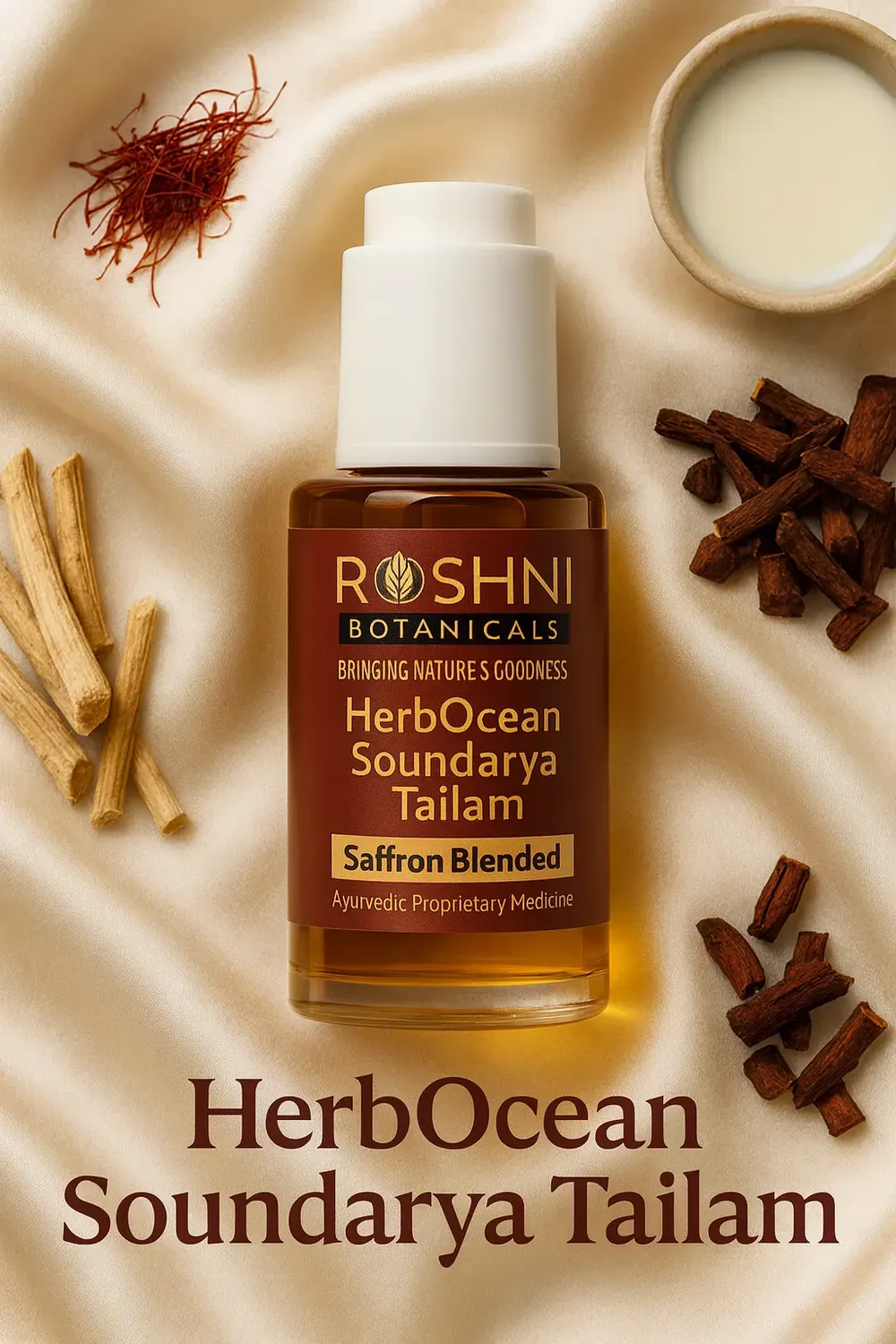
For dry skin, the step after the cleanse is where a classical Taila comes in. HerbOcean Soundarya Tailam is an AYUSH-licensed Ayurvedic medicine for external use, traditionally used to support healthy, comfortable, even-looking skin, and one that dry and mature skin tends to accept well. It is made by the goat-milk Kshira-paka method (the classical milk-and-oil method), in which the herbs are simmered with goat milk in a sesame base until the water has evaporated and only the medicated oil remains. Cooked into this oil are Manjistha, Mulethi, Raktchandan, Palash flower, bargad (Vatt) bark, Priyangu fruit, Laksha (lac, an insect resin), Daruhaldi and Nagkesar, and the finished oil also carries lavender, rose and mogra oils and Kesar (saffron). The saffron is cold-macerated, added without heat. It is made in-house at our GMP-certified unit in Bawana, Delhi, under AYUSH Licence No. DL-474 A&U, and built on the 40-year Ayurvedic formulation legacy of Vaidya Shri Ram Prakash Ji.
On clean, slightly damp skin at night, press a few drops between the palms and pat over the face and neck. A little goes far. The right amount differs from person to person. Dry and mature skin gets the most from it, and very oily or actively breaking-out skin may prefer a lighter option.
Patch-test on the inner forearm 24 hours before first use and discontinue if irritation occurs; avoid the eye area. For external use only. Avoid it if you are allergic to sesame, goat milk or a listed botanical. If pregnant or breastfeeding, check with your doctor. To start small, the Soundarya Tailam 10 ml trial gives you the same oil in a trial-size bottle.
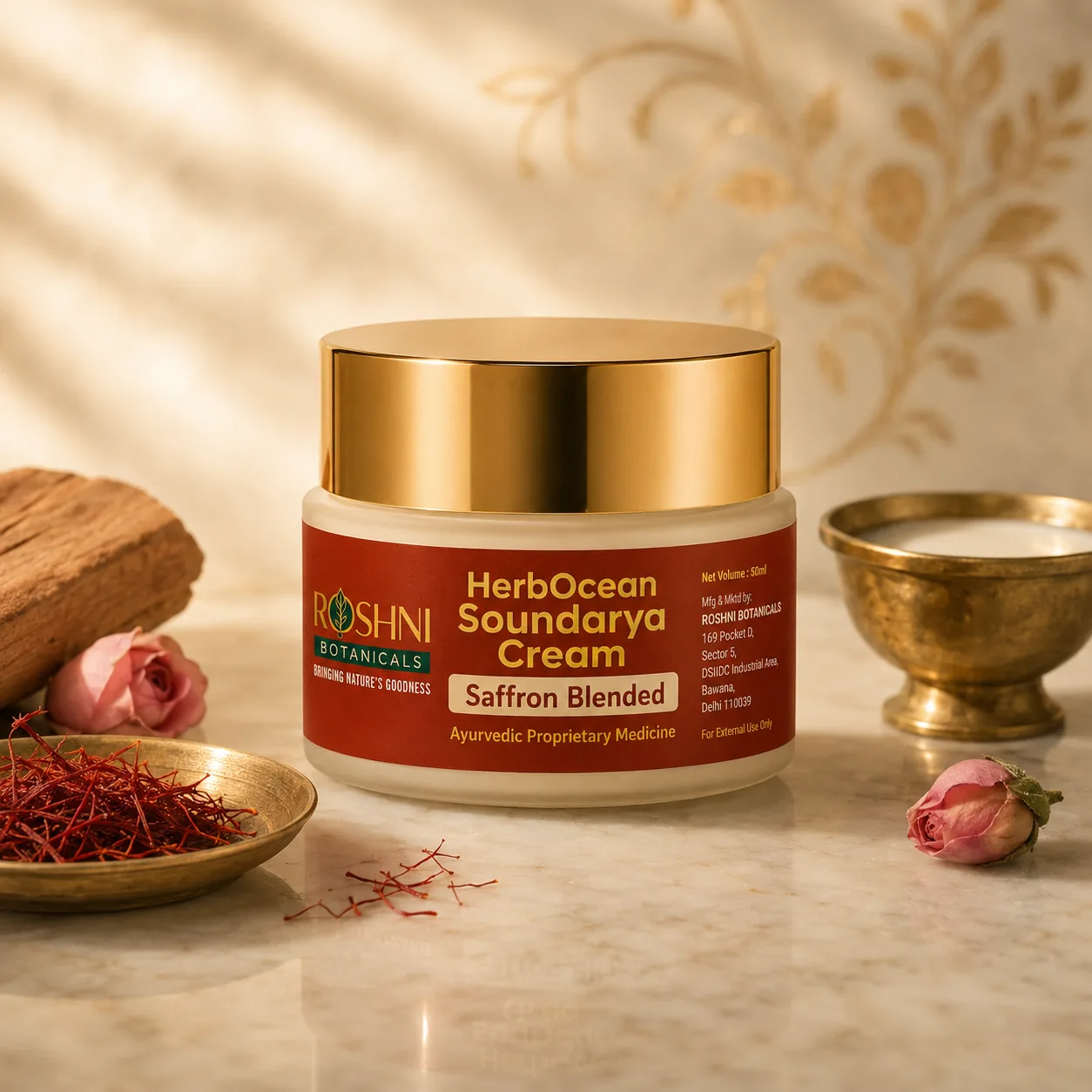
For the method behind the milk and the oil, read how a goat-milk face oil is made, and for the wider saffron oil lineage it sits in, read about the classical saffron oil tradition. If your skin also wants a cream, HerbOcean Soundarya Cream is an AYUSH-licensed Ayurvedic medicine for external use, traditionally used to support soft, nourished skin, and it helps maintain comfort in dry, depleted skin. Very oily or acne-prone skin may find it rich. Avoid if allergic to coconut, goat milk or a listed botanical, and patch-test first. If you are not sure which face oil is yours, read about choosing between our two Ayurvedic face oils.
Does Oil Cleansing Clog Pores?
It depends on the oil, on how much is left on your skin afterwards, and on your skin itself. No one can say that an oil will never raise a bump on any face.
Take online pore-clogging ratings with some care. They rest on an older rabbit-ear model, and when Draelos and DiNardo revisited the idea in 2006, in a small study of six people, they reported that finished products containing ingredients rated as pore-clogging were not necessarily pore-clogging themselves. A review by Lin, Zhong and Santiago sets out how plant oils differ on the skin barrier. It looked at oils on skin, not at oil cleansing, and the little we could find on oil cleansing itself looks at ready-made cleansing oils rather than a plain oil.
Two more things are worth knowing. Pore size comes from what you inherit, along with your age and how much oil your skin makes, and the way you cleanse does not change it. Nor does a breakout mean you have not washed well enough. Wipe the oil away well, and if new bumps appear, give it a rest.
Who Should Skip Oil Cleansing
It suits dry skin, but some faces are better off without it, and some need a word with a dermatologist first.
Very oily skin may do better with a gentle foaming face wash. In an active acne flare, keep extra oil and handling off inflamed skin: use a mild cleanser and touch your face as little as you can. A history of fungal folliculitis, the small, itchy bumps of one size that can appear on the chest, back and forehead, means oils may not suit you: ask a dermatologist which oil, if any. Skin that is broken, weeping, freshly peeled or fresh from a clinic procedure is no place for massage: follow the aftercare advice of your clinic or dermatologist. And an allergy to the oil, sesame included, is a reason to keep that oil off your skin altogether and choose another plain oil, after a patch test.
In humid, sticky weather, use less oil, or switch to a mild wash on those days.
For persistent or cystic acne, acne that starts suddenly in adulthood, itchy bumps that do not settle once you leave oils off, or dryness that cracks, bleeds, or comes with itchy, scaling patches that may be eczema, the next step is a dermatologist, not another experiment at home.
Cleanse First, Then Nourish
Let a plain oil and a warm cloth lift the day away, then let your own skin judge the swap from foam to oil: if it feels soft and comfortable after washing, with no tightness and no new bumps, it suits you. For the wider picture, an Ayurvedic skincare routine by concern helps you pick a single product for your main concern, and the Ayurvedic skincare range is where to see the rest.
References: 1. Vagbhata. Ashtanga Hridaya, Sutra Sthana 2 (Dinacharya Adhyaya): daily oil massage within the daily regimen, cited at chapter level. 2. Danby SG, Brown K, Wigley AM and colleagues. The effect of water hardness on surfactant deposition after washing and subsequent skin irritation in atopic dermatitis patients and healthy control subjects. Journal of Investigative Dermatology, 2018; 138(1): 68 to 77. Controlled forearm washing study, 80 participants, United Kingdom; funded by a water-softener maker. 3. Sharngadhara Samhita, Madhyama Khanda 9 (Sneha Kalpana): the preparation of medicated oils. 4. Draelos ZD, DiNardo JC. A re-evaluation of the comedogenicity concept. Journal of the American Academy of Dermatology, 2006; 54(3): 507 to 512. Modified human patch study on the upper back, six participants, United States; supported by the research firm of the second author. 5. Lin TK, Zhong L, Santiago JL. Anti-inflammatory and skin barrier repair effects of topical application of some plant oils. International Journal of Molecular Sciences, 2018; 19(1): 70. Narrative review. Educational, not medical advice.
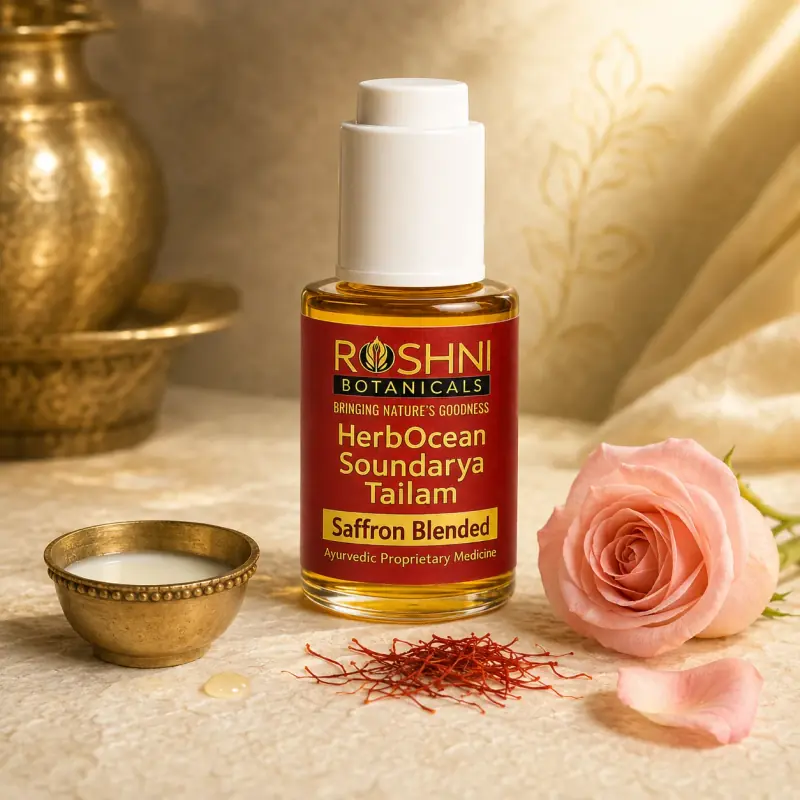
Soundarya Tailam
A saffron-infused facial Taila prepared in the goat-milk Kshira-paka tradition, with Manjistha, Mulethi and Kesar. For soft, bright, even skin.
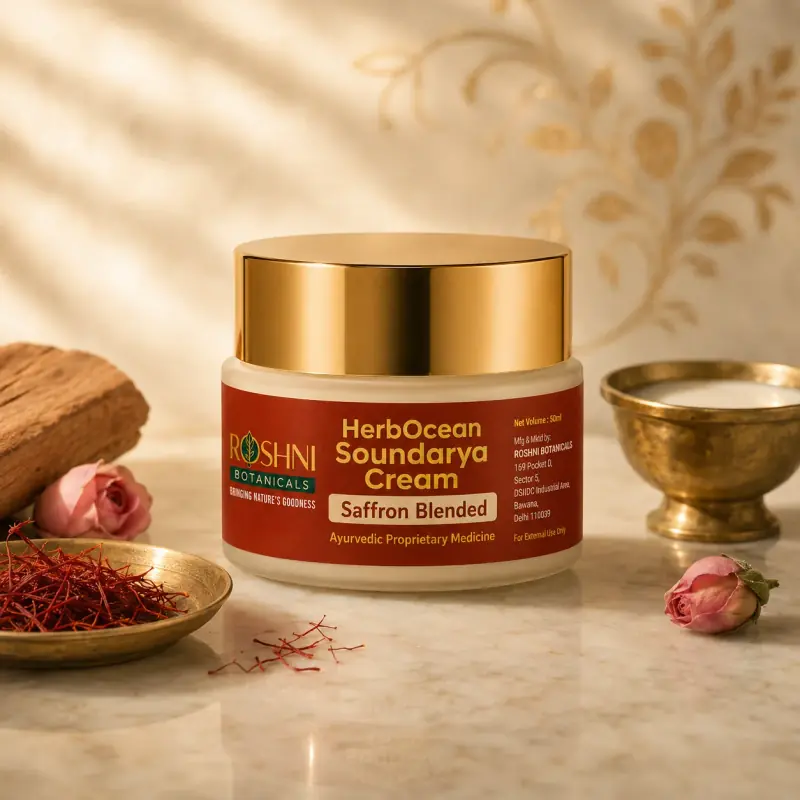
Soundarya Cream
A rich saffron brightening and repair cream with bargad (Vatt) bark on a goat-milk and coconut base, with shea and kokum butters, traditionally used in the care of skin where post-acne marks (PIH) linger.