How to Verify an AYUSH Licence Before You Buy (With a Real Example)
A plain guide to the one fact on an Ayurvedic pack you can actually check: what an AYUSH manufacturing licence is, how to read a licence number, and where verification genuinely works in 2026.
Pick up any Ayurvedic oil, cream or hair product sold in India and you will usually find a line of small print near the batch number: a manufacturing licence number, often prefixed by the state. Most buyers read past it. It looks like a formality, the sort of thing printed because a rule says so.
It is actually the single most checkable fact on the whole pack. A brand's story cannot be verified. Its photography cannot be verified. Its licence number can be, because it was issued by a government office that keeps a record of it.
This is a plain guide to doing that check. It covers what an AYUSH manufacturing licence is, how to read a licence number, where verification is genuinely possible in 2026 and where it honestly is not, and which label details tend to travel together with a real licence. We have used our own licence as the worked example, because it is the one we can show you in full.
What an AYUSH manufacturing licence actually is
Drugs are a state subject in India when it comes to manufacturing. So an AYUSH manufacturing licence is not issued by the Ministry of Ayush in Delhi to everyone centrally. It is issued by the AYUSH directorate or drug-licensing authority of the state where the factory stands, under the Drugs and Cosmetics Act, 1940 and its Rules.
The licence authorises a specific firm, at a specific address, to manufacture medicines of a specific system: Ayurvedic, Siddha or Unani. It also names the dosage forms permitted, such as oil, ointment or powder. A firm licensed to make oils is not automatically licensed to make tablets. The dosage forms are listed on the licence itself, so a pack whose form is not on the certificate is worth a question.
Two points follow, and both matter to a buyer.
First, a product made under this licence is legally a drug, not a cosmetic. Where the formulation is not a classical recipe taken straight from an authoritative Ayurvedic text, it is classified as an Ayurvedic Proprietary Medicine, and that phrase should appear on the pack. A cosmetics registration is a different licence under a different set of rules, and it does not carry the same manufacturing obligations.
Second, the licence attaches to the manufacturer, not to the brand on the front of the bottle. Many brands are marketed by one company and made by another. That is perfectly legal, but it means the name you recognise and the name on the licence may differ. If the pack says "marketed by" one firm and "manufactured by" another, the licence number belongs to the second one.
How to read a licence number: a worked example
Our own AYUSH manufacturing licence is DL-474 A&U. It is issued by the Directorate of AYUSH, Government of NCT of Delhi, to Roshni Botanicals for its in-house manufacturing unit in Delhi. Read it in two halves.
DL is the issuing state: Delhi. State prefixes are the usual convention, so you will see UP, MH, KL, TN, HR and so on in the same position. The prefix tells you which directorate to approach if you want to confirm the number, which is useful in itself.
474 is the serial number of the licence in that directorate's register.
A&U is the system the licence covers: Ayurvedic and Unani. You will also see forms such as "AUS" for Ayurvedic, Unani and Siddha, or a plain "Ay". Some states issue separate numbers for different licence categories under Rules 154 and 154-B of the Drugs and Cosmetics Rules, so a firm can legitimately hold more than one number.
We print DL-474 A&U on every label and publish it on our website, alongside the certificates it goes with. You will find it on the site's quality and certifications page and repeated on each product page, including the HerbOcean Anti-Acne Roll-On. A licence number that appears on the pack, on the website and nowhere in between is doing its job.
Where you can actually verify it
This is the part where most guides on the internet go vague. Here is the current position, as of August 2026.
The national portal: e-Aushadhi
India now has one national licensing portal for AYUSH manufacturing: e-AUSHADHI at e-aushadhi.gov.in, relaunched in 2026 and run by the Ministry of Ayush. All states now process licence applications, approvals and renewals through it.
You cannot make an account on it as a consumer. The only roles the portal issues are Licensing Authority, Drugs Inspector and Licensee. That is by design; it is a regulatory workflow system, not a public directory.
But it does have one public, no-login page that is very useful: Document Verification, at e-aushadhi.gov.in/document_verification. You enter the exact Document ID printed on a licence or certificate, complete a captcha, and the portal returns the record: firm name, address, licence type, licence number, valid-upto date and current status. No login, no fee, about thirty seconds.
Now the honest caveat, because it changes how you use this. The page verifies by document ID only. There is no search by brand name, no search by firm name, no browsable list. You must already have the document in front of you, which in practice means the brand has to show it to you first. And licences issued before the 2026 relaunch were granted on paper forms; those may not return a result until the issuing authority migrates them through the portal's Legacy Module. A blank result on an older licence therefore means "not found in the portal", not "fake". Treat it as a prompt to ask the state directorate, not as a verdict.
The portal also publishes a statistics page showing state-wise counts of licensed AYUSH manufacturers. Delhi shows roughly 150 Ayurvedic, Siddha and Unani manufacturers as of August 2026. Useful for context, but it lists counts, not names.
States that go further
Maharashtra is the standout. The state FDA's manufacturing portal at fdamfg.maharashtra.gov.in offers a genuine public search, including search by manufacturing licence number. Every eSigned Maharashtra FDA licence also carries a TPAV code, a verification code printed on the document itself. Enter that code on the portal and it pulls up the licensee record. If you are checking a Maharashtra-made product, you have a real self-service route.
Most other states do not publish a list. Kerala's Drugs Control department, which handles the ASU wing, is a fair example: no public register of licensed ASU manufacturers. Where that is the case, three practical routes remain, in increasing order of effort:
- Ask the brand to send you a copy of its licence certificate. A licensed manufacturer will have it as a PDF and no reason to withhold it.
- Write to the state AYUSH directorate or drug controller quoting the licence number and asking for confirmation.
- File an RTI application if a written reply does not come.
One trap worth knowing
Search for "e-Aushadhi" and you will land on several state websites of the same name, including Rajasthan's and Odisha's NIRAMAYA system. These are hospital drug supply-chain systems: stock, indents, distribution to government facilities. They have nothing to do with manufacturing licences, and a great many people waste an afternoon on them. Go to e-aushadhi.gov.in directly rather than through a search result.
What else on the label signals a licensed medicine
A licence number rarely travels alone. On a properly labelled Ayurvedic medicine, you should expect to see all of the following:
- The manufacturing licence number, printed on the pack, not only on the website.
- The words "Ayurvedic Proprietary Medicine" where the formulation is proprietary rather than classical. Some packs also carry "For external use only" where that applies.
- Batch number, manufacturing date and expiry or best-before date. A medicine without a batch number cannot be traced or recalled.
- MRP written as "(incl. of all taxes)". This is a legal-metrology requirement, and its absence is a genuine slip rather than a stylistic choice.
- Manufacturer's name and full address, not merely a city. If the pack says "marketed by", look for the separate "manufactured by" line.
- Net quantity and a list of ingredients with quantities.
Sitting alongside the licence, the companion document to look for is the Schedule-T GMP certificate, issued on Form 26-E1. Schedule T sets the good manufacturing practice standards for ASU medicines: premises, water, equipment, records, testing. A GMP certificate names the licensee, the site and the dosage forms it covers, and it carries validity dates.
Ours runs from 11-09-2024 to 10-09-2029 and covers the dosage forms Oil, Ointment and Powder. We publish it, along with the AYUSH licence, on our quality and certifications page.
Red flags
None of these prove wrongdoing on their own. Together, they are a pattern worth pausing on.
No licence number anywhere, but heavy "100% natural" and "miracle" language on the front. Any formulation with water and preservatives in it is not one hundred per cent anything. Loud adjectives filling the space where a number should be is the oldest substitution in the category.
An FDA logo on an Indian Ayurvedic product. The United States Food and Drug Administration does not license or approve Ayurvedic medicines, and it does not issue a logo for use on packs. Any such badge is decoration, and it tells you the pack was designed to look regulated rather than to be checked.
Claims of curing a named disease. India's Drugs and Magic Remedies (Objectionable Advertisements) Act, 1954 restricts advertising a cure for the conditions listed in its Schedule, and separately makes any false or misleading claim in a drug advertisement an offence, whatever the condition. Percentage figures without a cited study fall in the same territory.
A price shown without the "(incl. of all taxes)" wording. Small, but it indicates nobody checked the label against the rules.
A licence number that appears only in marketing copy and never on the pack itself.
Two minutes, once
You will not do this for every purchase, and you do not need to. Do it once for a brand you are thinking of buying regularly, and you have settled the question for good.
The check is short: find the licence number on the pack, read the state prefix, ask for the certificate, run the document ID through e-aushadhi.gov.in/document_verification, and write to the state directorate if the record is an older one. Five minutes at the outside, and usually two.
A brand that prints its numbers, publishes its certificates and names its manufacturing address is inviting exactly this check. Take it up. It is the only part of a label that answers back.
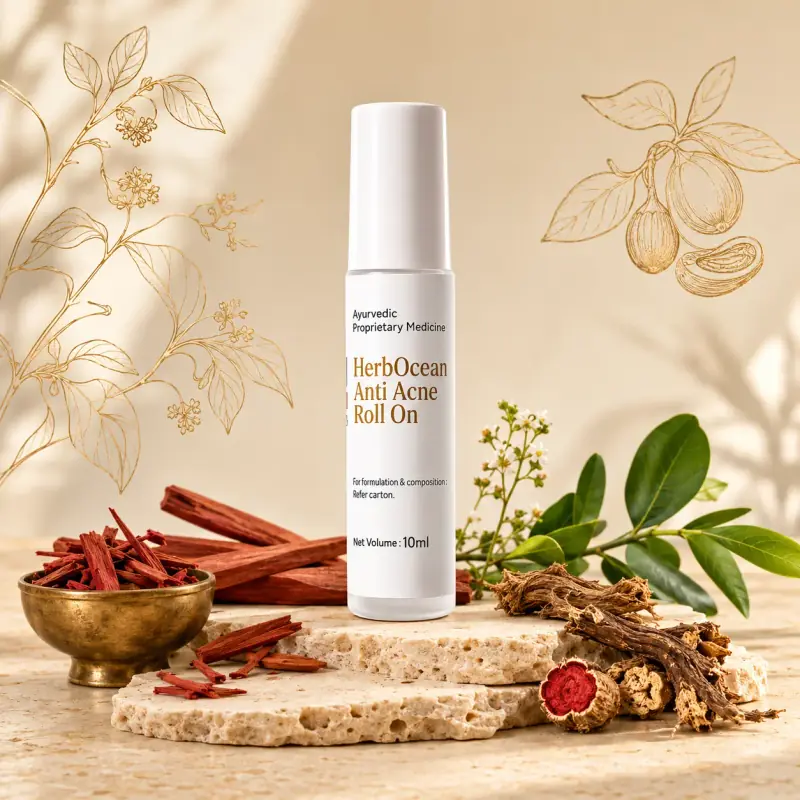
Anti-Acne Roll-On
Ayurvedic spot care for active pimples and post-acne marks (PIH) — a herbal roll-on classically indicated for acne (Yuvanpidika). Made in-house in Delhi.