Dark Skin Around the Mouth: Causes, Everyday Triggers and Gentle Ayurvedic Care
Skin around the mouth darkens from friction, lip-licking and old marks, not from anything a lemon can fix. Gentle, saffron-led Ayurvedic care for even tone.

You notice it in the mirror or in a photo: the skin around your mouth sits a shade or two deeper than the rest of your face. It is one of the most common pigmentation worries Indian women carry (in one study of 1,204 women across four Indian cities, most of those over 30 showed some pigmentation at the corners of the lips), and one of the least honestly written about; most of what ranks online will hand you a lemon and a promise. The reassuring truth is that this darkening usually has ordinary, traceable causes, and it answers to patient, gentle care, not to anything that stings.
Key takeaways
- The skin around the mouth is thin and constantly in motion, so it darkens easily from friction: wiping, rubbing, upper-lip threading and waxing, and the licking-chapping cycle.
- On melanin-rich Indian skin, that low-grade irritation settles into post-inflammatory hyperpigmentation (PIH), which is why the harsh fixes, lemon, baking soda, bleach creams, reliably deepen the very shadow they promise to solve.
- The trigger moves with the season: dry winter air chaps the lip border and feeds lip-licking, while monsoon sweat brings constant wiping; the zone needs different kindness in January and July.
- Classical Ayurveda reads facial discolouration (Vyanga, the classical term) through aggravated Pitta (one of the three doshas, the biological energies in Ayurveda) expressing in the skin, and holds one’s natural complexion (Chhaya) as the thing to care for, not to change.
- A velvety, thickened or suddenly spreading darkening, or one arriving with tiredness or weight changes, needs a doctor before any cream; most other cases answer to gentle care, sun protection and weeks of patience.
Why the Skin Around Your Mouth Darkens
Start with what this zone endures. The skin bordering your lips is among the thinnest on your face, and it never rests: it stretches with every word, meal and smile, gets wiped by tissues and dupattas a dozen times a day, and hosts more grooming friction than any other strip of your face. Upper-lip threading and waxing, repeated every few weeks for years, is a cycle of micro-irritation landing on the same few centimetres. Melanin-rich skin responds to exactly this kind of low-grade, repeated provocation by laying down pigment, post-inflammatory hyperpigmentation (PIH), which is why the shadow often maps precisely to where the wiping and threading happen.
Two more residents of this zone deserve naming. The lip-licking cycle: saliva wets the lip border, evaporates and dries it further, the skin chaps, you lick again, and the repeated irritation deepens colour in a ring around the mouth; children and anyone who breathes through the mouth at night know this pattern best. And old eruptions: the pimples that cluster around the chin and mouth corners in many women leave PIH behind, so some of today’s shadow is simply yesterday’s breakouts, settled but not yet gone. Hormonal shifts can add their own band of deepening here, a pattern that behaves like a cousin of melasma; keep that word descriptive rather than diagnostic, and let a dermatologist do the naming if the patch is large or symmetrical.
One honest check before you set out to correct anything: make sure what you are seeing is pigment at all. The area around the mouth sits in natural shadow, the fold lines running from the mouth corners and the slight recess under the lower lip darken under any overhead light, and many women have a perfectly even complexion that photographs unevenly at noon. Look at the zone in soft, indirect daylight near a window, face the light straight on, and compare. If the darkness largely dissolves, you are looking at anatomy and lighting, not melanin, and no cream on earth is required. If it holds its ground in kind light, read on.
The season decides which trigger leads. Through North India’s dry winter, the lip border chaps and the licking cycle runs hardest, so winter care is about grease and restraint: a plain balm reapplied often, and the discipline not to lick. Through the monsoon, sweat pools and the wiping cycle takes over, so July’s kindness is a soft cotton handkerchief pressed, never dragged, and a face gently rinsed after the drenched commute. Same zone, different enemy, moving with the calendar.
The Classical Lens: Vyanga, Pitta and Your Own Chhaya
Classical Ayurveda catalogued facial discolouration centuries ago under Vyanga, described in the Sushruta Samhita among the minor conditions of the face, and read it through aggravated Pitta (with Vata), the hot, transforming principle expressing itself in the skin. The lens is genuinely useful here, because it points care in the right direction: cool, calm and protect, rather than scrub, strip and bleach. Heat and friction feed the problem; nothing in the classical playbook answers irritation with more irritation.
The tradition also offers this page its ethics in a single word. Chhaya is one’s natural complexion, the tone that is yours, and classical complexion care aimed to keep it even, luminous and healthy, never to trade it for a different one. That is the promise this post makes: the goal for the skin around your mouth is the same tone as the rest of your face, nothing else. Any product, home remedy or relative promising you a different shade is solving a problem you do not have.
The Nuskha Trap: Why Lemon Makes This Zone Worse
Now the hard rule, stated with love for the tradition that produced the softer ones. Raw lemon, baking soda, toothpaste and bleach creams have no business on the thin skin around your mouth. Lemon is acidic and photosensitising; baking soda is alkaline and abrasive; both strip a zone that is already the most provoked strip of your face, and on melanin-rich skin that stripping becomes fresh pigment within weeks. The cycle is cruelly neat: the harsh fix irritates, the irritation deepens the shadow, the deeper shadow invites a harsher fix. Well-meaning advice recommending lemon for this exact zone is everywhere online, including on pages wearing Ayurvedic labels, and it deserves to be retired with respect: the instinct to reach for the kitchen is honourable, but this is the one strip of your face the kitchen should not touch.
The gentler substitutions cost less anyway. Cleanse this zone with lukewarm water and a mild cleanser, because hard tap water plus a harsh foaming wash strips the thin skin twice over; most metros’ mineral-heavy supply already leaves it tight. Blot sweat, never saw at it. Space threading appointments a little wider when the zone is provoked, and press something bland and soothing on it afterwards rather than going straight into sunlight. And if you are unsure whether your shadow is a settled brown mark or something redder and angrier, our guide to brown marks versus red marks explains the difference, and our fuller piece on how dark spots differ from pigmentation maps the wider territory.
Gentle Care That Respects a Thin-Skinned Zone
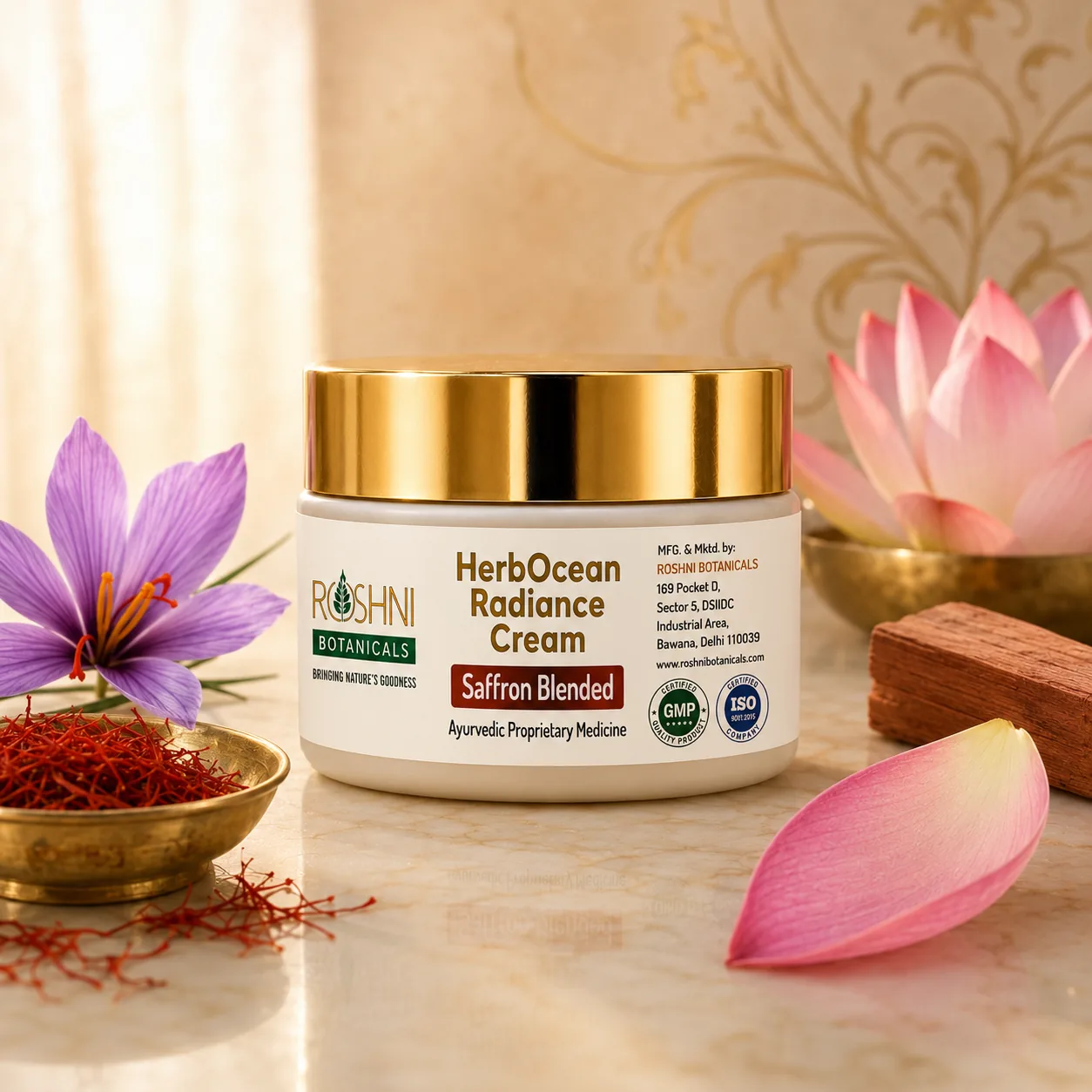
Here is the routine, answer-first. Evening: cleanse gently, pat dry, and take a pea-sized amount of HerbOcean Radiance Cream for the whole perioral zone, pressed in with the ring finger, the hand’s lightest. Morning: sunscreen, without negotiation, because ultraviolet light deepens every kind of pigment this post has named, and the commute delivers it daily. Give the cream a minute or two to settle before the sunscreen goes over it, so the two layers do not ball up on this mobile, expression-creased zone. Between the two: nothing abrasive, nothing acidic, nothing that tingles. Give the routine eight to twelve weeks, judged by a weekly photo in the same light rather than a daily mirror interrogation, and expect edges to soften before anything vanishes; on melanin-rich skin, pigment leaves the way it came, gradually.
Radiance Cream earns its place in this zone by temperament. It is an AYUSH-licensed Ayurvedic medicine for external use, led by the classical complexion-supporting (Varnya) herbs: saffron (Kesar), sandalwood (Chandan), Manjistha, red sandalwood (Raktchandan), lotus (Kamal) and wild Himalayan cherry (Padmaakh), the cooling, calming end of the classical pharmacy, traditionally used in the care of uneven tone and pigmentation. It was formulated by Vaidya Shri Ram Prakash Ji, the master vaidya (a classical Ayurvedic physician and formulator) whose 40-year formulation legacy the HerbOcean line is built on, and made in-house at Roshni Botanicals’ GMP-certified unit in Bawana, Delhi. Patch-test on the inner forearm for 24 hours before first facial use, and apply it to clean, unbroken skin, never immediately after threading or waxing. Readers whose darkening is part of a larger facial pattern will find the fuller plan in our guide to the Ayurvedic treatment for melasma on Indian skin.
Two small daily habits round out the routine, both hiding in plain sight. First, the toothpaste: strong mint pastes and their foaming agents sit on the chin and mouth corners twice a day, and in sensitive skins that residue is a quiet, twice-daily irritant; rinse the lather off the surrounding skin properly after brushing and pat dry, rather than letting it dry where it landed. Second, the concealer: if this shadow has you patting on heavy coverage every morning and rubbing it off every night, that daily cycle of applying and rubbing off is itself feeding the shadow. Wear less here, not more, take it off with the gentlest touch you own, and let the zone spend its evenings bare.
When Darkening Around the Mouth Needs a Doctor First
Most perioral darkening is friction, licking or old marks, and the routine above serves it well. A short list of patterns should skip the routine and see a doctor first. Darkening that appeared suddenly or is spreading week on week. A patch that itches, burns, flakes or feels velvety and thickened rather than flat, textures that can point to conditions a cream should not be guessing at. Darkening that arrives alongside unusual tiredness, weight change or menstrual shifts, which deserves basic blood work, including B12, since deficiencies can show themselves around the mouth. And any darkening in a child. None of this is meant to alarm; it is sequencing. A dermatologist’s ten minutes first makes the patient months that follow worth their while.
The Same Tone as the Rest of You
The shadow around your mouth built up slowly, from wiping and threading and licking and old pimples, and it will leave the same way: slowly, under gentle care, sun protection and a firm refusal to hand it anything harsh. Keep the routine small, the pea-sized evening press of HerbOcean Radiance Cream, the morning sunscreen, the soft blot instead of the wipe, and let the weeks do what lemons never could. Your chhaya, the complexion that is yours, is the goal and the destination; this zone just needs help matching it again.
References: Sushruta Samhita, Nidana Sthana 13 (Kshudra Roga), on Vyanga, classically a Vata-Pitta discolouration among the minor conditions of the face. Hourblin V, Nouveau S, Roy N, de Lacharrière O. Skin Complexion and Pigmentary Disorders in Facial Skin of 1204 Women in 4 Indian Cities. Indian Journal of Dermatology, Venereology and Leprology. 2014;80(5):395–401 (n = 1,204; most women over 30 showed moderate-to-severe pigmentation at the corners of the lips). Kannan R, Ng MJ. Cutaneous Lesions and Vitamin B12 Deficiency: An Often-Forgotten Link. Canadian Family Physician. 2008;54(4):529–532 (a clinical review; hyperpigmentation is among the recognised mucocutaneous signs of B12 deficiency, noted here only as a reason to check, never as a diagnosis).
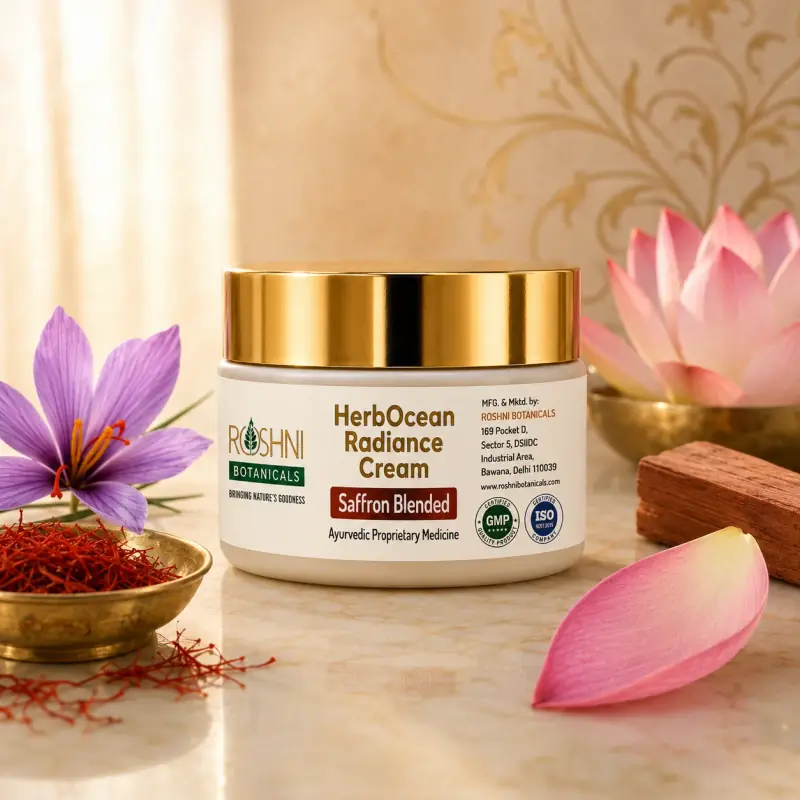
Radiance Cream
A daily saffron and sandalwood brightening cream with Manjistha, red sandalwood and lotus in a light coconut base. Supports a luminous, even-looking skin tone.
Part of our guide: Ayurvedic treatment for melasma on Indian skin.