Is Soundarya Tailam a Kumkumadi Alternative? Two Saffron Oils, One Tradition
Kumkumadi is a family of classical saffron oils, not one recipe. Where Soundarya Tailam and Radiance Tailam each meet it, and how to choose between them.
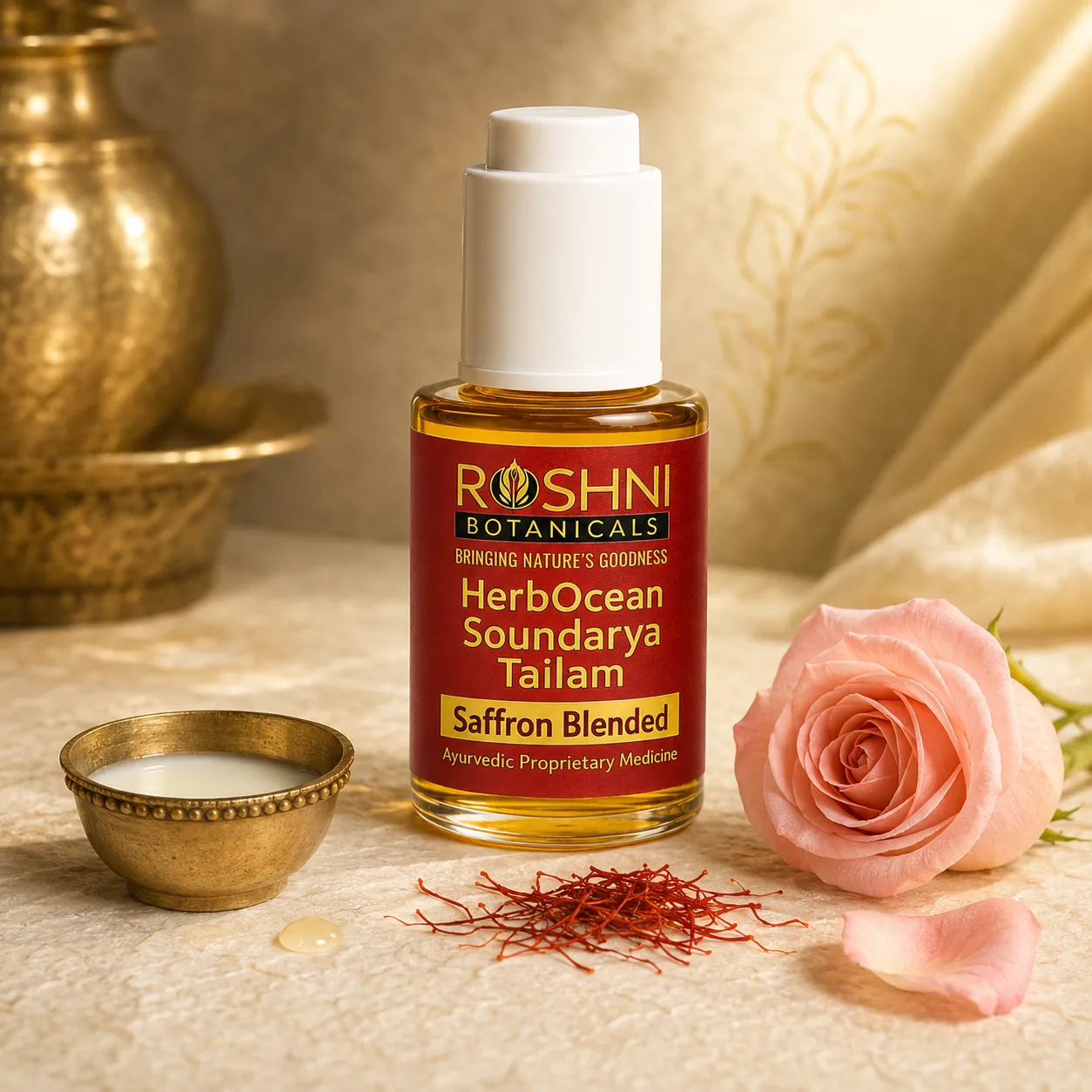
Kumkumadi sounds like the name of one famous bottle, the saffron oil for the night. But kumkumadi names a family of classical saffron oils recorded in more than one version, not a single locked recipe. That is why two serious bottles can look almost unrelated once you turn them round and read the panel.
If you are standing in front of two HerbOcean saffron oils and wondering which one is the kumkumadi one, the short answer is that both draw on that family, from different sides. Soundarya Tailam keeps the goat milk, the sesame base and several herbs of the earliest recorded kumkumadi recipe; Radiance Tailam shares one of its classical indications, melasma, and its saffron, sandalwood, lotus and Padmaakh companions. A saffron-led Taila (medicated oil) has a classical use of its own, each of our two Tailams meets that family in its own place, and the choice between them turns on your skin.
Key takeaways
- Kumkumadi names a family of classical saffron oils for the face, not one fixed recipe; the herb lists differ from one text and one pharmacy to the next.
- HerbOcean Radiance Tailam is classically indicated for melasma, a concern the kumkumadi texts also name, and carries several herbs from the classical lists: a saffron-led Taila with sandalwood, Manjistha, red sandalwood, lotus and Padmaakh bark, the three Triphala fruits declared alongside, in a sesame base.
- HerbOcean Soundarya Tailam is made by the goat-milk Kshira-paka method (the classical milk-and-oil method), in which the herbs are simmered with goat milk in a sesame base until the water has evaporated and only the medicated oil remains.
- The earliest kumkumadi listing, in Ashtanga Hridaya, cooks its herbs with goat milk, and the liquorice, lac and Manjistha of Soundarya Tailam all appear in the classical kumkumadi lists, so the two lineages touch rather than compete.
- Both are AYUSH-licensed Ayurvedic medicines for external use, used a few drops at night; the choice turns on whether uneven tone or dry, mature skin is the concern.
What the Word Kumkumadi Means
Kumkuma is saffron. Adi means beginning with, and the rest. Read literally, the name is the oil of saffron and its companions, named in the classical way after the first herb in its list.
The earliest recorded version is in Ashtanga Hridaya, and later compendia, Chakradatta and Bhaishajya Ratnavali among them, carry their own. Almost all of them cook the herbs with milk, goat milk in the earliest, and one leaves it out. What the recorded versions share is saffron, liquorice and a sesame base, with lac, sandalwood, lotus and Manjistha in almost all of them. The Ashtanga Hridaya gives its version as nasya, drops taken through the nose; the later compendia and everyday practice use kumkumadi as a face oil.
Our two saffron Tailams are licensed under their own names, each with its own declared formula, and each meets that family in a different place.
What a Saffron-Led Taila Is Traditionally Used For
In the classical reading, a saffron-led facial Taila is traditionally used in the care of skin that looks dull, dry or uneven, and it is named in the context of melasma, the facial patches the texts call Vyanga (the classical term for facial pigmentation). Sushruta describes Vyanga as a painless, thin, dusky patch on the face. If that is what brought you here, our handbook on Ayurvedic care for melasma on Indian skin covers melasma on its own terms. A saffron-led oil belongs inside a steady routine: a gentle cleanse, shade from the midday sun and the same few drops each night.
Ayurveda locates skin lustre in bhrajaka pitta, the aspect of Pitta (one of the three doshas, the biological energies in Ayurveda) that the texts seat in the skin itself, named for the shine it gives. For the single-ingredient view, what saffron is used for in Ayurvedic skin care is covered separately.
Radiance Tailam: Where It Meets the Kumkumadi Family
HerbOcean Radiance Tailam is the oil in our line that meets kumkumadi on pigmentation. It is a saffron-led Taila of twelve herbs at equal weight, sandalwood (Chandan), Manjistha, red sandalwood (Raktchandan), lotus (Kamal), Padmaakh bark, Kakoli, Palash flower, Kuth, turmeric (Haldi) and the three Triphala fruits, Amla, Baheda and Harad, in a sesame (Til tail) base, with saffron (Kesar) and three finishing oils, lavender, rose and mogra. The saffron is cold-macerated: it is steeped into the finished oil once the cooking is over, not boiled with the herbs.
Read that list against the earliest recorded kumkumadi recipe and the overlap is in the companions: saffron, sandalwood, Padmaakh, lotus and Manjistha, carried in sesame. The goat milk, liquorice and lac of that recipe sit in the other bottle.
It is an AYUSH-licensed Ayurvedic medicine for external use, classically indicated for melasma (Vyanga) and traditionally used to support even tone where dark spots and post-inflammatory hyperpigmentation (PIH) show on melanin-rich Indian skin. The pigmentation side of it is set out in Radiance Tailam as a classical Taila for uneven tone and dark spots.
Soundarya Tailam: The Goat-Milk Kshira-paka Lineage
HerbOcean Soundarya Tailam meets the same family through its method. It is made in the goat-milk Kshira-paka tradition: the herbs are simmered with goat milk in a sesame base until the water has evaporated and only the medicated oil remains. Goat milk (Ajadugdh) is the largest single ingredient in the formula. The classical chapter on medicated oils, in Sharngadhara Samhita, allows milk as the liquid the herbs are cooked in, and that is the method this oil follows.
The output is a Taila: for all the milk that goes into the process, what comes out is a medicated oil. Its herbs and resin are Manjistha, liquorice (Mulethi), red sandalwood (Raktchandan), Palash flower, bargad bark (Vatt), Priyangu fruit, lac (Laksha), Daruhaldi and Nagkesar, nine ingredients at equal weight, with saffron (Kesar) and the same three finishing oils, lavender, rose and mogra. Vatt is bargad, the banyan (Ficus benghalensis), and the part used is the bark.
It is an AYUSH-licensed Ayurvedic medicine for external use, traditionally used to support healthy, comfortable, even-looking skin, and one that dry and mature skin tends to accept well. For the method itself, how a classical goat-milk face oil is actually made walks through it, and a closer look inside Soundarya Tailam sets out what it holds.
Where the Two Lineages Touch
The earliest recorded kumkumadi, in Ashtanga Hridaya, cooks its herbs with goat milk in sesame oil, and the liquorice, lac, Manjistha and red sandalwood of Soundarya Tailam all appear in the classical kumkumadi lists. Set side by side against that earliest listing, each of our panels holds part of the recipe: Soundarya Tailam its goat milk, sesame, saffron, Manjistha, liquorice and lac, with bark from the same banyan tree; Radiance Tailam its saffron, sandalwood, Padmaakh, lotus and Manjistha. So a neat split between kumkumadi oils on one side and goat-milk oils on the other is tidier than the texts ever were. Our two Tailams each take one road through a tradition that ran both.
Both are made in-house at our GMP-certified unit in Bawana, Delhi, under AYUSH Licence No. DL-474 A&U, and built on the 40-year Ayurvedic formulation legacy of Vaidya Shri Ram Prakash Ji. The difference between them is the road, not the roof: one shares a classical indication of kumkumadi, melasma, the other its goat milk and many of its herbs, and each is declared herb by herb on its label.
In practice the two oils are handled the same way: a few drops at night on damp skin, patch-tested first, judged over weeks rather than days, and over months where pigmentation is the concern. What differs is what each one is reached for.
How to Choose Between the Two
If your main concern is uneven tone, dark spots or the post-inflammatory marks that melanin-rich Indian skin is prone to, Radiance Tailam is the oil to start with. If kumkumadi brought you here for pigmentation, one of its classical indications, that is the bottle.
Dry or mature skin is a different question. Soundarya Tailam is the goat-milk road, and dry and mature skin tends to accept it well. Very oily or actively breaking-out skin may prefer a lighter step. Mature skin brings its own questions, and saffron in Ayurvedic age-care takes those up properly.
The two can also share a week. One simple rhythm is Radiance Tailam on most nights for pigmentation care and Soundarya Tailam twice a week for deeper nourishment, with each oil patch-tested separately and introduced one at a time. The longer side-by-side lives on Soundarya Tailam or Radiance Tailam: choosing an Ayurvedic face oil, and if you came for the tradition rather than the choice between our two bottles, the kumkumadi tailam tradition explained is the page to read next.
How to Use a Saffron Facial Oil at Night
At night, on clean, slightly damp skin, press in two or three drops of Radiance Tailam or three or four of Soundarya Tailam with light upward strokes for about a minute, and leave the oil on overnight. Press the oil in rather than dragging it across the skin, the unhurried way of the facial oil massage (Mukha Abhyanga). Patch-test on the inner forearm 24 hours before first use and discontinue if irritation occurs; avoid the eye area. For external use only. Avoid if allergic to sesame, to a listed botanical or, for Soundarya Tailam, to goat milk. If pregnant or breastfeeding, check with your doctor.
A saffron Taila is a night step, and daytime sun care is a separate habit. HerbOcean does not manufacture a sunscreen, and nothing in the range replaces one, so if pigmentation is your concern, choose a sunscreen with your dermatologist and wear it every morning; the oil belongs to the night.
Hard water, which much of Delhi lives with, can leave a face feeling tight after washing, and over-washing skin that already feels dry adds to it. A mild cleanser, lukewarm water and a gentle pat dry are the better start to the night.
See a dermatologist for patches that keep widening month on month, for pigmentation that arrives suddenly or changes quickly, for a patch that looks different from the rest or that itches, bleeds or changes its shape or border, for new pigmentation after a new medicine, and for any reaction to a new oil that does not settle within a few days of stopping it. Pigmentation on Indian skin is better looked at early, in person.
Which Bottle to Reach For
Both HerbOcean saffron oils draw on the kumkumadi family. Soundarya Tailam keeps its oldest method, herbs cooked with goat milk in sesame; Radiance Tailam keeps its saffron, sandalwood and lotus companions.
For uneven tone and dark spots, Radiance Tailam is where we would start you. For dry or mature skin that wants nourishment first, Soundarya Tailam. Patch-test first, external use only, and give either of them weeks, and pigmentation months.
References: Ashtanga Hridaya, Uttarasthana 32 (Kshudra Roga Pratishedha), on the earliest recorded kumkumadi oil, prepared with goat milk in sesame oil. Ashtanga Hridaya, Sutrasthana 12, on bhrajaka pitta seated in the skin. Sharngadhara Samhita, Madhyama Khanda 9 (Sneha Kalpana), on the classical preparation of medicated oils, including those processed with milk as the liquid medium. Sushruta Samhita, Nidana Sthana 13 (Kshudra Roga), on Vyanga among the classical facial discolourations. Ravi AP, Varada MS, Sanila VK, Leena KC. A Comprehensive Review on Kumkumadi Thaila. International Journal of Ayurveda and Pharma Research. 2023;11(11):61-66 (narrative review comparing the kumkumadi lists across seven classical texts). Educational, not medical advice.
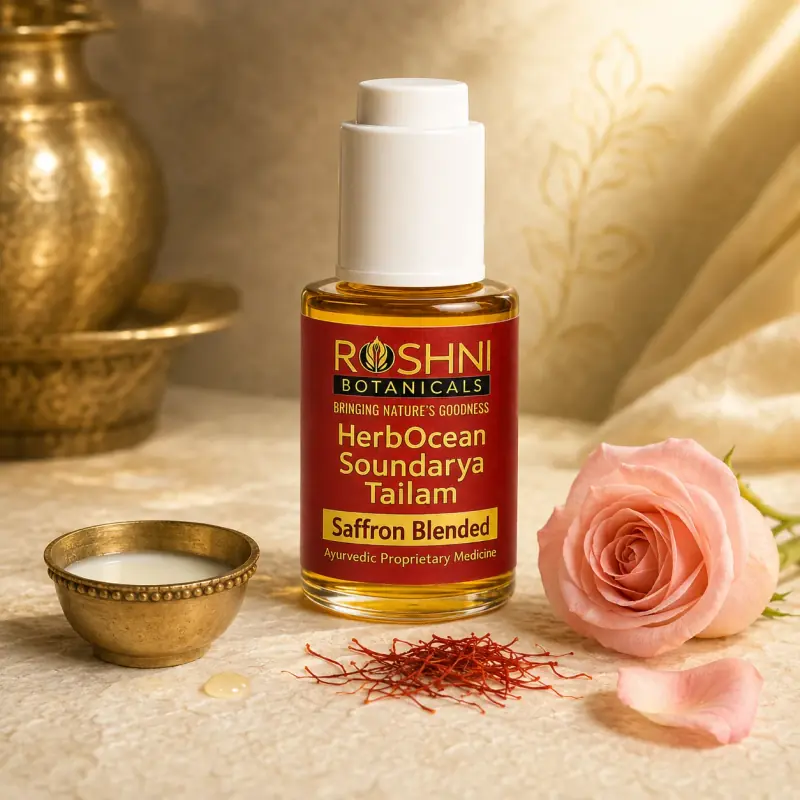
Soundarya Tailam
A saffron-infused facial Taila prepared in the goat-milk Kshira-paka tradition, with Manjistha, Mulethi and Kesar. For soft, bright, even skin.
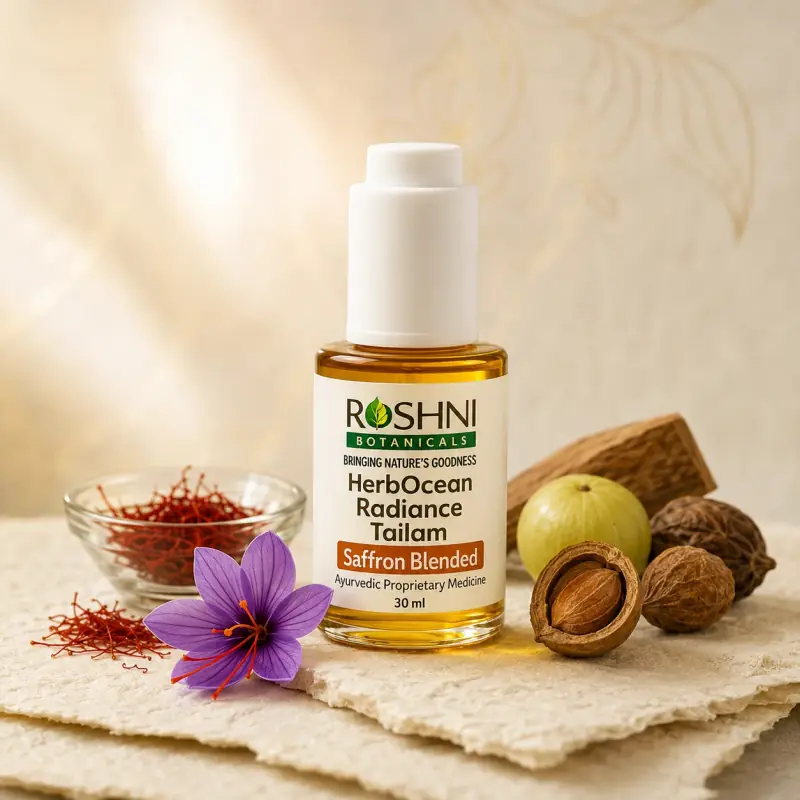
Radiance Tailam
A saffron brightening facial Taila with Manjistha and red sandalwood, traditionally used to support even tone where melasma, dark spots and PIH show.
Part of our guide: Ayurvedic treatment for melasma on Indian skin.