

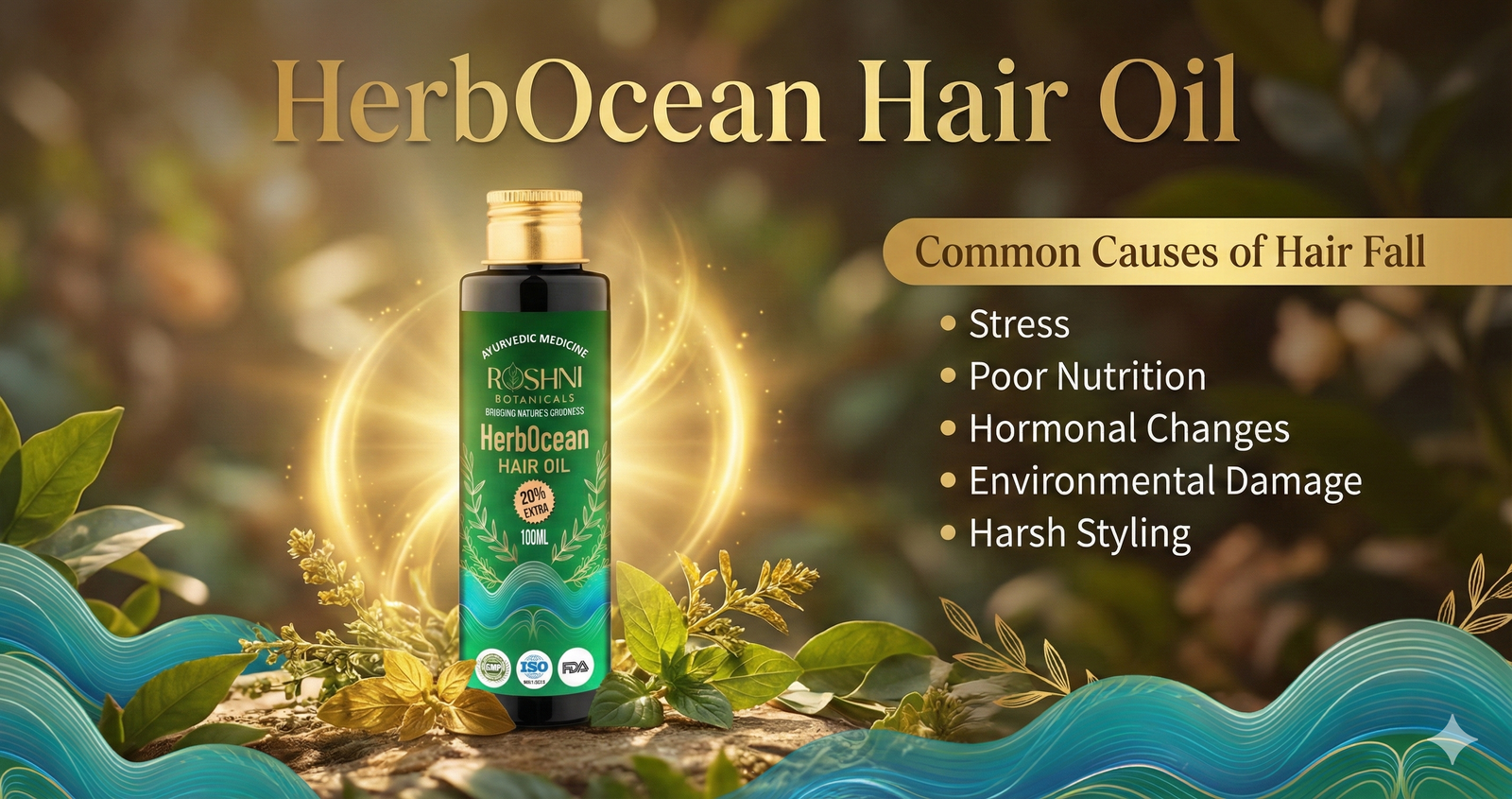
It can be challenging to figure out why your hair is falling out because there is usually more than one reason. One week your hair looks great, and the next week your comb is full of hair. The truth is that hair loss is often a "signal," not just a surface problem.
Ayurveda has a unique approach to addressing hair loss. It doesn't just strive to "stop shedding." Instead, it focuses on supporting the scalp, calming the mind, nourishing the roots, and balancing the body so that the hair cycle may go back to normal.
In this tutorial (Discover Mode), we'll talk about:
• what really causes hair loss,
• how to detect what kind of hair loss you have,
• what Ayurveda prescribes for long-term hair strength, and
• how to use HerbOcean Hair Oil as a practical, relaxing regimen.
A quick overview of the main ideas
• Stress, illness, hormones, thyroid issues, a lousy diet, dandruff on the scalp, and rigorous styling are all big reasons why hair falls out.
• Telogen Effluvium, or stress-related shedding, usually starts 2 to 3 months after a trigger and can usually be halted.
• Ayurveda helps hair fall by focusing on nourishing the roots, keeping the scalp clean, resting, and having regular massages (abhyanga-style care).
• Botanical evidence: Rosemary oil has been shown to help people with pattern hair loss, while lavender oil has shown promise in early hair growth studies.
• Oiling your scalp two to four times a week can make it feel better, less dry, and help your hair seem stronger over time.
What does "normal" hair loss mean?
Every day, it's normal to lose hair. But you should pay attention if you notice:
• sudden heavy shedding (clumps, handfuls),
• thinning at the crown/parting,
• a broadening hairline,
• an itchy scalp with flakes, or
• breaking (short snapped hairs, not whole strands).
Telogen effluvium is a common temporary pattern in which hair falls out quickly after stress, illness, or changes in the body. Once the problems are fixed, it normally goes away in a few months.
Common Causes of Hair Loss (And How They Show Up)
| Cause | What you might see | What helps the most |
|---|---|---|
| Stress or not getting enough sleep | can make your hair fall out, make it dull, and make your scalp feel tight. | a calming routine, a scalp massage, and sleep repair |
| Problems with the thyroid | hair loss all over, dry hair, feeling weary, and changes in weight | assistance with thyroid tests and treatment |
| Nutrients like protein, iron, vitamin D, and vitamin B12 are missing | weak roots, poor growth, and more hair on the pillow | Change your diet and go to the lab if you need to |
| After a fever, illness, or a large life upheaval | shedding starts after 2 to 3 months | time and loving care |
| Dandruff or scalp inflammation | flakes, itching, and hair loss on the scalp | herbs that destroy bacteria and clean the scalp |
| Using too much heat and styling | hair breaks, splits, and feels scratchy | Use less heat and oil to protect your hair |
| Hormonal changes (after having a baby, PCOS, or perimenopause) | Thinning around the split, losing more hair | medical checkup and a routine for stress and nutrition |
| Family history of hair loss | thinning at the crown and temples | early, consistent care and, if necessary, medication options |
If your hair falls out quickly, badly, or in patches, you should consult a dermatologist or trichologist.
Ayurveda's Point of View: A Simple Reason for Why Hair Falls
Ayurveda says that the health of your hair and scalp is often linked to:
• stress and a heavy nervous system load (hair fall gets worse when you're under a lot of mental stress),
• "heat" and irritation on the scalp (itching, inflammation, dandruff),
• weak nourishment to the roots (dryness, brittle hair), and
• a bad daily routine (sleep, digestion, and changes in the seasons).
Ayurvedic hair care isn't merely "oil for hair" for this reason. It's a habit:
-
Calm the system,
-
Nourish the scalp and roots,
-
Keep the scalp clean and balanced, and
-
Be consistent.
A narrative evaluation of Ayurvedic treatments reveals that common practices include the use of topical oils and pastes, as well as scalp manipulation (massage), for addressing diverse hair issues.
How HerbOcean Hair Oil Works (Hands-On and Focused on the Roots)
HerbOcean Hair Oil is a traditional herbal and scented oil that is supposed to nourish the scalp and hair length:
This product contains amla, bhringraj, jatamansi, brahmi, shikakai, nagarmotha, chharilla, sugandhbala, gudhal (hibiscus), tulsi, gulab, neem, lavendula spicata oil, rosmarinus oil, murrayakoenigii oil (curry leaf), and sesame oil.
Roles of Ingredients (Simple to Understand)
| Part | Common use in hair care | How it helps with hair care |
|---|---|---|
| Bhringraj (Eclipta alba) | Ayurveda calls it the "King of Hair." | Animal and preclinical research reveal that it may help hair grow. |
| Brahmi | calming herb | can assist with hair loss caused by stress |
| Jatamansi | grounding and relaxing oil | good for a quiet scalp and oiling that focuses on relaxation |
| Amla | classic hair tonic | makes hair look stronger, shinier, and healthier |
| Shikakai | natural cleaner | helps clean and soften the scalp |
| Neem and Tulsi | scalp herbs | aid with itchy, flaky scalp and cleaned the scalp |
| Hibiscus (Gudhal) | traditional hair use | makes it soft and smooth |
| Rosemary oil | scalp stimulation | Focus of a randomized comparative trial in pattern hair loss |
| Lavender oil | relaxing fragrance | Preclinical study says it may promote hair growth |
| Sesame oil | basic Ayurvedic oil | deeply nourishes the hair and skin |
This oil can help with hair loss and migraines/stress
Many people say that their hair falls out more when they are:
• stressed out,
• experience migraines or head stress, or
• don't get enough sleep.
A relaxing scalp massage could make you feel better, and performing the same thing every day makes it easier to keep to your routine. The smells of lavender and rosemary in HerbOcean Hair Oil help you relax while your herbs do their job of nourishing your hair. It's not a medical treatment; it's more like "self-care that helps."
How to Get the Most Out of HerbOcean Hair Oil
1) To stop hair loss (2–4 times a week)
• Part your hair and put oil right on your scalp.
• For 5 to 10 minutes, rub in small circles.
• Leave for one to three hours or overnight.
• Wash with a mild shampoo.
Tip: It's better to have a few good things than a lot of bad ones. It's preferable to use a small amount of oil every day than a large amount every now and then.
2) For hair that is dry and frizzy (every wash day)
• Use 3 to 6 drops in the middle and ends of your hair 30 minutes before you wash it.
• If your scalp gets greasy quickly, don't put a lot of oil on it.
3) For a scalp that gets dandruff (2–3 times a week)
• Put a little oil on your scalp.
• If your dandruff is oily or sticky, don't leave it on for too long.
• Be careful about how often you wash your hair and how you clean your scalp.
Telogen effluvium shedding normally only lasts a short time, it's crucial to be kind and stick to a regular maintenance routine.
Inspired by Ayurveda: A Simple Hair Care Plan for Every Week
Monday: Massage and oil (1–2 hours) → wash.
Wednesday: Lightly oil the ends and scalp, then wash.
Friday: Wash after oiling and massaging (optional overnight).
Every day, you should:
• Don't wear tight hairstyles,
• Use fewer heat tools,
• Add protein to your meals, and
• Sleep for 7–8 hours.
Things That Make Hair Fall Out More Often
• Tight ponytails or buns every day
• Washing your hair with hot water
• Straightening or blow drying it a lot
• Not getting enough iron and protein in your diet
• Not paying attention to thyroid symptoms like dry hair or skin, weight increase or loss, and feeling weary
Who Can Use HerbOcean Hair Oil?
Good for:
• males and women
• dry scalp, normal scalp, and a tendency to get dandruff
• programs for hair loss caused by stress
• those who want their hair to look thicker and smoother
Patch testing is a smart idea, especially if you are allergic to essential oils.
Don't apply it to skin that is broken or irritated. Talk to a doctor if you are pregnant, breastfeeding, or taking treatment for your scalp.
Frequently Asked Questions (SEO-Friendly)
1) What is the most typical reason for hair loss that happens out of the blue?
Stress, illness, surgery, sleep issues, or significant changes in the body can all produce telogen effluvium, which is a typical cause of unexpected hair loss. It normally starts a few months after the trigger and becomes better with time and care.
2) Do thyroid disorders cause hair loss?
Yes. Telogen effluvium and more severe hair loss patterns may be connected to thyroid problems, especially hypothyroidism. Testing can help if you think you have thyroid problems.
3) Does rosemary oil really help hair grow?
A randomized comparative research evaluated rosemary oil against 2% minoxidil in androgenetic alopecia, revealing an increased hair count in both groups at the six-month interval.
4) Is Ayurvedic hair oil adequate to keep hair from falling out?
You can use oil to help, but for long-term results, you need to take care of your scalp, eat well, and manage your stress. Ayurveda says that hair loss is a problem with the whole body, not just the scalp.
5) How many times a week should I use HerbOcean Hair Oil?
Two to four times a week is what most individuals should do. If you have oily hair, you can do it twice a week. If you have dry hair, you can do it three to four times a week.
6) Is it good to leave hair oil on all night?
Yes, if your scalp feels wonderful. If you have oily skin and often acquire dandruff, start with 1–3 hours and observe what occurs.
7) Does having dandruff cause your hair fall out?
Scalp irritation and dandruff can make shedding worse since they make you itch and pain. Scientists have studied neem-based remedies for reducing dandruff, and rosemary and neem extracts have been shown to kill fungus in the lab.
8) How long will it take to see results?
Hair cycles are slow. Many people notice that their hair feels better and is less dry within a few weeks, but it normally takes 8–12 weeks of regular practice (and fixing the problems) for hair density to get better.