

There isn't always one explanation for hair loss. Stress and bad scalp health might sometimes be the cause. Sometimes it's breakage that looks like "hair fall." Other times, it's dandruff, accumulation, or weak roots. Ayurveda emphasizes on a schedule (dinacharya) and a mix of herbs because of this. A healthy hair oil is more than just oil.
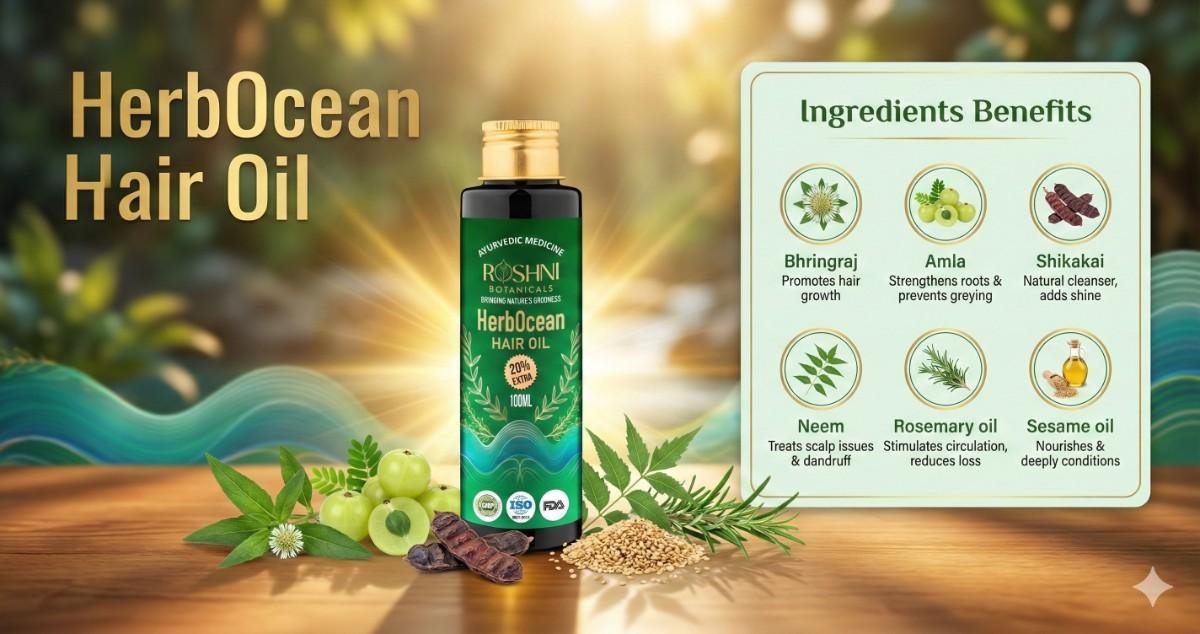
Roshni Botanicals' HerbOcean Hair Oil is marketed as an Ayurvedic oil that helps with hair loss by nourishing the scalp, promoting hair development, and making the hair feel better (as stated on brand pages).
Important Points (Quick Summary)
-
Bhringraj is one of the most researched Ayurvedic herbs for hair; preclinical studies demonstrate that it can help hair grow.
-
Rosemary oil has been shown to work in people with androgenetic alopecia, with outcomes similar to those of 2% minoxidil over 6 months.
-
Shikakai helps with gentle cleansing because it has natural saponins, which can aid when buildup and oiliness on the scalp make hair fall out more.
-
There is evidence that shows neem can help reduce dandruff in controlled conditions.
-
A daily champi (scalp massage) program helps lower stress levels and help you relax, which is crucial because stress can make you lose hair.
-
There is some evidence that lavender essential oil can help with migraines, mostly when it is inhaled. It might also go well with a soothing oiling routine.
-
Keep in mind that hair grows slowly. Most people need to stick to a regimen for 8 to 12 weeks to see improvements in shedding and texture, and 3 to 6 months to see an increase in density.
Why Hair Falls Out (and Why Strong Roots Are Important)
Before we discuss about the ingredients, it's helpful to know what usually sets them off:
-
Weak roots and fragile follicles can be caused by genetics, not getting enough nutrients, having a baby, or changes in hormones.
-
Inflammation of the scalp (itching, sensitivity, dandruff, and an imbalance of microbes)
-
Buildup and plugged follicles (oil, dust, and styling products)
-
Breakage (from heat, dryness, and chemical treatments)
-
Stress and not getting enough sleep (which often causes telogen effluvium-type shedding)
A good Ayurvedic program works on the scalp, roots, hair shaft, and mind-body stress all at once.
What are the ingredients in HerbOcean Hair Oil?
HerbOcean Hair Oil is made with traditional Ayurvedic herbs, essential oils, and a base oil that is good for the hair (sesame). The recipe has:
Bhringraj, Jatamansi, Brahmi, Shikakai, Amla, Nagarmotha, Chharilla, Sugandhbala, Gudhal (Hibiscus), Tulsi, Gulab (Rose), Neem, Lavendula spicata oil, Rosmarinus oil, Murrayakoenigii oil (curry leaf), and Sesame oil. (As given.)
Brand pages say that it is an oil that helps hair grow and stop falling out.
Table of Benefits of Ingredients (Ayurveda and Modern Evidence)
| Ingredient | Why it's utilized (in basic terms) | What research says |
|---|---|---|
| Bhringraj (Eclipta alba) | A classic "keshya" herb that helps with roots, thickness, and calming the scalp | Preclinical tests demonstrate that it promotes hair development and modifies the follicle phase |
| Rosemary oil (Rosmarinus) | Stimulates the scalp and supports the roots | In a human experiment, rosemary oil worked as well as 2% minoxidil over six months (AGA) |
| Hibiscus and Gudhal | They make hair softer and stronger in the traditional way | Most studies on hibiscus extracts for hair growth have been preclinical |
| Shikakai (Acacia concinna) | Natural cleanser that helps get rid of extra oil without being too harsh | People have used shikakai pods to clean their hair and scalp for a long time |
| Neem | Helps keep your scalp clean and fight dandruff | Controlled research have shown that neem leaf treatments can help reduce dandruff |
| Lavender oil | Helps you relax and calm down | Lavender aromatherapy (mostly inhalation) can help with migraines |
| Sesame oil (Til oil base) | Deep-nourishing carrier that helps with barrier and softness | It has been shown to help the skin barrier by fighting free radicals and inflammation |
| Curry leaf (Murrayakoenigii) | Traditional hair tonic that makes hair stronger and shinier | Reviews talk about traditional use and nutrients good for hair and scalp |
| Scalp massage (method) | Better relaxation and routine consistency | Studies demonstrate that it lowers stress levels and makes you feel better |
Ayurveda uses a lot of herbs to help with scalp problems and assist a calming routine. Some of these plants are Jatamansi, Sugandhbala, Chharilla, and Nagarmotha. There may not be a lot of modern studies on hair, therefore the safest way to say it is "traditionally used."
4 Ways HerbOcean Hair Oil Helps Your Hair
1) Support for the root and follicle
-
Bhringraj is the main character here. Eclipta alba extracts have been demonstrated to cause hair growth in animal models and alterations in the way follicles cycle in studies.
-
Rosemary oil has a good "modern evidence" base: a randomized experiment in androgenetic alopecia compared rosemary oil to 2% minoxidil over 6 months.
2) Clean Scalp (Without Using Strong Shampoos)
A lot of people put oil on their scalp but neglect to clean it. Shikakai has been used for a long time as a gentle cleanser since it has saponins in it, which are natural cleansing agents.
3) Help with dandruff and itching (comfort for the scalp)
When the scalp is inflamed or flaky, hair loss happens more often. There is research that shows neem can help reduce dandruff.
If you have bad dandruff or scalp psoriasis, treat that first. Oiling alone may not be adequate.
4) Relaxation (not well known, but very effective)
Stress can make hair fall out. A regular champi routine also helps you relax and feel better. Studies on scalp massage reveal that it lowers tension and makes you feel better.
There is some evidence that lavender aromatherapy can help with migraines (mainly through inhalation), so the smell and massage routine can be a plus for persons who hold tension in their head and neck.
Step-by-step guide on using HerbOcean Hair Oil
The best routine for most people is 2 to 3 times a week.
✅ How to apply
-
Make four to six portions in your hair.
-
For short to medium hair, use 1 to 2 teaspoons.
-
For long hair, use 2 to 3 teaspoons.
-
First, put oil on your scalp.
-
Then, pull the rest of the oil through the middle of your hair.
-
For 5 to 8 minutes, massage in slow, circular motions. Don't scratch your nails.
-
Let it sit for 45 to 90 minutes, then wash your hair.
If your scalp gets oily quickly, don't put a lot of oil on your hair lengths. Instead, focus on your scalp and simply lightly oil the ends.
Method for overnight use (once a week if dryness is high)
-
Use less than you think you need.
-
Loosely braid hair.
-
In the morning, wash your hair with shampoo (twice if necessary).
“Quick Champi” for When You're Busy (15 minutes)
-
Put a few drops in your hands and rub them together.
-
2 to 3 minutes of scalp massage.
-
Put a towel on for five minutes.
-
Clean.
It's not only the oil that helps you relax and feel better; the scalp massage itself does too.
Who Can Use It (And Who Should Be Careful)
✅ Good for
-
Guys and girls
-
Most hair types (dry, normal, somewhat oily)
-
People who are losing hair because of stress, dryness, seasonal shedding, weak roots, or lackluster texture
⚠️ Be careful if
-
You have an active infection, eczema or psoriasis flare, or an extremely sensitive scalp.
-
You are pregnant or breastfeeding and have a sensitivity to essential oils.
-
You are allergic to plants and essential oils.
✅ Patch test (recommended):
Put a tiny amount behind your ear or on the inside of your arm for 24 hours. If you have sensitive skin, essential oils can make it worse. (Clinical education sites often propose general safety tips for essential oils.)
What Results to Expect (A Realistic Timeline)
-
Week 1–2: Softer hair, less dry hair, and easier to manage hair
-
Week 3–6: The scalp feels calmer (if dandruff isn't too bad) and there is less breakage
-
Week 8–12: Many people will lose less hair and have healthier hair
-
Months 3 to 6: noticeable improvements in density, especially with rosemary-like regimens that have been tested on people
Frequently Asked Questions (FAQs)
1) What is the finest Ayurvedic substance for hair growth?
Bhringraj is a well-known Ayurvedic hair herb that has shown promising preclinical study on hair growth.
There is a lot of evidence that rosemary oil works for androgenetic alopecia.
2) Can Ayurvedic hair oil reduce hair loss completely?
It can help stop hair loss caused by dryness, breakage, tension on the scalp, and a small imbalance on the scalp. If your hair is falling out because of anemia, thyroid problems, PCOS, or advanced androgenetic alopecia, oil can help, but you might also need to see a doctor.
3) How often should I put hair oil on?
Most people do best when they do it 2–3 times a week.
1–2 times a week for a very greasy scalp.
Three times a week for a very dry scalp.
4) Should I put oil on a clean or filthy scalp?
Oil works best on a scalp that doesn't have a lot of styling product on it. If you use a lot of styling products, wash your hair first or cut down on the oil time.
5) Do you really need to massage your scalp?
Yes, massage is part of the "result." Research on scalp massage reveals that it can help with relaxation and stress, and it makes the practice more consistent.
6) Can it help with dandruff?
Neem-based scalp practices might help keep the scalp clean if the dandruff is mild to moderate. There is proof that neem treatments lower the amount of dandruff.
If your dandruff is bad or doesn't go away, add an anti-dandruff shampoo plan.
7) Does lavender oil assist with migraines?
There is some evidence that lavender essential oil can help with migraines, mostly through inhalation aromatherapy. It may also be helpful as an extra technique.
Hair oil is not a medical therapy, but the smell and massage may help you relax.
8) How long should I wait to wash my hair after putting in oil?
Most folks only need 45 to 90 minutes.
Overnight is optional, however it's best for hair that is really dry.
9) Is it OK to use on hair that has been chemically treated?
Yes, just lightly oil the ends and lengths, and don't over-oil the scalp if it gets oily soon.
10) What is the finest shampoo to use after putting oil on your hair?
Use a gentle or sulfate-free cleanser. Shampoo your hair twice if it feels heavy, using a small amount each time.
Citations (References)
Eclipta alba (Bhringraj) promotes hair development
Eclipta alba's ability to make hair grow
Clinical research comparing rosemary oil and 2% minoxidil
Shikakai cleaning and saponins
Neem and less dandruff
Effects of scalp massage on stress and physiology
Lavender essential oil and migraine
Sesame oil as a topical barrier and anti-inflammatory
Brand context pages that talk about where HerbOcean Hair Oil fits in.