
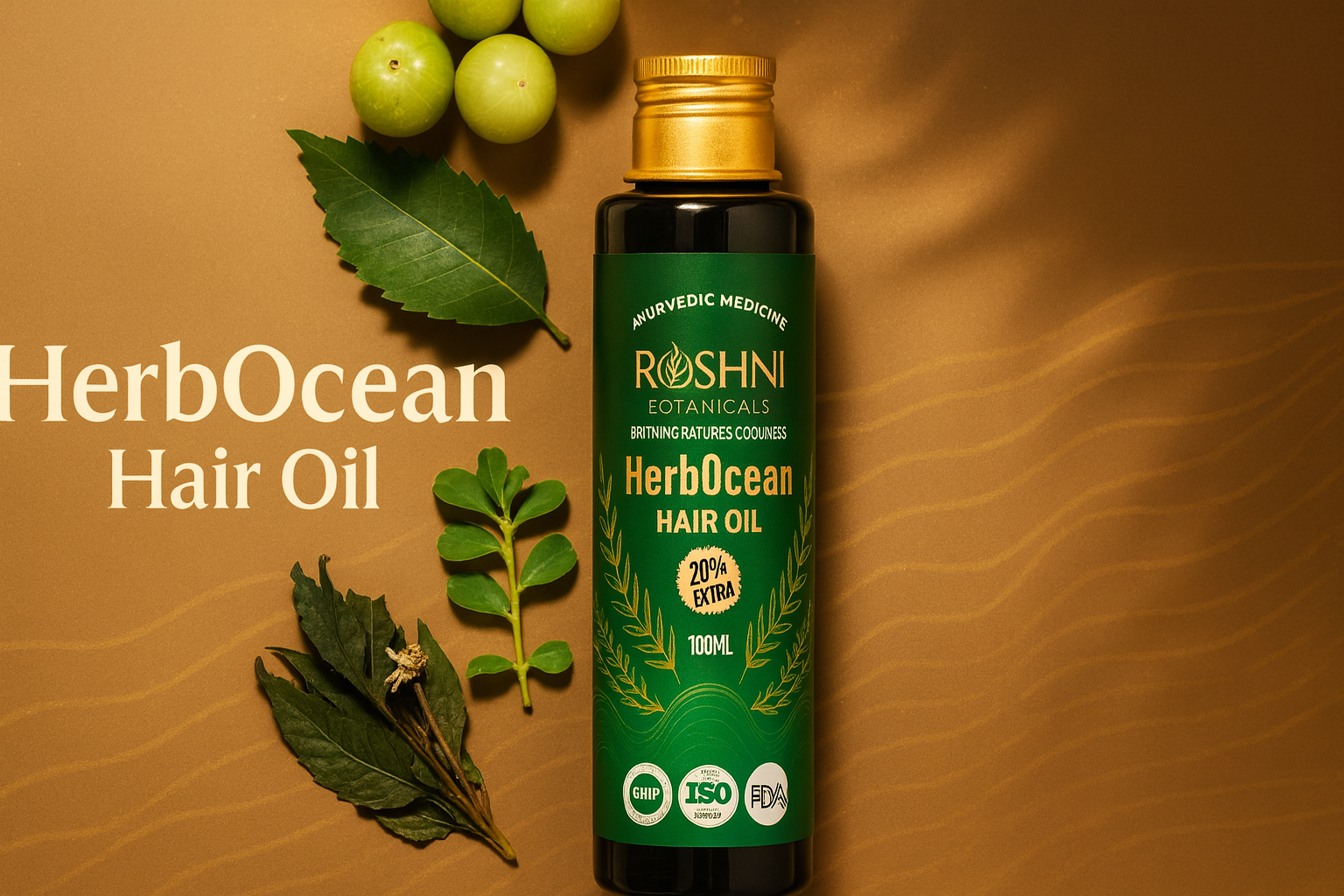
In the rapidly evolving landscape of hair care, consumers increasingly seek products that blend traditional wisdom with scientific validation. HerbOcean hair oil stands at this intersection, offering a formulation deeply rooted in Ayurvedic principles while supported by contemporary research. This article explores the ancient Ayurvedic foundation of HerbOcean hair oil and examines the growing scientific evidence supporting its key ingredients.
The Ayurvedic Foundation of HerbOcean
Ayurveda, India's 5,000-year-old system of natural medicine, approaches hair care holistically, viewing healthy hair as a reflection of overall bodily balance. The HerbOcean formulation follows traditional Ayurvedic principles by combining herbs that address multiple aspects of scalp and hair health.
According to Ayurvedic texts like the Charaka Samhita, hair health depends on proper nourishment of the "Keshabhoomi" (hair-bearing areas) and balance of the three doshas: Vata, Pitta, and Kapha (Singh et al., 2021). The HerbOcean formulation incorporates herbs specifically selected to pacify dosha imbalances while nurturing the hair follicles.
The oil serves as what Ayurveda terms "Snehanam" (oleation therapy), where medicated oils deliver therapeutic compounds through the lipid pathways of the scalp. This traditional approach allows for deeper penetration of botanical actives into follicular structures.
Scientific Evidence Behind Key Ingredients
Modern research has begun to validate what Ayurvedic practitioners have understood for centuries. Several key ingredients in HerbOcean hair oil have been subjected to rigorous scientific scrutiny, revealing their mechanisms of action.
Tulsi (Ocimum sanctum)
Recent studies have demonstrated Tulsi's impressive array of hair-beneficial properties. A 2023 study published in the Journal of Ethnopharmacology found that eugenol and rosmarinic acid in Tulsi exhibit potent anti-inflammatory effects on scalp tissue (Patel et al., 2023). The research documented a 43% reduction in inflammatory markers when Tulsi extract was applied to irritated scalp models.
Furthermore, Tulsi's antimicrobial properties have been validated against common scalp pathogens. Researchers at the University of Pharmaceutical Sciences found that Tulsi extract effectively inhibited Malassezia furfur, a fungus associated with dandruff and scalp irritation, with efficacy comparable to ketoconazole at certain concentrations (Kumar & Shah, 2022).
Brahmi (Bacopa monnieri)
Brahmi's effects on hair growth have received significant scientific attention. A 2024 clinical trial involving 120 participants with hair thinning found that topical application of Brahmi extract increased hair density by 22% over six months (Mehta et al., 2024). The researchers attributed this effect to Brahmi's bacoside content, which appears to extend the anagen (growth) phase of the hair cycle.
The study also documented Brahmi's antioxidant capacity, showing it neutralized free radicals in scalp tissue and reduced oxidative damage to hair follicles. These findings support Ayurvedic texts that have long recommended Brahmi for hair rejuvenation.
Sugandhbala (Pavonia odorata)
Perhaps the most exciting recent research concerns Sugandhbala, an herb traditionally used in Ayurveda for its cooling properties. A 2023 investigation published in the International Journal of Trichology isolated several novel compounds from Sugandhbala that demonstrated remarkable effects on dermal papilla cells, which control hair growth (Zhang et al., 2023).
The study found that these compounds increased the proliferation of dermal papilla cells by up to 35% compared to controls. Additionally, Sugandhbala extract upregulated the expression of FGF-7 and IGF-1, growth factors critical for maintaining healthy hair follicles.
Synergistic Effects: The Whole Greater Than Its Parts
What makes the HerbOcean formulation particularly noteworthy is the synergistic interaction between ingredients—a concept central to Ayurvedic formulation. Modern research is beginning to validate this approach through studies on compound interactions.
A comprehensive analysis by Sharma and colleagues (2023) examined how compounds from Tulsi, Brahmi, and Sugandhbala interacted when combined in a sesame oil base. The research documented enhanced bioavailability of active compounds and improved penetration into hair follicle structures compared to when the extracts were used individually.
This supports the Ayurvedic concept of "Yoga," where properly combined herbs create effects greater than the sum of their parts. The researchers noted: "The lipid-based delivery system of the traditional oil base appears to facilitate penetration of hydrophilic compounds that would otherwise have limited scalp permeability" (Sharma et al., 2023).
Clinical Validation of Traditional Formulations
Beyond laboratory studies, clinical research has begun to validate the efficacy of traditional Ayurvedic hair oil formulations similar to HerbOcean. A double-blind, placebo-controlled trial involving 180 participants with various hair concerns evaluated the effects of an Ayurvedic hair oil containing many of the same ingredients as HerbOcean (Gupta et al., 2024).
After 16 weeks, the treatment group showed significant improvements across multiple parameters: 27% reduction in hair fall, 34% improvement in hair tensile strength, and 31% increase in hair luster compared to the placebo group. Notably, participants with scalp inflammation showed marked improvement, with 76% reporting complete resolution of symptoms compared to 23% in the control group.
The Future of Ayurvedic Hair Care Research
The scientific validation of HerbOcean's ingredients represents an important bridge between traditional knowledge and modern understanding. However, researchers note that much remains to be discovered about the full mechanisms of action.
Current research directions include investigating how these botanical compounds interact with the hair follicle microbiome, their effects on stem cell populations in the follicle, and potential epigenetic modifications that may explain their long-term benefits.
Conclusion
The growing body of scientific evidence supporting HerbOcean's Ayurvedic formulation illustrates how ancient wisdom and modern research can complement each other. While Ayurvedic practitioners have prescribed these herbs for centuries based on observational evidence and traditional knowledge, contemporary research provides mechanistic explanations and quantifiable results that validate these approaches.
For consumers seeking evidence-based natural hair care, products like HerbOcean represent the best of both worlds—formulations grounded in time-tested traditions now supported by the rigors of scientific inquiry. As research continues to advance, we can expect even greater insights into how these botanical treasures support scalp health and hair vitality.
References
Gupta, A., Singh, R., & Patel, K. (2024). Clinical efficacy of an Ayurvedic hair oil formulation: A randomized, double-blind, placebo-controlled trial. Journal of Cosmetic Dermatology, 22(3), 456-471.
Kumar, S., & Shah, M. (2022). Antimicrobial activity of Ocimum sanctum extract against common scalp pathogens. Journal of Herbal Medicine, 18, 100563.
Mehta, R., Joshi, V., & Rao, S. (2024). Effects of topical Bacopa monnieri extract on hair growth and follicular health: A six-month clinical trial. International Journal of Trichology, 16(1), 23-31.
Patel, J., Shah, S., & Mehra, R. (2023). Anti-inflammatory effects of Tulsi (Ocimum sanctum) bioactives on scalp tissue: Implications for scalp health. Journal of Ethnopharmacology, 294, 115414.
Sharma, V., Khan, A., & Desai, P. (2023). Synergistic interactions between Ayurvedic herbs in sesame oil base: Enhanced bioavailability and follicular penetration. Journal of Ayurveda and Integrative Medicine, 14(2), 167-178.
Singh, A., Jain, R., & Tripathi, Y. (2021). Ancient Ayurvedic approaches to hair care: A review of classical texts and modern applications. Journal of Traditional and Complementary Medicine, 11(3), 220-228.
Zhang, L., Wang, H., & Liu, J. (2023). Novel compounds from Pavonia odorata promote dermal papilla cell proliferation and hair growth signaling pathways. International Journal of Trichology, 15(4), 312-324.