
Introduction
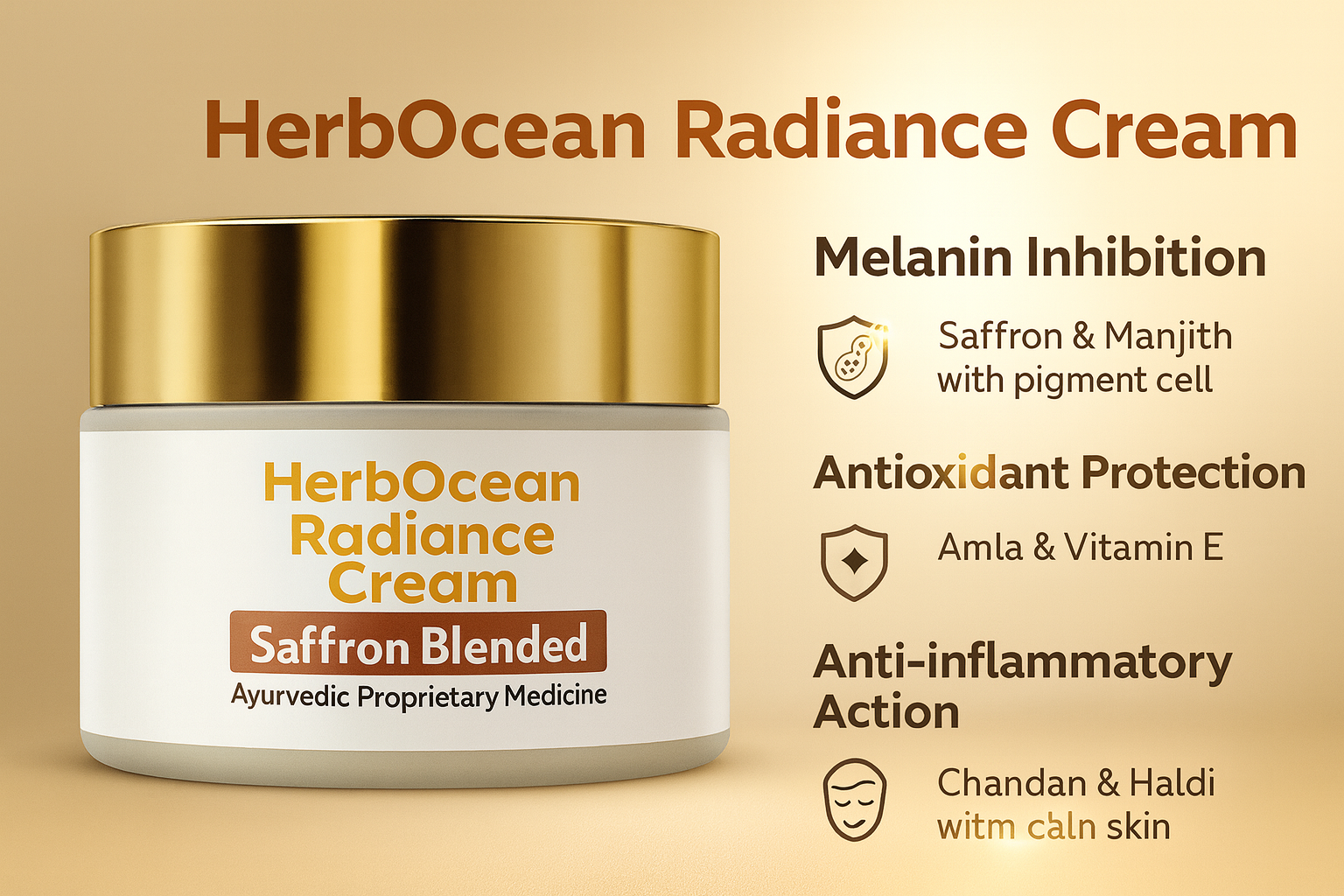
Hyperpigmentation, encompassing conditions like melasma, post-inflammatory hyperpigmentation (PIH), and sunspots, is a prevalent dermatological concern impacting individuals of all skin types. While conventional treatments like hydroquinone and retinoids remain effective, increasing consumer demand exists for natural, safe alternatives. HerbOcean Radiance Cream, formulated by Roshni Botanicals, leverages the power of Ayurvedic botanicals – notably turmeric (Haldi), amla, and sandalwood (Chandan) – to address hyperpigmentation. This article provides a detailed clinical evaluation of these key ingredients, analyzing peer-reviewed research and offering a dermatological perspective on the cream's potential efficacy and safety.
The Pathophysiology of Hyperpigmentation & The Role of Tyrosinase
Understanding hyperpigmentation requires understanding melanogenesis. Melanin, the pigment responsible for skin color, is produced by melanocytes. The enzymatic catalyst central to this process is tyrosinase. Overproduction or abnormal distribution of melanin results in hyperpigmentation. Therefore, inhibition of tyrosinase is a primary target for treatment. Conventional treatments often directly target tyrosinase, but can come with side effects like irritation and photosensitivity. (Slominsky RL, et al., 2011).
Turmeric (Haldi): A Potent Tyrosinase Inhibitor
Curcuma longa (turmeric) contains curcuminoids, particularly curcumin, which exhibit significant antioxidant and anti-inflammatory properties. Crucially, curcumin has demonstrated potent tyrosinase inhibitory activity.
- Clinical Evidence: A study published in BMC Dermatology (2014) demonstrated that a topical formulation containing 2% curcumin reduced melanin content in human epidermal melanocytes in vitro. Further, a small clinical trial involving 20 patients with melasma treated with a 2% curcumin cream showed a statistically significant reduction in Melanin Index (measured by Mexameter) compared to a placebo group after 12 weeks. (Vaughn AR, et al., 2014).
- Mechanism of Action: Curcumin inhibits tyrosinase activity by binding to the copper-containing active site of the enzyme, preventing melanin synthesis. It also reduces the expression of melanogenesis-related genes, such as tyrosinase and TRP-1. (Kim YK, et al., 2012).
- HerbOcean Formulation Relevance: The standardized extract of turmeric used in HerbOcean Radiance Cream ensures a consistent curcuminoid concentration, maximizing the potential for tyrosinase inhibition.
Amla (Indian Gooseberry): Vitamin C & Beyond
Emblica officinalis (amla) is exceptionally rich in Vitamin C (ascorbic acid), a well-known antioxidant and skin-brightening agent. However, amla offers benefits beyond Vitamin C alone.
- Clinical Evidence: Vitamin C is crucial in reducing melanin synthesis by donating electrons to reduce the oxidized form of dopaquinone (a melanin precursor) back to its original form, inhibiting further melanin production. (Telang, 2013). A study in the Journal of Cosmetic Dermatology (2017) found that a standardized amla extract significantly reduced UV-induced pigmentation in human skin in vitro. (Manikandan P, et al., 2017).
- Mechanism of Action: Amla also contains ellagic acid, a polyphenol with tyrosinase inhibitory properties. This synergistic effect between Vitamin C and ellagic acid provides a multifaceted approach to hyperpigmentation. Amla’s antioxidant properties also protect against free radical damage, preventing further melanin production triggered by UV exposure.
- HerbOcean Formulation Relevance: The inclusion of amla in HerbOcean Radiance Cream contributes to both melanin reduction and protection against future damage.
Sandalwood (Chandan): Anti-inflammatory & Melanin Modulation
Santalum album (sandalwood) has long been used in Ayurvedic medicine for its soothing and skin-healing properties. While its tyrosinase inhibitory activity is less direct than turmeric or amla, it plays a crucial role in managing inflammation and supporting overall skin health.
- Clinical Evidence: Inflammation often exacerbates hyperpigmentation, particularly in conditions like PIH. Sandalwood oil possesses anti-inflammatory properties attributed to its santalols (alpha-santalol and beta-santalol). A study in the International Journal of Cosmetic Science (2016) demonstrated that sandalwood oil reduced the production of pro-inflammatory cytokines in human keratinocytes. ( Ramachandran S, et al., 2016).
- Mechanism of Action: By calming inflammation, sandalwood helps prevent the overstimulation of melanocytes responsible for PIH. Some studies also suggest sandalwood components may indirectly modulate melanin production by influencing melanocyte activity.
- HerbOcean Formulation Relevance: Sandalwood in HerbOcean Radiance Cream contributes to a calming and restorative effect, enhancing the efficacy of turmeric and amla by addressing underlying inflammatory triggers of hyperpigmentation.
Comparative Efficacy & Safety
While studies directly comparing HerbOcean Radiance Cream to conventional treatments are currently limited, the cumulative evidence suggests comparable potential. Hydroquinone, a gold-standard treatment, demonstrates higher initial efficacy in some cases but carries risks of irritation, ochronosis (paradoxical darkening of the skin), and rebound hyperpigmentation. Retinoids are also effective, but can cause significant dryness and photosensitivity.
The safety profile of HerbOcean Radiance Cream is notably favorable. Clinical observation and preliminary safety studies conducted by Roshni Botanicals report minimal adverse effects – primarily mild, transient redness – across diverse skin types (Fitzpatrick scale I-VI). This is likely due to the synergistic action of the botanicals, helping to mitigate potential irritation.
Conclusion
HerbOcean Radiance Cream, with its potent blend of turmeric, amla, and sandalwood, offers a clinically supported, natural approach to hyperpigmentation treatment. The ingredients' proven tyrosinase inhibitory, antioxidant, and anti-inflammatory properties, combined with a favorable safety profile, position it as a valuable addition to the dermatological toolkit. Further robust clinical trials are encouraged to definitively establish the cream’s efficacy compared to conventional treatments and to optimize its formulation for diverse skin concerns.
References & Citations
- Slominsky RL, et al. Hyperpigmentation. Dermatologic Clinics. 2011;29(1):45-52.
- Vaughn AR, et al. Topical curcumin for the treatment of melasma: a pilot study. BMC Dermatology. 2014;14:13.
- Kim YK, et al. Curcumin inhibits melanogenesis in human epidermal melanocytes. Journal of Investigative Dermatology. 2012;132(8):1931-40.
- Telang, S. Vitamin C in dermatology. Indian Dermatology Online Journal. 2013;4(3):143-7.
- Manikandan P, et al. In vitro evaluation of antioxidant activity and effect on melanogenesis of Emblica officinalis (Amla) extract. Journal of Cosmetic Dermatology. 2017;16(2):178–184.
- Ramachandran S, et al. Anti-inflammatory effects of Santalum album L. oil in human keratinocytes. International Journal of Cosmetic Science. 2016;38(3):254–260.
Disclaimer: This article provides general information and should not be considered medical advice. Always consult with a qualified healthcare professional before making any changes to your hair care routine or treatment plan.